Polar expedition AeN JC3 – day 1 and 2: Tromsø

This article is part of the series “2022-02: Winter cruise KPH”.

Day 1 and 2 · 19 – 20 February 2022

Oh, well – where to start? I’m still completely overwhelmed from the polar winter expedition Arven etter Nansen (The Nansen Legacy) with the icebreaking polar research vessel Kronprins Haakon that just ended three days ago.

Ok, perhaps it’s best to start with the beginning.

The beginning

It’s Saturday, 19 February 2022 early in the morning. I look at my baggage in my one-room flat. A huge suitcase, an even huger bag, my photo backpack and my bulky Canada Goose down parka plus winter boots.

Do I really have everything? Warm clothes? The helseerklæring – a medical certificate that proves me “seaworthy”? All camera equipment? All gloves and mittens? LAN-cable with adapter for Mac? My reading glasses? Passport? Woollen underpants? Balaclava?

I made a complete packing list, I packed twice(!) but still I’m a bit nervous. When I’m on the ship, it’s probably too late to organise left-behind things.

The taxi arrives at 8:15. It drives north to the harbour, opens the gate to the restricted area and continues directly to pier 25. I’m not alone. Other people that came by taxi or brought by private car and a lot of luggage are there, too. And there it is: Kronprins Haakon, my home for the next three weeks.

My cabin

I ascent the gangway – I have to go twice with all my luggage – and there is a reception. I tell my name and get my key card. I’m in cabin 385. I get a short description of where to find it. It is quite low on deck 3 and right in the front. These cabins are told to be the loudest when the ship starts breaking ice.

The cabin has a huge window. Wow! Behind the window: two bull eyes. As closed and locked as possible. So I won’t see anything from my cabin, but that’s ok. It’s pretty roomy with a desk, a small table, a small sofa and space to store your stuff. And a bathroom. I’ll share this cabin with P., a scientist.

Waiting

Next event: passport control through the police. Then: the first meeting. Here we learn, that departure is delayed, because a crane has to be fixed. Estimated time of departure: tomorrow after bunkering fuel.

While I can take it easy the scientists are busy. They don’t wear lab coats, they wear safety boots and helmets and use pallet jacks to put their equipment to the right places. And there is a lot equipment! Several containers full of it!

11:30 – lunch. Wow, the food is rich in variety and it tastes wonderful. I heard that many people gain weight on these cruises. Now I understand.

12:30 – group photo. That’s my job because I have all my camera equipment with me. Click. Click. Click.

13:00 – safety briefing. How to put on the survival suit in case of evacuation. I’m the guinea pig. And I hear a thing that photographers dream of: Almost every place on the ship is freely accessible. The quarterdeck at the ship’s stern, the helicopter deck at the ship’s bow, the bridge on level 8, the observation deck on level 9. Great! I use the spare time to stroll around a bit.

15:00 – safety training. We „muster“ which means we gather all in the mess – the same room where we eat – split into two groups and enter the life boats. These boats are equipped with everything you need to survive for some days but when you go to the toilet everyone can see it. Made for survival, not for comfort or privacy.

17:00 – dinner. 18:30 – a second meeting. 20:00 – the equipment of the polar institute is accessible: I fetch two pairs of boots and a floating overall size XL. A helmet I already have.

22:45 – bed time. First night on the ship. My bunk bed looks small but is comfortable and very cozy. Good night!

Day 2 – More waiting

I wake up. Do we move? I’m not sure. The internet reveals: we have moved and are now south of Tromsøya. Let’s go out onto the heli deck. Oh, what a beautiful morning!

The ships moves to the bunker station. There it will lie for many hours. Bunkering fuel takes time.

A lot of time. I help a bit here and there, but I cannot do so much. The scientists are extremely organised and mostly it’s faster for them when I do not try to help. At least I can carry some stuff around.

The departure is estimated for 16:00 but when we have dinner at 17:30 we still lay at the same place. I overhear that this delay is larger than usual. When will we start? Will this affect the planning? As most things on board I just don’t know. I’m the newbie.

The journey begins

17:54 – while I am eating my chilli con carne I feel a change in the ship. I look out of the window and almost shout out: „We are moving!“. Finally we are on our way!

After dinner I stand on the heli deck for a long time. I’m on the phone with Annika – maybe the last time for some weeks. I watch the ship going under the bridge Sandnessundbrua that connects Tromsøya and Kvaløya. I watch the Northern Lights. And I’m very happy. The journey begins!

We are on our way

This article is part of the series “2022-02: Winter cruise KPH”.

After a lot of delays the departure of the icebreaker Kronprins Haakon was estimated for today, 16:00. But even when going to dinner at 17:30 we were moored at the bunker station. Some minutes before six I felt some change in the vessel’s vibration, looked out and could see lights passing by. I almost shouted out – “we are moving!” So finally we are on our way to P1, the first station 500 km east of Svalbard. We will travel there for 40–48 hours.

Today I stood on the helicopter deck, watched Tromsø passing by and the polar lights in the southeast.

Tomorrow I hopefully will wake up in the open Barents Sea continuing north for the whole day. There’ll be open water for some days and then more and more sea ice.

Arctic research expedition with the Norwegian Polar Institute

This article is part of the series “2022-02: Winter cruise KPH”.

Kronprins Haakon is a Norwegian icebreaking polar research vessel. It was build 2018, can cut through one metre of solid ice, has 15 different laboratories on board and place for 35 scientists or other staff in addition to the crew.

Four days ago Kronprins Haakon had arrived in Tromsø. It was travelling 26 days since it left Cape Town, the only stopover on its return trip from Antarctica.

This morning I went on board of Kronsprins Haakon. Not as a visitor to look around but with a suitcase, an enormous bag full of warm clothes, a heavy camera backpack and my Canada Goose down parka. I will stay on board for three weeks to participate the winter cruise “Arven etter Nansen JC3” that will lead us to the Barents Sea east of Svalbard and a bit beyond.

What happened?

Some of you may know that I’ve been working as a data engineer at the Norwegian Polar Institute in Tromsø since autumn 2020. In this position I’m not only a software developer but a data manager of polar research data.

Three and a half weeks ago my colleague M. told me she would join the winter cruise and mentioned that there might still be an available place.

Of course I was very eager to participate. Beside of my private passion for the Arctic I wanted to get a deeper and hands-on understanding of the research data. Where does it come from? How is it measured? And how is it transferred to the digital world? And nothing would teach me better than joining this very winter cruise, where conditions could be quite rough.

I mentioned it to M., another colleague and he introduced me to the expedition leader. There I was told that there was indeed a vacancy on board and that I was welcome to join if my boss would agree.

Since then it had been crazy times with some organisation, a lot of worries and little sleep.

  • 1 Feb: My boss had to check the budget for my participation.
  • 4 Feb: A seafarer’s doctor examined me and gave me my helseerklæring – a medical certificate that proves me “seaworthy”.
  • 16 Feb: I had to take a PCR test and wait for the result for two days. Then I had to take another PCR test, but that’s a whole story in itself.
  • 18 Feb: I had to do a survival suit training in the Tromsøsundet.
  • 18 Feb: I had to pack clothes and equipment I will need on the cruise. Everything beside of two pairs of boots, a helmet, a floating suit and a survival suit. These are provided by the Norwegian Polar Institute.
  • 19 Feb (today): I took a taxi to the port of Tromsø. I was driven directly to Kai 25, took some photos and then went on board.
  • Still today: passport control through the police, a security briefing, lunch and dinner, carrying boxes to the labs, entering the rescue boat and some more …

The next weeks

When Kronprins Haakon will leave Tromsø tomorrow morning we will sail north. First destination is a point referred as P1. It is approx. 500 km east of Svalbard’s southern tip. From there we will continue heading north to the other stations, if weather and sea ice conditions allow it.

The northernmost position is planned to be approx. 82° N, somewhere in the Arctic Ocean. That’s more than 10 degrees of altitude further north than I’ve ever been and less than 900 km to the North Pole.

I’m so excited, that’s really way up north!

We will work both on the sea ice and on the ship using various measurement and sampling methods. Some of them I learned a bit last week but most of them I do not know yet. I’m a newbie. I’m here to learn. And hopefully I’ll learn a lot on this cruise.

After three weeks of tokt (Norwegian for “cruise”) we are supposed to arrive in Longyearbyen on 11 Mars. There I’ll take a flight back to Tromsø the same day.

I will not blog on this cruise because there will be a lot of work and hardly any reliable internet connection. But I’ll definitely take photos, both for the Norwegian Polar Institute and in private for this blog.

So, my dear readers, cross your fingers that I do not get seasick, we can reach our planned destinations and most of all that no one has Covid on board.

You can check the live position of the Kronprins Haakon on the map below. And you are welcome to leave a comment. See you again in mid-March when I’ll answer your comments and start posting articles.

23. Feb, 13:03: Just a short note: This map does not seem to work in polar regions. At time we have internet. Outside temperature -17.4 °C. Position round about 76°29′ N 31°11′ E.


Night promenade at Telegrafbukta

Clear sky, almost full moon, no wind. The snow is crisp and glitters in the moonshine. -10 °C. I take a promenade and enjoy the calmness of the night. The aurora is weak, more a bonus than the main act. Snow and moon win tonight.

Moving – Tromsø style

Today I move within Tromsø in a quite special way …

I moved long distances as from Munich to Skelleftehamn (2230 km) and shorter distances as from Essen Möserstraße to Droysenstraße (1 km). Now I have to move again.

My former landlord will sell the apartment where I lived when working in Tromsø. Therefore I had to find a new “work base camp”. And I found it, a flat of 30 m².

The first photo shows the old place, the second one the new place.

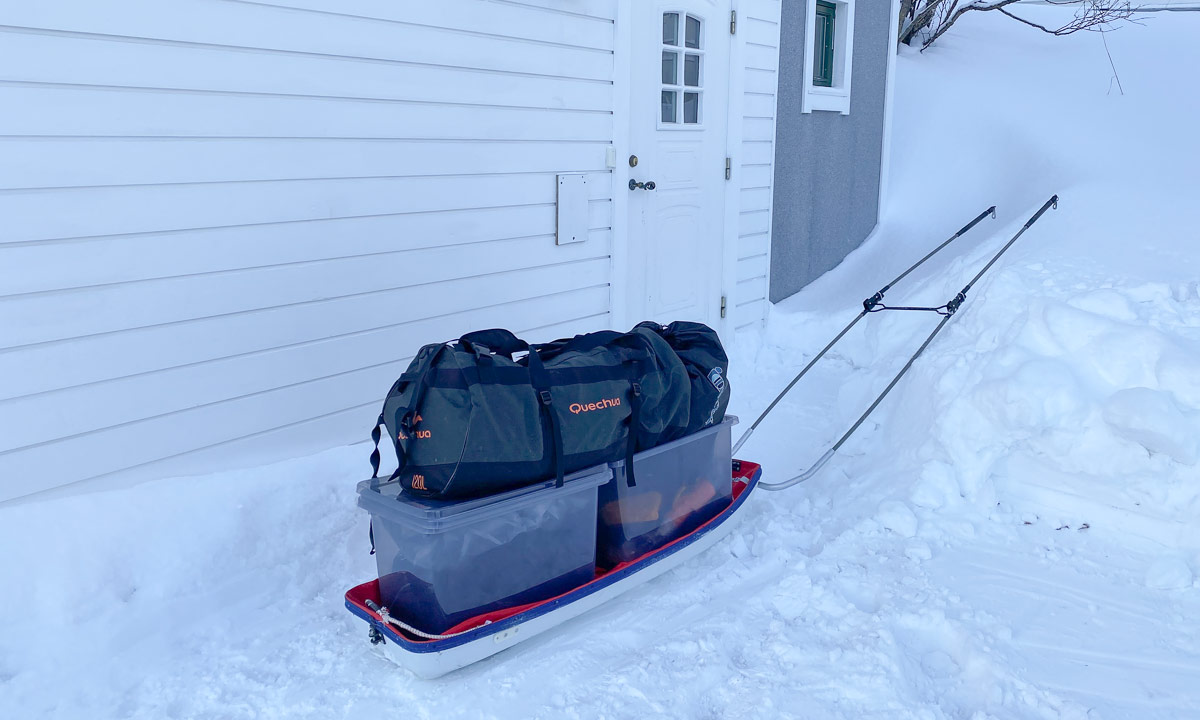
In case you do not know all houses on southern Tromsøya and you’re wondering what the pulka sled is about I’ll show you another photo:

That’s how I move today! By chance the new flat lies just on the other side of the street and I do not need my car. Weather and snow are fine and pulling banana boxes on the pulka works like a charm, especially since almost all my books, records, the grand piano and much more is in Annika’s and my house in Obbola in Sweden. So it’s mostly basic stuff and a lot of winter and outdoor equipment to move. I can take it easy and will be ready this evening anyhow.

I love moving like this!

Sea ice field work training on the Sørbotn

Peacefully I wake up this morning. It is already light outside. WHAT? LIGHT? WHY? AND WHEN?

I check my mobile phone – the clock shows 8:01. SH**!!! At 7:45 we were supposed to meet at the Norwegian Polar Institute, at 8:00 we were supposed to leave there for a field work training on the sea ice. But not me. I have overslept!

We – that’s 5 instructors and round 20 participants of the Sea ice field work training arranged by the Norwegian Polar Institute and the Arctic University of Norway in Tromsø. I realise that my colleague M. already tried to reach me and ring back. I tell her that I will take my own car and hopefully make it to our destination with only a small delay.

Our destination – that’s Sørbotn, the southern tipp of the fjord Ramfjorden where the training will take place on the sea ice of the frozen fjord.

I manage to dress, make tea and pack in 20 minutes thanks to previous day’s preparation and a fondness for packing lists. Although I take it easy while driving (safety first!) I arrive less than 10 minutes late while the preparations are still in progress.

We are split in two groups. Our group will do measurements of ice and snow depths first and take ice core samples after lunch break. I won’t go here into details too much, because I’m a newbie to all this and I do not want to write half-understood nonsense. I’ll have to look up some details of today’s stuff later.

Although I drill holes in the ice, help calibrating the GEM2 device, measure temperatures in a freshly taken ice core and use a MagnaProbe to measure a transect of snow depths I have a lot of time to take photos, too. So, let’s just start with this.

Being on the ice with a bunch of nice people is not only a lot of fun but it will help me in doing my job at the polar institute. Part of it is to manage scientific data. The deeper my understanding on collecting data the better I can do my work. The most interesting thing today was observing the coexistence of advanced sensor technology paired with GPS tracking and the usage of rulers, pencils and paper as in the early days of polar research.


There was one thing I wasn’t involved in: The usage of a remote-controlled underwater drone. We clearly could see some fishes and jellyfish (do you spot it on the 1st image below?) on the live display. I know that it’s used for research, but I would love to have it just as a toy.

Hopefully this was not the last time that I was involved in field work this year. And perhaps we’ll be lucky with the weather again next time. For while we had calm conditions and even sunshine, wind drove heavy snow squalls over Tromsø just some hours after we called it a day.

Sea ice field work training – preparations

My job at the Norwegian Polar Institute is both to write applications and to manage scientific data. Since I’m not a scientist it’s hard to understand sometimes, how data is collected and digitalised.

To learn more about this I’ll participate a sea ice field work training tomorrow. It is organised by the polar institute and UiT, the Arctic University of Norway. We’ll be on the sea ice of Sørbotn – part of the fjord Ramfjorden the whole day and learn different measurement methods as coring and magna probe. (Don’t ask me any questions today. I hope I’ll know a bit more tomorrow.)

The instructors measured the ice depth yesterday. It is round 50 cm and absolutely safe to walk and work on. We had two preparative meetings where we discussed possible risks and how to dress properly. Although it is forecasted to be only -5 °C and hardly any wind it’s always good to have enough stuff to stay warm when being outside on the ice. I started packing today.

Some of the items I’ll take with me:

  • Thick Kamik rubber boots with inner shoe – really warm!
  • Red hard shell jacket and matching bibs. Not warm, but absolutely wind proof.
  • Grey down parka. For resting and having lunch outside.
  • The brown fur hat. 100% polyester, H&M, EUR 9.90. I used it once in -37 °C and although cheap it’s warm and works well.
  • Ski goggles – just in case.

The hard shell jacket and bibs are not mine. Yet. They belong to the polar institute and I got them recently. After five work years they are mine. The attached fur is my private one.

Maybe some of us will get a Regatta floatation suit, a warm, water- and windproof coverall, but I’m not sure yet so I’ll take all the private stuff with me. I love winter. I do not love freezing.

More to come after the training …

Oh, what a beautiful sunrise!

Mountains on Kvaløya photographed from Sydspissen, Tromsøya.

While the first images are made with a strong (though non-professional) telephoto lens (500–600 mm, ƒ/6.3), this gives a bit more impression of the mountains this morning: