Sea ice field work training on the Sørbotn

Peacefully I wake up this morning. It is already light outside. WHAT? LIGHT? WHY? AND WHEN?

I check my mobile phone – the clock shows 8:01. SH**!!! At 7:45 we were supposed to meet at the Norwegian Polar Institute, at 8:00 we were supposed to leave there for a field work training on the sea ice. But not me. I have overslept!

We – that’s 5 instructors and round 20 participants of the Sea ice field work training arranged by the Norwegian Polar Institute and the Arctic University of Norway in Tromsø. I realise that my colleague M. already tried to reach me and ring back. I tell her that I will take my own car and hopefully make it to our destination with only a small delay.

Our destination – that’s Sørbotn, the southern tipp of the fjord Ramfjorden where the training will take place on the sea ice of the frozen fjord.

I manage to dress, make tea and pack in 20 minutes thanks to previous day’s preparation and a fondness for packing lists. Although I take it easy while driving (safety first!) I arrive less than 10 minutes late while the preparations are still in progress.

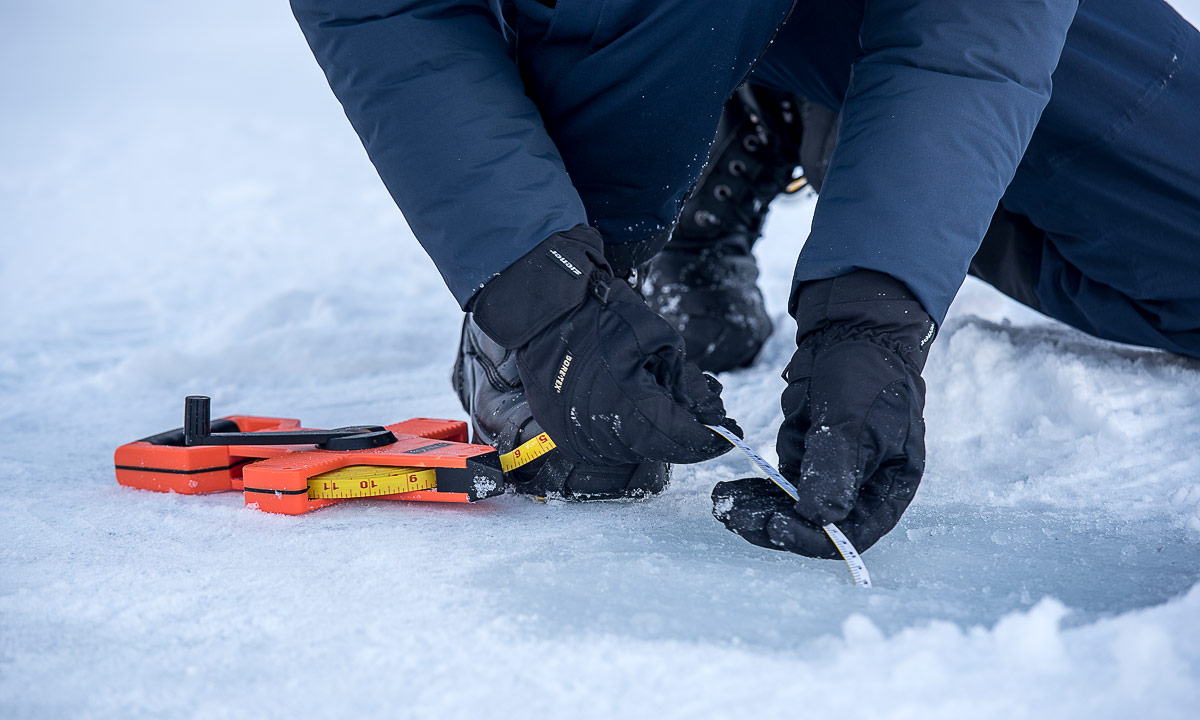
We are split in two groups. Our group will do measurements of ice and snow depths first and take ice core samples after lunch break. I won’t go here into details too much, because I’m a newbie to all this and I do not want to write half-understood nonsense. I’ll have to look up some details of today’s stuff later.

Although I drill holes in the ice, help calibrating the GEM2 device, measure temperatures in a freshly taken ice core and use a MagnaProbe to measure a transect of snow depths I have a lot of time to take photos, too. So, let’s just start with this.

Being on the ice with a bunch of nice people is not only a lot of fun but it will help me in doing my job at the polar institute. Part of it is to manage scientific data. The deeper my understanding on collecting data the better I can do my work. The most interesting thing today was observing the coexistence of advanced sensor technology paired with GPS tracking and the usage of rulers, pencils and paper as in the early days of polar research.


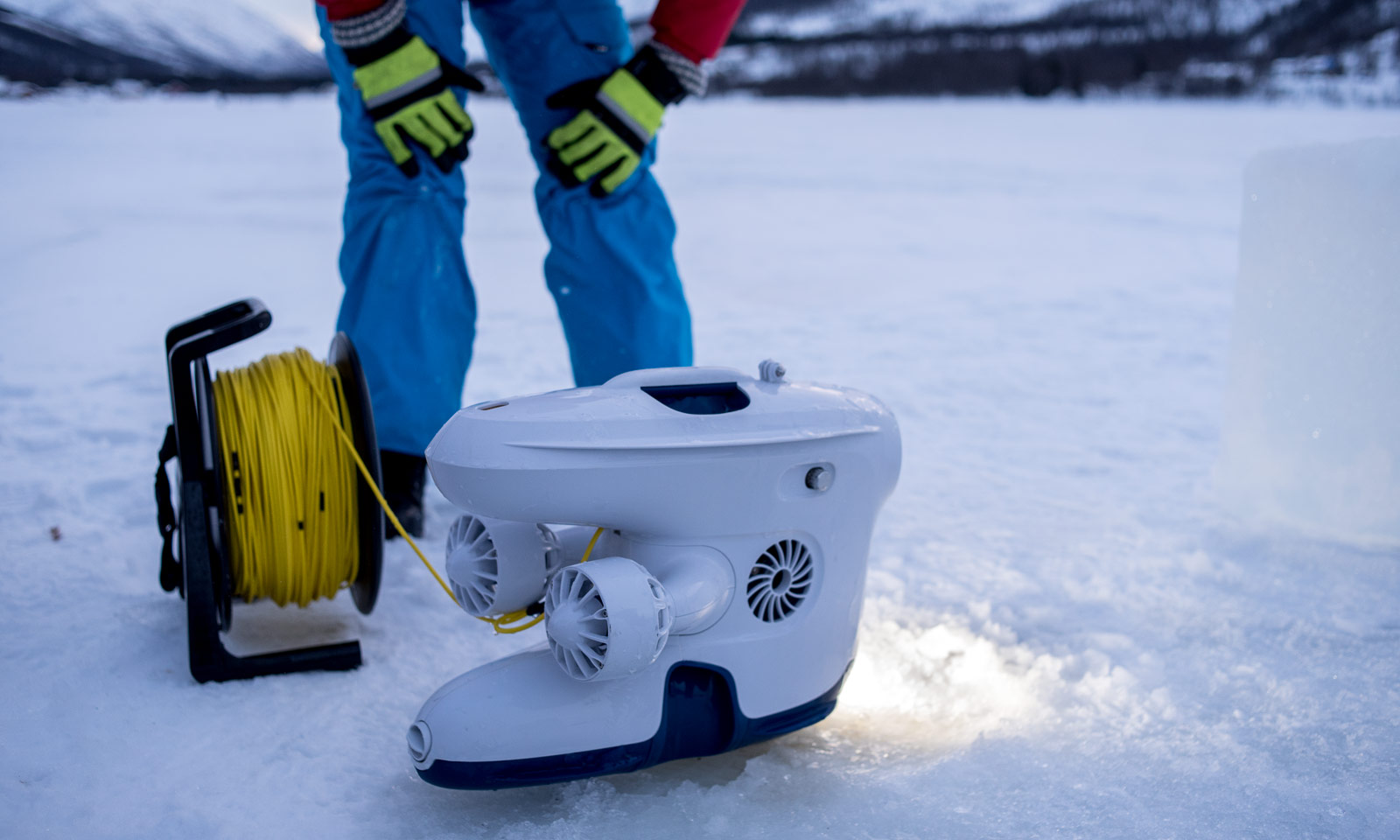
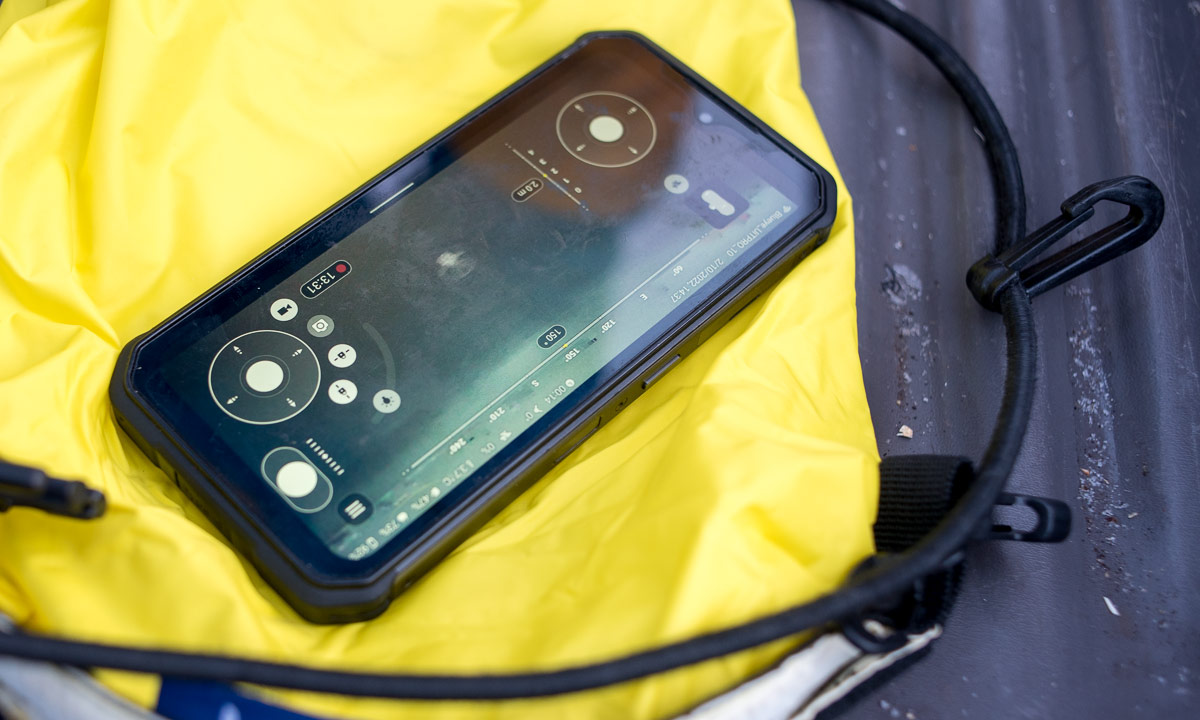
There was one thing I wasn’t involved in: The usage of a remote-controlled underwater drone. We clearly could see some fishes and jellyfish (do you spot it on the 1st image below?) on the live display. I know that it’s used for research, but I would love to have it just as a toy.
Hopefully this was not the last time that I was involved in field work this year. And perhaps we’ll be lucky with the weather again next time. For while we had calm conditions and even sunshine, wind drove heavy snow squalls over Tromsø just some hours after we called it a day.

Sea ice field work training – preparations

My job at the Norwegian Polar Institute is both to write applications and to manage scientific data. Since I’m not a scientist it’s hard to understand sometimes, how data is collected and digitalised.

To learn more about this I’ll participate a sea ice field work training tomorrow. It is organised by the polar institute and UiT, the Arctic University of Norway. We’ll be on the sea ice of Sørbotn – part of the fjord Ramfjorden the whole day and learn different measurement methods as coring and magna probe. (Don’t ask me any questions today. I hope I’ll know a bit more tomorrow.)

The instructors measured the ice depth yesterday. It is round 50 cm and absolutely safe to walk and work on. We had two preparative meetings where we discussed possible risks and how to dress properly. Although it is forecasted to be only -5 °C and hardly any wind it’s always good to have enough stuff to stay warm when being outside on the ice. I started packing today.

Some of the items I’ll take with me:

  • Thick Kamik rubber boots with inner shoe – really warm!
  • Red hard shell jacket and matching bibs. Not warm, but absolutely wind proof.
  • Grey down parka. For resting and having lunch outside.
  • The brown fur hat. 100% polyester, H&M, EUR 9.90. I used it once in -37 °C and although cheap it’s warm and works well.
  • Ski goggles – just in case.

The hard shell jacket and bibs are not mine. Yet. They belong to the polar institute and I got them recently. After five work years they are mine. The attached fur is my private one.

Maybe some of us will get a Regatta floatation suit, a warm, water- and windproof coverall, but I’m not sure yet so I’ll take all the private stuff with me. I love winter. I do not love freezing.

More to come after the training …

Oh, what a beautiful sunrise!

Mountains on Kvaløya photographed from Sydspissen, Tromsøya.

While the first images are made with a strong (though non-professional) telephoto lens (500–600 mm, ƒ/6.3), this gives a bit more impression of the mountains this morning:

January sun in Tromsø

After ten days with snow and wind, rain and storm and many, many clouds – there it is – the sun. The first time i see the sun in Tromsø since some day in November.

Photo taken with my iPhone through the window pane of the canteen at lunch break.


I couldn’t sleep

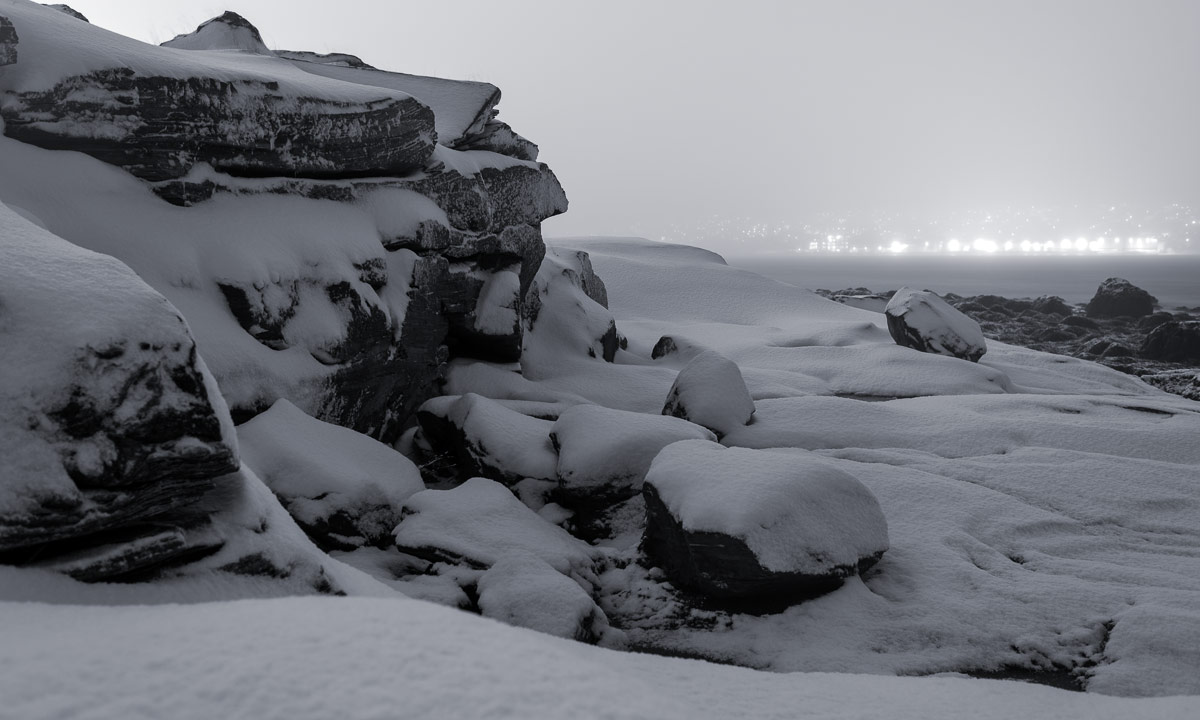
I couldn’t sleep. Not at all! At 1:30 I gave up and went out for a walk. And took some photos. Black and white. By the coast. Snow showers.

Now I try to catch some sleep. Good night!

____

Not I see, that the 2nd JPEG has quite strong colour artefacts. I may correct that. Later.

I walk to work

Back in Tromsø I decided to walk to work this week. 2½ km to the Norwegian Polar Institute in the Framsenteret and 2½ km back home. So I get at least a bit of motion each day. And a bit of outdoor feeling, too.

Monday, 17 January

It has snowed quite a bit the night and is still snowing. It’s -4 °C and the wind is calm. It’s fun to trudge through the powder snow.

Lunch time. We get the table by the panoramic window. Some boat owners clear the landing of the marina from snow.

Tuesday, 18 January

-3 °C and snow fall again but now the wind is stronger and squally. Luckily I have it in the back.

It gets warmer the whole day and it starts to rain. Wet ice and deep puddles on my way back.

Wednesday, 19 January

+2 °C, a bit of rain. Rubber boots, slush, ice, water puddles.

Thursday, 20 January

-1 °C and fresh snow.

I don’t trust the snow. I know that ice and slush lurk beneath the surface. Therefore I wear rubber boots again with attached spikes to avoid slipping on the wet ice. The gloves protect against the wind, the reflective wristbands with the blinking LEDs and the high visibility vest against not being seen by car drivers. No cyclists the last days.

Friday, 21 January

-6 °C, almost like winter. The canteen invites to “sun buns” and cacao because it is “soldagen”, the day where the sun is finally visible in Tromsø again after 8 weeks. Unfortunately clouds block the low hanging sun.

This weekend I won’t see the sun neither. We got warm weather and storm and unfortunately a lot of rain. So I’ll probably keep myself mostly inside.


Fresh snow in Tromsø

Since yesterday evening I am back in my “work town” Tromsø. How I got here after 17 hours of travelling is another story. I only mention that it among others had to do with snow.

And snow we got in Tromsø as well. Round 30 cm of fresh, clean snow cover the ground, the houses, the trees and build fields of slush in the shallow parts of the sea.

These photos are from a short promenade from Telegrafbukta and Sydspissen.

The middle of the polar night

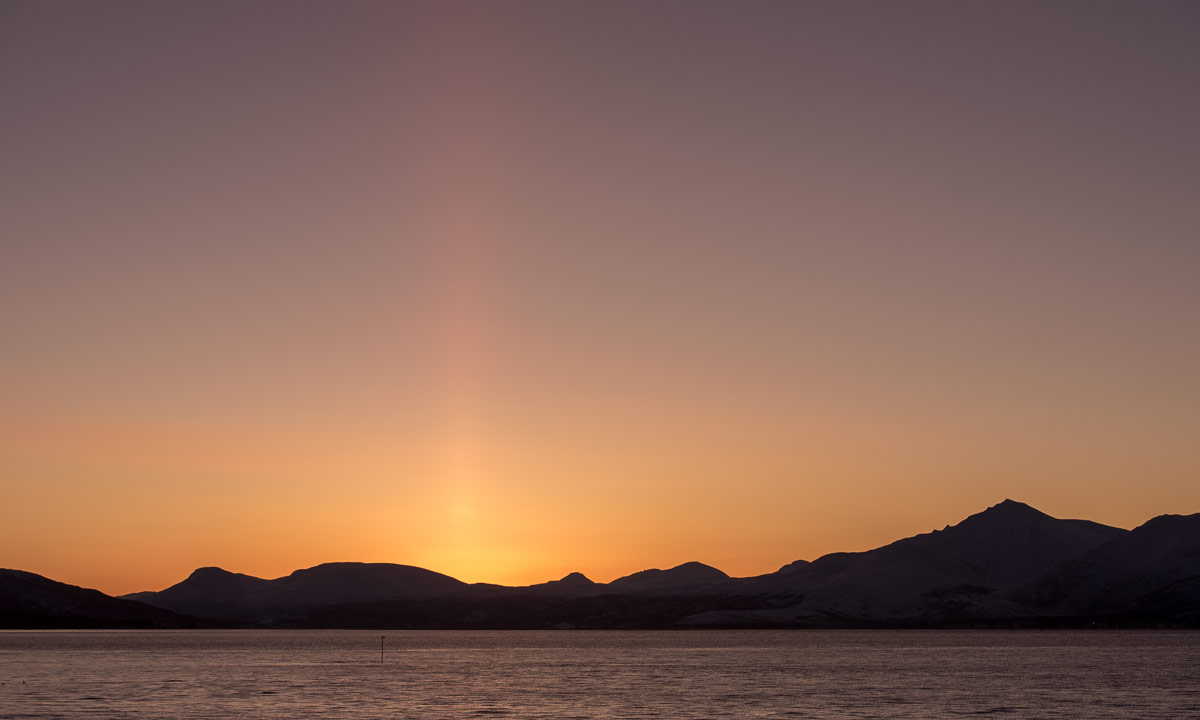
Today it’s the darkest day of the year, which means, that half of the polar night in Tromsø is over. With the risk of repeating myself, even the darkest day is not dark, especially when it’s a crisp, clear day with a lot of – well no sun – but cloudless sky and warm, colourful light.

No, you couldn’t see the sun, but the direction where it was, because a light pillar created by reflections of ice crystals in the air marked its position.

People where outdoors, not only on land but seaside, too. Two people clad in neoprene doing a long-distance winter swim. Three women paddling and taking a rest at Telegrafbukta. And finally me who after some hesitation took a winter bath. Air temperature -8 °C, water temperature +4 °C, alas no wind. Perfect conditions!

How long it will take until you can see the sun again? Well in Tromsø probably in a month but I’m cheating. In a week Annika and I head to our home in Sweden, where there’ll be at least four hours of sun every day. Beach holiday in the south ;-)