Blue hour – golden hour

Some winter days are grey and colourless. The photos taken on such dull days appear almost look black and white as long you don’t have a colourful motive.

Some other winter days are clear and colourful. There are two colours, that are especially prominent: orange and blue.

Orange is not only the colour of candlelight and cozy fires, but of the golden hour, too. The golden hour is defined by the time, when the sun’s altitude is between -4° (thus below the horizon) and 6°.

Blue is the complementary colour of orange. If you look at snow in the shadow you may realise, that it’s not of perfect white but looks a bit blueish. And the whole landscape gets a blue tinge when the sun’s altitude is between -6° and -4°. This period has a name, too, it’s called the blue hour.

Both images are made today. The first one at 09:32 (sun ±0°), the second one at 08:30 (sun -4.5°). If you have a closer look to the 2nd photo you can see the first sunrise colours on the left part of the sky. I should have make it a bit earlier.

It’s a good thing for such to live way up north. In Skelleftehamn the sun won’t rise more than 6 °C for two months, that’s golden hour even at lunchtime! And since the path of the sun is quite flat, these time periods are quite long. Today I didn’t need to rise up very early since the days are still short, but this will change soon:

Sunrise was 09:35 on 1 January and will be 08:20 on 1 February and 06:44 on 1 March. Then it’s time to get out of bed really early! Or to travel even more north, but that’s another story …

Links

The Baltic Sea freezes over

I guess, another kayak season has come to an end when I have a look at the photo I made two days ago.

The night before last was cold in Skelleftehamn with a minimum of -17.4 °C, since then it got warmer and it snowed 5 – 10 cm. Tomorrow I’ll have another look at the same place and take some other photos.

Even though temperatures have been mostly subzero for a while it will take some more weeks until it’s save to enter the ice and walk or ski to the island Gåsören, which you can see in the background.


Winter solstice 2017

It’s winter solstice today which means that it’s the shortest day of the year, at least in the northern hemisphere. Here in Skelleftehamn it was only 3 hours 44 minutes between sunrise and sunrise today and the sun rose hardly above the horizon. From now on the days will grow longer which feels a bit like winter’s ending. But far from it – it’s fortunately the astronomical beginning of winter today, not the end!

Hopefully the rain that we occasionally got the last weeks (e.g. yesterday) will come to an end and more snow will fall. Much more snow! I also hope that it will get colder to make the Baltic Sea freezing over so that I’m able to walk or ski to the islands. But this will probably take some more weeks.

This photo by the way is taken at 10:35, 58 minutes before the sun reached its highest point.

Opening the skiing season 2017/18

Today I had another day off and since the weather was sunny and nice but too windy to kayak, I opened the skiing season today. It was just 4.3 km but a good start to try out my brand new skis. Oh my, they are quite fast and it will take some time till I’ll get used to them. The snow wasn’t perfect neither but it was fun anyway.

Thanks to Y. in Umeå for her purchase advice and for her professional waxing!

Thanks to Friluftsfrämjandet Skelleftehamn for preparing the ski track in Skelleftehamn!

Winter is just some miles away …

Let’s face it: The weather in Skellefteå and Umeå has been nasty the last days – temperatures above zero and a lot of rain making the minor roads icy and incredibly slippery. Most of the snow of the days before has been thawing away. So just now there’s much more winter in Germany towns than here beside the coast of the Baltic Sea.

The good thing: winter is not far away. I was in Umeå today and Annika and I drove westwards to catch a glimpse of winter. First it continued raining a good while, the road was dark and wet and the snow was slushy and ugly. But suddenly – just within a few kilometres the weather changed and rain turned into snow. Snow fall increased and anything was snow covered and white: the roads, the trees, the traffic signs, the bogs and the parking place where we stopped to visit the Hägring (english: mirage).

Hägring is an artwork between Bjurholm and Vännäs. It is a church-shaped object built of mirror fragments and stands in the midst of a bog. We’ve been there in May and knew that the bog is wet but safe to walk on. It was funny anyway to walk through knee-deep snow and feeling the bog bouncing underneath our feet with each step.

We continued westwards, Annika was driving and I was navigating and taking some pictures through the windscreen. Right after Bjurholm we took a minor road to Örträsk, a village by the lake Örträsksjön. Everything was snow covered. We stopped at the small grocery to buy something to drink but it was closed due to the “snow storm”. Well, we knew of the level one weather warning but it didn’t seem so severe.

Since days in December are short (and we didn’t find a place to eat in Örträsk) we decided to return to Umeå but on another route taking some minor roads eastwards. Snow fall intensified but still only some centimetres covered the roads.

While we followed the small ways the snow on the road got deeper and deeper until Annika’s Golf ploughed through 10 cm of snow. Where there was a house, people were outside to clear the snow with any available tool – from shovels to quite huge shovel loaders. But we didn’t get stuck.

Finally we reached the European route E12 which runs between Mo I Rana (Norway) and Helsinki (Finland). Even this road was covered with snow but much better to drive than the smaller forest roads before. 66 km to Umeå and it was snowing almost the whole way back. The last part however we came into the more maritim and warmer climate of Greater Umeå area and snow turned back into rain. We however got our winter impressions. Within just in half a day! One of the big advantages of living here!

On a final note, a “making-of” photo of Annika: Me walking to the Hägring:


A clear winter morning at Långhällan

Today I took time off work. I stood up quite early and at 7:30 I took the car to Långhällan, a place by the coast which I love for photographing. Today I tried out my new Tamron telephoto lens (150 – 600 mm) and I’m very contended. All photos shown here are made with this lens and focal lengths between 400 and 600 mm.

The morning was cold with temperatures round -10 °C and the sky was completely clear beside of a layer of clouds at the southeastern horizon. The locals call this cloud phenomenon “vinterväggen” – the winter wall. Although it was more than one hour before sunrise, the horizon was already of a bright orange colour. The first photo.

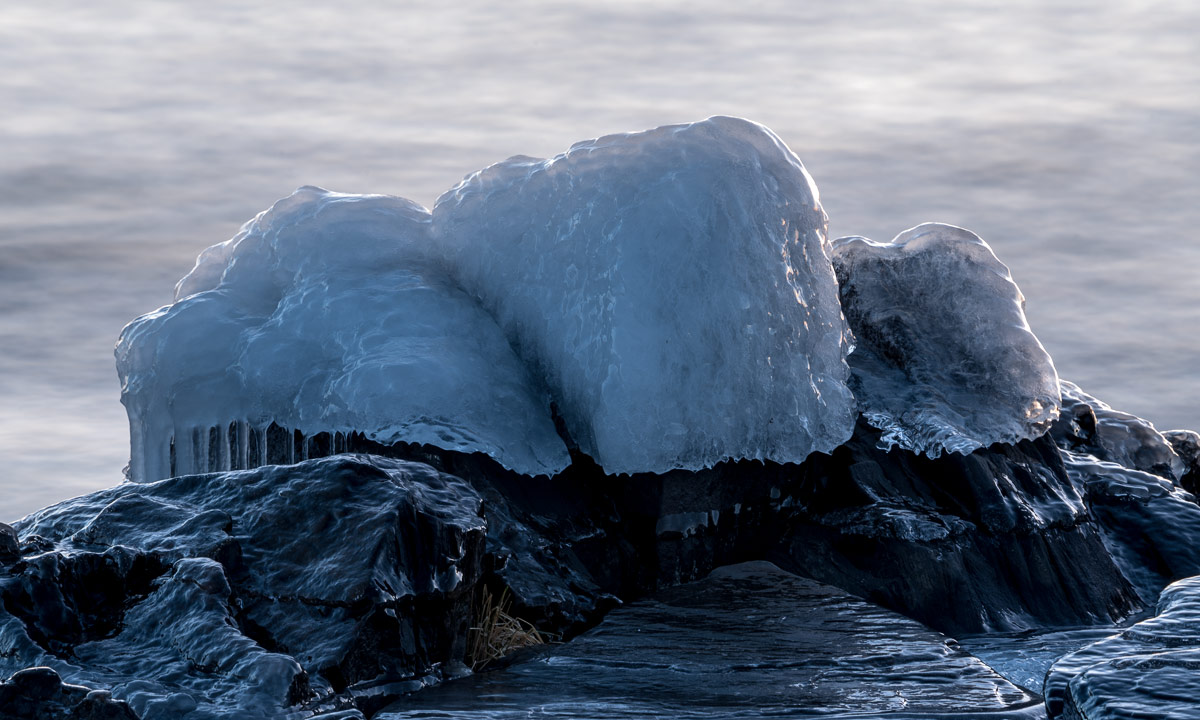
As usual the other side of the celestial sphere was of a pale purple colour. The ice and rocks however were still of cold blueish colours. I could have waded to the rock with its shining ice cap, but I wanted to test my new lens. Photo number two.

Långhällan’s shore is partly solid rock, partly round stones of different sizes. Each of the stones, that are partly below and partly above water has such an ice cap as on photo number two. Photo number three – just for the impression.

On one of the rocky salients there’s a small but deep puddle of water which was covered with ice too thin to bear me. I could have tried to walk on it (I wore waterproof chest waders) but probably I would have destroyed the motive: a small ice pane sticking out from the icy surface. Another good argument for a telephoto lens. Photo number four.

While I looked round and breathed the crisp air the sun has started to rise, still invisible since it was behind the vinterväggen but the rim of the clouds were illuminated in a bright glowing orange. I had taken some other pictures of the lighthouse before, but this photo wins. Photo number five.

When waves splash water on the frozen stones long chains of icicles are formed. Some of them were already in the sun (Photo number six) …

… while most others still were in the shadows of other rocks. These icicles had reached the ground and created a row of ice pillars in a ice portal. Photo number seven.

I looked at the sea. Parts of the ice covered rocks were sunlit and glowed orange-colours as if they would gleam from the inside. The good thing with chest waders is that you can kneel down into the water for a better perspective without getting wet. Photo number eight and the last one of today’s series.