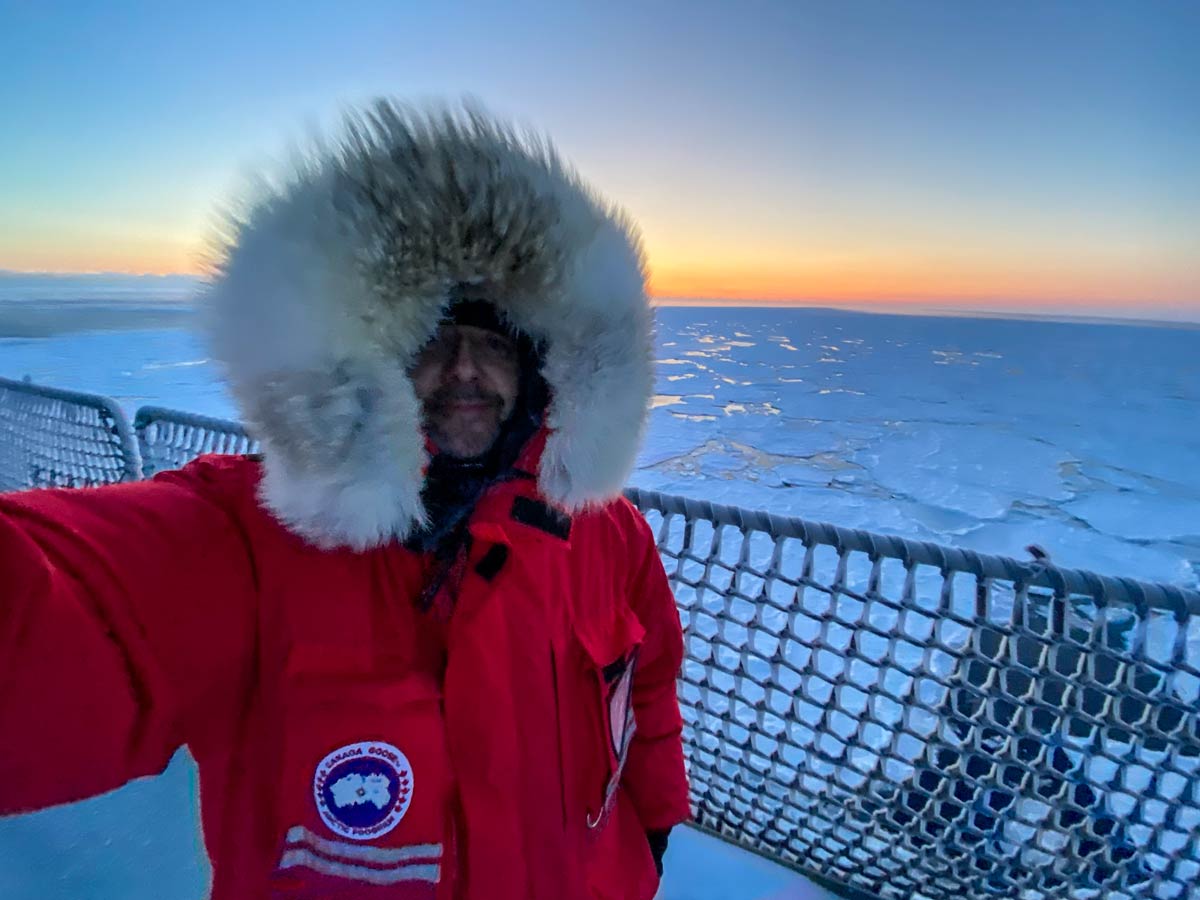
Arctic research expedition with the Norwegian Polar Institute

This article is part of the series “2022-02: Winter cruise KPH”.

Kronprins Haakon is a Norwegian icebreaking polar research vessel. It was build 2018, can cut through one metre of solid ice, has 15 different laboratories on board and place for 35 scientists or other staff in addition to the crew.

Four days ago Kronprins Haakon had arrived in Tromsø. It was travelling 26 days since it left Cape Town, the only stopover on its return trip from Antarctica.

This morning I went on board of Kronsprins Haakon. Not as a visitor to look around but with a suitcase, an enormous bag full of warm clothes, a heavy camera backpack and my Canada Goose down parka. I will stay on board for three weeks to participate the winter cruise “Arven etter Nansen JC3” that will lead us to the Barents Sea east of Svalbard and a bit beyond.

What happened?

Some of you may know that I’ve been working as a data engineer at the Norwegian Polar Institute in Tromsø since autumn 2020. In this position I’m not only a software developer but a data manager of polar research data.

Three and a half weeks ago my colleague M. told me she would join the winter cruise and mentioned that there might still be an available place.

Of course I was very eager to participate. Beside of my private passion for the Arctic I wanted to get a deeper and hands-on understanding of the research data. Where does it come from? How is it measured? And how is it transferred to the digital world? And nothing would teach me better than joining this very winter cruise, where conditions could be quite rough.

I mentioned it to M., another colleague and he introduced me to the expedition leader. There I was told that there was indeed a vacancy on board and that I was welcome to join if my boss would agree.

Since then it had been crazy times with some organisation, a lot of worries and little sleep.

  • 1 Feb: My boss had to check the budget for my participation.
  • 4 Feb: A seafarer’s doctor examined me and gave me my helseerklæring – a medical certificate that proves me “seaworthy”.
  • 16 Feb: I had to take a PCR test and wait for the result for two days. Then I had to take another PCR test, but that’s a whole story in itself.
  • 18 Feb: I had to do a survival suit training in the Tromsøsundet.
  • 18 Feb: I had to pack clothes and equipment I will need on the cruise. Everything beside of two pairs of boots, a helmet, a floating suit and a survival suit. These are provided by the Norwegian Polar Institute.
  • 19 Feb (today): I took a taxi to the port of Tromsø. I was driven directly to Kai 25, took some photos and then went on board.
  • Still today: passport control through the police, a security briefing, lunch and dinner, carrying boxes to the labs, entering the rescue boat and some more …

The next weeks

When Kronprins Haakon will leave Tromsø tomorrow morning we will sail north. First destination is a point referred as P1. It is approx. 500 km east of Svalbard’s southern tip. From there we will continue heading north to the other stations, if weather and sea ice conditions allow it.

The northernmost position is planned to be approx. 82° N, somewhere in the Arctic Ocean. That’s more than 10 degrees of altitude further north than I’ve ever been and less than 900 km to the North Pole.

I’m so excited, that’s really way up north!

We will work both on the sea ice and on the ship using various measurement and sampling methods. Some of them I learned a bit last week but most of them I do not know yet. I’m a newbie. I’m here to learn. And hopefully I’ll learn a lot on this cruise.

After three weeks of tokt (Norwegian for “cruise”) we are supposed to arrive in Longyearbyen on 11 Mars. There I’ll take a flight back to Tromsø the same day.

I will not blog on this cruise because there will be a lot of work and hardly any reliable internet connection. But I’ll definitely take photos, both for the Norwegian Polar Institute and in private for this blog.

So, my dear readers, cross your fingers that I do not get seasick, we can reach our planned destinations and most of all that no one has Covid on board.

You can check the live position of the Kronprins Haakon on the map below. And you are welcome to leave a comment. See you again in mid-March when I’ll answer your comments and start posting articles.

23. Feb, 13:03: Just a short note: This map does not seem to work in polar regions. At time we have internet. Outside temperature -17.4 °C. Position round about 76°29′ N 31°11′ E.


A winter journey from home to work

Last Saturday I travelled to work. ObbolaTromsø, that’s round 1000 km – the reason why I do not commute weekly.  This time it is a bit suspenseful, because there are two obstacles on my way.

One obstacle is easy: taking a covid test at the test center. The other is much bigger: The road over the Bjørnfjell – the only road – has been closed for many hours due to stow storm conditions. Well, I start my journey anyhow. We’ll see.

At 5:30 in the morning Annika takes me to the train station in Umeå. The first 9½ hours were just a “normal” train journey beside of the train being mostly ahead of time. One change in Boden – nothing special, just long and a bit boring.

I leave the train in Abisko Turiststation where I parked my car. My car – will I find it or is it submerged under a pile of snow? To my relief hardly any snow covers my car. I already hoped so, because Abisko is known for its low precipitation because mountains in the west protect it from bad weather. Much more snow and rain fall on the other side of the mountain range and that’s exactly where I have to go through. Some minutes after leaving Abisko behind it starts snowing. Snowfall increased more and more but isn’t severe and the Swedish mountain road is open. Soon I cross the Norwegian border and …

… have to stop because of a lowered tollgate with a red blinking light. Beside of two trucks I am alone. I am relaxed because I know that the road has been opened for driving in convoy one hour ago (thanks internet!). I just have to wait for the large snowplough to fetch us.

After twenty minutes the tollgate went up and the red light goes out. That’s all that happens. I hesitate. And now? Do I have to wait? Or may I drive? I don’t dare and ask one of the Norwegian truck drivers. He answers I should just go ahead and so I do. The drive is snowy but not bad and soon I arrive at Bjørnfjell brøytestasjonen where the snowploughs are located and now also the Covid19 registration. I register myself, get a covid test and start taking photos while waiting for the result.

I take an image of a snowed in car. The snow plough driver goes to me and asks for what purposes I take photos. “Just for my blog.” “Ah ok, just curious.” Good to talk to him, because so I learn that beside of the mountain passage behind Bjerkvik road conditions are good. Here they got a lot of snow the last 24 hours and one of the cars looks like this:

After round 20 minutes I get a ping ♪. It’s an SMS with a link to my test result. Negative :-). 260 km to go, that’s four hours when conditions were good.

The first 100 km the road conditions are good and weather is ok. The next photo shows how driving looks like.

The next hour it snows a lot. Sight is still good. To my left and right everything is covered with snow, from the largest church to the smallest branch of a tree. Winter wonderland.

Then it starts to get nasty. Snowfall intensifies more and more and the snow has the consistence of superglue. My windscreen wipers hardly manage to push away the gluey snow and finally I have to turn into a side road and de-ice the wipers. Scratch, scratch … . I’m not alone. In front of me a car with a driver doing the same. Behind me another car stops. Am I in the way? No, just another scratch, scratch. On the other side of the side road another one.

I still have some holes to peek through but it is extremely tiring to drive car through the night like that. Alas, after two hours I drive over the large concrete bridge Tromsøbrua and am on the island Tromsøya. Apparently Tromsø’s snow removal has given up. The minor roads are covered with 20 cm of snow with deep tyre tracks. I understand more and more why most Norwegians have cars with all-wheel drive (and so have I).

22:45. I make a last stop at the supermarket nearby that is open until 23:00. I’m lucky because Norwegian supermarkets close on Sundays. By the way: the supermarket’s parking place is in much better condition than the roads.

One other minute driving and I arrive at my flat in Tromsø after 17½ hours travelling. I’m tired but it takes another hour until I’m relaxed enough to sleep. Next week I’ll walk …

Home in Obbola

Yesterday TromsøBjørnfjell by car. Today BjørnfjellAbisko Turiststation by car. -17 °C in Abisko. Then nine hours by train via Boden to Umeå where good friends fetched us by car. Then UmeåObbola in Annika’s car that was parked at the friend’s house.

Here in Obbola it is quite warm, only -1 °C, but it is snowing and storming. You can hear the wind howl and see the snow glued to the seaside windows.

Home!

When a boat take photos

One month ago I joined two whale watching boat tours to the sea round Skjervøy, one on 21 November, one on 27 November. Most of the time I was outside on deck to take photos.

Days were short and it became darker and darker soon. There are some options what you can do on a moving boat if you want to take photos but light is low. One of them is to use high ISO values. Depending on your camera this can result in a photo with a lot of noise.

Another one is to take your tripod with you and integrate the boats movements while taking photos with a long exposure. That’s what I did on the return passage of these boat trips. The exposure times of these photos lie between 10 and 13 seconds.

Two movements are caught in these photos. The large ones are created by the rolling and pitching of the boat. The small ones are caused by the vibrations of the motor.

While I mostly focussed on taking pictures to the side I almost skipped an interesting motive: the stern wave of the boat.

Some tips:

  • Use a telephoto lens. It will magnify the movements of the lights.
  • In wintertime take your warmest clothes with you. It can be colder on the boat than you might expect.
  • Avoid the bow of the ship when waves get higher to avoid your camera equipment and yourself being soaked by breaking waves.

Here is a set of images I made on two Hurtigruten journeys some years before. You see less vibration, since the Hurtigruten ships are much larger.

To the photo series “bevegelse” >

Whale watching – second try

Yesterday Same meeting point, same tour, same boat as 6 days before. But completely different weather! No stormy wind from the north and clouds everywhere, but a clear and starry sky.

And off we went.

It was just incredible how much brighter everything was although it was less daylight than last Sunday. After two hours the island Nordfugløya came into view. A cloud parked itself over the island.

Slowly the colours of the sky intensified and remained colourful the whole short day, because now it was the first day of polar night¹.

It took us round 3½ hours to reach our destination, the sea round Skjervøy. So we had only limited time before we headed back. Already at one, half past one o’clock it started getting darker again.

Eight hours after our departure we had returned to Tromsø.

I have been outside for round seven hours. I didn’t freeze because I was wearing my warmest winter parka. I was inside once to eat a bowl of soup and once when I stood at the ship’s bow and the sea spray soaked the whole foredeck (including me). So I was eager to take a shower not because of being cold but I wanted to get rid of the salt hands and face were covered with.

Resumé: It was a great boat tour and I enjoyed the air, the colours, the light.

And the whales? Oh yes, the whales! Almost forgot them ;-) Well, we saw some of them, mostly orcas and the first fin whale of the season. There were not many whales around and they were quite in a distance, so for photographing whales this tour was not ideal. Too little time and too high the boat decks above the water. I would love to paddle kayak there but I’m pretty sure that I never ever will dare to do that.

____

¹ Where I live in Tromsø we technically had 14 minutes of daylight yesterday but already 1.3 km north it was the first day of polar night.


No whales today

To the left the Brim Explorer, a boat located in Tromsø for amongst other whale watching. To the right the tourists waiting to be boarded. The boat is fully booked, I am not alone.

Before leaving an announcement: The crew will try its best but it’s not granted that we reach the waters where the whales are. Anyone is free to leave and given a full refund. Most people stay and so do I. First of all I’m not surprised, as another tour operator already cancelled today’s tour. And then I just want to be a day on the water. Whales of course would be a nice extra.

To the left Tromsøbrua, the bridge that connects Tromsø with the mainland. To the right the safety on board drill, that everyone had to join.

And then we’re off.

To make it short: What we didn’t get today was whale sightings. What we got today was rough weather in the open parts. The boat was rolling and pitching like a cork in the waves. More than one passenger got sea sick. The unpredictable movements of the boat and the dim light under the grey sky made photographing a bit adventurous. Several times I was forced in and one passage even the doors were locked. The rest I was outside, partly taking photos, partly just looking around and letting the wind blow around my nose.

Conclusion: an awesome tour even without whales. If you want to participate as well: take your warmest clothes with you. And those of you that just want to stay home and look at some whale photos may read my article about Whale watching in Andenes. Enjoy.

Note to myself: TromsøyaRingvassøya/ReinøyaVannøyaNordfugløyaArnøya/LaukøyaSkervøya/KågenLyngenReinøyaTromsøya

Travelling from Tromsø to Obbola

Live from the journey …

Part 1 – written in Hotell Sørreisa.

Saturday 16 October at 12:17 my train to Umeå will depart. Not from Tromsø (no train station), but from Abisko Östra. From there the train to Umeå will take nine hours. Then it’s only twenty more kilometres to our home in Obbola.

From Tromsø to Abisko I’ve planned to take the car. And this was the forecast for the Swedish mountains four days ago:

Half a metre snow! Holy moly! Luckily you can rely on the fact, that these forecasts are unreliable. Now only some centimetres of snow are forecasted for tomorrow.

Wednesday

While some trees in town shed there coloured leaves the mountains are already clad in snow. The first photo is taken in the centre of Tromsø, the other one near where I live.

Thursday

I change to winter tyres, a must have for crossing the Norwegian/Swedish mountains. Due to unsure weather conditions I decide to start my car trip already on Friday and book a room with breakfast in Sørreisa.

Friday

Half past three I have packed my stuff (why is the large suitcase so heavy again?) and start my car trip TromsøSørreisaAbisko. The first fifteen minutes stop and go in town, then over the bridge and onto the E6 that I follow for round 130 km south. The temperature slowly drops from +3 °C to -2 °C and gradually snow is not something far on the mountain slopes but lies left and right from the road E6.

It starts getting dark quite early. Sun down here in is already at 17:20. Here, that is Sørreisa Hotell, where I’ll stay overnight. This hotel does not only provided affordable rooms but really good Thai food as well.

Part 2 – written in Kiruna, sitting in the train to Boden.

Saturday

The next morning my car windows were covered with frost and the temperatures were slightly sub-zero. I had enough time to avoid the main road and instead took road 84 that has both mountain and coastal stages. I can warmly recommend this detour.

The smaller lakes in the mountains were mostly frozen. To my surprise even parts of the fjord Sagfjorden near Sjøvegan  were covered with thin ice. I thought it would take longer to make the saltwater freeze.

After I joined the main road E6 I left it again to follow the E10 to Sweden. There was some snow on the ground, but it wasn’t snowing.

45 minutes later I arrived in Abisko Östra. Here’s a cozy cabin, where I had stayed several times to explore Abisko. The owners generously allowed me to park my car here for free, while I am in Sweden. Thank you, Anneli and Thomas! It was nice meeting you again!

In Abisko it started snowing. I bought some lemonade and then waited for the train to come. It came in time. I got into the train. Now it’s only round nine hours to Umeå. With the car it is 700 km to Umeå so taking the train is not only more ecological and comfortable but also faster.

Part 3 – written in the train between Kiruna and Gällivare

When the train arrived in Kiruna it was winter. Everything was covered with snow, it was windy and constantly snowing. We had a stay of half an hour and I went out to take some photos. My anorak was warm enough, the summer barefoot shoes weren’t. No problem, since the train was overheated I quickly got  warm again.

After we left Kiruna more and more snow sticked to the slightly warmer train windows until I could hardly see through the window anymore.

Part 4 – written in the connection train somewhere between Älvsbyn and Jörn.

In Gällivare and Nattavaara there was more snow, but then the train approached the coastal region where it uses to be slightly warmer. The ground was also snow covered but the snow looked wet and probably won’t last long.

Meanwhile it had started to get dark. We were late but the connection train in Boden was supposed to wait for us. And so it did.

In Älvsbyn I took the last out-of-the-train photo today. It was dark and mostly I took photos from my own reflections, not from the outside.

I’m glad when I can leave the train. First of all I’m tired and want to arrive home. Then the train compartment is strongly overheated, too. I’ve been in saunas colder than this!

Part 5 – written from home on Sunday.

There’s not much more to tell. Leaving the town Vindeln behind I could see less and less snow until soon no more snow covered the ground. At 21:09 the train arrived in Umeå where Annika already waited on the platform. Half an hour I finally was home.

Today, after a rich breakfast:

I’m so glad to be here. At more than two weeks I’ll spend home in Obbola until I’ll take the same way back to Tromsø in early November.

A short and rainy Hurtigruten trip

This article is part of the series “2021-08: Northern Norway”.

After 2700 km by car we had arrived in Bjørnevatn near Kirkenes. From there it would be another 900 km back to Tromsø, my temporary home. So Annika and I had decided to go by ship and use the Hurtigruten for our journey west. Last Friday we went on board of the MS Vesterålen, the smallest and oldest ship of the current Hurtigruten fleet. I left it to be parked while Annika used the regular gangway. The ship departed round 12:30, round 35 hours later we arrived in Tromsø.

The weather was rainy, chilly, windy and although parts of the upper deck are well protected against wind and rain we often sat there alone. While it was quite rainy there were a lot of small holes in the clouds that let the sun peek through. Especially the light on the first day was very wonderful.

I just show some of the photos I made from the upper deck. All of them are made with a telephoto lens and focal lengths between 150 and 600 mm. To avoid blurred images because of the ship vibrations I hardly used a tripod but used ISO 800–1600. But now to the photos:

Grense Jakobselv

This article is part of the series “2021-08: Northern Norway”.

This sign marks the only Russian–Norwegian border station. In February 2018 I crossed this border to Russia together with Annika and two friends. This time we stay in Norway and I take just a photo of the sign.

Our destination today (which is 30 August): Grense Jakobselv, a small border village. As the road to Hamningberg the road there is opened only in summertime and we never have been there before.

It starts like a typical car trip. The road goes along the Jarfjorden and a large lake. In Vintervollen the road turns right and we see the barrier that closes the road in winter. It is open. Now the road leads over the mountains. The rocks here are the oldest in Norway with an average age of 2.9 billion years. I’m not a rock expert and so I take a photo of a birch instead of a random rock whose type and age I cannot determine.

We reach the small river Jakobselva. This small and shallow river is special because here it marks the Norwegian–Russian border. The pink salmon (also called humpback salmon) do not care, they are busy to go upstreams and not all fish succeed.

We continue to the village Grense Jakobselv. For me the biggest surprise was the chapel. In my view every northern Norwegian church is made of wood and painted white. Not the King Oscar II Chapel (built 1869) that is made of stone.

While I wasn’t properly prepared about the church I knew something else: There is a sandy beach. It is at the very end of the road. Annika and I take a bath. Water temperature is about 11–12 °C. It feels quite strange to change clothes for a bath while you can hear the Norwegian army practising shooting.

As many minor roads in northern Norway the road to Grense Jakobselv is a dead-end road and so we have to drive the very same road back. After having been back we get something we have missed on the journey so far: an afternoon nap!

Fylkesvei 8100

This article is part of the series “2021-08: Northern Norway”.

There are places that are so fascinating, that you want to return there for a longer time. For me the road to Hamningberg is one of these places.

Originally Annika and I didn’t have the plan to visit Hamningberg. It’s a detour of 2×40 km just to see a former fishing village whose houses are now used as summer cottages. On the other side the road 8100 that leads there is closed in wintertime and we never had the chance before to drive there.

So right before Vardø we spontaneously decided to turn left into the road Fylkesvei 8100. We could turn if it was boring. Well, it wasn’t. We were both extremely fascinated by the roughness of the landscape and the many light moods because of the constantly changing weather

The photos are just some snapshots I made on our tour. Maybe I have time to return there some other time with more time for making photos.