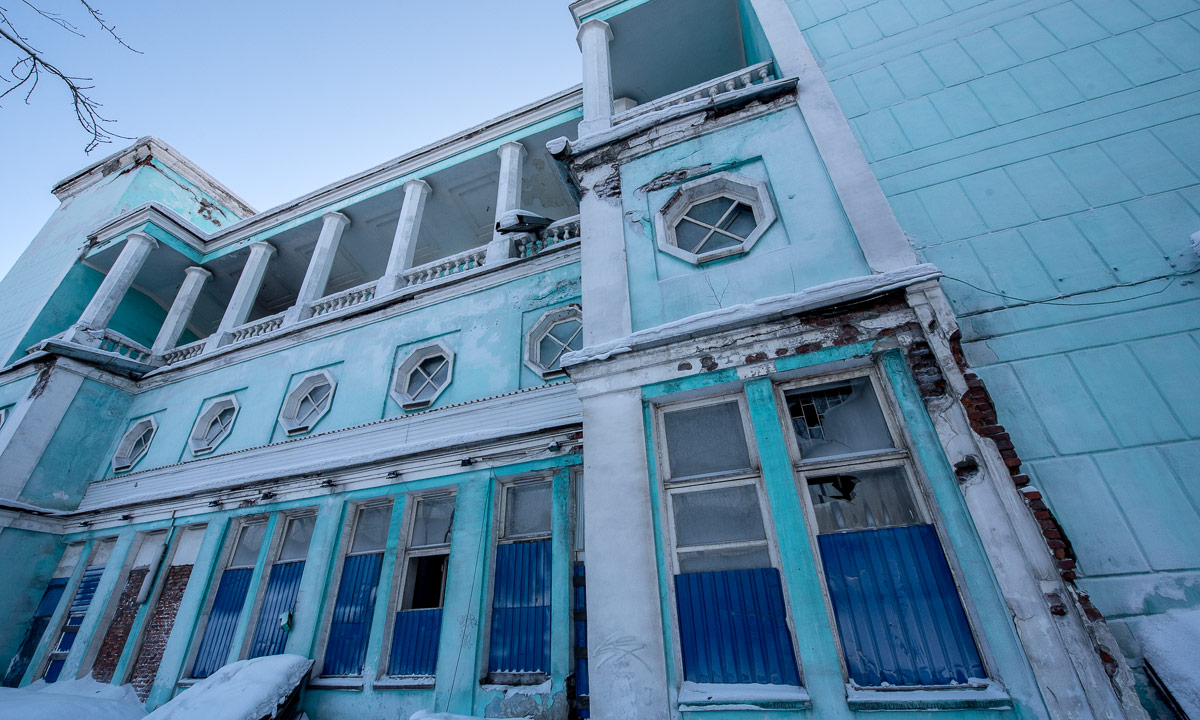
A tour to the easternmost point of mainland Norway

This article is part of the series “2018-03: Varanger peninsula”.

Day 29 and 30 of my winter journey 2018

Yesterday we continued our journey to Ytre Kiberg which is 13 south of Vardø, one of the Hurtigruten stops. We started in Vadsø – another Hurtigruten stop – after a breakfast with our host Nils, bought a basis of food for the next days and took the E75 northwards. We made a stopover in Ekkerøy, a village on a peninsula near Vadsø. We like this place and will try to stay there for some nights next week.

At lunchtime we reached Cape East Arctic Adventure, our stay for four nights. We were welcomed by Trond, the owner and operator of Cape East Arctic Adventure and were shown our cozy bedroom, the kitchen and the homely living room. After making ourselves at home we went along the beach to the village and the harbour.

In the evening we were invited to a three course dinner based on freshly caught cod: Fish soup – cod with potatoes and carrots and finally cod roe. Everything was extremely tasty and it was Annika’s and my first time where we tasted cod roe. Yummy!

In Kiberg you are as east as you can be in the Central European Timezone, therefore sun is rising already at 6:24. I was awake very early and took a morning walk round 6 o’clock. Some snow drifts had been created by snow and wind over night but now the weather was less windy and quite sunny. At least for a short time. While I went the way to Indre Kiberg clouds approached, wind increased and it started to snow. It was hardly imaginable that it was sunny just a short time before. Weather changes here quite often as Annika and I should find out later.

After breakfast Annika and I took the car to the other side of the village, put on our snow shoes and started a hike to Kibergsneset, easternmost point of mainland Norway. This place is more east than e.g. St. Petersburg, Kairo or Istanbul! It was windy but quite sunny, when we started our tour but weather changes fast on the Varanger Peninsula:

Actually this hike is just a promenade but the weather may transform it into a small expedition. We were exposed to wind and snow and grateful, that we didn’t experienced a full storm. The weather was rough anyway and I was glad about my windproof jacket and two pairs of mittens.

We continued on a small hiking trail, first with, then without snowshoes because the thin snow layer was hardened by the wind and easy to walk onto. There’s a coastal fortress build by Germans in WW2 on Kibergsneset but we couldn’t see it in the snow weather. Instead of looking for it we continued to the small lighthouse at Kibergsneset that marks the easternmost point of mainland Norway (and most of Europe). Shortly before we reached it the sun came out and we continued the last metres in full sun. While I made some photos a small snow shower approached with the sun still shining.

From the lighthouse there was an amazing view over the arctic coast of the Barents Sea, but only for some moments. Soon the next snow shower came by and hid most of the view onto both the coast and the sea.

The way back was much shorter because we knew the way and went downwards. Even though the view was limited by the snow showers Ytre Kiberg came into view again soon and surprisingly the weather was nice and sunny again.

After this very windy promenade we were glad to find shelter in my car. We took the car to Vardø to eat something and after that we tried the road to Hamningberg. We knew that the road was closed in winter but we curious how long we would come.

Well, not very long. We managed to get to Smelror, some kilometres north from Vardø.

The main road however was definitely closed as you can see. There are no people living in Hamningberg permanently and the only motorised way to reach it in wintertime is by snowmobile. For car it is open less than half the year.

We took the car back to Kiberg, enjoyed the incredible and unbelievable colours of the sky and were surprised by a strange weather phenomenon: -6 °C and rain (including a faint rainbow!)

The rest of the day? -10 °C and wind outside, no more photos, no more excursions.

Fun fact: We took the E75 northwards. If you would take it southwards you could travel more than 4000 km and finally would arrive on Crete, Greece.

A trip to Murmansk – day one

This article is part of the series “2018-02: A trip to Murmansk”.

Day 22 of my winter journey 2018

tl;dr Alyosha monument · old concrete buildings · Church of the Savior on Waters · view over Murmansk · restaurant Tundra · nocturnal Murmansk

Alyosha (Алёша)When we arrived in Murmansk the day before it was already dark and we were tired. Today after breakfast we were eager to explore. We ordered a taxi to our first tourist attraction: The Alyosha Monument.

“Defenders of the Soviet Arctic during the Great Patriotic War” (Защитникам Советского Заполярья в годы Великой Отечественной войны), commonly called Alyosha (Алёша) is a monument to Soviet soldiers, sailors, and airmen of WW2.

It was build in 1974 and it’s the second-tallest statue in Russia. The 70th aesthetics and the communistic concrete appeal didn’t help to make me like this statue, but I always have difficulties with war memorials. I’m a pacifist.

I enjoyed however the view over Murmansk. It was visible, that it’s a large town (it has 300,000 inhabitants) with a large port and many concrete high-rise buildings.

After we visited Alyosha we started to walk back into the center of Murmansk, where our hotel Azimut was located. We turned right into the street Ulitsa Aleksandrova. To the left there were old concrete buildings. They were extremely rundown and I was shocked to see these building and imagine people living here. Maybe the inside would look nicer, but the outside was horrifying.

In many directions you could see these high-rise estates with rectangular concrete buildings. But we could see something else: a Ferris wheel. We went on and came to a permanent amusement park, located beside the lake Semyonovskoye (Семеновское озеро). Of course the lake is covered with ice and snow in wintertime and some locals used the ski tracks going round the lake.

From that place the next destination was quite near: the Church of the Savior on Waters (Спас на Водах), a small Russian orthodox church, built 2002.

When we came to the church I could see some people leaving, going backwards and making the sign of the cross again and again. It is allowed to enter the small church but not to take pictures. I’ve never been in an orthodox church before and I was stunned. The walls were covered with icons of saints and incense was burned. Some elderly women were lighting candles and immersed into deep prayers and almost seeking physical contact to the icons and other objects. I felt deeply touched by this lived religiosity although I’m not religious by myself. On a table some food was placed. Bread and fruit, among others a bag with three lemons. Sacrifices or donations to the priests?

I have to admit that I felt like an intruder and completely at the wrong place. I have to read more about this religion and a bit about how to behave.

We continued our promenade back and passed the Memorial Complex to the Soldiers and Seamen Who Died in Peaceful Time.

We left the memorial behind and entered the streets of the center. We walked back to our hotel and took a short rest. We passed an old theatre, painted in bright indigo but more a ruin than a building. A pity, I think it must have been beautiful in former times.

Then the hotel. I had twisted my ankle one week ago and was glad to rest the foot a bit. Time for shooting some photos from the 16th floor.

Some hours later. We decided to eat dinner and Annika and I found the restaurant Tundra (Тундра) that got excellent reviews in the internet. And excellent it was. The restaurant was fully booked but we were allowed to sit in the bar. In Russia the food is quite cheap compared to Scandinavia even in really good restaurants. The dishes are not as huge as in many places in Europe. I like that because it gave me the opportunity to taste different things: borscht and caviar with seaweed. Both very tasty!

After a nice evening at this great location with fantastic food we went back to the hotel. Murmansk is definitely not the most beautiful town in daylight but it wins a lot when it gets dark because many places, streets, parks and buildings are illuminated with lights of all colours.

We have seen a lot that day, both the beautiful and less beautiful facets of this arctic Russian town and I was as exhausted as I use to be when strolling through a big town for a whole day.

We were glad however to have another day to explore a bit more.

Some other random pictures of the day:

That arctic feeling

Have a look at the following photo:

It could have been taken at some spot at the Arctic Sea, couldn’t it? But it wasn’t. I made that photo just today, only 2 km away from home!

Today I wanted to test whether the camera backpack worked well together with the waist harness of my pulka. Therefore I made a small ski tour. First I crossed the ice between mainland and the island Storgrundet. The water between mainland and island is well protected and always calm. Therefore the ice is about 40 cm thick and more than safe to cross. I crossed the forested island, which is partly less than 200 meters wide and soon stood on one of the snow drifts at the outer shore. Beside of some smaller other islands and an old boat shed all I could see was clouds, snow, and ice.

There were many thick ice floes along the shore, but the ice between them was hardly a centimetre thick. No surprise, since large parts of the sea had been free of ice last week. I pierced the new ice with a stick and measured 60 cm water beneath. Not life-threatening, but I definitely didn’t want to get soaked and therefore sticked to the shoreline of Storgrundet. That’s where I took the photo above.

The other photo? Yes, that’s me with my Norrøna jacket (light and windproof), my Lowepro camera backpack and my Fjellpulken pulka. The test succeeded: pulka and backpack do work well together! Good to know for the ski tour in the Swedish mountains that I’ll start next week …

Question: Do you see the mistake I’m making on the 2nd photo? Please comment.

3× winter coast

Yesterday, 13:30

After having lunch, Annika and I drove to Näsgrundet, where the Baltic Sea had been mostly clear of ice three days before. Still most of the sea was ice-free, only at the coast some meters of new thin ice had formed.

It had started clearing up and the temperatures dropped to -15 °C already in daytime. The cold air over the open water created sea smoke, that gleamed in the colours of the low sun.

Yesterday, 23:00

It continued getting colder and soon the temperature dropped below -20 °C. Before sleeping I was out again, this time to check for an optical effect, that can appear when it’s as cold as then: light pillars. Even though it was round -23 °C I wasn’t lucky, but I took some photos of the Rönnskär industry anyhow.

Today, 8:00 – 9:00

This morning was the coldest yet this winter with temperatures round -24 °C. That’s when I start wearing two pairs of gloves for taking pictures. The inner fleece glove for handling the camera and a thick woollen mitten for staying warm when I just wait or look for motives.

The first motive may look quite boring but I love motives like these: just different cloud layers and ice up to the horizon plus the first gentle sunrise colours.

Remember, this part of the Baltic Sea had been clear of ice the day before. Due to the cold weather it has frozen within a range of several kilometres within less than twenty hours. It still amazes me how fast this process can be.

After I had made the former photo I detected that purple-red spot beside of the island Gåsören. The sun started to rise. I changed the lens and made a telephoto shot. (It’s quite blurred due to the atmospheric conditions)

Then I waited for the sun to rise. And really – after some minutes the sun succeeded to rise above the lower cloud layer. But only seconds later the upper cloud layer, that approached from the southwest covered the red orb again and the sun disappeared for the rest of the day.

Though it was still below -20 °C it started to snow.

Checking the winter …

This winter has been quite lagom yet. It hadn’t been too warm for a longer period, nor it was it really cold. We got snow several times, but we didn’t get any lake effect snow neither as e.g. five years ago where it snowed more than 80 cm within 24 hours.

Yesterday and today it snowed round 20 cm. Since we already had round half a meter of snow, the fence of my garden is about to disappear in the snow.

I took the photo above through the window of my living room. It shows my (and the neighbours) backyard. The fence is round 80 cm high.

Today I took the car to the Näsgrundet, one of my favourite places in Skelleftehamn. When I had been at the same place 12 days ago, the Baltic Sea was covered with ice as far as the eye could see. When I arrived today I was really surprised to see the Baltic Sea clear of ice again.


The photo above shows a small bay beside of Näsgrundet. The ice had been broken by wind and the floodwater two days ago. The wind was pushing the ice floes slowly offwards and some of them already had started to drift seawards.

That was the view to the northeast. The view to the southwest is completely different: there is the peninsula Rönnskär with the copper smelter of the same name. It snowed but the low sun managed to peek through the airy cloud layer. Temperature was -9 °C and the chimneys smoked.

In front of the industrial plant is the “cape” of Näsgrundet, which is a peninsula as well. I took a short discovery tour and found another motive. When I was standing up, Rönnskär and some trees were visible but when I knelt down I was able to hide the background and to make a completely different photo:

I intensified both contrast and colours to give this photo a more irreal appeal. The motive itself however is unchanged.

What type of winter comes next? I could take a look at the weather forecast of SMHI, but I have difficulties to take it seriously. Beside of the overall temperature and wind direction trends the web forecasts for Skelleftehamn are quite bad. The 20 cm of snow for example weren’t forecasted at all.

But in the back of my mind I know that lake effect snow could be possible again as long as the Baltic Sea is open and wind comes from eastern directions …


Blue hour – golden hour

Some winter days are grey and colourless. The photos taken on such dull days appear almost look black and white as long you don’t have a colourful motive.

Some other winter days are clear and colourful. There are two colours, that are especially prominent: orange and blue.

Orange is not only the colour of candlelight and cozy fires, but of the golden hour, too. The golden hour is defined by the time, when the sun’s altitude is between -4° (thus below the horizon) and 6°.

Blue is the complementary colour of orange. If you look at snow in the shadow you may realise, that it’s not of perfect white but looks a bit blueish. And the whole landscape gets a blue tinge when the sun’s altitude is between -6° and -4°. This period has a name, too, it’s called the blue hour.

Both images are made today. The first one at 09:32 (sun ±0°), the second one at 08:30 (sun -4.5°). If you have a closer look to the 2nd photo you can see the first sunrise colours on the left part of the sky. I should have make it a bit earlier.

It’s a good thing for such to live way up north. In Skelleftehamn the sun won’t rise more than 6 °C for two months, that’s golden hour even at lunchtime! And since the path of the sun is quite flat, these time periods are quite long. Today I didn’t need to rise up very early since the days are still short, but this will change soon:

Sunrise was 09:35 on 1 January and will be 08:20 on 1 February and 06:44 on 1 March. Then it’s time to get out of bed really early! Or to travel even more north, but that’s another story …

Links

The Baltic Sea freezes over

I guess, another kayak season has come to an end when I have a look at the photo I made two days ago.

The night before last was cold in Skelleftehamn with a minimum of -17.4 °C, since then it got warmer and it snowed 5 – 10 cm. Tomorrow I’ll have another look at the same place and take some other photos.

Even though temperatures have been mostly subzero for a while it will take some more weeks until it’s save to enter the ice and walk or ski to the island Gåsören, which you can see in the background.


Winter solstice 2017

It’s winter solstice today which means that it’s the shortest day of the year, at least in the northern hemisphere. Here in Skelleftehamn it was only 3 hours 44 minutes between sunrise and sunrise today and the sun rose hardly above the horizon. From now on the days will grow longer which feels a bit like winter’s ending. But far from it – it’s fortunately the astronomical beginning of winter today, not the end!

Hopefully the rain that we occasionally got the last weeks (e.g. yesterday) will come to an end and more snow will fall. Much more snow! I also hope that it will get colder to make the Baltic Sea freezing over so that I’m able to walk or ski to the islands. But this will probably take some more weeks.

This photo by the way is taken at 10:35, 58 minutes before the sun reached its highest point.