A winter journey from home to work

Last Saturday I travelled to work. ObbolaTromsø, that’s round 1000 km – the reason why I do not commute weekly.  This time it is a bit suspenseful, because there are two obstacles on my way.

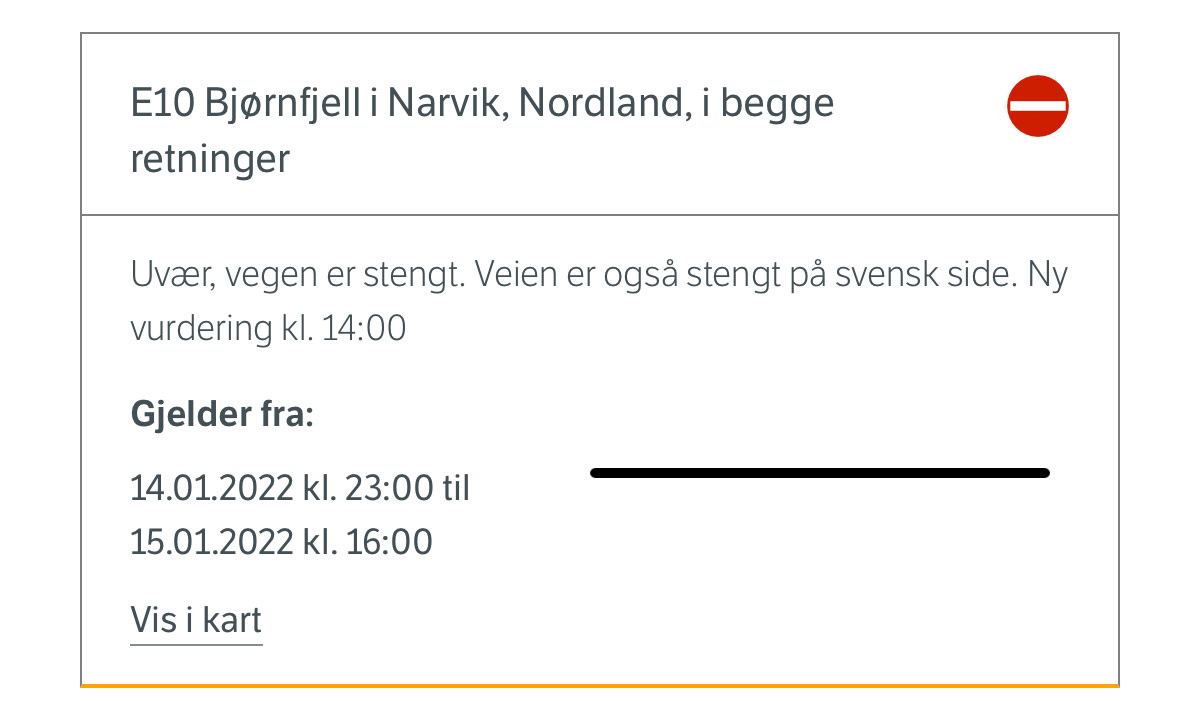
One obstacle is easy: taking a covid test at the test center. The other is much bigger: The road over the Bjørnfjell – the only road – has been closed for many hours due to stow storm conditions. Well, I start my journey anyhow. We’ll see.

At 5:30 in the morning Annika takes me to the train station in Umeå. The first 9½ hours were just a “normal” train journey beside of the train being mostly ahead of time. One change in Boden – nothing special, just long and a bit boring.

I leave the train in Abisko Turiststation where I parked my car. My car – will I find it or is it submerged under a pile of snow? To my relief hardly any snow covers my car. I already hoped so, because Abisko is known for its low precipitation because mountains in the west protect it from bad weather. Much more snow and rain fall on the other side of the mountain range and that’s exactly where I have to go through. Some minutes after leaving Abisko behind it starts snowing. Snowfall increased more and more but isn’t severe and the Swedish mountain road is open. Soon I cross the Norwegian border and …

… have to stop because of a lowered tollgate with a red blinking light. Beside of two trucks I am alone. I am relaxed because I know that the road has been opened for driving in convoy one hour ago (thanks internet!). I just have to wait for the large snowplough to fetch us.

After twenty minutes the tollgate went up and the red light goes out. That’s all that happens. I hesitate. And now? Do I have to wait? Or may I drive? I don’t dare and ask one of the Norwegian truck drivers. He answers I should just go ahead and so I do. The drive is snowy but not bad and soon I arrive at Bjørnfjell brøytestasjonen where the snowploughs are located and now also the Covid19 registration. I register myself, get a covid test and start taking photos while waiting for the result.

I take an image of a snowed in car. The snow plough driver goes to me and asks for what purposes I take photos. “Just for my blog.” “Ah ok, just curious.” Good to talk to him, because so I learn that beside of the mountain passage behind Bjerkvik road conditions are good. Here they got a lot of snow the last 24 hours and one of the cars looks like this:

After round 20 minutes I get a ping ♪. It’s an SMS with a link to my test result. Negative :-). 260 km to go, that’s four hours when conditions were good.

The first 100 km the road conditions are good and weather is ok. The next photo shows how driving looks like.

The next hour it snows a lot. Sight is still good. To my left and right everything is covered with snow, from the largest church to the smallest branch of a tree. Winter wonderland.

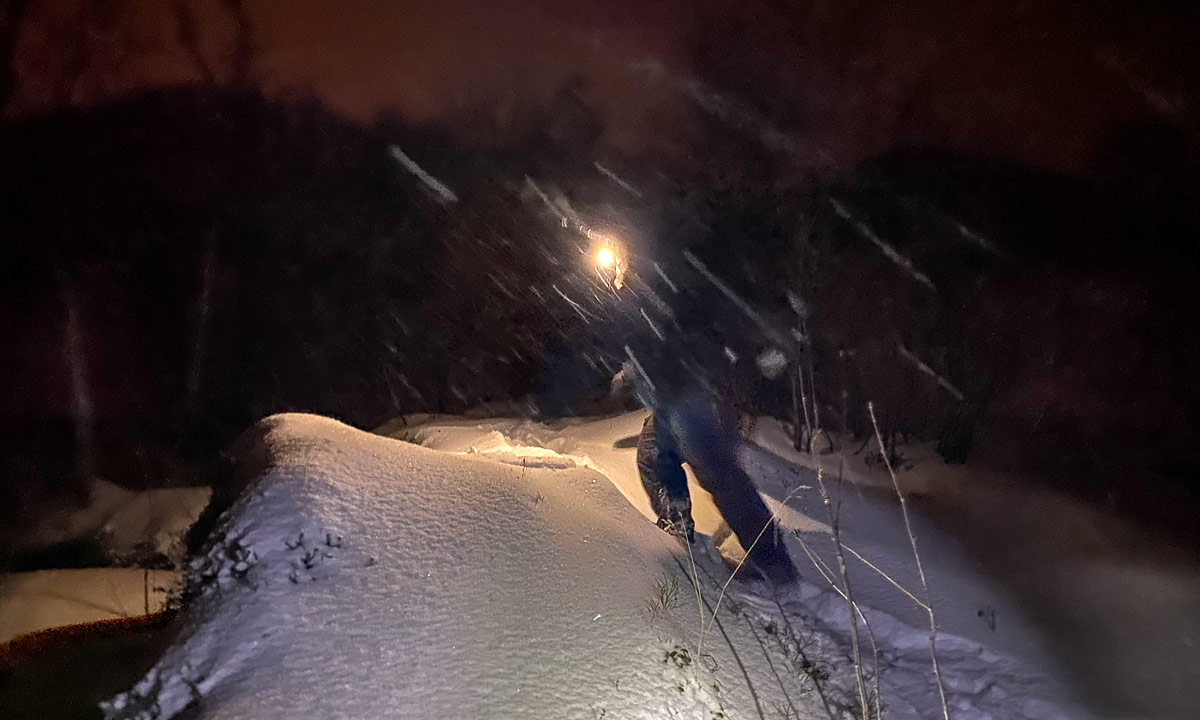
Then it starts to get nasty. Snowfall intensifies more and more and the snow has the consistence of superglue. My windscreen wipers hardly manage to push away the gluey snow and finally I have to turn into a side road and de-ice the wipers. Scratch, scratch … . I’m not alone. In front of me a car with a driver doing the same. Behind me another car stops. Am I in the way? No, just another scratch, scratch. On the other side of the side road another one.

I still have some holes to peek through but it is extremely tiring to drive car through the night like that. Alas, after two hours I drive over the large concrete bridge Tromsøbrua and am on the island Tromsøya. Apparently Tromsø’s snow removal has given up. The minor roads are covered with 20 cm of snow with deep tyre tracks. I understand more and more why most Norwegians have cars with all-wheel drive (and so have I).

22:45. I make a last stop at the supermarket nearby that is open until 23:00. I’m lucky because Norwegian supermarkets close on Sundays. By the way: the supermarket’s parking place is in much better condition than the roads.

One other minute driving and I arrive at my flat in Tromsø after 17½ hours travelling. I’m tired but it takes another hour until I’m relaxed enough to sleep. Next week I’ll walk …

A cabin named Fredly

Let me take you to my favorite place
Just a five hour drive from the city
Just follow the road until it stops
And then keep walking for another forty minutes
Then – out of nowhere – there it is
My cabin!

(Ylvis, “My cabin”)

I was lucky to get the my employer’s cabin for the Christmas week this year. The cabin of the Norwegian Polar Institute lies on a mountain slope by the fjord Kattfjorden. Two days ago Annika and I packed my car with a a lot of food and winter equipment and drove to the cabin, which is 40 km away from where I live in Tromsø. It lies by the road to Sommarøya (the summer island) which is a funny name when you drive through intense snow fall.

We did not have an address, but a small map and a description and so we found the parking place where the cabin supposed to be. And there it was, up on the hill in seemingly pathless terrain.

But under the snow there was a path up the hill and we found it. It took some efforts to bear everything up.

A Norwegian cabin can be everything from a wooden box to a luxury retreat. Our cabin has running water (cold and hot), electricity, underfloor heating, a kitchen, a bathroom with shower, a wood-burning stove, a sauna, internet and more.

We followed the manual and turned the underfloor heating to the maximum, but even after some hours the cabin was as chilly as before. We failed to fire the wood-burning stove because there were only large logs of wood and no axe.

At one o’clock in the night we woke up. Whether it was because of the gusty and stormy wind or of the cold I cannot say. 8 °C in the cabin, the same as hours before.

I put on clothes and went down the hill to look for an axe in the woodshed by the road. I didn’t find one but I found bags with smaller pieces of wood. I hefted one up (exhausting!) and finally was able to make a fire. We were awake for an hour, sitting by the oven, gladly watching the thermometer showing the rising temperature.

Right now it’s icy cold
But in sixteen hours, it’s gonna be hot!

(Ylvis, “My cabin”)

The next day I slept until 10 o’clock. It was still dark and Annika and I took breakfast. One hour later it was bright enough to see the falling snow. We put on our clothes and went to the fjord Kattfjorden, which is less than 100 metres away from the cabin – and 20 metres in altitude.

We looked at the rocky coast and the seaweed covered stones and decided not to winter bath here today. Soon we trudged uphills through the snow back to the cabin and took it easy for the rest of the day. I can say, that the short days in the time of the polar night can be really relaxing.

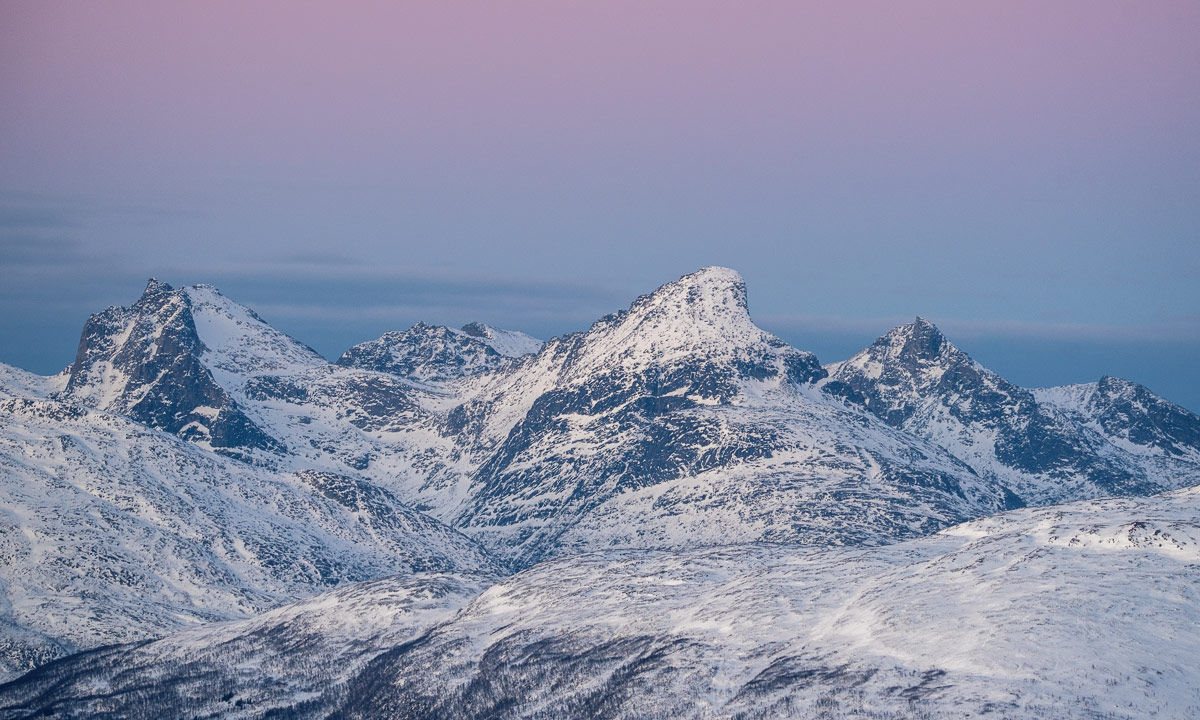
At 13:00 the sky started to clear up and the snowy mountain ranges glowed colourfully. Polar night does not mean that it is pitch black 24 hours a day.

How lucky we are, we who may be here and stay for Christmas. In the cabin named Fredly (peaceful shelter).

Tromsøya crossing in winter

An almost true story to be read out loud with a deep and rough voice.

I survived one of mankind’s largest expeditions of our times – the crossing of the arctic island Tromsøya from south to north! Probably I’m the first one, who dared to face this extraordinary challenge.

The arctic ice breaker could not approach the harsh coastal line of Tromsøya’s southern tip. Too mighty the storm, too sharp the rocky cliffs, too high the enormous waves! I was forced to row the last mile in a wooden dinghy. When I approached land I realised that despite of months of planning I was without food! Would I survive? Well, the tour must start, with or without provisions. One has to go on in live.

The land was wild and it was hard to find the entry point of my expedition. Where is Sydspissen, the Southern tipp? With my extraordinary orientation skills I finally managed to find this unexplored promontory which would be the starting point for my crossing.

I followed the coastal line through a field of invincible rocks. The storm howled and the surge of waves covered everything in spray. I decided to leave the exposed coast and seek shelter in the inland. To my surprise I found some ancient dwellings.

It seemed that this hostile island had been inhabited earlier. What a discovery! I continued my way and realised that I was not alone. People still seemed to live here. While most of the indigenes hid inside some dared to be outside, guarded by their dogs. The houses were shocking. While the people seemed to have some basic skills in woodcraft, they still lacked the knowledge of constructing right angles.

I continued my way through the forbidding terrain. After a while it opened and gave view to an extent of ice. Could it be a lake? Probably it had been frozen for centuries. Here I spotted more locals. As the others before they ignored me. Didn’t they dare to seek contact? I do not know. First I though they would hunt seal or walrus but they just seemed to wander around without any goal.

Soon I was alone again in the rough mountain scape of this arctic island. Orientation was extremely difficult. Without my compass and sextant I probably would have been lost forever in this pathless country. I was completely on my own.

The terrain descended and gave view to a strange installation. Scaffoldings pointing up to the sky were erected randomly on that slope. Was is temples or other places of worship? Who build them? When? And why? Probably one never will find out.

Since I lost my food I was forced to continue my expedition. Time was precious. The land was bleak and barren. No trees, no bushes, nothing. Maybe some moss seeking shelter between the stone could survive under the eternal snow. For other plants this place is too hostile. 

The mountains became even higher and I got view on a small coastal village, probably abandoned ages ago. One wooden house lay nearby but it lacked a door and most of the walls.

I looked for walkable paths that would lead me further north. The more north I came the more glaciers covered the land.

It started to get dark but without food I did not dare to seek shelter. I was forced to go on and on without any rest. Amidst the mountains I spotted two indigenes. They sat on some kind of toboggan well clad in furs to keep them warm in the harsh sub-zero climate. I did not dare to disturb them and only managed to get a blurred photo as a proof of my observations.

According to my positional measurements the northern tipp of Tromsøya could not be far. I had survived until now. Would I make it to Nordspissen, the northern tip?

Alas – after more efforts and privations I managed to reach Nordspissen. I was grateful that fate allowed me to be the first human who reached this remote spot on foot. To my big surprise the legend was true: There is a mystic monument at Tromsøya’s northern tip and I can prove it:

But my efforts were in vain. I was too late! The last ship of the season just had passed by. Now I was forced to live here on this remote and solitary polar island for another year. But that’s daily routine for tough explorers like me.


Fjellheisen and Fløya

Today I was too lazy to hike up a mountain. So I packed warm clothes and camera equipment and the car to the mainland. There I took the cable car Fjellheisen. From the mountain station I walked up the nearest top Fløya. Not a lot of snow there but the temperature of -12 °C (and of course the wind) made it feel quite wintry.

Some photos:

Not reaching the top of the Nordtinden

Today I hiked the last daylight tour this season. Next Saturday sunrise is 11:25 and sunset is 11:38. The following day a seven week period of polar night will begin.

I wanted to hike onto the top of the Nordtinden (640 m), which I assumed to have a lot of snow after last Sunday’s experience. But it turned out different than planned.

Let’s start with a funny selfie:

What’s that? Winter jacket and no snow? Aren’t you overdressed, Olaf? Well, first I was glad about the fur-rimmed hood, because it was quite stormy already in the lowlands and then I wanted to gain 600 metres in altitude. It would be colder and windier on the top of the mountain.

Part 1 – hiking the icy gravel road

At 9 o’clock – round one hour before sunrise – I parked my car in Skulsfjord on the island Kvaløya. There was enough light to start the tour. First I followed a gravel road for 2.4 km. Easy peasy when not the whole road had been covered with ice. I had snow shoes with me for later use, but no spikes for the shoes. Mistake.

Part 2 – following the trail up

After 2.4 km I turned left to follow the hiking trail up to the mountain Nordtinden. Well, mostly I avoided following it because it was very icy and slippery. I considered cancelling the tour but often I could walk on the bouncy patches of heather beside the trail and so continue the tour.

Part 3 – gaining height

A steep passage made me doubt again. Shall I return? Continue? Well, let’s go a tiny bit further, just ten other metres up. I was lucky. Now the terrain was less steep. First only a bit of snow covered the stones and the heather but soon more and more snow covered the ground.

Part 4 – coming to a dead end

I knew that I lost the regular way. The way itself was not visible anymore, but I could see on my interactive map that I was a bit lower than the trail. Maybe I could go up somewhere else.

It was stormy and gusty and the wind tried to blow me down several times. The snow was not fluffy but wind pressed and hard and therefore slippery. When I had to traverse a slope I mounted my snowshoes. It took a while because I had some issues with the bindings. Now it dared to traverse the snow field, but since I didn’t take my walking sticks with me (mistake) it was a bit hard to walk up in the wind and gain balance.

And then I came to a dead end. A quite beautiful dead end, but still a dead end. I had to return.

Part 5 – returning, retrying and finally returning

So I walked back until I finally met the trail again, at least according my iPhone map. The way itself was hidden under the snow. Beside of that Norwegian hiking trails can be marked quite poorly, you have to navigate by yourself.

OK, I can navigate. I even had paper map and compass with me. But where the trail supposed to be there were only snow and rocks. And it was quite steep. And the snowshoes were a bit bitchy. And sun would set at 13 o’clock. Therefore I made the decision to not to try to reach the summit but abandon the tour and return. And so I did.

First I walked on snow but then I had to put off my snowshoes. In the lower part I ignored the icy trail and walked down on the heather. Much easier! Three and a half hours later I arrived at my parked car.

Résumé

It was a pity that I didn’t reach the top, but it was a fine though rough tour anyhow. From next week I have to find alternatives that are doable in twilight and darkness using a head torch.

For the records: 9.6 km, ca. 600 metres in altitude.

A short after work tour of the Sørtinden.

This article is part of the series “2021-07: Back in Tromsø”.

Here I stand on one of the tops of the Sørtinden, where I was ten days ago the first time. Today the view was much better but it was very windy.

Looks like a normal mountain tour round Tromsø like I’ve made the last weeks, doesn’t it?

But it wasn’t. This time I didn’t hike alone. It was the first post-covid tour organised by the Norwegian Polar Institute. It was seven people and two dogs joining the tour. After many months of home office I fully enjoyed doing something together with other people, most of whom I didn’t know. Yes, it’s possible again in Norway. What a relief!

After we had arrived at the top we took a longer rest. While we shared some goodies I learned a lot about prioritising when being on tour. While I use to take my camera equipment with me, others provide things like …

I just can say that warm fried cinnamon rolls are extremely tasty. Another day I learned something valuable.

Dear colleagues, takk for turen – thanks for the tour.

Tromtinden

This article is part of the series “2021-07: Back in Tromsø”.

It wasn’t planned, that I woke up already before 6 o’clock. Anyhow I took the opportunity to get an early start for my 2nd mountain tour of #onceaweek. Todays destination is the Tromtinden in the northwest of the island Kvaløya. The starting point is 50 km away so I had to take the car. It won’t be the last time.

The car ride however is incredible. Now many trees bear autumnal colouring. It is already impressive in the shadow, but then I suddenly drive into the sun and was almost blinded by these colours, to bright and intense they were.

I have to take another photo, that shows the road to Tromvik. It lies in the shadow while the sun illuminates the bald mountain peaks.

Already at 7:20 I start the tour. It’s 2 °C. It seems that most Norwegians prefer to start their hiking tours much later and so I am completely alone. The first part crosses boggy ground. There are some planks leading over wet parts but they are quite slippery because of ground frost.

The way leads up through a sparse birch forest. Now the path is less muddy and starts being dominated by rocks. No wonder – it’s going to be a mountain tour.

On a small plateau I find some cloudberries. There are overripe and have a bland taste, but the frozen one in the shadow is really tasty. Cloudberry sorbet!

On a saddle between the Mellomtinden and Tromtinden the view opens to the northwest and a mountain lake as well as the sea appears.

I follow the ascending path until I stand on a larger plateau. From here I can see the steep northwest face of the Tromtinden and the marking of the summit.

After traversing the plateau the path gets steeper, leads mostly over rocks and I have to stop several times to look where it continues. Do you see the mark on the next image?

After crossing some rock fields and a bit of level I “climbing” I arrive at the summit plateau with its impressive cairn and an even more impressive 360° view.

9:15 – finally time for breakfast. Three cloudberries didn’t fill me up.

I almost spend one hour on the Tromtinden and enjoy being outdoors completely undisturbed.

Finally I start walking down. Slowly and carefully I take my steps on the rock fields but then the path gets easier and easier. When I am halfway down I meet the first other hiker – a woman with a dog. From now on I meet twelve other people (plus three dogs) until I arrive at the car. The sky is blue and it has become so warm, that I only wear a t-shirt.

I arrive at the car at round 11 o’clock. I’m surprised that the car thermometer shows only 7 °C, but the sun has still quite a lot power. Now I’ll head home, only with a detour to the grocery to buy a huge bowl of salad for lunch.

For the stats: 8.3 km, summit altitude 636 m.

A hike to the Stor-Kjølen

This article is part of the series “2021-07: Back in Tromsø”.

Let’s be honest and face it. I’ve been really lazy this year and my outdoor fitness is near non-existent. I don’t like that. There is a simple solution for that: Be more outdoors!

Today I started the project #onceaweek. I want to make an outdoor tour with at least 10 km every week. (Thanks M. for your inspiration.)

I will try to blog about these tours and I want to give each tour some photographical focus. Today’s theme: vegetation zones.

From forest to fjell

The gravel road is quite steep in the beginning. First it leads through birch forests that have started to colorise autumnal. Then the landscape opens and is not dominated by trees anymore.

Gaining height

At the lake I leave the gravel road and the character of the hike starts to get alpine. It’s however still a hiking tour, no climbing needed on the whole tour.

From earth to moon

The vegetation is becoming more and more sparse. Some tufts of grass, a fern, moss, map lichens. And then I pass the first snow field. I look up the mountain I wish to climb. It is just an enormous pile of stones. Fortunately there’s a way round this slope.

The mountain top of the is a plateau of rocks with even less live. It’s almost like being on another planet or moon. And there it is: the space station.

“Oh, the space station looks so cozy inside!” – „Well, that’s not the space station, it’s the varmebua, a small wooden cabin to give shelter to hikers.“

“Um, hikers? On an alien moon?” – “Well, we are on earth and the ‘space station’ is a radar station used for controlling the air traffic of a larger part of Northern Norway.“

I had been almost alone on my way up but on the summit there were many other hikers. Some passed, others took a rest like me.

Looking around

The plateau provided a 360° panoramic view. I could see many mountain chains, the higher tops all snow covered. Anyhow, it’s Tromsø and so fjords and open sea are present as well.

This could be a favourite place of mine in Tromsø’s gorgeous nature. But it is way too early to know this. Remember, it is my first tour of #onceaweek. There will be other places to discover.

For the stats: 16 km, summit altitude: 788 m.

Grense Jakobselv

This article is part of the series “2021-08: Northern Norway”.

This sign marks the only Russian–Norwegian border station. In February 2018 I crossed this border to Russia together with Annika and two friends. This time we stay in Norway and I take just a photo of the sign.

Our destination today (which is 30 August): Grense Jakobselv, a small border village. As the road to Hamningberg the road there is opened only in summertime and we never have been there before.

It starts like a typical car trip. The road goes along the Jarfjorden and a large lake. In Vintervollen the road turns right and we see the barrier that closes the road in winter. It is open. Now the road leads over the mountains. The rocks here are the oldest in Norway with an average age of 2.9 billion years. I’m not a rock expert and so I take a photo of a birch instead of a random rock whose type and age I cannot determine.

We reach the small river Jakobselva. This small and shallow river is special because here it marks the Norwegian–Russian border. The pink salmon (also called humpback salmon) do not care, they are busy to go upstreams and not all fish succeed.

We continue to the village Grense Jakobselv. For me the biggest surprise was the chapel. In my view every northern Norwegian church is made of wood and painted white. Not the King Oscar II Chapel (built 1869) that is made of stone.

While I wasn’t properly prepared about the church I knew something else: There is a sandy beach. It is at the very end of the road. Annika and I take a bath. Water temperature is about 11–12 °C. It feels quite strange to change clothes for a bath while you can hear the Norwegian army practising shooting.

As many minor roads in northern Norway the road to Grense Jakobselv is a dead-end road and so we have to drive the very same road back. After having been back we get something we have missed on the journey so far: an afternoon nap!

Norwegian summer journey I

This article is part of the series “2021-08: Northern Norway”.

Annika and I have two weeks holiday and are travelling through Northern Norway. Our southernmost point: Lofoten, right now we are in Hammerfest.

Ten images looking back:

10 – We are on the high plateau Sennalandet. There are hardly any trees and the road E6 crosses the plateau in a straight line. I can imagine how rough and lonely this place may be in winter.

9 + 8 – The Øksfjordjøkelen is definitely worth the 16 km detour. The parking place and the small path leading through the sparse birch forest grant impressive views on this glacier. When the weather is clear.

7 – It’s grey on our passage from Andenes, Vesterålen to Gryllefjord, Senja. I stand on the top deck of the ferry and wonder how many tourists may have rung this bell and what had happened then.

6 – We just left Andenes by ferry. The razor sharp mountain line of Bleik will soon transform into a whitish grey scheme slowly vanishing in the drizzle.

5 + 4 – It is grey on our short ferry passage from Fiskebøl, Lofoten to Melbu, Vesterålen, too.

3 – One of the typical features of the Norwegian landscapes is the presence of high summits and fjords. Sometimes the mountains are reflected in the water surface of the sea.

2 – Hauklandstranda is one of these incredible beaches on the Lofoten islands with white sand and turquoise water. The sun is shining – time for a bath. Air temperature 11 °C, water 12 °C. Not as cold as expected.

1 – We pass Sildpollnes kapell on the Lofoten twice. Once on our way south and once when heading back again. There’s a parking place by the road where stairs and ways lead up to some hills that present a view over the landscapes around.

0 – On Saturday I leave Tromsø to fetch Annika from Riksgränsen train station in Sweden. It’s still not possible to travel further to Narvik by train. Our destination today: a room in Tjeldsundbrua.