Grense Jakobselv

This article is part of the series “2021-08: Northern Norway”.

This sign marks the only Russian–Norwegian border station. In February 2018 I crossed this border to Russia together with Annika and two friends. This time we stay in Norway and I take just a photo of the sign.

Our destination today (which is 30 August): Grense Jakobselv, a small border village. As the road to Hamningberg the road there is opened only in summertime and we never have been there before.

It starts like a typical car trip. The road goes along the Jarfjorden and a large lake. In Vintervollen the road turns right and we see the barrier that closes the road in winter. It is open. Now the road leads over the mountains. The rocks here are the oldest in Norway with an average age of 2.9 billion years. I’m not a rock expert and so I take a photo of a birch instead of a random rock whose type and age I cannot determine.

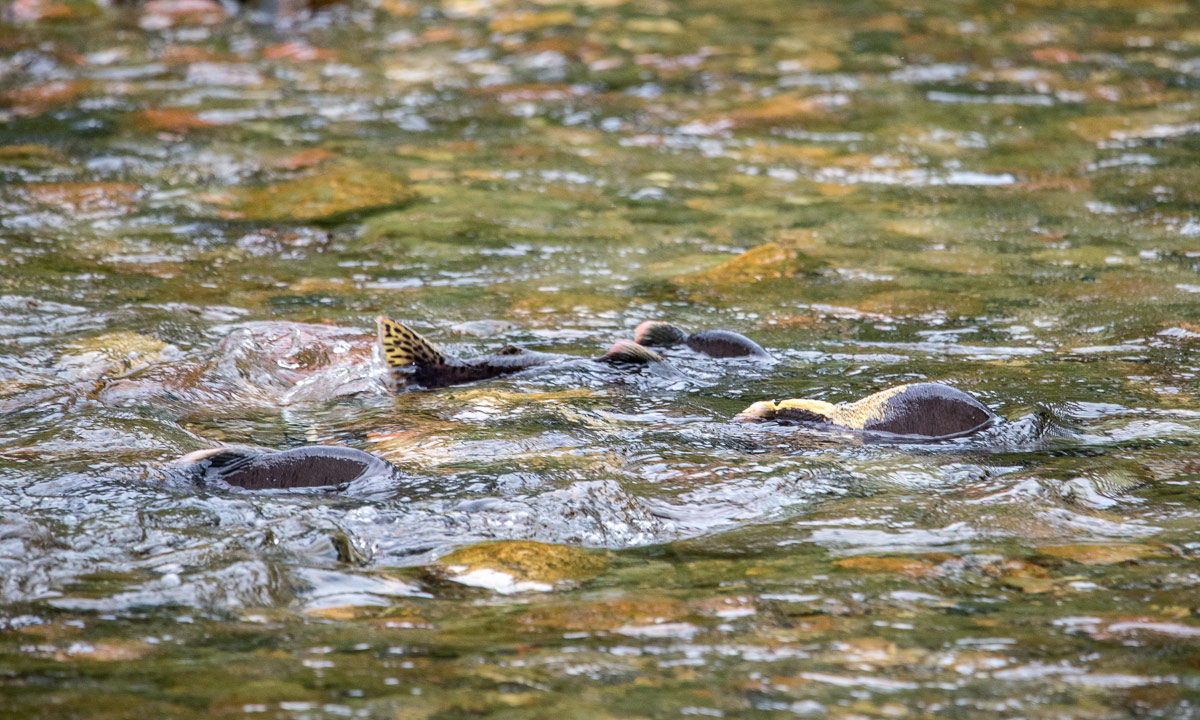
We reach the small river Jakobselva. This small and shallow river is special because here it marks the Norwegian–Russian border. The pink salmon (also called humpback salmon) do not care, they are busy to go upstreams and not all fish succeed.

We continue to the village Grense Jakobselv. For me the biggest surprise was the chapel. In my view every northern Norwegian church is made of wood and painted white. Not the King Oscar II Chapel (built 1869) that is made of stone.

While I wasn’t properly prepared about the church I knew something else: There is a sandy beach. It is at the very end of the road. Annika and I take a bath. Water temperature is about 11–12 °C. It feels quite strange to change clothes for a bath while you can hear the Norwegian army practising shooting.

As many minor roads in northern Norway the road to Grense Jakobselv is a dead-end road and so we have to drive the very same road back. After having been back we get something we have missed on the journey so far: an afternoon nap!

Norwegian summer journey I

This article is part of the series “2021-08: Northern Norway”.

Annika and I have two weeks holiday and are travelling through Northern Norway. Our southernmost point: Lofoten, right now we are in Hammerfest.

Ten images looking back:

10 – We are on the high plateau Sennalandet. There are hardly any trees and the road E6 crosses the plateau in a straight line. I can imagine how rough and lonely this place may be in winter.

9 + 8 – The Øksfjordjøkelen is definitely worth the 16 km detour. The parking place and the small path leading through the sparse birch forest grant impressive views on this glacier. When the weather is clear.

7 – It’s grey on our passage from Andenes, Vesterålen to Gryllefjord, Senja. I stand on the top deck of the ferry and wonder how many tourists may have rung this bell and what had happened then.

6 – We just left Andenes by ferry. The razor sharp mountain line of Bleik will soon transform into a whitish grey scheme slowly vanishing in the drizzle.

5 + 4 – It is grey on our short ferry passage from Fiskebøl, Lofoten to Melbu, Vesterålen, too.

3 – One of the typical features of the Norwegian landscapes is the presence of high summits and fjords. Sometimes the mountains are reflected in the water surface of the sea.

2 – Hauklandstranda is one of these incredible beaches on the Lofoten islands with white sand and turquoise water. The sun is shining – time for a bath. Air temperature 11 °C, water 12 °C. Not as cold as expected.

1 – We pass Sildpollnes kapell on the Lofoten twice. Once on our way south and once when heading back again. There’s a parking place by the road where stairs and ways lead up to some hills that present a view over the landscapes around.

0 – On Saturday I leave Tromsø to fetch Annika from Riksgränsen train station in Sweden. It’s still not possible to travel further to Narvik by train. Our destination today: a room in Tjeldsundbrua.

Black and white weather

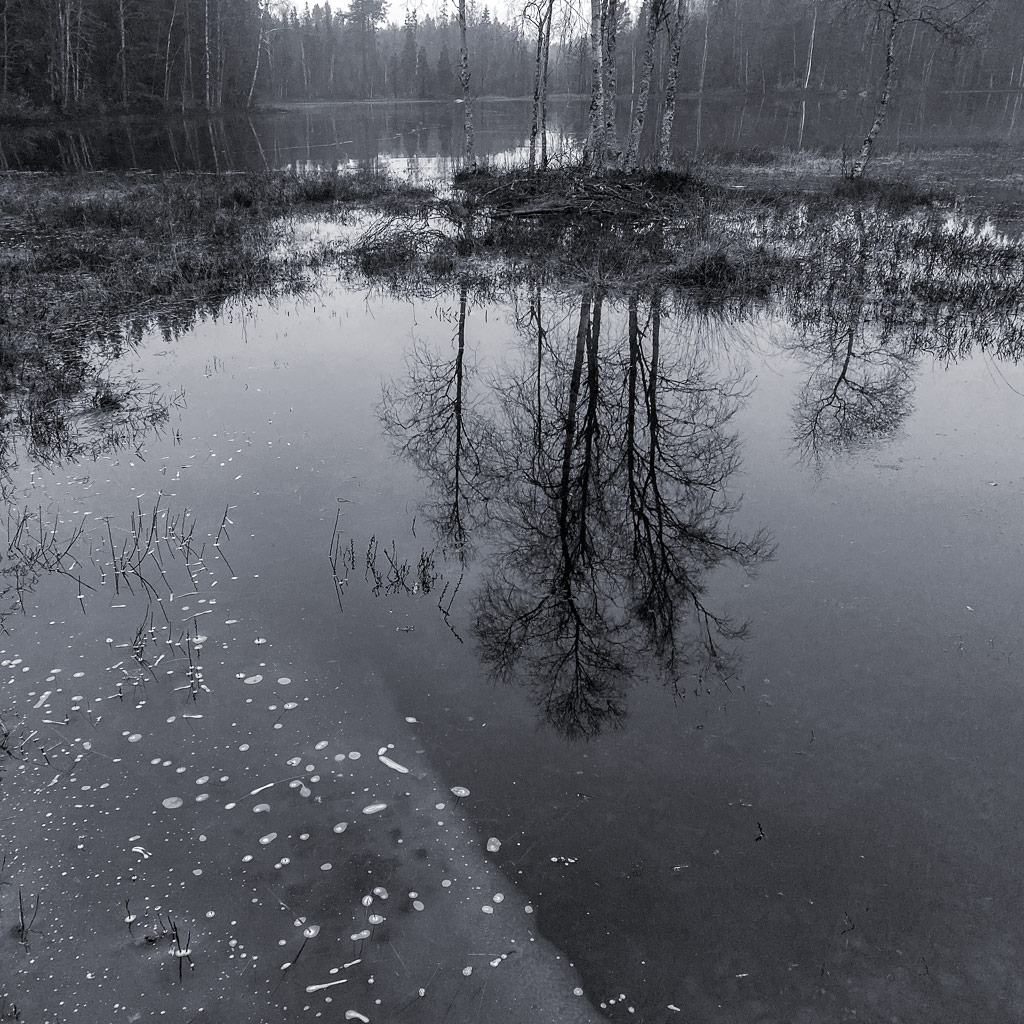
+1 °C, grey and hazy with some rainy showers. I ignore the weather and go out for a longer walk. Time to put a black and white film in the iPhone.

From dawn till dusk

After some cloudy days the sky cleared yesterday afternoon so that Annika and I could do cross-country skiing under the full moon. Beautiful!

This morning was crisp (-17 °C) and sunny. I took a short break from work and skied a bit along the icy coast, just in time to see the sun rise behind the layer of clouds at the horizon.

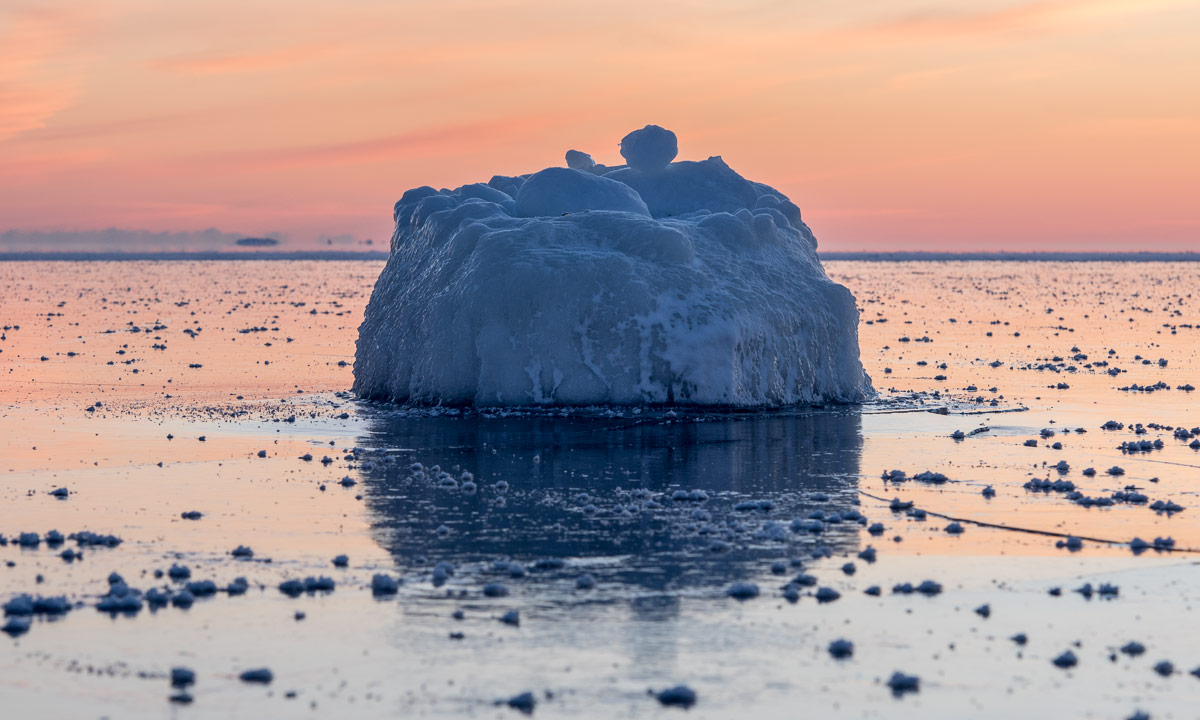
I stopped working already at 14:30 and directly put on the skis again. I managed to follow more or less the icy edge to the bay Vitskärsudden, our favourite bathing place. The sun was going down already and lit the ice in warm sunset colours. The scenery looked really arctic. And it felt arctic, too. I felt quite cold and was glad, that I had a down jacket with me to put over the touring jacket.

It was mostly the forests that revealed the fact, that it’s not the Arctic Ocean but the Baltic Sea that I ski along. And of course the houses, hardly 200 meter away from the icy shore.

When I arrived at Vitskärsudden I realised that – unless another storm would break all the ice – bathing season is finally over. I posted a picture on Facebook in the Umeå winter bathing group and then returned home, still on skis but mostly following the roads.

Even with taking the photos the tour took less than two hours. But it felt like having holiday. It’s really a privilege to be able to live here!


Flying to Tromsø

This article is part of the series “2020-10: New in Tromsø”.

7:58 – Umeå airport. I’m one of the first passengers for the flight SK2023 to Stockholm Arlanda at 9:50. Outside it is dim and foggy but I’m waiting outside anyway to avoid using my face mask that will accompany me the whole day today.

9:43 – Umeå airport. I’m going to the airplane. Of course with face mask. Soon our airplane departs and lifts us above the thick layer of fog and then the clouds. Welcome sun! After we landed in Stockholm Arlanda i realise that it’s as foggy there as home. I have something looking forward to: Japanese food. Then I’ll pass the security control once more. As already in Umeå my camera bag is examined for explosives, this time very thoroughly.

Next stop: Oslo-Gardermoen airport.

Why I’m taking this long and environmentally unfriendly trip by plane? Because the passenger trains from Sweden to the Norwegian Narvik have been cancelled for months. From there I could have taken a bus to Tromsø. Hopefully the train will be opened soon again.

13:46 – arrival in Oslo. And guess what, it’s foggy again. The airbus A320 was almost empty. Only 25 passengers instead of 180. I (and the stewards) have the last 7 rows for me alone.

In Tromsø I first have to show my passport and my employment contract, then I have to go to the baggage claim to get my luggage. It has to go through the custom. While doing that I somehow leave the arrival area where I planned to make a corona test. Since the info desk is closed I have to continue without any test. Maybe I’ll manage to get one tomorrow in Tromsø. This could shorten my quarantine of ten days.

The most visible ad at the airport: Norrøna outdoor equipment featuring a downhill skier. That slope would be hundred times too steep for me but I start longing for snow.

Next (and final) stop: Tromsø. The checkin is in ten minutes.

16:30 – Somewhere above the airport Oslo Gardermoen. Our airplane has started. It is hardly half full. The fog has vanished and I have a view to the autumnal surroundings of the airport.

This landscape looks cosy, a bit like Tolkien’s Hobbiton. An hour later the landscape looks completely different.

Soon the plane starts to sink giving me the probably fastest sunset I’ve ever seen. Hardly more than five minutes later we have landed on the airport Tromsø Langnes where I get a lift of K., my roommate in Tromsø.

Tomorrow I’ll have a day off. The next day I’ll start working at the Norwegian Polarinstitute. Unfortunately from home because I’m in travel quarantine. That’s not the easiest start, but that cannot be changed.

A walk in the bog Torsmyran

Annika googled it, then we visited it shortly last Saturday, yesterday I took the opportunity to visit this bog with more time: The Torsmyran Nature Reserve.

The parking place is right next to the E4, 45 km southwest from Umeå. You open a gate (and close it behind you to keep the moose away from the road). Then you walk to a small forest strip and follow a round 100 metres long wooden ramp leading into the bog. The platform at the end of the ramp is raised so you have a nice view over the 8.3 km² large bog.

That’s it.

As long as you don’t dare to enter the bog by foot. At first the bog looks flat, but if you take a closer look you see that there are slightly higher parts, mostly covered with heather. Even pine trees grow here and the ground is safe to walk. Beside of these parts there are large areas covered with peat moss, a sure sign that you will get wet walking onto. Even with rubber boots! And there are depressions. Some are covered with water, others with brown mud.

Is the mud deep? Well, have a look at the next photo:

You see the bit of a stick sticking in the mud? That’s my walking stick that I use when hiking through bogs. It’s two metres long. Without any effort I could stick it into the mud like that. Anyhow it was possible to avoid such treacherous places in this labyrinth of humps and pools, even though I came quite near to take same pictures.

After a while I come to a line of wooden planks. Old wooden planks. Old, half rotten planks with rusty nails looking out. I decide to follow the path. First it is quite easy, but then the planks go submarine. Since both my camera and I myself are packed waterproof I continue. Although the planks were slippery I succeed without taking a bath.

There is a signpost in the middle of the bog, leading to cities and places in the area. Who needs a signpost at such a remote place? Well, winter is coming and the bog will be frozen and covered with snow. Then the whole area is easily accessible by snowmobile. And that’s what the signpost is for: Helping the snowmobile drivers.

I leave the signpost behind and continue the path. Partly the planks lie directly on the mud. *Crack!*. One of the planks breaks under my right foot but still supports my weight. When I come to another watercourse to cross and see the the planks deeply sunken into the water I decide to turn back. This passage looks quite challenging and for a round trip I would have to cross the watercourse again at another place.

Slowly I walk back to the platform at the end of the ramp. I have to zigzag a lot to avoid open water or muddy patches but I arrive. I’m quite wet and muddy from taking some photos. I however already suspected that and have spare clothes in the car and a canister with water for cleaning. And something even more important: Chocolate and something to drink!

Disclaimer: It’s not the first time that I hiked on boggy ground. It needs some experience to avoid the soft patches and knowing how to free yourself when sinking in mud. That’s why I have a long and stable walking stick with me that could support my weight in case of sinking. Take care!


Wintry weekend in June

Friday, 5. June

At 16:00 I’m at the southern entrance of the University Hospital of Umeå to fetch Annika from work. We go for a weekend tour that we’ve planned for months. We want to drive the vildmarksvägen on the day of it’s opening. Most of this tourist route is open the whole year, but a part is closed more than half the year due to heavy snow.

Today’s destination: the small town Gäddede, where we have hired a tiny cabin on the campsite. The weather is grey but all birch leaves glow intensely. The Swedish weather forecast issued a level 2 warning for high flow but to our astonishment there is very little water in many lakes we pass. We pass even some reindeers, three moose and some black grouses.

Saturday, 6. June

After breakfast we drive along the lakes Kycklingsvattnet, Stor-Jorm and Lill-Jorm. The lakes are open and everything is green. In the distance there are snow covered mountains.

Ten minutes later it looks like this:

What happened? Time travel? No, we are just 200 metres higher than before and although its only 600 metres above sea level the conditions are still wintry here. From now on we travel between the seasons. Sometimes still winter, sometimes already spring. The small brooks and streams carry a lot of water, but most of the lakes are quite empty.

We leave the vildmarksvägen and turn left to pay the Norwegian border a short visit. Of course we are not allowed to cross it due to corona. So we turn our car back to the vildmarksvägen. We travel along some lakes, first partly frozen, then still ice covered until we come to a sudden stop.

A long line of cars, motor cycles and camper vans waits in front of us. They all wait for the opening of the closed passage. We leave our car and walk to the barrier, that will be opened at 12 o’clock.

After half an hour of waiting the barrier opens and the long line of cars starts to move. The next hours there’s a lot of stop-and-go, because people are just stopping and parking anywhere to take pictures making the vildmarksvägen a single file road. But nobody seems to be impatient or even angry, they all have come to see the large snow walls beside the road that tell a lot about last winters snow falls.

Annika and I climb up one of the walls to have a look to an old concrete hut marked with a red cross. We peek inside where we find first aid equipment. Is it still in use? Well, perhaps not, the dressing bandages were fabricated 1957.

And outside: winter landscapes with metre-high snow. We really regret that we have forgot to take our skis with us. Some others are smarter than we and ski through the white. Well,maybe next time …

After driving a bit back and forth we finally take the obligatory snow wall photos.

Sunday, 7. June

After an overnight stay in the rainy Saxnäs we head back home. While there is some old snow left in Saxnäs the Swedish inland is free of snow. As on the trip there some of the lakes have very low water levels. I could stroll there for hours but we want to arrive early home in Obbola und so I only take two shorter strolls to take some pictures.

After some hours of driving, a lunch break in Lycksele and another two hours of driving we arrive home in Obbola in the afternoon. Thank you Annika for a fantastic weekend trip.

A skitour from cabin to cabin – part 3

This article is part of the series “2020-03: Ski tour Jämtland II”.

8 March – Vålåstugan

The weather forecast was right. After a calm and sunny day yesterday it looks very different outside. It is grey and the wind has become stormy and gusty.

All people consider their plans. Among others a group of four decides to remain. They wanted to continue to Helags, round 22 km in the southwest. They would have got the stormy wind straight from the front.

Other skiers plan to return to Vålådalen. It’s Sunday, their last holiday. They ask each other to team up and they exchange phone numbers with Olle, one of the wardens. I do not envy them being out in rough weather with increasing wind speeds with squalls up to 27 m/s in the afternoon. While they equip themselves with balaclavas and ski goggles Annika and I keep inside, peeking through the window that starts to be covered with wet snow.

After all skiers have left Vålåstugan it’s very quiet inside with 10 people remaining. Most of them are on their rooms, only one man seems to love cooking. Until noon he has baked fresh bread, made popcorn and fried pancakes. We are invited to popcorn and get part of the pancake powder so that we can make our own ones. If I’m inside the whole day my interest in eating dramatically increases.

While we spend most of our time reading and being lazy the benches on the sun terrace start to snow in. That’s however nothing compared to the other side of the cabin. A metre high snowdrift has started covering the marked way to the outdoor toilet until Olle relocates the waymarks to a less snowed area. At the same time it has became quite warm, slightly above zero.

In the afternoon the other skiers start to ring. At the end of the day it is clear: All of them reached Vålådalen without any harm. We are quite relieved because we read and heard stories about serious (and even deadly) incidents in the mountains in winter time.

We are equipped with a metal shovel, with warm down bags and bivy bags, but even good equipment is only of limited help when the weather is too severe or there is no snow to dig in.

Tomorrow we want to ski to the mountain cabin Lunndörren. According to the forecast it will be slightly colder, sunny and less windy. Good to know, then we dare to continue our tour.

9 March – Vålåstugan – Lunndörren

The next day the skis in front of the house are wrapped in wet snow, now frozen again. I’m glad that my skis are inside. Yesterday evening I glued the long climbing skins under them because we may have to climb many snow drifts today. The weather is fine and it promises to be a sunny day.

At 8 o’clock we say hejdå to the stugvärdarna – the wardens – Olle and Amie. We shall greet the stugvärdarna at Lunndörren. We put on our backpacks, mount the skis, I put on the belt that is connected with the pulka and then we depart.

The first part is easy to ski and extremely beautiful. At every branch tip of the birch trees small pieces of ice are hanging and sparkling in the sun.

We spot a reindeer. When you see one, there are probably others around, too. And so it is. Five reindeers that carefully look at us. They gather in a small group until we come nearer and they walk away.

The first 4 km the snow is perfect. There’s grip for the skis and even with the climbing skins we can glide effortlessly other the snow.

Then it gets more difficult. The plains are so exposed to the wind that they are almost snow-free. Sometimes there’s a visible path, sometimes we have to ski around.

Then the snow gets so hard and slippery that everything starts to slide and it’s near impossible to break. Yesterday’s warm weather and today’s frost have created an icy crust on top of the snow. Sometimes the pulka runs more beside than behind me. When it goes downhills I take large detours to flatten the slope avoiding becoming too fast. Beside of my problems skiing this snow can look very beautiful, especially against the sun.

Later the snow at the surface is as icy as before but the underlying snow doesn’t bare the weight any longer so that we break through. Several times I am run over by my pulka while my skis are stuck. My left wrist still hurts a bit from one fall, one of the less nice memories of this fantastic ski tour.

At last it was snowmobiles that have improved the situation for us. The tracks they have left have broken the icy crust and here we can ski quite well even though I have to unmount the skis for some of the steeper parts. We want to arrive anyway. It’s Annika, who spots the flag of the STF, the Swedish Tourist Association. And there it is: The mountain cabin Lunndörren!

Here Jonas, Arne and I seeked shelter from the storm 17 days ago.  Now we are first welcomed by the friendly cabins in the sunshine and then the friendly wardens.

Lunndörren has a highlight we have been looking to for days: A sauna! Already at 17:00 Annika and will sit there enjoying the heat. But before taking a sauna we take another opportunity. Former guests asked for permission to cut a hole into the ice of the small lake by the sauna some days before. Therefore Lunndörren has an ice hole this season. Of course we have to take an ice bath before the sauna. (Taking it after sauna is considered cheating by winter bathers.)

If you ever want to take pictures of a person making faces: Throw her or him into icy water. Four examples (Photos: Annika Kramer):

After 95 °C in the sauna we took a shower. No, not a normal shower with shower head and and chrome valve, just a bucket full of hot water. But it’s enough to wash your hair and yourself. We feel so fresh again afterwards!

Later that evening I stroll around in the full moon. This will be the last night of the ski tour. Tomorrow we will ski back to Vålådalen, where I parked my car only seven days ago.

10 March – Lunndörren – Vålådalen

It’s always a bit strange, the last tour day. Car keys get more important than the pocket knife and mobile internet becomes normal again. Fortunately it’s much easier to ski today than the day before and comfortably we follow the red crosses marking the winter path. After a while we see the first cross country ski-runs and more people around. At the end we have to navigate, because there are so many possible ways. I decide to take the bridge over the river Vålån, the very same bridge I used on the other ski tour three and a half weeks ago. And almost suddenly we are standing on the parking place next to my car. We unmount the skis, load the skis and pulka into the roof box and fill the car with leftover food, sleeping bags, snow shovel and other equipment. And since we were quite fast today we even make it to lunch.

Tack för turen, Annika. Thanks for the tour. Where do we ski next winter?


A skitour from cabin to cabin – part 2

This article is part of the series “2020-03: Ski tour Jämtland II”.

6 March – Gåsen – Vålåstugan

What a beautiful morning: blue sky, -8 °C, hardly any wind. I take my tripod and make some photos of the mountains around us.

After two cozy days at Gåsen Annika and I are eager to continue our ski tour and already at 8:15 we say farewell. Next stop: Vålåstugan, 16 km away.

The first kilometre the way leads up. The snow is grippy and soon we are on the top of the saddle. Cirrus cloud have risen and there’s a halo with sun dogs around the sun. We look back and spot Gåsen in the distance. Just some dark spots in an apparently endless expanse of snow, but there you get all you need, from shelter to food.

One and a half hour later we see the emergency hut Härjångsdalen. At the same time a helicopter is coming from north. It lowers fast, turns a lap and then lands directly by the hut. Shortly after we arrive, too. Two people climb out of the helicopter. They inspect the emergency phone in the hut. I would love to have a job that includes flying helicopters to see the mountains from above.

We continue our trip through the kalfjäll – the bare mountains above the timberline.

Slowly we descend and the first birch trees come into view. We take a break on a small hill where the wind has blown away the snow. Normally this could be a rather bad place to rest, because it is exposed to the wind from all directions but today it’s calm and sunny. Soon after the break I take off the jacket and ski without. The woollen shirt is warm enough in the sun.

At 13:50 we arrive at Vålådalen. We are the first guests today. A lot of people are expected today, among others a group of fourteen, guided by the Swedish Tourist Association STF. We have the choice, where to stay and choose room 1 in the new cabin, where we’ll share the 4-bed-room with the two STF tour guides.

Gradually other skiers come, from single skiers to larger groups. Some have pulkas, most only backpacks. Some stay in the old cabin, most in the larger new one. Here the kitchen is quite large and all people find place.

7 March – Vålåstugan

Another beautiful morning. -10 °C.

As we did in Gåsen we do not continue to the next cabin but stay here for a day. Today we are lucky, because the weather is so beautiful. We do a small ski tour to the other side of the valley. It’s always fun to ski without a heavy backpack or pulka. And on the slope leading up to the mountain Gruvsmällen we even have mobile internet. I use the opportunity to check the weather for tomorrow. Oops, that doesn’t look promising.

On the way back we pass the water source. It is protected by a wooden hut which lies deeply under the snow. A stair leading down to the hut is cut into the snow. I wonder how the stugvärdarna – the wardens – knew where to start digging, then I spot an orange plastic bar. Maybe that bar marks the entrance to the hut. Inside you can see, that the hut is built directly over a small stream. Here you can refill the water buckets from the kitchens.

And water we need. Already before our ski tour Annika has started to water the dried food: potatoes, onions, vegetables, feta cheese. In the evening we wait until the larger groups have completed cooking. Then Annika starts to make another frittata. Ingredients: the dried food mentioned above, butter, egg powder, milk powder, salt, herbs and spices. And again it tastes great.

Olle, one of the wardens comes with a weather update. That’s important for the guest of Gåsen because here is no mobile reception. He confirms what I already know: Tomorrow it will snow and be very windy with average wind round 19 m/s.

People start discussing: shall they continue to the next destination tomorrow or stay at the cabin? We decide to stay another day and get a thumbs up from Olle. Others plan to ski back to Vålådalen tomorrow. Tomorrow it’s Sunday and many have to work again on Monday.

Continue with part 3 >