Over the kalfjell to Berlevåg

This article is part of the series “2018-03: Varanger peninsula”.

Day 38 of my winter journey 2018

The Varanger Peninsula has many inhabited places at the coast, but you cannot take the car and drive around the whole island, not even in summer. There are three roads:

  • The E 75 to Vardø via Vadsø. In summer you can continue to Hamningberg, but this place has been depopulated since 1964 though some houses are used as summer cottages.
  • The 890 to Berlevåg via Kongsfjord. In summer you can continue to Store Molvik, but there are only summer cottages.
  • The 890 and 891 to Båtsfjord.

We explored the towns connected by the E 75 so far. Yesterday however we left the Varanger Peninsula, visited the Sea Sami Collections in Byluft and spent the night in Seida near Tana. Today we continued our trip and entered the Varanger Peninsula again, this time using the 890 to Berlevåg.

A local in Ekkerøy had warned us about this road, which leads about the kalfjell – the bare mountains above the treeline. The weather conditions can be severe and the road can be closed anytime due to bad weather or only accessible by kolonnekjøring, which means that you drive in a guided convoy led by a snowplough. Mostly it’s not snow that is the problem, but strong winds, that can create impassable snowdrifts within minutes.

The weather today however was fine and we didn’t have any difficulties in crossing the kalfjell. The road is really exposed to the elements and I can imagine that the very same road will be completely impassable in stormy conditions.

There is however another possibility to travel from one place to another: using the Hurtigruten ships, that connect Berlevåg, Båtsfjord, Vardø and Vadsø on their way from Bergen to Kirkenes.

Eight times Ytre Kiberg and around

This article is part of the series “2018-03: Varanger peninsula”.

Day 31 and 32 of my winter journey 2018

1. Yesterday, Ytre Kiberg – the morning

Two days ago two other guests arrived at Cape East Arctic Adventure, our cozy stay in Ytre Kiberg. They came from Utrecht in the Netherlands and were on a three week car trip from Utrecht to the North Cape and back – 8500 kilometres in total!

Trond, our fantastic host made a special breakfast for them: King crabs, locally caught in the Barents Sea. Annika and I got our share, too. King crabs are probably my favourite seafood but it was the first time I got such for breakfast.

After breakfast Trond had some work to do: clearing the snow with his rotary snow plough. Last days had been very windy with some short but intense snow showers. The snowploughs had to work a lot to keep the roads clear of snow and Trond had to clear the snow on his property several times a day. This morning the snow drifts were especially high and Trond had to work hard to get through with his snowblower.

2. Yesterday, Vardø – a private guide tour by Trond

After the driveway was cleared, Trond invited the Dutch guests and us to a short private guided tour in Vardø. We entered his all-wheel drive car and he drove us the short way to Vardø – a town with 2100 inhabitants located on an island – where he showed us some of his favourite places. There is a lot of street art in Vardø and next time I have to take a closer look to all the graffiti and more conceptual artworks. But you cannot do all in a single journey.

There’s a mountain pass between Vardø and Ytre Kiberg called Domen. It’s quite exposed to the elements and when we crossed it waves of driving slow covered the road.

3. Yesterday, Skallelv – a short visit

Soon after we arrived in Kiberg, the Dutch guests left and Annika and I made a car ride to Skallelv, 30 km south of Ytre Kiberg. The weather was really nice: sunny and hardly any wind. We went round a bit and I made some photos. I had however problems with some lenses, they got moisture inside that tends to freeze when being outside. Hopefully they will dry within the next days.

4. Yesterday, Vardø – the Vardøhus Fortress

After a rest we took a tour to Vardø again, this time we wanted to focus on two local attractions: The fortress and the witch memorial.

The Vardøhus Fortress (Vardøhus festning) was built round 1300 and is the northernmost fortress of the world. Beside of being a museum it is used today as a school for the Norwegian marine. Shortly after we arrived there, the Trollfjord, a Hurtigruten ship landed in Vardø and shortly after many tourist rushed through the fortress. In contrary to us they only had litte time.

5. Yesterday, Vardø – Steilneset Memorial

After visiting the fortress we went on to visit the witch memorial. It’s not easy to reach. First of all you have to know that it is called Steilneset Memorial (or find it visually), then you have to plunge through deep snow, because there are no cleared ways to the memorial.

In 1621 91 people, mostly women and Sami people had been executed for witchcraft. This memorial, created in 2011, shows the history of all 91 people and lists the confessions made. It is a shocking and touching place about the cruelty of mankind and worth to visit, if you are in Vardø and have the time.

After this long and eventful day we were quite exhausted and decided to take it a bit more easy the next day.

6. Today, Ytre Kiberg – a promenade in Ytre Kiberg

Today morning it was quite warm (-4 °C) and almost windless. 10 cm of new snow had been fallen over night. After breakfast we took a medium short promenade along the beach and into the village and back. The weather was changeable as it uses to be here. It could change from sun to snow within less than a minute.

Snow fall intensified and it became a bit windier, too.

7. Today, Ytre Kiberg – a private tour though the partisan museum

At 15:30 we had an appointment: we were invited to visit the Partisanmuseet – the partisan museum in Ytre Kiberg. We would get a personal guided tour from Steinar Borch Jensen – expert for the history of Kiberg and around – who would open the museum for us.

Trond took a huge spade, we entered the car, drove the short way to the museum, plunged through the snow to the entrance, where Steinar already had started to clear the outer stairs. Trond joined him shovelling.

The museum is not the biggest and the showpieces maybe not the most special, it’s the stories behind the showpieces that matter. Steinar had a lot to tell about the partisans in Northern Norway that fought on the Soviets side against the National Socialists in World War II. Beside of Steinar’s huge knowledge about that time there was another facet, that made our visit in the museum very special. Both Trond and Steinar have personal relations to the partisans. They know their relatives and they know the places where they lived. For many Norwegians the history of WWII is not just an academic interest but personal history. Soon the last witnesses of the past will be gone.

I felt very touched by the visit and was glad that we got the opportunity to get involved into the local history, but it made me thoughtful, too and reinforced my personal pacifistic worldview.

8 .Today, Ytre Kiberg – the first Varanger polar lights

Actually I planned only seven stories in this long blog article, but well …

I was out after a great two course dinner: reindeer (provided by Trond), pancakes (provided by Annika) and me doing the dishes. I wanted to make a photo of Cape East Arctic Adventure, Trond’s house, where Annika and I had such a good time. Then I spotted faint polar lights. I wore only a t-shirt and got in to fetch my Canada Goose parka. I was outside quite a while since the polar lights gradually became stronger. They constantly changed place making it hard to take any good pictures. It was -10 °C, quite windy and more and more I closed the zipper of the parka to prevent freezing. After a while the aurora weakened and I went in to look at the photos. I’m not content with the image above, but it’s a nice remembrance of our fantastic stay at Cape East Arctic Adventure in Ytre Kiberg.

Tomorrow we will leave and stay in Ekkerøy for some days.

Tusen takk, Trond, for your kindness and your great hospitality!

A tour to the easternmost point of mainland Norway

This article is part of the series “2018-03: Varanger peninsula”.

Day 29 and 30 of my winter journey 2018

Yesterday we continued our journey to Ytre Kiberg which is 13 south of Vardø, one of the Hurtigruten stops. We started in Vadsø – another Hurtigruten stop – after a breakfast with our host Nils, bought a basis of food for the next days and took the E75 northwards. We made a stopover in Ekkerøy, a village on a peninsula near Vadsø. We like this place and will try to stay there for some nights next week.

At lunchtime we reached Cape East Arctic Adventure, our stay for four nights. We were welcomed by Trond, the owner and operator of Cape East Arctic Adventure and were shown our cozy bedroom, the kitchen and the homely living room. After making ourselves at home we went along the beach to the village and the harbour.

In the evening we were invited to a three course dinner based on freshly caught cod: Fish soup – cod with potatoes and carrots and finally cod roe. Everything was extremely tasty and it was Annika’s and my first time where we tasted cod roe. Yummy!

In Kiberg you are as east as you can be in the Central European Timezone, therefore sun is rising already at 6:24. I was awake very early and took a morning walk round 6 o’clock. Some snow drifts had been created by snow and wind over night but now the weather was less windy and quite sunny. At least for a short time. While I went the way to Indre Kiberg clouds approached, wind increased and it started to snow. It was hardly imaginable that it was sunny just a short time before. Weather changes here quite often as Annika and I should find out later.

After breakfast Annika and I took the car to the other side of the village, put on our snow shoes and started a hike to Kibergsneset, easternmost point of mainland Norway. This place is more east than e.g. St. Petersburg, Kairo or Istanbul! It was windy but quite sunny, when we started our tour but weather changes fast on the Varanger Peninsula:

Actually this hike is just a promenade but the weather may transform it into a small expedition. We were exposed to wind and snow and grateful, that we didn’t experienced a full storm. The weather was rough anyway and I was glad about my windproof jacket and two pairs of mittens.

We continued on a small hiking trail, first with, then without snowshoes because the thin snow layer was hardened by the wind and easy to walk onto. There’s a coastal fortress build by Germans in WW2 on Kibergsneset but we couldn’t see it in the snow weather. Instead of looking for it we continued to the small lighthouse at Kibergsneset that marks the easternmost point of mainland Norway (and most of Europe). Shortly before we reached it the sun came out and we continued the last metres in full sun. While I made some photos a small snow shower approached with the sun still shining.

From the lighthouse there was an amazing view over the arctic coast of the Barents Sea, but only for some moments. Soon the next snow shower came by and hid most of the view onto both the coast and the sea.

The way back was much shorter because we knew the way and went downwards. Even though the view was limited by the snow showers Ytre Kiberg came into view again soon and surprisingly the weather was nice and sunny again.

After this very windy promenade we were glad to find shelter in my car. We took the car to Vardø to eat something and after that we tried the road to Hamningberg. We knew that the road was closed in winter but we curious how long we would come.

Well, not very long. We managed to get to Smelror, some kilometres north from Vardø.

The main road however was definitely closed as you can see. There are no people living in Hamningberg permanently and the only motorised way to reach it in wintertime is by snowmobile. For car it is open less than half the year.

We took the car back to Kiberg, enjoyed the incredible and unbelievable colours of the sky and were surprised by a strange weather phenomenon: -6 °C and rain (including a faint rainbow!)

The rest of the day? -10 °C and wind outside, no more photos, no more excursions.

Fun fact: We took the E75 northwards. If you would take it southwards you could travel more than 4000 km and finally would arrive on Crete, Greece.

A trip to Murmansk – trip home

This article is part of the series “2018-02: A trip to Murmansk”.

Day 24 of my winter journey 2018

After two days of visiting Murmansk we were prepared for our trip back. The bus arrived shortly after 7 o’clock local time (5 o’clock CET) and we started our trip home.

We left town and crossed the Kola Bay. It was still dark.

Then I fell asleep. I woke up shortly before our rest at the small shop, that seems to be located in the middle of nowhere.

Meanwhile it was as bright as day. We followed the E105 that would bring us first to the Russian-Norwegian border and then back to Kirkenes. Some images taken from the bus:

Finally we came to the border. We had to leave the bus with all our luggage. I bought huge winter rubber boots in Murmansk and some books and was curious what I would have to do at the customs, but since I stood in the queue “nothing to declare” no one cared.

Next station: showing the passports. Chris, Ørjan and Annika had already went through, now it was my turn. I gave the passport to the border official, trying not to smile – no one seems to smile when communicating to strangers. The man looked at my passport for several minutes, typed things into the computer, looked at the passport again, stood up and left. He came back with a woman discussing something in Russian. The woman left again, the man continued working. Again he left, again he came back with the woman. I didn’t understand a single word and started wondering what the problem could be, I guess it was computer problems. It took round 15 minutes until I got my passport back with some Russian words, probably an apology or an explanation about what went wrong.

I climbed into the bus and we were driven to the Norwegian customs. What a difference! The handling was not only much faster, but much more friendly. The Norwegian border officials smiled, made some friendly small talk and hardly a minute later we were through the customs and again in the Schengen Area where you can move between countries without needing a visa.

Some very brief observations from Murmansk:

  • The difference between poor and rich, cared and ruined is quite visible
  • People won’t smile at you, especially the officials and salespersons
  • The food in the restaurants we visited was extraordinary good
  • Many people don’t speak any English. Exceptions found in our hotels and restaurants
  • I felt like 4 year old when I tried to decipher the Cyrillic letters.
  • I didn’t feel welcome every second, but safe all the time

Travelling to Murmansk was a very interesting experience and I would love to see more of Russia. Next time I would like to use internet services as e.g. couchsurfing to get into contact with the locals. I guess I would get another view of Russia.


A trip to Murmansk – day two

This article is part of the series “2018-02: A trip to Murmansk”.

Day 23 of my winter journey 2018

When we came home from our dinner last night it started to get quite foggy und it became colder. The fog intensified and the city started to smell smoggy.

This morning however was clear and some millimetres of snow dust had fallen over night making everything looking white and fresh. It was much colder than the day before (Murmansk airport reported -29 °C) but the hotel doesn’t have a thermometer so I don’t know how cold it was in town.

After breakfast we went through the Park Zhertv Interventsii (Парк Жертв Интервенции), a small park directly at the hotel.

Then we continued through the streets and across the railway to the port.

We wanted to visit the atomic icebreaker Lenin (Ленин) and check if we already could buy tickets. Lenin was the world’s first nuclear-powered surface ship and launched in 1957. She was decommissioned 1989 and subsequently converted into a museum.

Two big ships lay at the pier: Lenin and Vladivostok (Владивосток). Parts of the water surface were covered with ice but most of the water was open and steaming in the cold. The other side of the Kola Bay was hardly visible in the fog although only one kilometre away. The small ice particles in the air made the air feel quite cold.

A man left the icebreaker to meet a french couple at the pier, that had booked a tour. Unfortunately we couldn’t follow with them since this tour was privately booked. The man could speak a bit of German and we learned that the outside temperature was round -22 °C and that we had to wait for the first public tour at 12 o’clock.

So we went back to town, this time crossing the railway by a pedestrian bridge. Large chains of good wagons, some empty, some filled with charcoal were seen on almost all tracks.

While Chris and Ørjan went their own ways Annika and I went to the center to find a book shop. We knew that we had to follow the Lenin Alley (Проспект Ленина) and we found several book stores where I among others bought a pictured children dictionary English—Russian.

We continued the alley and finally came to Murmansk Mall (Мурманск Молл), a large shopping mall. Here both local stores and many international shops as e.g. H&M were found. The mall was extremely tidy and a huge contrast to the many rundown concrete buildings.

We’ve been in another mall the day before where you mostly could find Russian fashion for women. And that means mostly fur coats, partly in very fancy colours, high heeled boots and a lot of accessories in pink, silver and glitter. Some of them looked like plastic toys made for four-year-old girls, but in adult sizes. A fashion quite different from the informal one in Germany or Sweden.

I was really irritated when I entered some shops. People in Murmansk don’t smile or even laugh in public unless they know each other quite well. When you enter a shop the salesperson will stand up and observe you and even follow you through the shop. They won’t take contact with you, they won’t smile but will instead look stonily at you. I felt treated completely unwelcome and more like a thief than a customer. Strange and irritating!

Annika and I went back to the hotel and passed a Lenin figure and a house painted in bright turquoise, a colour that seems to be quite popular in Murmansk, as some other houses were painted the same.

We met Chris and Ørjan at the hotel and continued to the port together. Although it had become warmer it was still quite cold and some of the water that was open in the morning had frozen over in the last hours.

We arrived at the port at half past eleven and were the first one’s for the guided tour through the icebreaker Lenin. Shortly before twelve Annika and I could go aboard but most other tourist pushed to the front so that Chris and Ørjan were left behind. Later we realised that they attended another tour just some minutes later.

The following hour was one of the most boring experiences for long and made me remember some of the dullest school lessons. We were guided in a crowd of people by a Russian guide that loved to speak in a monotonic language without a split second of resting. Since he was so eager to talk another group behind us fenced us in so that we could hardly move and we were really glad to be able to sneak from the icebreaker before the guided tour was over. I guess, that most tourists are Russians too and so are able to understand the guide but even then I consider this kind of guiding as extremely boring and almost narcotic. My personal advise: Look at the boat from the pier but avoid the tour.

Some pictures from the inside anyway.

After this experience we needed fresh air and a café. We went to the Café Yunost (Кафе Юность), took some sweet cakes and after that we returned to the hotel to rest for a while.

In the evening we went to Terrasa (Терраса), another restaurant, though not to the White Rabbit (Белый кролик), our preferred choice. First it was Friday and then it was a holiday: Defence of the Fatherland Day. Therefore many restaurants had been fully booked. We enjoyed the food, went home to the hotel to take a short drink. Then we went to bed early. Next morning the alarm clock would ring at 6:15 local time, that’s 4:15 Swedish time.

When being in the hotel I took pictures from above. Here you could spot almost all places and attractions we visited the last two days, among others Alyosha, the Church of the Savior on Waters and the icebreaker Lenin. A good summary of the last two days.

A trip to Murmansk – day one

This article is part of the series “2018-02: A trip to Murmansk”.

Day 22 of my winter journey 2018

tl;dr Alyosha monument · old concrete buildings · Church of the Savior on Waters · view over Murmansk · restaurant Tundra · nocturnal Murmansk

Alyosha (Алёша)When we arrived in Murmansk the day before it was already dark and we were tired. Today after breakfast we were eager to explore. We ordered a taxi to our first tourist attraction: The Alyosha Monument.

“Defenders of the Soviet Arctic during the Great Patriotic War” (Защитникам Советского Заполярья в годы Великой Отечественной войны), commonly called Alyosha (Алёша) is a monument to Soviet soldiers, sailors, and airmen of WW2.

It was build in 1974 and it’s the second-tallest statue in Russia. The 70th aesthetics and the communistic concrete appeal didn’t help to make me like this statue, but I always have difficulties with war memorials. I’m a pacifist.

I enjoyed however the view over Murmansk. It was visible, that it’s a large town (it has 300,000 inhabitants) with a large port and many concrete high-rise buildings.

After we visited Alyosha we started to walk back into the center of Murmansk, where our hotel Azimut was located. We turned right into the street Ulitsa Aleksandrova. To the left there were old concrete buildings. They were extremely rundown and I was shocked to see these building and imagine people living here. Maybe the inside would look nicer, but the outside was horrifying.

In many directions you could see these high-rise estates with rectangular concrete buildings. But we could see something else: a Ferris wheel. We went on and came to a permanent amusement park, located beside the lake Semyonovskoye (Семеновское озеро). Of course the lake is covered with ice and snow in wintertime and some locals used the ski tracks going round the lake.

From that place the next destination was quite near: the Church of the Savior on Waters (Спас на Водах), a small Russian orthodox church, built 2002.

When we came to the church I could see some people leaving, going backwards and making the sign of the cross again and again. It is allowed to enter the small church but not to take pictures. I’ve never been in an orthodox church before and I was stunned. The walls were covered with icons of saints and incense was burned. Some elderly women were lighting candles and immersed into deep prayers and almost seeking physical contact to the icons and other objects. I felt deeply touched by this lived religiosity although I’m not religious by myself. On a table some food was placed. Bread and fruit, among others a bag with three lemons. Sacrifices or donations to the priests?

I have to admit that I felt like an intruder and completely at the wrong place. I have to read more about this religion and a bit about how to behave.

We continued our promenade back and passed the Memorial Complex to the Soldiers and Seamen Who Died in Peaceful Time.

We left the memorial behind and entered the streets of the center. We walked back to our hotel and took a short rest. We passed an old theatre, painted in bright indigo but more a ruin than a building. A pity, I think it must have been beautiful in former times.

Then the hotel. I had twisted my ankle one week ago and was glad to rest the foot a bit. Time for shooting some photos from the 16th floor.

Some hours later. We decided to eat dinner and Annika and I found the restaurant Tundra (Тундра) that got excellent reviews in the internet. And excellent it was. The restaurant was fully booked but we were allowed to sit in the bar. In Russia the food is quite cheap compared to Scandinavia even in really good restaurants. The dishes are not as huge as in many places in Europe. I like that because it gave me the opportunity to taste different things: borscht and caviar with seaweed. Both very tasty!

After a nice evening at this great location with fantastic food we went back to the hotel. Murmansk is definitely not the most beautiful town in daylight but it wins a lot when it gets dark because many places, streets, parks and buildings are illuminated with lights of all colours.

We have seen a lot that day, both the beautiful and less beautiful facets of this arctic Russian town and I was as exhausted as I use to be when strolling through a big town for a whole day.

We were glad however to have another day to explore a bit more.

Some other random pictures of the day:

A trip to Murmansk – prelude

This article is part of the series “2018-02: A trip to Murmansk”.

Day 21 of my winter journey 2018

I think, I know northern Europe quite well, especially when it comes to Sweden and Norway. There are many gaps to fill as for example Iceland, the Faroe Islands or Greenland, but thats all island only reachable by plane or by ship.

There is however a huge arctic area that is reachable by land, although with minor difficulties. I’m talking about Russia.

The journey started two months ago with an idea. When Annika and I planned to visit Chris and Ørjan in Kirkenes, why shouldn’t we cross the Norwegian-Russian border and visit Murmansk, the world largest town north from the polar circle. Chris and Ørjan were as interested as us, so that we were four people on that short trip to Russia.

Unlike the other countries we use to visit we would need a valid visa to cross the border and travel to Russia. Even though we used the help of a travel agency in Kirkenes that helped us with the visa application it took some efforts until the visa were ready.

Two month later – or four days ago – we started our journey. At 2 o’clock we entered a small bus in Kirkenes and drove to the border, which is only 15 km away. First stop: the Norwegian side. We showed our passports and entered the small bus again. Next stop: the Russian border. Here things started to take more time.

We had to fill out a form in two copies, that was as small as the passport. Therefore some lines were so tiny that the letters hardly were three millimetres high. Even with instructions it took much concentration to fill out these forms and since we only had one ball pen it took a long time till we were ready with the form completion. After that we had to show our passports and the forms to the frontier guard. Motto: don’t smile! That took time, too, but after this accurate border check we were ready to enter the bus again.

I’ve never been in Russia before and I was really curious to see this country that is near in geography but remote in my mind. The first part of the bus tour however didn’t reveal anything new. Mostly we could see snow, hills and birch trees – the very same landscape as on the other side of the border. Even the street signs seemed to be alike beside of some Cyrillic letters.

But when we came to towns like Zapolyarny (Заполя́рный) or Pechenga (Печенга) it was quite visible that we had left Scandinavia. No wooden houses painted in red and other colours were visible, but large rectangular concrete buildings.

After some time it begun to get dark and it started snowing. The snowfall quickly intensified and the bus driver who was very cautious slowed down. When we reached Sputnik (Спутник), the buildings were hardly visible anymore in the snowy dusk.

Soon after Sputnik we took a ten minute break. I would have loved to go to the toilet but they took (a) 25 Rubel and (b) only cash. We hadn’t any Russian cash and therefore couldn’t use the toilet, but at least Annika succeeded to buy some kind of pizza with credit card.

It became dark and I started to get tired. I love to travel by train but I consider it exhausting to sit in a bus. Soon I started to doze off. But finally Murmansk (Мурманск) on the other side of the Kola Bay (Кольский залив) came into view. We left the E 105, crossed the bay and drove through the outskirts of the town.

Two other passengers were brought to another hotel, then we four to our hotel Azimut. Internet reviews taught us, that you have a good view from the upper floors and were lucky to get our hotel rooms in floor 16, the floor right under the “Sky Bar”. The internet was right, the view was great:

Next day we would meet at 8 o’clock local time (Moscow Time) which is 6 o’clock Norwegian time. Two whole days of exploring Murmansk lay before us, but before that we had to sleep and rest.

Crossing three borders

Day 19 of my winter journey 2018

Whilst I still haven’t finished the blog articles about my ski tour with Jonas, life (and holidays) went on. Jonas and I had arrived at Solberget on Thursday evening and Jonas went home yesterday (on Sunday). This morning I packed the last things, stuffed them into the car and went to Nattavaara Station, where Annika arrived with the 7:38 train. With this reunion another stage of my six and a half week winter journey had begun. Destination: Kirkenes and Varanger, the easternmost parts of Norway.

Today we started with a travel day by car. We travelled 600 kilometres and crossed three borders.

Stage one: (Solberget) – NattavaaraGällivareSvappavaaraVittangiÖvre SopperoKaresuando.
And the first border: Sweden – Finland.

Stage two: Karesvanto (Finland) – Palojoensuu (Finland) – road 93 …
Second border: Finland – Norway.

Stage 3: … road 93 – Kautokeino (Norway) – Karasjok (Norway) – Karigasniemi (Finland).
The third border Norway – Finland. And since it was dark and I was tired we directly continued to our destination for an overnight stay: Giellajohka (Finland).

The temperatures had been between -20 °C and -28 °C for the last hours and the weather was bright and clear. The new fingernail moon shone above the eastern horizon and the first stars came out. Good conditions for polar lights. And we had polar lights actually here in Giellajohka but unfortunately a thin layer of clouds approached and therefore the aurora was less impressive. A photo anyway:

Tomorrow we will continue to Kirkenes to visit friends. It’s a smaller distance to travel than today, just 209 kilometres.

Impressions of the Jokkmokk Winter Market

Day 1 and 2 of the winter journey 2018

The first time I’ve been on the Jokkmokksmarknad – the Jokkmokk Winter Market – was 2005. As many other tourists I strolled over the market looking at the many products, everything between fox furs, Sami handicraft and plastic tools for the everyday life.

Since then I’ve been on the market several times, last time in 2015. And I still enjoy the market. Some random impressions:

But my focus has started to change. More and more I want to talk to all the people on the market. With the old guy from Finland trading with fur products, with the American artist building objects from weaving looms, with the Sami women selling grammar books about “lulesamiska”, with the people selling double-walled sauna tents. So many interesting people, all with their own story.

Another way of storytelling I witnessed at 4 o’clock. Sofia Jannok, a famous Sami singer and songwriter presented her current program, which is very political from a Sami perspective. As a musician however I had a strong focus on the music, which I enjoyed very much even though it wasn’t the music I use to listen to. I asked Sofia after the concert if I may publish a photo and I may:

I could tell more but the laptop battery is almost empty and dinner is served in 15 minutes. Two strong arguments for closing the article. We’ll hear soon …


A first glimpse of winter

I’m sitting in the bus travelling to Skellefteå to go to work. This time I don’t travel from Skelleftehamn as usual but from Umeå where Annika and I landed yesterday evening after our one-week journey through Scotland.

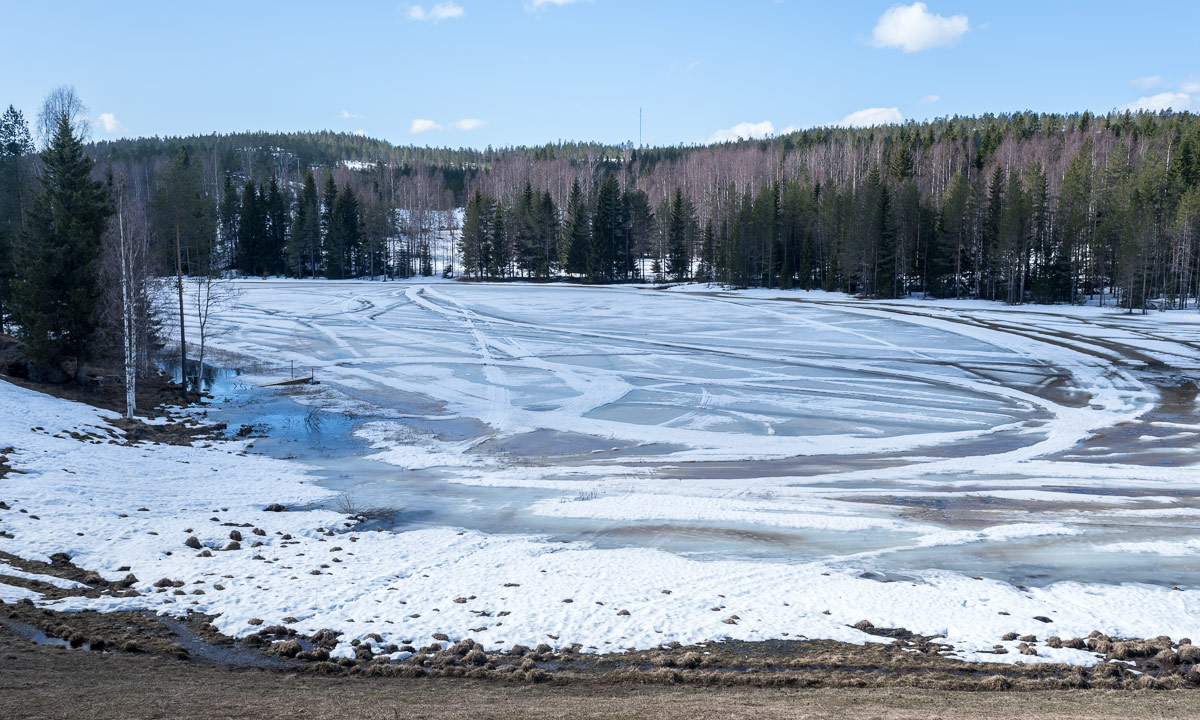
While it was warm in Scotland (hardly below 10 °C, up to 17 °C) it is quite cold in Northern Sweden. Not really wintry cold, but cold enough that the lakes start to freeze over and precipitation is more snow than rain.

Time to change to dubbdäck – to studded tyres!