A short trip to Arvidsjaur – Main course

This article is part of the series “2015-12: Short trip to Arvidsjaur”.

Yesterday morning was cold: The thermometer at the stuga – the cottage – showed -19 °C. Our plan for the day: Try to find the snowy mountain that we saw yesterday and make a snowshoe tour if possible. After breakfast we packed snowshoes, cameras, GPS, map and warm clothing and entered the car.

Meanwhile we knew the following:

  • The mountain area is called Vittjåkk (“white stream”) – samian: Vyöhtjage.
  • Arvidsjaur wanted to sell the ski resort last year.
  • There where two ways to Vittjåkk, but we didn’t know if any of them was ploughed.

We tried the direct way, which is more like a maze of forest paths. Fortunately almost all of them where ploughed. Thanks to Annikas great navigation we found our way to Vittjåkkstugan, the valley station of the ski resort where we parked our car. Beside of another car and two pedestrians walking their dogs the whole area seemed to be deserted.

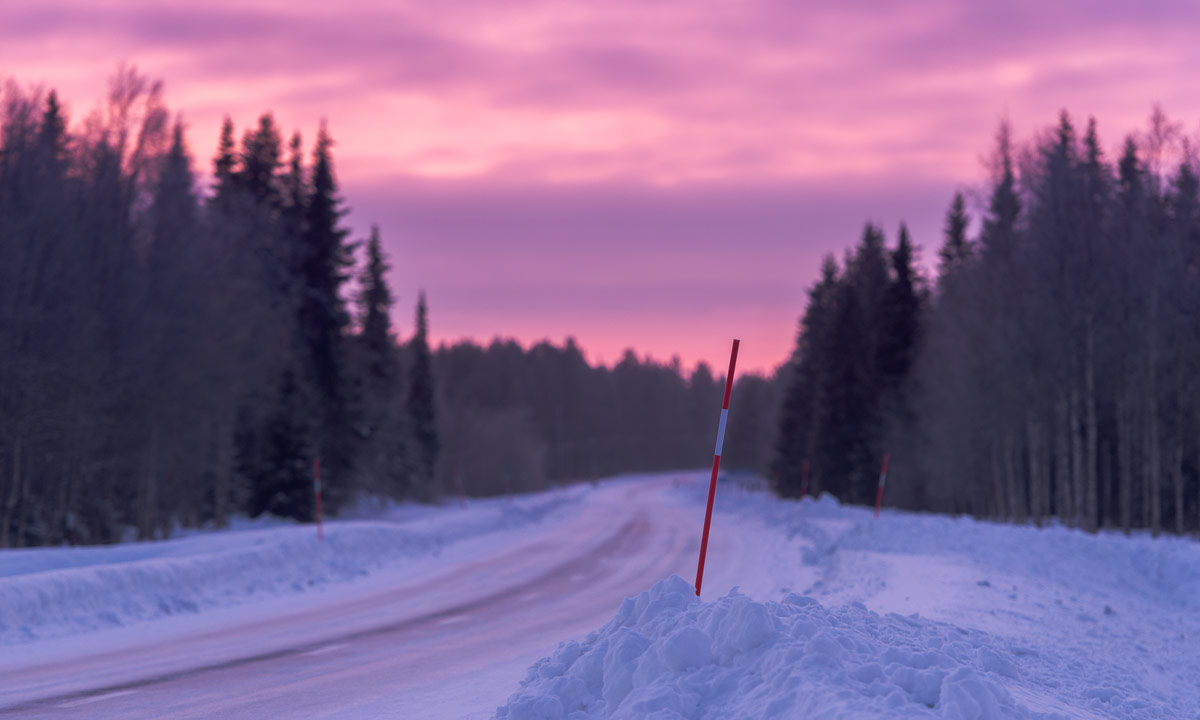
We mounted the snowshoes and ascended the first mountain. The sun hadn’t risen yet but the whole horizon showed warm pink and orange pastell colours. While we ascended the slope on a snowmobile track parallel to a ski lift the deep orange sun rose above the hilly forest landscape around and started to illuminate the snow.

We continued the tour until we were on the first peak, enjoyed both view and sun and wondered why it seemed so warm. Hadn’t it been -19 °C in the morning?

We turned right and descended the first peak just to head to the main summit. I was really stunned that you could find such a mountain landscape just “round the corner”. There were many tracks. Snowmobile tracks. We didn’t see any ski or snowshoe tracks; people start to get lazy.

After a while we stood on the top of the main summit – don’t ask me for a name, I couldn’t find any – and made a short rest, both of us drinking tea and taking pictures.

On the descent we wanted to catch as much sun as possible and took a detour. As you can see we succeeded …

… but we had to leave “safe terrain” and had to plunge through snow – sometimes knee deep even with the snowshoes. After 2 hours, 45 minutes we arrived at the car. A short but fantastic mountain hike.

When I started the car engine the car thermometer showed -8 °C, but it dropped down to -18 °C when we drove down toward the valley to Arvidsjaur. A good example for atmospheric inversion.

When we arrived at our cabin, we had -21 °C, later the temperature dropped to -22 °C. Probably the whole day had been quite cold in the lowlands. The inside of the cabin was quite cold, only + 11 °C, since the main heating wasn’t build for those wintry temperatures, but on the other side it was still 33 °C warmer than outside. A huge difference!

The rest of the day: Calm and lazy – just perfect after such a great tour.

Långhällan – some kind of another world

Today it was even a bit colder as yesterday. When I left the house to make some photos, the thermometer showed -10 °C and it hardly became warmer today.

This time I drove to one of my favourite places nearby, Långhällan, where the coast is quite rocky. When I left the car to walk the remaining 250 meters I could already hear the waves breaking ashore. The first view of the rocky coast was like from another world. The higher parts of the rocks were covered with a bit of snow, while the lower rocks were crusted with a layer of ice. This layer will grow with every wave rolling ashore.

The next hour(s) I spend sitting and crawling on the ice covered rocks and tried to make pictures of the incoming waves. I took more than a hundred pictures but I’m not completely content yet. Anyway, it was just fun being outside and experiencing this fine weather.

Finally the sun came out and started to fill nature with light – first of soft pink, then of intense yellow and orange colours.

I made another “photo session” and took even more pictures of the waves, this time illuminated by the low sun, but time was short and the waves were less impressive.

Soon the sun vanished behind some trees and I walked along the coast were I spotted the next motives: Last day high water has surrounded the lower parts of the small bushes with a solid layer of ice, that gleamed and sparkled in the sun.

After a while I had enough of taking pictures and slowly returned to the car. Two photos from the way back through the forest. It got colder – down to -15 °C and the soft-edged snowy landscape made me feel, that I left the world Långhällan and I was back in my home world again. The only thing that lacks for a real winter: A bit more snow.

Appendix 1 – Things that I was glad to have today

  • Warm cloths: insulated jacket and warm thermal pants, as well as warm gloves. I love winter but I don’t like to freeze.
  • Warm and waterproof “Muck Boots” rubber boots that kept my feet warm and dry.
  • A good camera, a good tripod and my favourite lenses.
  • Spare batteries – a must-have when it’s cold.
  • Most of all: My crampon-like spikes from Snowline – without them I wouldn’t have any chance to climb on the ice covered rocks.

Appendix 2 – making of

Freezing over – day three

A picture from yesterday where the morning was as cold as the day before. This will close the little series about ice on the Baltic Sea because today morning it was more than 10 °C warmer and hardly any ice was left. Tomorrow it all will be gone until it starts to get cold again.

Late October sunrise

Even after switching to standard time you don’t have to stand up extremely early to catch the sunrise over the Baltic Sea. Sunrise today was 7:06 and since I already was awake I took the car to the shore. Sky was clear and illuminated in warm orange colours while the open sea was of a deep blue. A nice contrast and since there ware hardly any clouds the photo has some kind of an abstract look. When the sun came – click – I made this photo:

After two warmer weeks it was chilly this morning with temperatures round -5 °C. Of course the sea is still open, but the water puddles on the waterfront were covered with ice.

Did I say “of course sea is still open”? Well, not everywhere! After making the photos above I drove to the little beach Storgrundet where I saw the first thin layer of ice lying on the cold sea water. (The photo itself is far apart from being good – I’ll try to make better ones tomorrow morning if it’s as cold as today.)


From Nallo to Vistas, Alesjaure, Abiskojaure and back to civilization

This article is part of the series “2015-08: Kungsleden hike”.

August 30 – September 2: Day eight to eleven of the summer hike through the mountains of Swedish Lapland

Nallo – Vistas

After two days in Nallo Annika and I were eager and keen to move on. After our breakfast we said goodbye to stugvärd Janne and started to ford the stream behind of the hut. Fortunately the water level dropped to normal again and quite easily we could cross the stream.

Then we went along the Nallú, a fantastic mountain that changed its appearance every other second because of the moving clouds and the changing light situations. We never tired of looking at this big mountain that seemed to accompany us a long way.

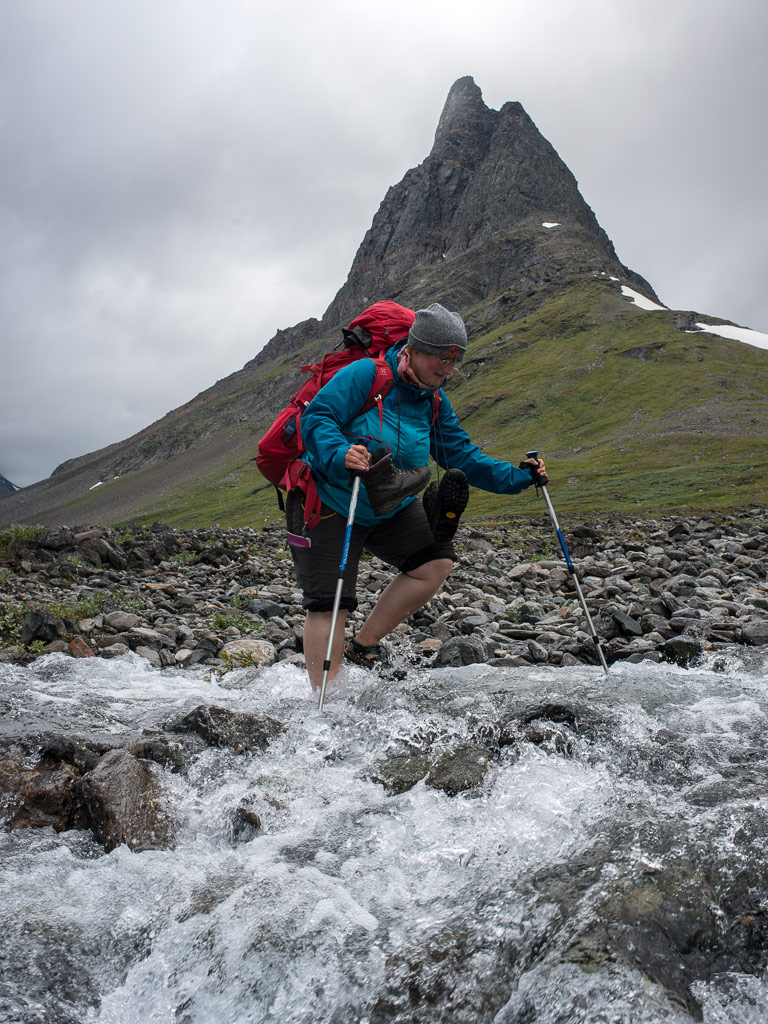
After a while another stream that we had to cross, came down from the lake Nállujávrrit. While I managed to splash through with my high rubber boots, Annika decided to take of her shoes and wade through it in her sandals – brr, the water was really ice cold!

We continued the hike through the fast-changing scenery. Quite soon we saw the first trees and realised that the big mountain ahead was the Vássačorru, that lies behind the valley Visttasvággi, where our next destination, the Vistasstuga is located.

Soon we crossed the Visttasjohka on the chain bridge and arrived at the cabin to meet the stugvärd – the warden.

Oh look: Coke and beer are priced down! That’s because the season only lasts three other weeks. After that the huts are closed down until their reopening for the skiers in February or March. But because none of the cans would survive the frost, all liquids has to be drunk in the next three weeks or poured away. We decided to save some cokes from this cruel destiny.

We were placed in the outhouse – the main building was in the act of being renovated. There we sat on the front stairs, ate, drank and looked on the river Visttasjohka. And we took a bath in this cold river. Chilling but refreshing! Finally the sun came out. I crossed the bridge to make a photo of our cabin.
Later – it started getting dark – we got a visitor: A big moose stood beside the river. I went out, where I could observe this huge animal, how it ate leaves and grass, less than 10 meters away. It looked at me but wasn’t disturbed by me at all, it even passed quite near until it vanished between some trees. This was one of the moments were I was glad and touched as a “normal person”, but a bit grumpy with myself, that I was too lazy to carry my big tele lens for better and sharper pictures. I never experienced a moose so near and so fearless.

Vistas – Alesjaure

The trip the day before was short: only 9 kilometres, this day it would be twice as much: 18 km. The first kilometres were a bit boring since they went through birch forests and quite muddy passages. But after a while the landscape opened and we could see the mountain Siehtagas with its glacier Siehtagasglaciären. In front of the mountain there were alpine meadows and small birch forests. In front of that the turquoise water of the Visttasjohka glimmered in the sunlight.

We went up again until we again were over the treeline. This part of the valley Visttasvaggi is beautiful and very varying. The first rest we made in the lee side of a huge cuboid rock. We weren’t the first – someone built a bench by laying a plank over two stones. The second rest we made at the Tjatjajaurekåtan (there’s not much left of it).

After a while I saw some reindeers grassing. There were shy and quickly went away when I came nearer. We saw (probably) them again when we had a view at the sami village Alisjávri that lies at the lake with the the same name. From that it’s not far to the mountain huts of Alesjaure – the Swedish version of Alisjávri. The Alesjaurestugorna are the biggest mountain huts of the STF – the Swedish tourist association. I prefer the smaller ones as e.g. Nallo, but it’s fine to have a shop, a drying room and especially a sauna. And we used it all! It’s nice to go to sleep after being in the sauna and having a wash in the river Aliseatnu.

Alesjaure – Abiskojaure

I didn’t make many pictures of this part of our tour. I was a bit bored of this part of the trail and found nothing special in the landscape. Just some photos of human evidence: Tent poles for a lavvu and a crossing over a long reindeer fence.

It was the first time, that I was really impatient and just wanted to arrive. Some kilometres before Abiskojaure we came below the treeline. Most of the birch trees still were green but you could see, that autumn is near. No wonder, it was the 1st of September, beginning of autumn for the meteorologists.

Finally we reached another chain bridge and shortly after it arrived in Abiskojaure. The sun came out and even though it was much colder than one week ago we could sit and lie on the short-cut lawn in front of the hut. I took the last bath of the journey and strolled around making some photos. After crossing a small swamp I came to a quite huge sandy beach beside the lake Ábeskojávri. A beautiful place!

The evening it started to become chilly, hardly 3 °C. I was curious if we would get the first frost of the season next morning …

Abiskojaure – Abisko Östra

… and yes, we got frost. -2.5 °C showed the scientific thermometer of the swedish weather service, when I had my first look. On the water surface of the buckets lay a layer of ice and round the leaves of lower plants I could see the first autumnal hoarfrost.

I was up very early that morning and I went to the beach at the lake again. First it looked quite normal but then it started to get foggy and misty while the sun rose behind the mountain Giron. What a beautiful sight! I stood there for at least an hour and only walked back to get another full battery for my camera. Later I met Annika, showed her the place and was glad that I could share this awesome experience.

I was a bit sad – this would be the last day of hiking through the wonderful mountain landscape of Swedish Lapland. But each journey has some kind of end and so had ours. We started our tour through the birth forests along the lake Ábeskojávri, than along the river Abiskojåkka.

After a while a famous landmark came into sight: Lapporten – “The Lapponian Gate”, a U-shaped valley framed of two mountains that give this valley its specific and recognizable shape. However, since this photo is taken from the backside, it hardly shows this special shape.

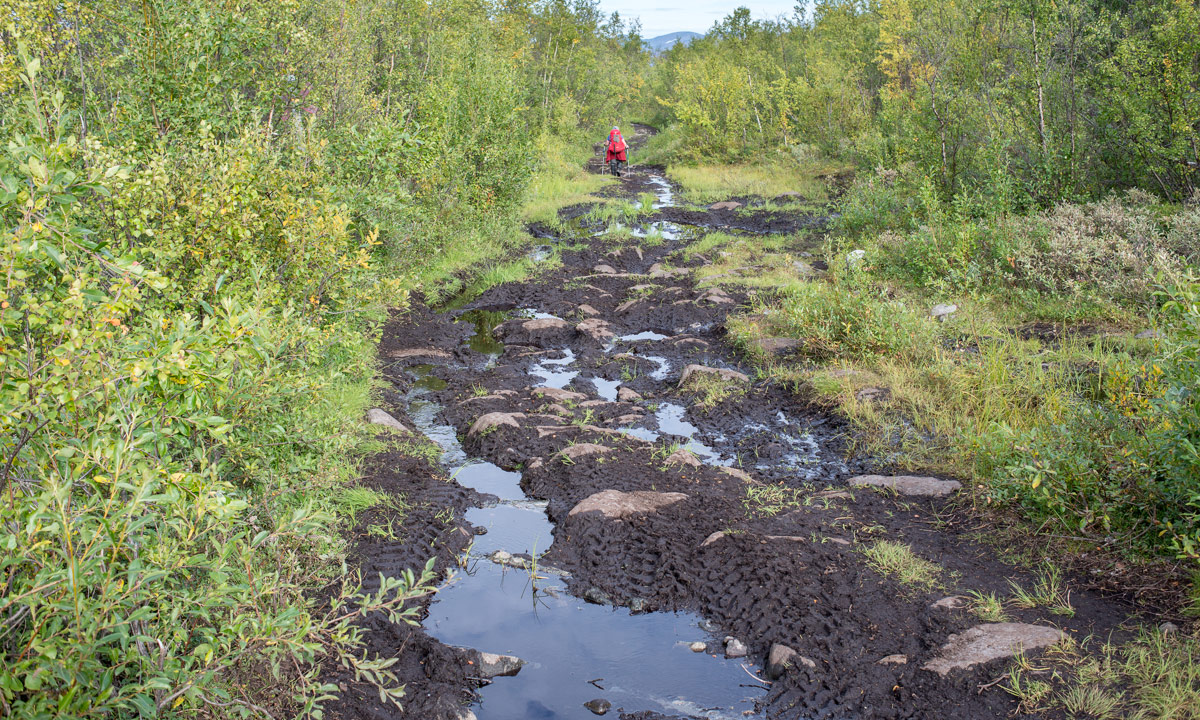
Since Alesjaure we followed the Kungsleden – the King’s Trail, but right after the bridge over the stream Nissonjohka we left the main trail that leads to the Abisko Mountain Station and turned right to Abisko Östra, the village, were we planned to stay for two other days. The way, however, was not much fun to go. A lot of all-terrain vehicles has turned the way into mud. Since I lost my lens cap and I was afraid that mud would splatter my lens, I packed the camera into its waterproof bag long before the worst mud patches. And that’s why this is the last photo of our hiking tour:

Thank you Annika, för trevligt sällskap – for nice company. Where should we hike next?

Any suggestions?

An overnight stay on the island Gåsören

Saturday

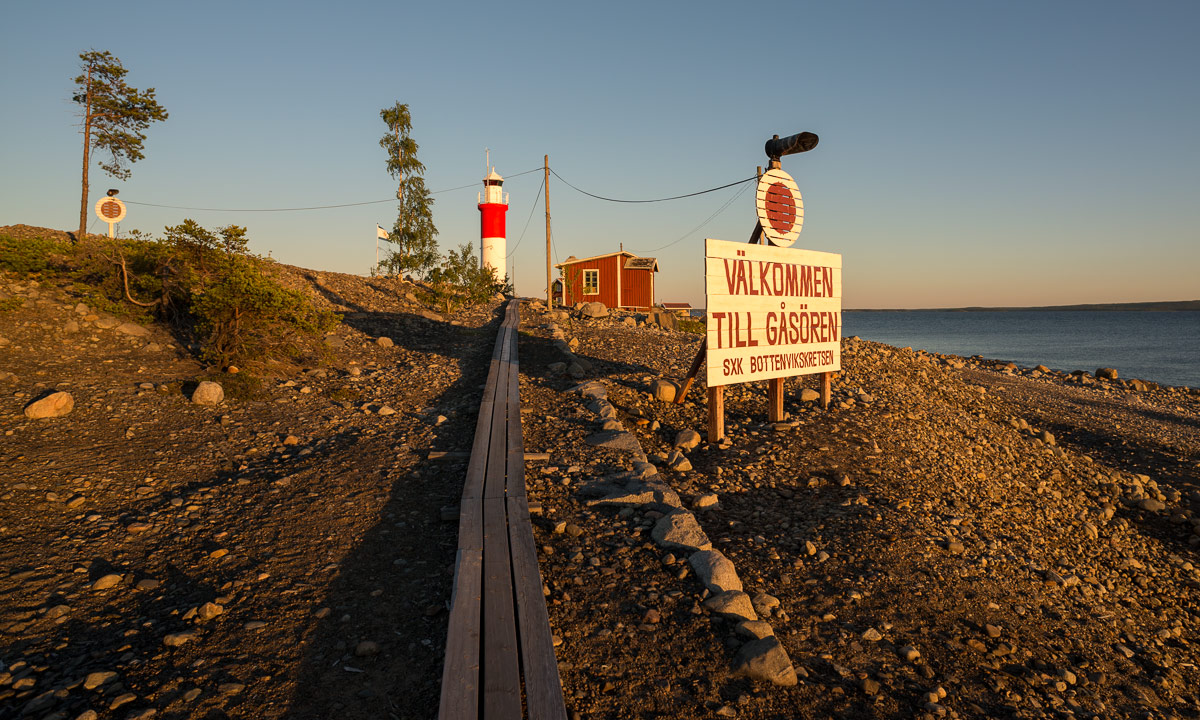
The advantage of short kayak trips with overnight stay: you can start quite late. It was 7 p.m. when I started pulling my loaded kayak from home to shore. A quarter later I sat in the kayak and started paddling. It’s only four, five kilometres to the island Gåsören that shone in the warm light of the evening sun.

The first thing to do: Put up the tent before sundown. The second thing to do: Taking a picture of the lighthouse before sundown. The stomach reminded me of thing number three: Preparing food and eating. Todays dinner: Graved salmon on fire roasted bread à la plein air.

I was quite curious if I would catch the first polar light. The short term forecast of Soft Serve News wasn’t too bad. But even if the sun already went down round 9 o’clock – two and a half hours earlier than eight weeks ago – I still had to wait for the sky getting darker. After a while however I could see the first faint greenish garlands. My first Northern Lights of the season 2015/16! Great!

But then I saw something in the sky that I thought was much more fascinating: Right above the red coloured northern sky I could see a layer of lucent clouds. They looked really strange because there weren’t red or purple – they were pale white! I never saw something like that before. They looked extremely far away, almost extraterrestrial. I wondered if this perhaps could be noctilucent clouds – clouds that are found in extremely high altitudes of round about 80 kilometres. I stayed awake for a long time, I just couldn’t tear my eyes away from this wonderful phenomenon. Two pictures of the clouds:

Of course I checked my hypothesis directly, when I went home. Yes – I guessed right. My first noctilucent clouds ever. I was really lucky and I’m happy that I could see them just from my tent.

But let’s leave the Mesosphere and go back to earth again. If you tent on the island Gåsören, you can see other lights, too. Lights of civilisation: The peninsula Rönnskär is quite nearby. On Rönnskär there is Boliden Rönnskär, one of the most efficient copper smelters. You think industry is unsightly and ugly? Well, not Rönnskär by night in my opinion:

Sunday

I woke up in broad daylight although it was only half past five. I took one halfhearted picture out of my tent and then I started reading.

I started the book “Norwegen der Länge nach” written by Simon Michalowicz that was published just some weeks ago. Simon hiked from the Southern tip of Norway to the North Cape – round about 3000 kilometres.

I read in the tent – I read sitting in front of the island’s sauna — I read sitting or lying on a floating boat bridge, only interrupted by a short bath in the Baltic Sea. I followed Simon’s tour and just couldn’t stop reading. It was noon when I finally finished the book. If can warmly recommend it to all German readers that love Scandinavia or are interested in hiking. There’s a website as well: www.simonpatur.de.

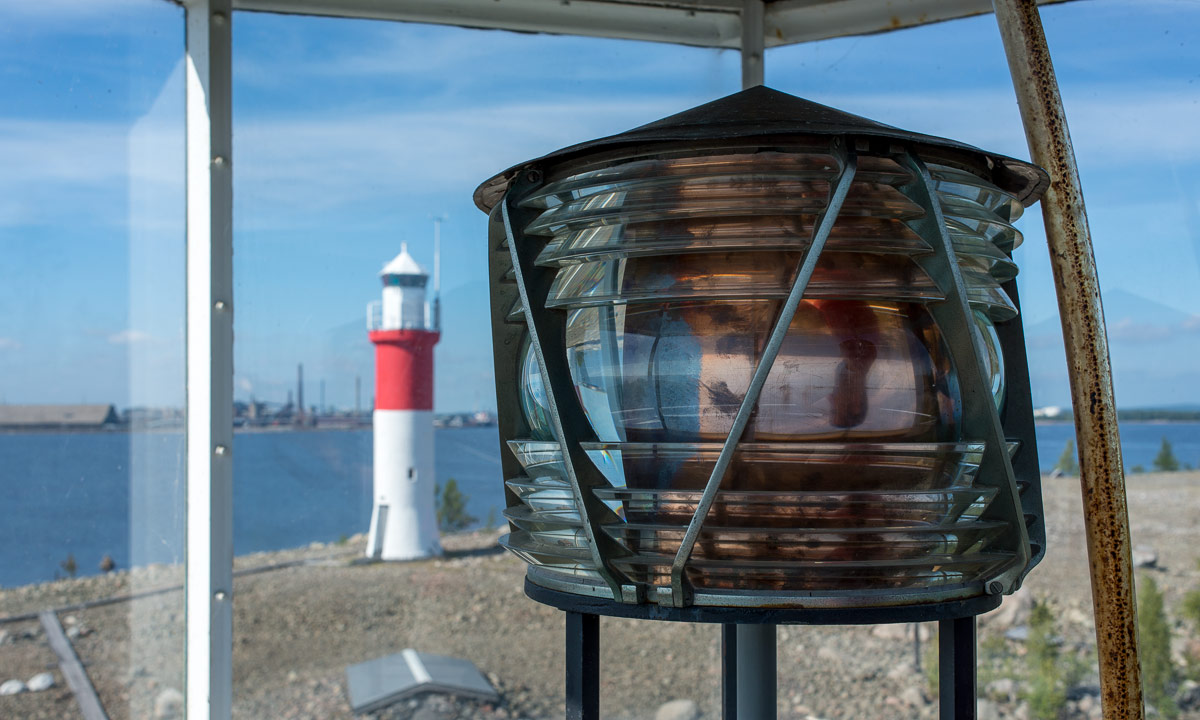
I wasn’t alone on the island. Some people hired the old lotshus – the pilot’s house for an overnight stay. The first motor boats came in for a day visit. And both summer cottages – there’re only two on Gåsören – were used, too. From T. who owns one of the cottages I learned that it was international lighthouse day today. So before I packed all my stuff together and paddled home I went up the two stairs in the old lighthouse and made a last photo.

I was home again half past two. Many experiences and a good book in less than twenty hours – that’s a fine weekend.

Translation:

EnglishGermanSwedish
Noctilucent cloudsLeuchtende NachtwolkenNattlysande moln

From Å to Rystad

This article is part of the series “2015-07: Lofoten and Vesterålen”.

Day 2

Next morning when we woke up in Å we could see blue sky through the fogged car windows. The rain has stopped. We made a walk through the little fishing village and had breakfast on the cliff with a fantastic view on the mountains and the sea.

After that we continued our trip through the incredible landscape of the Lofoten. We had to stop several times to take pictures, for example of this small mountain lake near the road to Nusfjord:

Later we came to a place that became quite famous over the years: Uttakleiv – a beautiful sandy beach that just invites you to jump into the turquoise-coloured water. It almost looks Caribbean but as soon as you enter the ice cold water you’re reminded of being in Northern Norway, not in the south. The bath was fun, anyway.

Here we stayed for a while and enjoyed the sun. But after a while we continued our road trip to Brenna on the island Austvågøy. We didn’t find a camping ground at the end of the road and turned, but soon we stopped the car again. Actually because I wanted to take pictures of the sheep that lay at the sandy beach, but some children nearby discovered something much more interesting: A fox cub. I changed to the telephoto lens and I came quite near. Probably the fox hadn’t made any bad experiences with humans yet.

After that we stopped at a camping ground near Rystad that we already saw on the way to Brenna and decided to stay overnight. Soon the tent was put up on the grassy ground. Slowly the sun went round the mountains and sank down. The next hours were incredible – the light was so wonderful, both the sunlit main land in the south and the sea in the north glowed in the most fantastic colours. But have a look by yourself:

Round one o’clock we lay down in our tent, but only because clouds came and it started to rain a bit. What a wonderful first day on the Lofoten!