Continuing to the Vesterålen

This article is part of the series “2015-07: Lofoten and Vesterålen”.

Our third day started with a lot of rain. We put the wet tent into the car and continued our tour to Kabelvåg where we visited a friend of mine. We took a small mountain hike but it was cloudy and wet. Only far away in the east you could see some sunny patches on the top of the snowy mountains.

After the hike Delle and I looked for a camp ground. But first I had to take a picture of the beautiful rainbow near Sildpollen.

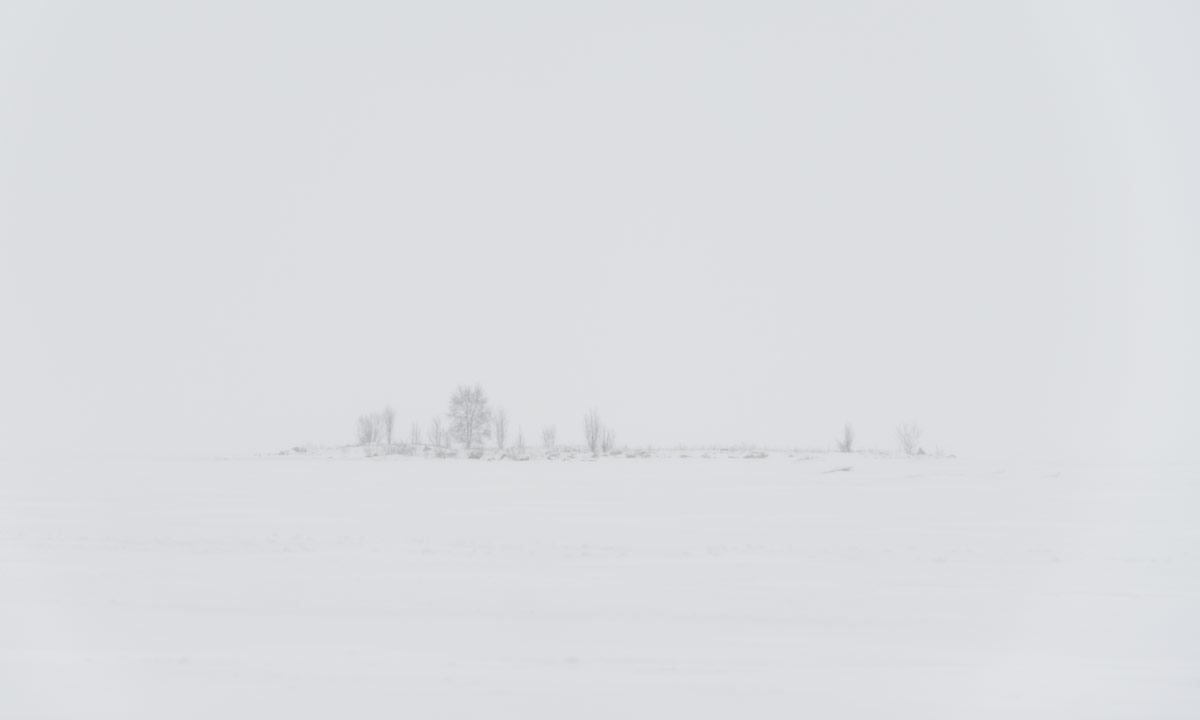
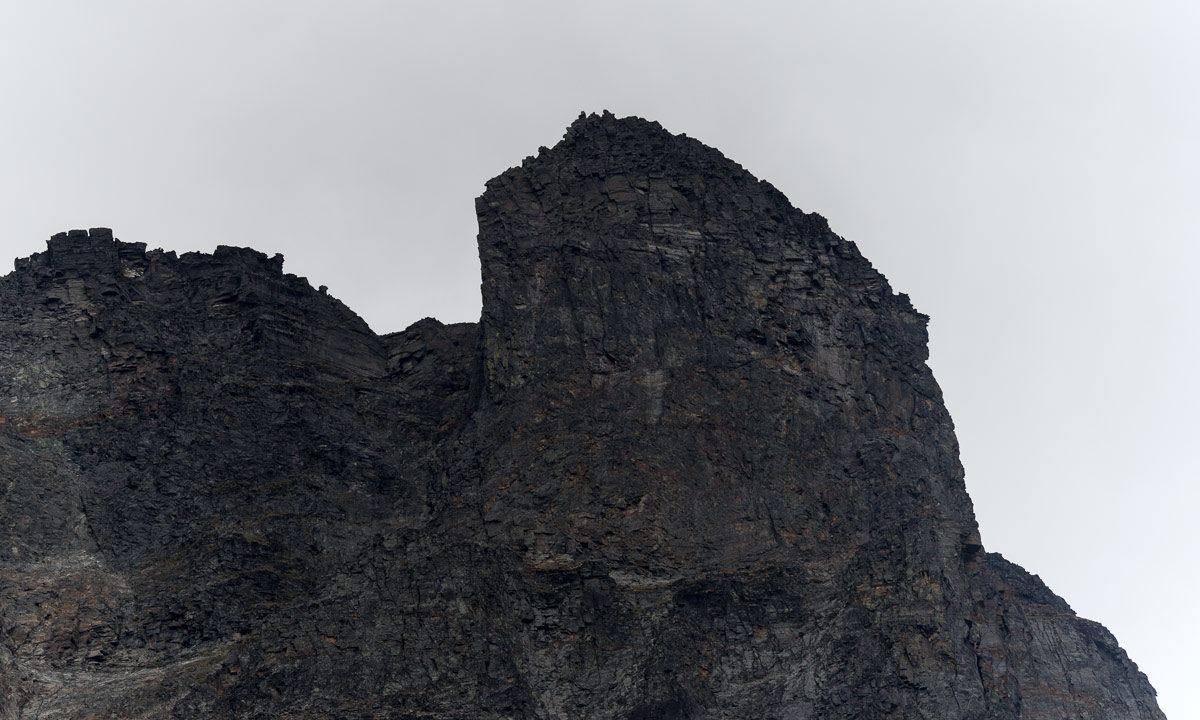
This time we tented on a bigger campsite in Sandsletta. When I woke up quite early the next day I could see another rainbow over the Vatnfjorden, but later it started to rain and pour down again. And again we put the soaked tent into the car. We continued on the road 888 to Fiskebøl. The clouds were hanging low and you could hardly see any mountain, just some white and light grey schemes.

Soon we arrived in Fiskebøl where we waited for the ferry. Again we were lucky – we waited hardly half an hour until we entered the ferry for the short crossing to Melbu, the southernmost city of the Vesterålen. We visited friends of mine, this time in Haukenes were we tented near the friend’s house. The cocks tried to wake me up ridiculously early, but in vain. I continued sleeping until 8 o’clock.

Alas it was the first morning without rain (and the only one, too) and we could dry the tent. After a long and lazy breakfast with my friends we said farewell and continued our car trip. We got a tip to visit Stø at the northern end of the Vesterålen island Langøya. What a good tip and what a beautiful landscape – especially after the weather was nice and sunny. We made a short photo stop between Strengelvåg and Klo before we continued to Stø.

In Stø we parked our car and took a short hike over the mountains to a beautiful white sanded beach were we made a rest and I took a short bath. There’s a 15 km hiking trail as well; next time I’ll definitely will go it.

After our rest we slowly walked back and continued by car. First we had to head south to Sortland were we crossed the Sortlandsundet and headed north on the other side. The sky became more and more cloudy and we looked for a nice campground. Finally we found one in Bleik, quite near Andenes, a town at the northern end of the Vesterålen. We put up the tent and – guess what – it started to rain.

It had been raining the whole night and it continued raining. Again a soaking wet bunch of a tent lay in the back of the car. After a while of driving through the greyness we decided to head back to Skelleftehamn. It’s more than 900 kilometres and it took the whole day. Rain became less near Abisko and after we passed Jokkmokk the sky cleared up and we could see the full moon slowly rising. The next photo, which is the last of our car trip through the Lofoten and Vesterålen is taken near Storforsen, one of Europe’s biggest rapids. At 23:50 we were in Skelleftehamn again – and I was home.

  • 2296 kilometres in six days
  • a lot of clouds and rain, but two nice and sunny days, too
  • one night in the car, four in the tent (three of them on campgrounds)
  • two bathes and at least four rainbows
  • – a nice trip!


A hike and three tests

Do you remember Nokia? Cell phones and rubber boots? Today I tested a quite similar combination: Rubber boots and a Nikon lens. Plus a hiking trail.

A few weeks ago I discovered a big information board at a forest edge in Skelleftehamn. It describes the “kraftleden”The force trail or The energy trail. Perhaps the trail is named after Skellefteå Kraft, one of the sponsors I thought when I read the information.

Today I decided to try to hike the 18km long trail. I had two new things with me: My new rubber boots Tretorn Sarek which are made for hiking and my new lens Nikon 100mm f/2.8 (Series E), that I bought secondhand some days ago.

After a one kilometer walk I was at the starting point.

At the first junction I was lost, since I couldn’t see a sign. But after checking my photos of the information board I learned that the way marks where orange coloured blazes round the trees. That’s easy. The trail itself however wasn’t easy at all. It looked more like an area where you cut down trees and bushes. Like a stork I stalked through the cut down branches and twigs that lay criss-cross on this so-called trail hoping for a better path.

And the trail got better. But I still was slow. This time not because of the trail but of my new lens. It’s my first lens ever without an autofocus. This means that I have to focus manually at the lens itself. It took some time until I got used to it, but I still had to control every single shot on the display and I had to make some photos five times until I was satisfied.

I continued the trail – now a nice stony path until I came to the Örberget – altitude 40 meters, 30 meters higher than the starting point. It doesn’t take much to be called a mountain here. I made a photo of a “gravröse”, a tomb from the Bronze Age. Probably it was build at the shore some thousand years ago but the land has been rising round a centimeter a year since then.

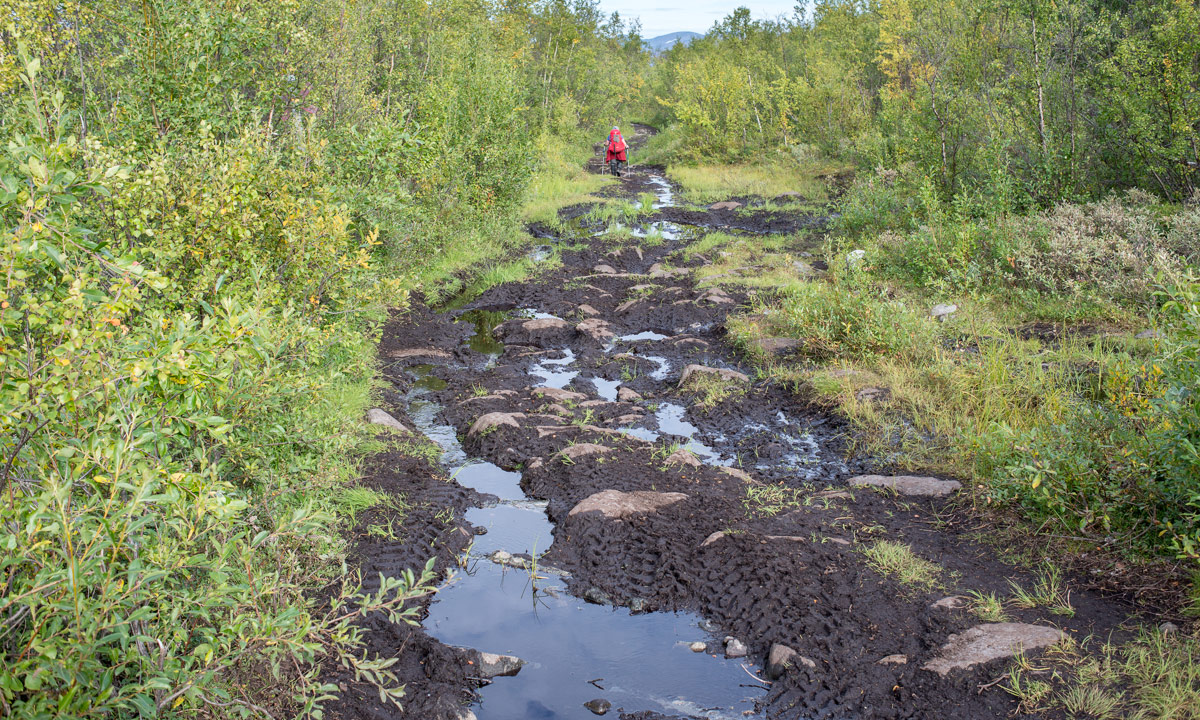
I continued the walk. The ground became wet and muddy and after a while I stood in front of a bog. In the middle of the bog I saw a wooden post with an orange blaze. OK, let’s go …

… now I knew, that the new rubber boots were not only comfortable but really waterproof. I didn’t get soaked, but it was quite close.

I always had to look down carefully to avoid the deep water and mud puddles, and I had to look forward to find my way. When I looked up I started to suspect why the trail was called kraftleden. Almost the whole trail followed the transmission lines and the Swedish word for transmission lines is kraftledning. That’s a really pragmatic approach to make a trail since some kind of path was made already to mount the power poles. But it’s not very inspiring just following the lines and not beautiful neither.

After round 11 kilometers I made a rest on a high seat normally used for hunting moose.

I continued the tour but I started to lose interest a bit. Parts of the way were hard to walk, harder than many mountain trails but without the reward of a beautiful landscape or great views. In addition of that I started the tour round half past two and I didn’t want to come to town too late. So I left the kraftleden and walked southwards through the forest. At the beginning I found some nice flowers and I changed the lens to a macro. First two additional test images of the new 100mm lens, then two flowers – a dactylorhiza maculata and a linnaea borealis:

OK, I have to admit: I tested four different things, not only three. Number four was a mosquito protection jacket, that came in quiet handy when I shot the macros of the flowers. Flocks of mosquitos darted for my blood, but they didn’t had a chance beside of biting into my unprotected hands.

After taking the flower images I had to walk some other kilometers until I came to the main road and another one to come to the bus station where I had to wait half an hour for the next bus. Happily I slipped of my rubber boots to try my socks, sat down and waited. Finally the bus came and half an hour later I was home. The GPS displayed:

19.0 kilometers · average when moving: 4.3 km/h · total average: 3.3 km/h

And here come todays test candidates:

Rubber boots Tretorn Sarek: Really nice and comfortable boots, perhaps a nuance too tight for me. They are made of natural rubber and it’s easy to turn the upper upside down. They could be a bit higher.

For me: 8 points out of 10.

Nikon 100mm f/2.8 (Series E): A small, lightweight lens with manual focus. I have to practise focussing. I prefer my huge Nikon 70-200mm VR II, but there’s a reason why I bought the former one: At the end of August I’ll start a two week hiking tour in the Scandinavian mountains and I want to save weight. The 70-200 weights more than 1500 gram, the new 100mm only 215 gram. Got the point? And it was cheap, too – only 53 Euros.

For me: 7 points out of 10.

The trail kraftleden: The only advantage of the trail is that you avoid navigation. Beside of that it’s an awkward combination of a trail a bit too hard to be nice and a bit too boring to be beautiful. I wouldn’t recommend it. If you want to give it a try, take high rubber boots and plenty of time with you. Take care and follow the way marks if you don’t want to end in almost knee deep mud as it happened to me today.

For me: 3 points out of 10.

The nameless mosquito jacket: Perhaps it’s not fun to walk within some kind of mosquito net but it was great, when I took the macro photos of the flowers. The hood is too big. Since it’s very light – only 214 gram – I will take it with me on all summer photo tours and perhaps even on the planned mountain hike. And with costing only 18 Euros it was a bargain, too.

For me: 6 points out of 10.

Translations:

EnglishGermanSwedish
Dactylorhiza maculata / heath spotted-orchid / moorland spotted orchidGeflecktes KnabenkrautFläcknycklar
linnaea borealisMoosglöckchenLinnea
upperSchaft (am Schuh)skaft

Storberget

Storberget – “The big mountain!” A bit more than 90 meters high, which sounds completely ridiculous, if you live in Norway, near the alps or another place that has real, big mountains. But Storberget is a mountain, too, with a lot of rocks, a small ravine and a view on the near Baltic Sea and some islands. And it’s near, just fifteen minutes by car and a walk through the forest.

Almost like summer

For me it’s not the warmth, that makes a Swedish summer, it’s the colours! Blue sky, green birch trees and meadows with yellow flowers – dry ones with dandelions or very wet ones with marsh-marigold – both are just beautiful.

Translations:

EnglishGerman
DandelionLöwenzahn
Marsh-marigoldSumpfdotterblume

A short trip to Umeå

I have to admit, that it felt a bit strange to travel to Umeå. For one thing it’s a big town and for another thing it’s south from Skellefteå and that’s not my usual travel direction.

You may laugh at me calling Umeå a big town. Umeå has 80000 inhabitants and that may not sound very much, but the whole city with its many big buildings and streets feels much bigger, especially if you compare it to Skellefteå – the next town nearby – which is less than half as big and appears only a tenth as busy as Umeå.

I stayed over night in a hotel in the 12th floor with a nice view over the town and the river Umeälven. What a pity that it rained almost the whole time.

Today it still rained a lot and I didn’t have any interest in city sightseeing. So I fled the town and took a long walk in nature. That’s much more my cup of tea.

Tromsø: At the shore

Day 15

Just strolling at the shore, at the seaside. Grey windy weather, the opposite of my day in the mountains yesterday. Just walking and letting the mind flow. My thoughts? I don’t know, i didn’t listen. A further step, balancing on stones, wading through shallow water, avoiding the ice, collecting some shells, looking around.

Just relaxing.

The bird is a Purple Sandpiper (Latin: Calidris maritima, German: Meerstrandläufer, Swedish: Skärsnäppa). My thanks to Patrick and Kevin for the identification.

The idea to stay another night in Tromsø and not to drive to Absiko today was good: Parts of the way to Abisko has been closed since yesterday evening due to the snow storm and are still closed. It’s still not clear whether they’ll be open tomorrow again. I guess I’ll give it a try.

A first mountain hike

Day six

Yesterday on Tuesday I stood up quite early to hike into the mountains. I packed my camera equipment, hot tea, nuts and raisins, compass, GPS and a down jacket. I considered first about taking my snowshoes with me but left them home, it didn’t look like much snow on the mountains.

I started the tour and headed to Langbakken, the place where we saw the sun two days before. I was greeted by the flock of sheep, some of them so tame and curious that they came to sniff on my hand. Then I climbed the fence and cut across country until I came to another fence with a gate. I went through the gate and followed the way beside of the fence until I came to a crossing where a way climbed up a forested hill.

The way didn’t continue but I just continued the direction until I came to a snow covered lake, the Dalvatnet.

I started to regret that I left my snowshoes behind, because with every step I sank 10 to 20 cm into the hard snow. It wasn’t the last time …

I knew the direction and had two options: Either crossing the open mountain brook or to just go ahead. I chose the latter. I had to cross a field with huge rocks where I really had to by careful and check every single step. After that I went up the steep slope. And it was much, much steeper than expected. I measured 40° with my compass. I had to be careful not to slip and I took many rests to calm down. Sorry, no photos.

But finally I reached the first hill took and horizontal terrain again. Just some more steps and I took a longer rest with the tea and my nuts. I was glad about my down jacket because the -8 °C felt much colder in the wind.

I could have sat there for hours and just watch the colours change. When the sun disappeared behind a mountain top the snow looked cold and bluish. When it appeared some minutes later in a gap between two mountains the snow was illuminated in yellow, orange and purple pastel shades. I’m no poet, I cannot describe it with words. After a while I continued to another lake called Finnurdvatnet, as frozen and snow covered as the first. I love the landscape above the treeline, especially in winter when it is reduced to snow, ice and rocks and some scattered small trees.

I would have loved to go further but the hard and partly crusty snow – knee deep some times – slowed me down quite much and both my condition as day light where limited. So I started my way back and went to another lake, the Nils-Persavatnet. Starting feeling exhausted I took another rest and continued to the ridge of the Hovden. I was quite glad to hit a snowshoe track that I could follow. It made it both easier to go. But first I had to look again. The sunset in the southwest, the intense purple colour of the sky in the southeast, the Hurtigruten ship on the Sortlandsundet, The huge bridge to Stokmarknes and the white snow-covered mountains everywhere. Just wonderful!

I continued the treeless ridge of the Hovden to the peak. Then I started the descend through the forest. I don’t think I would have found the whole way down without the snowshoe track that I could follow so easy. After a while I saw the same way I took when I started the tour, but from within the forest and the other side of a ditch. No wonder that I didn’t find this path in the morning! I jumped over the ditch and headed to the house of my friends. When I crossed Langbakken the same flock of sheep – as curious as in the morning hours – came again and some sheep (the same?) sniffed on my fingers again. But I longed after taking a hot shower and a nap in my bed and that was exactly what I did when I was back.

Conclusion:

A great first tour with beautiful weather in a fantastic landscape that would have been much easier with snowshoes. I guess that even the blister on my left heel came just from the wet snow in my boots that I could have avoided with snowshoes. Lesson learned, Olaf? Lesson learned!

Some vocabularies for my German readers:

down jacket – Daunenjacke
flock of sheep
– Schafherde
cut across country – querfeldein laufen
mountain brook – Gebirgsbach
treeline – Baumgrenze
crusty – hier: verharscht
ridge – Gebirgskamm, Grat
ditch – Graben

Links:

Map with the lakes and the peak of Hovden