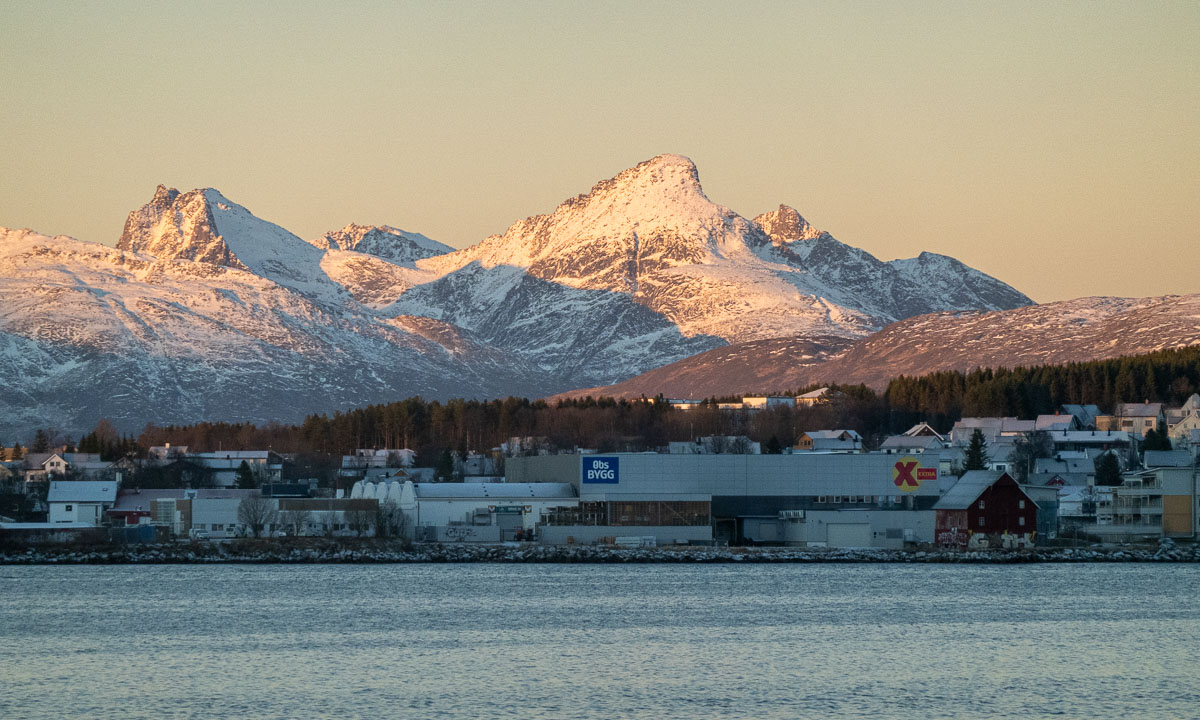
Grønnlibruna and Petterbolhaugen

It’s Sunday. Weather forecast looks very promising and I want to go out hiking. I scroll through my tour book and the net and cannot decide. Finally I just grab my stuff and the book and take my car to Kvaløya where I mostly use to hike. I’ll find something.

While driving I remember the small mountain Grønnlibruna where I’ve been already in November and May. There’s a lot of birch forest in the first half of the hike – perhaps a good place to be in autumn. I drive to the place where the tour starts and park my car.

The sky is covered with clouds and clouds flow through the valleys as well. But the yellow birch leaves of the forest I’m hiking though shine colourfully.

I reach the top of Grønnlibruna. Although it is only 401 metres high I am above the tree line. I continue to a smaller hill in the southwest to enjoy the autumnal colours. Later I’ll learn that it has a name: Petterbolhaugen. I reach the top and just in this moment the sun comes out. It already had started to illuminate small parts of the impressive mountains but now it shines on my face.

The weather become sunnier and sunnier and the views on the mountain panoramas are beautiful.

Many trees have lost already many leaves and even tiny puffs of wind take more leaves with them. Soon the colourful autumnal tinted forests will transform into grey collections of bare trees. Then I will hope for the first snow. But today I collect the colours – for the blog, my memory and my soul.

Kayaking into the dark

It seems, that summer is over. It’s less a matter of temperature but light. Next night will be autumnal equinox and today’s sunset was already at 18:47. Tromsø has almost the same longitude as Budapest.

Anyhow the Thursday paddling of Tromsø Havpadelklubb – the Tromsø sea kayak association – still hold place today. Next week will be the last time for this season. Today we had perfect conditions: No waves, no wind and 10 °C. We had many a summer day worse than that here in Tromsø

May I present, that is D5. It’s one of the many rental kayaks of the association and my standard choice. My own kayak is in Sweden.

Today we were 15 people heading to the island Grindøya on the other side of the sound between Tromsøya and Kvaløya. OK, let’s start …

First we paddled along the coast, then we started crossing the sound. From the boat houses to Grindøya it is round about 4 km.

This time we did not paddle round the island like in June or two weeks ago. Instead we headed for a beach at the northern tip and made a break there. I had a piece of soft chocolate cake with cashew nuts, a welcome leftover of the three day data management workshop that I joined this week. And while we stood or sat there it started getting dark.

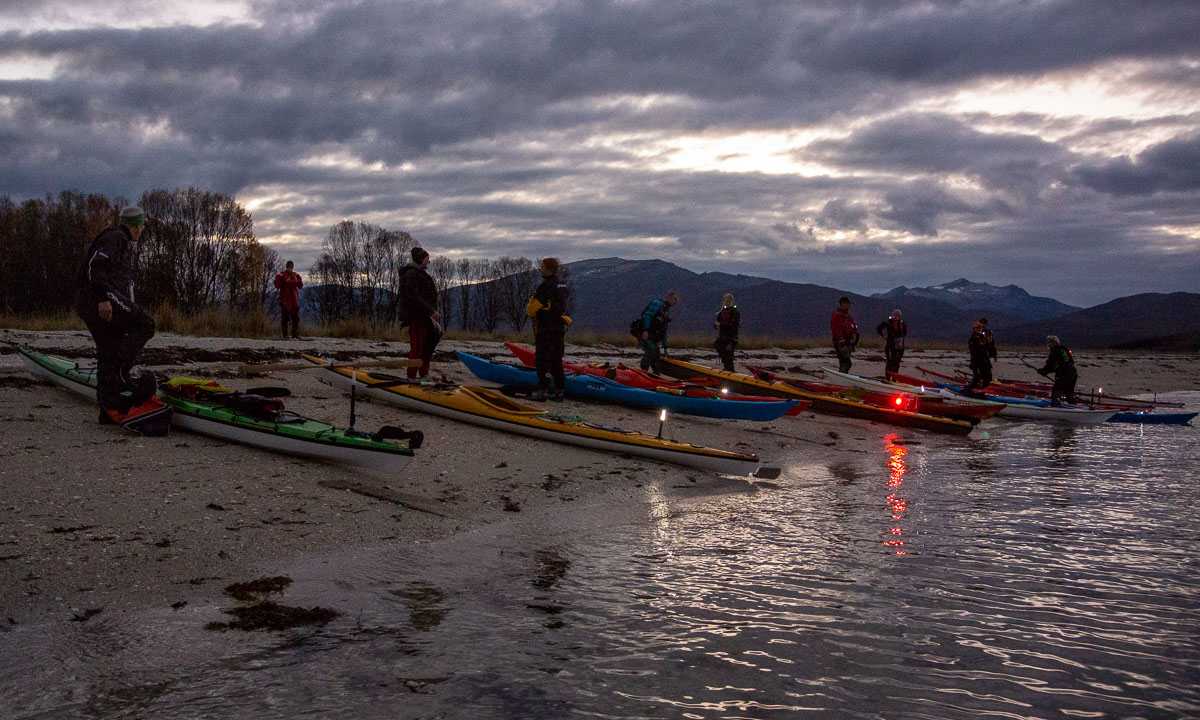
Some of my fellow paddlers already had switched on their lights on the way to Grindøya, now we all illuminated our kayaks and ourself. It’s less about seeing but about being seen. There is commercial shipping on the sound. We prepared our kayaks and departed.

While we paddled back it got darker and darker. It’s really a special experience to paddle through the dark in a group. You hear the drone of the city, occasionally interrupted by an airplane or a motorcycle. But that’s far away. Our own sounds are near: soft conversation and the little noises of the paddle entering and leaving the surface of the sea. And since you see less and less, hearing becomes more and more present. And anyhow I tried to paddle as silent as possible not to disturb the quietness.

When we arrived at the boat houses of Tromsø Havpadelklubb it had become dark. The tour lasted only an hour and a half plus a half hour break. But the peaceful sound of kayaking calmly through the darkness lingers still in my ears.


Stappen in the autumn

Reader, meet Stappen. Stappen, meet reader.

Hiking up Stappen is tour 54 in my book “På tur i Tromsø” – On tour in Tromsø – and it is marked blue, which somehow means that it is moderately easy. I tried to hike up Stappen in winter last year but gave up because of the steep terrain paired with snow. Today I gave it another try.

Autumn has been in full swing the last days and most of birch leaves are yellow, while other plants as groundcovers are anything between green, yellow and bright red. Sky today was grey but the colours shone brightly.

After crossing a bog I had started hiking up the mountain from the left side. Or should I say, climb? There was no recognisable path and it was quite steep. Since all rocks were overgrown, terrain was not so easy and I took it slowly and cautiously. I didn’t want to slip or find some hole between the rocks.

As usual the views were gorgeous. The island Tussøya with the pale sea behind, the mountain massif round Skamtinden that rose above the valley while gaining height. or the autumnal coloured marshes with their embedded lakes and small meandering streams.

You can see it on the first photo. The way up stays steep – up to 85% or 40° – until the very top. But finally I crossed the 550 metres level curve and was almost up, because Stappen is only 565.2 metres high. But up does not mean that it was a plateau, it was more a constant up and down and I used my hands a lot when it got steep. Fortunately the ridge was always some metres broad. I’m a bit afraid of heights. And then – after crossing most of the ridge – I reached the top.

Impressive is not the word that you would use to describe this knee-high heap of stones. It was quite obvious, that this mountain is not very popular. It is pretty steep to the sides, so that I could look straight down to the lake Botnvatnet (“the bottom water”). Later I would go round this lake on my way back.

But I was still on the top of the mountain and continued following the ridge that slowly descended. Here you can see two parts of the ridge:

On my way I found a small clearing surrounded by rocks. With the rough mountains around it looked like a secret valley, where dinosaurs still live. Well, they have to be tiny, the clearing was only round ten square metres in size.

This part of Stappen was much less steep, but when I looked back again it looked quite impressive anyhow.

After a while I reached the bogs – still at an altitude of round 330 metres and started to walk back onto the wet and bouncy ground.

Stappen was a nice tour but steeper than expected. At home I read the tour description in the book again. You had to read between the lines: While it was not mentioned, that the ascent is steep, alternative routes were mentioned with the words: “Her er det litt mindre bratt”.

Google translate’s translation: “Here it is a little less steep”.

Olaf’s translation: “Here it is little less steep which is still pretty steep. But other paths – those that you will choose – are much steeper! Anyhow, we marked the tour as blue so you might survive.”

At the end just three pairs of photos of this tour and my tour on 4 December:


Jämtland tour 22 – signposts and waymarks

This article is part of the series “2022-08: Jämtland and Trøndelag”.

If you want to hike you need either a good map and a compass, or a GPS, or you have an area with designated hiking trails. Then you in most cases have only two issues: find the right trail and follow it.

Easy, isn’t it? Yes, but wait – what’s that?:

Why are there two trails to Storerikvollen? Check the symbols. One shows a skier, the other a hiker. That’s the first think you have to know: There are summer and winter trails in the Swedish mountains. The latter ones are often a bit less hilly but can lead over bogs and lakes. So choose the right track. Quite often they go together for a while and then split up again. That’s where you have either to check a map (take an up-to-date one) or follow the right waymarks.

The waymarks for summer trails use stones and red paint. In Norway it is a red T, in Sweden it is mostly a red dot. Mostly they are painted on large stones, rocks or on cairns – heaps of stones. The advantage of cairns: they are easier to spot when it is foggy.

In wintertime most summer waymarks are hidden under a deep snow cover. Then it is the time of the winter waymarks: Red diagonal crosses.

The poles can be several metres long because of the snow, the depth of which can vary greatly. When you have snowstorm conditions in winter you sometimes just can spot the next cross. When you’re lucky. I took the following photo on 20 February 2020 on a ski tour. Two hours later we experienced average wind speeds of 25 m/s. Then you start to love the waymarks that guide you through the storm.

Back to our August Jämtland tour this week. We could watch some people replacing the old winter waymarks by new ones. An important job, probably done on a voluntary base. Voluntary work is so important in Norway that it has its own word: dugnad.

I guess the best sign posts we found in Nedalshytta in Norway. One “summer signpost”, one “winter signpost” and even ratings for the trails from green to black.

It’s always nice to meet some signposts on your way, but not all of them show the distances. I like the last one. The letters are holes in the metal sign, so it won’t snow over so easily in winter time.

But not all signs are about following the trail. They can show you the Swedish-Norwegian border. Or the way to the toilet. Or the toilet – often a “privy” – itself. Or where to park your dog in case you have any.

And some of the signs or marks are quite creative. I almost missed this “in-tree” waymark in Norway. Perhaps more funny than helpful.

But the clearest sign we directly spotted on our first hiking day in Storlien:

The words say henan, dittan and hittn which are apparently words in Jamska, a group of Jämtland dialects. They mean something like here, →there and →here. I cannot express it better. Anyhow this is an article about signposts and waymarks, not about linguistics.

Takk for turen – Thursday paddling – 8 september

Oh, what a wonderful kayak tour! And oh, what wonderful weather!

We were 31 kayakers from the Tromsø Sea Kayakers Club today and split into two groups. 19 paddled to Telegrafbukta, where I’ve been last week, 12 paddled to Grindøya, where I’ve been in June. I joined the Grindøya group and was very glad that I got some training this year. Not because of the waves that we had on the way there but because the group was experienced and quite fast. But I managed to follow and could take some snapshots on the tour.

Now it starts getting dark quite soon and we must have lighting at our life vests and the stern of the kayak. I had only some make-shift light and have to buy some equipment for next Thursday.

But now it’s getting late, so no more words, just some photos. To all today’s fellow paddlers: takk for turen – thanks for the tour.

Jämtland tour 22 – the trail

This article is part of the series “2022-08: Jämtland and Trøndelag”.

On the photo above you can see the trail from Blåhammaren to Storulvån. It is in fact two trails together: the winter trail that is marked with red crosses and the summer trail that mostly is marked with stones with a large dot of red paint on it. We didn’t follow this trail I only took the photo because of the beautiful evening colours.

Many parts of the trail are just like this. They lead through heather, grass, crowberries, and dwarf birches. Other parts of the trail lead over hills, across rock fields, through forests and sometimes over a reindeer fence.

This is when the trail is dry. But often it isn’t. The trail can just be very wet of last nights rain as we had it on our third day.

The trail can be boardwalks that lead over swampy area or bogs. Some of them may be under the water which makes them rather slippery.

And then there are rivers, streams and brooks. Some of them are crossed by a bridge. Some bridges are big, some are – well – small, simple, and pragmatic.

And then there are rivers that you have to ford. I ’m used to hiking in rubber boots and so I could splash through while my fellow hikers had to switch to sandals and wade through the ice cold water. Already Douglas Adams said: You have to know where your towel is.

And then there is mud. It can be slippery and sometimes quite deep, especially right before or after a plank. When you have a plank.

Especially the first day trail section StorvallenBlåhammaren was in an extremely poor shape. The others went around all these muddy patches while I – hey, I have rubber boots! – just continued straight ahead. But then at one point it happened. I made a step ahead and my right leg sank thigh deep into the mud. On the trail! Luckily Blåhammaren had a dry room.

But don’t be afraid, that’s not typical. Many sections of the trail look more like this:

How long the trail was? I don’t have the exact numbers but I think we hiked round about 135 km on 8 days, so round 17 km a day.

A cloudy hike up the Stor-Kjølen

The weather forecast promised sun for most of the day today. Nice conditions for hiking up the Stor-Kjølen. I’ve been there once almost exactly one year ago, today I chose the other route coming from the Northeast.

I was there, my camera was there, however the sun wasn’t. Thick and low clouds hung over the whole mountainscape.

1 – The trail

5-5½ km long, leading up 560 metres in altitude. It is well marked and a visible trail most of the time. One boulder field has to be crossed and the last part is mainly pathless, but not steep.

2 – The reindeer

Much less shy than the Jämtland reindeer. They let me get quite close and one of them came within 3 metres. It seemed to be very curious and I expected it to touch me with its soft nose asking for goodies, but it went away. Another reindeer with huge antlers was much more careful and stayed with its small herd.

3 – The summit

Visible from a lot of places in and round Tromsø because of its prominent, mushroom shaped flight radar station at the top. Beneath the station – a small hut. It’s the varmebua, a heated hut driven by Troms Turlag. Very welcoming today, when it was foggy and round 4 °C.

4 – The weather

According to yr.no 4 °C and sunny. While the temperature might have been correct the rest wasn’t. It was cloudy and foggy and partially also drizzly. But then the sea started to shine and glare. While the sun itself was still hidden by clouds the reflection of the water surface sent sunlight upwards to the Stor-Kjølen. Amazing light, nearly unphotographable.

I waited in the hut for the weather to change, but in vain. On my way back to the car the cloud layer lifted and I could see a bit more of the fantastic surrounding scenery. But if took some more hours until the sun came out today and then I was long home.

A nice tour anyway. Or as the Norwegians say: ut på tur aldri sur – Out on a trip, never sour.

Thursday paddling – 1 september

It was five weeks ago that I joined the Thursday paddling of my kayak club in Tromsø last time. That time we were only three paddlers, today we were 19. Could be the weather ;-)

One group of eight returned after a while, we others continued to the beach at Telegrafbukta where we took a longer break. While we had the wind in our backs on the way there, the wind already started to die down on our way back. Good luck! It was beginning to get dark, but many paddlers were prepared and had lights on their kayaks and themselves to be seen.

Some photos from today:

Takk for turen!