From the shadow into the sun

It has snowed quite a bit in Tromsø the last days and the snow depth measured this morning was 50 cm. The weather was fair and so there was no reason for me not to start the back country skiing season today.

I take the car to the parking at the Finnvikdalen on the island Kvaløya, where I started some other day trip ski tours the last years. I arrive at nine o’clock and am first. I change boots and jackets, put on gloves, mount the skis and off I go. The snow is fresh and fluffy and I guess that I won’t see my skis today a lot when I don’t follow another track.

First my skis sink 10–20 cm into the snow, later it will be more like 20–40. When I approach an old ski track covered in snow I decide to follow it. Where it will bring me? I’ll see.

At the beginning the track winds through the sparse birch forests. Everything looks quite grey and dull in the dim twilight.

When I however look back I see the first colour in the sky: A thin red cloud.

Twenty minutes later the southeastern sky is filled with the colours of sunrise. Which is no surprise, because it is actually sunrise. Somewhere far away behind the mountains of the mainland.

I continue following the old track. Looks like someone dragged a pulka behind. On one of the hills I spot a cabin. It is Stillvannsbua, a hut open for everyone and a popular tour destination.

The track passes the cabin and so do I.  Shortly after I meet a guy with a pulka. Probably he tented somewhere around. Was it him making this track? Probably, because soon it ends and I continue on areas of loose, untouched snow. Exhausting but beautiful.

On a lot of places the snow under my skis reacts with a loud, muffled noise and the snow sinks down a centimetre or two. The noise spreads in all directions for one or two seconds, a clear sign that the snow is quite unstable. But I’m in the midst of a valley– no avalanche risk here. When I reach the end of a valley I do not dare to proceed to steeper terrain but turn back. I am exhausted anyhow.

On my way back I still cannot see the sun. It is too low to be visible from here. The sky however is even more colourful and then it even starts to snow a bit. Snow and sun – one of my favourite weathers.

Some higher mountains are already sunlit …

And then there it is – the sun! It just appeared from behind a mountain.

All of a sudden the snow is not a featureless white but you can see every feature of the surface. The snowy land has got its colours back.

Everything that is lit by the low sun now shines in the most beautiful warm colours and I enjoy every moment of it. It is only nine other days, then the sun won’t rise again in Tromsø before 16 January. Polar night.

Now I’m not alone any more. A lot of skiers come towards me, many of them with a dog that pulls the skier. Three hours after I have started the tour I arrive at the parking again. The tour was short – just 7½ km – but the main thing was achieved: having been out in the wonderful nature that surrounds Tromsø.

The first winter day

This week it has become gradually colder. You could see it on the mountains, where the snow line dropped lower and lower. More and more the rain became slush and wet snow and yesterday evening it had become so cold, that the snow didn’t melt away immediately. This morning I had to remove some snow from my car before I could make a car trip.

I took the car to the island Kvaløya where it often is a bit colder than directly in Tromsø. The conditions were quite wintry although not all trees seemed ready for that.

Soon I arrived at the lake Finnvikvatnet where I parked the car. No ice on the lake yet so both the huge mountains and the tiny islets were reflected from the calm water surface.

This lakes lies on 230 metres and here the snow was much deeper, perhaps between 10 and 20 cm. Temperature was -2°C. Some flowers peeked out, while others probably were buried completely in the snow.

I was unsure how far I would come but packed my backpack with camera, water, chocolate and a warm jacket and started walking through the snow. I was the first one today and the snow was untouched beside of some animal tracks.

I spotted a pile of stones on a small mountain summit nearby. Maybe I could hike there? Well, let’s try – and make some photos on my way.

It was an interesting hike, because nothing is frozen yet. I was glad to have chosen rubber boots, otherwise I would have got very wet feet. Since I could not find the way under the snow I decided to choose a quite direct way up. That took a while, because it was steeper than expected and sometimes it was more like crawling through knee deep snow than hiking. But I arrived at the summit where I had a view on the higher mountains around and the sea in the west.

Now the terrain was flatter. Time to take some more photos.

A ruin caught my eye. I went there and tried to make photos but could not find a perspective I liked. But I had another option: I had my drone with me. So I could not only take a photo from a higher perspective but also one looking straight down and even one from within without touching the snow drift inside. A practical tool that I still have to become more familiar with.

Time to descend. This time I checked the map in my mobile phone and found the hiking trail. Much easier! In summer this is an easy hike for families.

The lower parts in the west are wooded and many trees still have colourful leaves. But above them the mountains are snowy although you can see, that the snow cover is not very deep yet.

That tour was not very long but I got my very first winter day and the first snow since 27 May. Yay!

Some photos from my short car trip back:

I want to thank my colleague D from work. It was him who offered himself on changing my tyres. Therefore I have studded winter tyres on my car since yesterday afternoon. Without them I wouldn’t have been able to do this tour. Thank you, D. !

Travelling from ice to summer

This article is part of the series “2023-06: Arctic Ocean cruise KPH”.

This photo was taken three days ago:

These photos were taken three hours ago:

Quite a contrast, isn’t it?

18 June (four days ago)

I stand on the sea ice for the last time as part of the polar research expedition with the ice breaker Kronprins Haakon. It has become quite foggy and we will close the ice station earlier due to bad visibility. If you cannot spot the polar bears it is not safe and we had quite a few of them the last two weeks.

19 June (three days ago)

Today we stop the ship several times for the usual CTD casts to get the salinity and temperature of the sea water in different depths. For science it is always interesting to get comparable measurements. One way is to do a transect, a series of the same type of measurements in different locations, mostly in a line. Today we do CTD casts at 2° W, 1° W, 0°, 1° E, and 2 °E. So today we have crossed the Prime Meridian.

For doing CTD casts the ship must stand still. At 1° E I use this to fly my private drone from the helicopter deck for the first picture above. (Memo to myself: do not fly a drone in fog, it is hard to land.)

20 June (two days ago)

After four days of fog it finally clears up in the evening. And for the first time in 18 days we can see land again, the long and narrow island Prins Karls Forland.

We can get a lot of information about what’s going on on the TV. On channel 9 there is OLEX, a navigation system. I see, that Helmer Hanssen, another research vessel owned by the University of Tromsø is nearby. The ships are getting closer and closer and I go up to the helicopter deck to take some photos. There’s a reason for the ships to meet. Malin, a researcher in the field of arctic and marine biology is transferred from our ship to Helmer Hanssen by boat. She will join another cruise.

21 June (yesterday)

In the morning we have approached Adventfjorden, where the main city Longyearbyen is located. Due to the touristic cruise ships occupying all dock places we will stop in the open water. From there we are transferred to land by boat as well. I’m in the first boat because I want to meet people in Longyearbyen at Forskningsparken. There UNIS, the university of Svalbard is located and a department of the Norwegian Polar Institute, too.

We get a car transport there and I meet Vegard, that helped me with drone flying and Luke, that I have worked with quite a bit. Luke and I have even time to get some outdoor lunch in the summery town. It’s sunny and more than 10 °C. (Too warm for me.) He mentions that it got quite green in Longyearbyen. And I spot the first flowers.

At the airport there are long queues everywhere. It is not build for large groups of slightly disorientated tourists. But we arrived early. Shortly after half past two we lift off. I glue myself to the window to see the fjords, the mountain chains and the glaciers of Svalbard passing by.

Amidst between Svalbard and Tromsø I manage to spot the arctic island Bjørnøya in the haze. For the first time in my life! The photo is heavily processed to make Bjørnøya visible.

And then we land in Tromsø where the vegetation just has exploded in my three weeks of absence. Everything is green and there are flowers everywhere. I am lucky and get a lift home. (Thank you, Tore!)

22 June (today)

I drop by in the office to meet my colleagues. Good to see them in real life. We talk about the cruise and many other things. But after work I take a bath in the sea. So refreshing when it is summer and 25 °C! That’s more than twenty degrees warmer than four days ago when I navigated my small drone to take a photo of Kronprins Haakon in the sea ice somewhere between Greenland and Svalbard.

23 June (tomorrow)

Tromsø is my work home, but Obbola in Sweden is my home home. Tomorrow I will travel there. If everything goes well it “only” takes 18 hours. And then I finally will be united with my wife Annika again in our cosy house by the Baltic Sea.

Ballooning in the Arctic

This article is part of the series “2023-06: Arctic Ocean cruise KPH”.

This is a balloon. This is a radiosonde.

This is an inflated balloon, filled with helium. This is an unpacked radiosonde, containing various sensors and a transmitter.

To watch the balloon start I leave the container on deck 6 and go outside. And there it comes, the red weather balloon with the attached radiosonde.

First it is stuck in turbulences and the heavy wind. On the next photo you see the radiosonde dangling to the right. It has been blown aside. After having been chased over deck by the wind gusts it finally lifts off and rises into the sky.

If everything goes well it will rise up to 30 kilometres sending weather data via Iridium satellite network.

This is a project of the German Meteorological Service (Deutscher Wetterdienst) where the data is used amongst others to improve weather forecasts.

There’s a reason why I could witness the balloon start today. Normally I would have joined the oceanographers on the ice today, but the whole ice station has been cancelled due to the weather. With wind speeds of 15 m/s, gust speeds of 19 m/s and snowfall with whiteout conditions the whole morning it was just not possible to establish a safe station. Instead of that we did only the CTD-casts (CTD stands for Conductivity, Temperature, Depth – important sea water properties) and deployed plankton nets. This you safely can operate from the ship. Meanwhile the ship was blown southwards with almost a knot (a nautical mile per hour).

Now it is half past eight and the ice guys are looking for a floe. Wind has started calming down a bit and the sun has come out. Perhaps we can start with our ice station tomorrow before breakfast. Let’s keep our fingers crossed!

First I’ve been on deck to take photos, now I’m enjoying the view from my cabin 468 on board of Kronprins Haakon.

Taking drone photos from the sea ice

This article is part of the series “2023-06: Arctic Ocean cruise KPH”.

Yesterday night we started our first ice station on our research expedition. Today I was on the sea ice twice. Once just before lunch to calibrate the compass of the drone and then in the afternoon to really fly it.

After informing the bridge to deactivate the radar to avoid interferences I took 149 pictures in 80 metres height with the camera showing straight down. I had to switch batteries in the middle. The computer will need hours to stitch together the images. Only then I do know if I covered the whole ice station area or if there are “holes” – areas that I forgot. It’s not so easy when you fly a drone manually and do not have a lot of practise. In addition to that the ice is drifting and so the GPS positions constantly change.

I took some “normal” drone shots as well. The photo I just want to show here I took in the beginning to check if the manual exposure was correct. This photo is slightly edited but I hope that I do not have to edit all 149 photos for the stitched “orthophoto”. I’ll know later, either in the evening or tomorrow morning. Then I’ll write a bit more.

The next images show first some of the researchers and me – with the red helmet – in the foreground. The other image is a map that shows where we are right now.

More about the ice station in general and the drone flying in special you can find in the next article “AO2023 – the first ice station”.

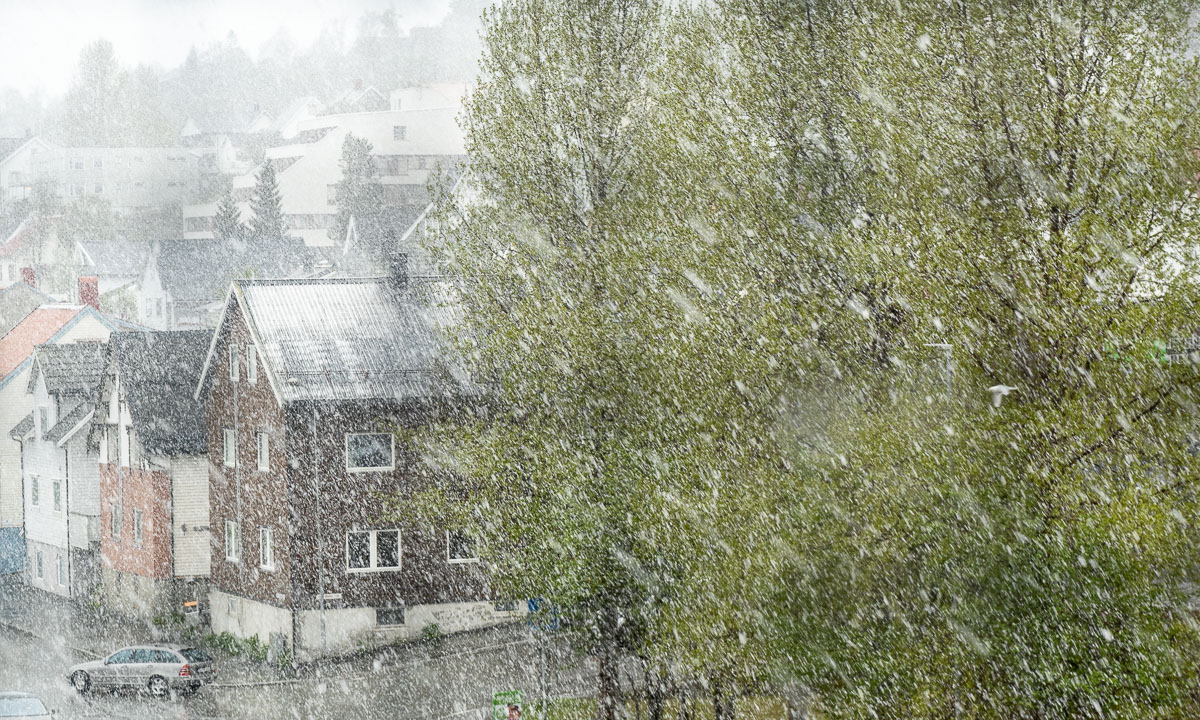
Snowy intermezzo

Last week it felt like spring is finally coming. Flowers were blooming in the forest, the snow had melted away rapidly and even the birch trees finally had become green.

Since then it had been raining a lot. Yesterday it got quite cold and the rain turned into wet snow.

There were snow showers the whole night and this morning, too with temperatures round 0–1 °C. Is this what spring looks like? And we’re talking about the end of May.

Alas it was only a short intermezzo and while the mountains still look whiter than before snow has melted away throughout the day.


My first Thursday paddling 2023

Today I was joining the “Thursday paddling” of the Tromsø Sea Kayakers Club. They started the season two weeks ago, I joined today for the first time this year.

At 18:00 a group of 13 kayakers left the shore by the boat houses and headed to Telegrafbukta, the small bay near my apartment. In the dull weather the kayaks and the paddlers in their drysuits always look quite colourful.

Although I’ve already been paddling in Sweden several times this winter it took me some time to find a rhythm. When I’m alone, I use to paddle slower.

At Telegrafbukta we decided to continue to Sydspissen, the southern tip of the island Tromsøya. There we turned back, paddling through snow showers.

We already saw it on the way there – there was very low water at Telegrafbukta, or just “Bukta” as the locals say. We took a break there but only a short one. The weather was too chilly to be comfortable.

We talked about the weather and came to the conclusion, that summer probably already was on first of May and now summer season is over. I’m not completely sure, if this theory will prove true, but on the way back spring or summer seemed to be far away.

It reminded me at last years first Thursday paddling. It was on 28 April and the weather was as snowy as today. Let’s see how the weather is next week.

Back in Obbola – 20 hours

Sunday 10:30

After a breakfast in the sun heated winter garden Annika and I dress for a kayak tour. Special challenge today is not the frozen bay but the deep snow in our garden. I plunge through the snow, Annika is taking snowshoes while dragging the kayak behind. We are walking over the ice to the small skerry island Lillskär and then turn left until we approach open water. There we start the tour. I give Annika a push, then be both are sitting in our kayaks hopping forward until we reach open water.

We paddle to the islands Obbolstenarna. The way there is fast, a clear sign that we have tailwind. And true, the way back takes much longer. Yes, we are cold, but the winter garden is very warm and soon are we.

Sunday 17:00

A friend from Stockholm is visiting us today. Time to dig out our barbecue place. The two benches are covered with 20-30 of snow and it takes a bit of digging, until they are usable again. On the photo you still can see last day’s ski track crossing the bench.

Sunday 19:00

It gets cold and we have moved to the winter garden again. Blue sky, blue sea, blue snow, blue hour.

Sunday 20:23

A bright greenish light crosses the night, much faster than a plane. What was that? Many other sightings in Sweden confirm my thoughts: it was a bolide, an extremely bright meteor. I never saw anything like this. Since it was a matter of seconds, I couldn’t even think of taking a photo.

Monday 5:45

I wake up. Unnecessarily early for having vacation. Anyhow I peek out of the window. A beautiful morning, and with -13 °C a cold one for beginning of April. I pull ski pants and a down jacket over my pyjamas, slip into my boots and go out to take photos and wait for the sun. The icy edge at the horizon is already sunlit and I can see a weak light pillar above the island Bredskär. Fifteen minutes later the sun rises over the forestal island and I enjoy the sun for a short while.

Monday 6:30

When I’m back in the house it is still early. Time to take off the warm overclothes and continue sleeping …


Moon, Venus, Aurora

I’m sitting in the train travelling home to in Obbola where I’ll stay for some weeks. First vacation, then work. It’s the first time since Christmas. Time to post some photos I shot in Tromsø last week.

While I was in Longyearbyen it snowed quite a lot in Tromsø. The official snow depths last week were round 130–140 cm.

That ended a period of slush, rain and icy roads and my walks to work had become much more pleasant. I love snow!

Then it cleared up. In the evening of the 23 March I could see the young waxing Moon and the planet Venus. And then the polar light came out. Perhaps nothing new but still beautiful.

Skitour on the Austeråsfjellet

Slowly I’m gaining height with my fjellski. It is sunny and almost windless. Round -6 °C. I seem to be alone. I start traversing a slope while continuing gaining height. I’m nervous. I’m not a downhill skier and every metre I ski up I have to ski down again somewhere.

Mission accomplished: I’m above the tree line. Above me the blue ski, below the white snow. And, while I go further I get another blue: The sea.

When I look back I can see the whole island Tromsøya. Somewhere over there in the south, hidden by the wooded hills is my small rented apartment.

I didn’t plan a route for today. I just wanted to be out enjoying the winter. But when a heap of stones marks a top and it’s easy to reach I have to ski there. Mountain summit 1: Kraknesaksla (ca.335 m). With a nice view into the sound Grøtsundet.

According to the map there are some lakes a bit down. The lakes are invisible. There is only snow. What I can see are the buildings. One small cabin and a wee, tiny shed with a wind turbine. The cabin is closed and I cannot see any sign. Probably it’s private.

I continue my ski trip. I have reached a vidda – a plateau.

Now I start to see other people. A single skier, a group of three going uphills, a skier with a dog in the distance. Most locals love to be outdoors but perhaps not as early as I.

I decide to ski to a mountain top I found on my map app Norgeskart. It’s called Jerremaš (467 m) and is a kilometre away. On the way there I see that the group of three heads into the same direction while two others are already returning. Seems to be a popular place.

And it is. I’m not alone. Several other skiers are sitting there, enjoying the sun, talking Norwegian. Almost all of them are 65+.

I look at the 360 degree panorama. There are snowy mountain chains everywhere, the sound Kvalsundet, the island Ringvassøya and somewhere in the northwest the Norwegian Sea.

How shall I continue the tour? Skiing downhills and letting the others watch how I fall face first into the snow? As I mentioned before, I’m not a downhill skier. The others are probably all former Olympic athletes. I decide to take a small detour …

I start to ski down. To my surprise the hills are gentle and the snow is soft and uniform. I manage to ski downhill the broad, snowy slopes and I’m enjoying it. Sometimes I even think, it is too slow.

Much faster than expected I leave the vidda behind. I pass the first trees and see more and more tracks – and skiers. Many of them are skiing on the prepared ski trail that cuts through the valley like a German Autobahn. Others just sit on a mat in the snow taking a break.

A hole in the snow triggers my curiosity. I ski there and look down. A shallow mountain stream flows down there. Open water. It’s comforting that the snow layer is more than a metre thick.

Now it’s only some more kilometres to ski back to the parking lot where I started my ski tour this morning. Although I’m avoiding the prepared ski trail it is obvious, that more and more skiers have been here the weekend. Ski tracks everywhere.

After round about 17 kilometres I’m back at the car. Pretty exhausted and thirsty but very satisfied.

Here’s a map from today’s ski tour. I went counterclockwise. Red is faster than green but still not fast. I’m not a downhill skier.