A small sightseeing tour in Norsjö kommun

One of the disadvantages of a long journey as I made it this winter is that you cannot meet your local friends for a long time. It felt like ages ago, that I was in Kusfors to visit my good friends Martine and Lasse, that I got to know the very first day when I arrived in Skellefteå five years and some days ago.

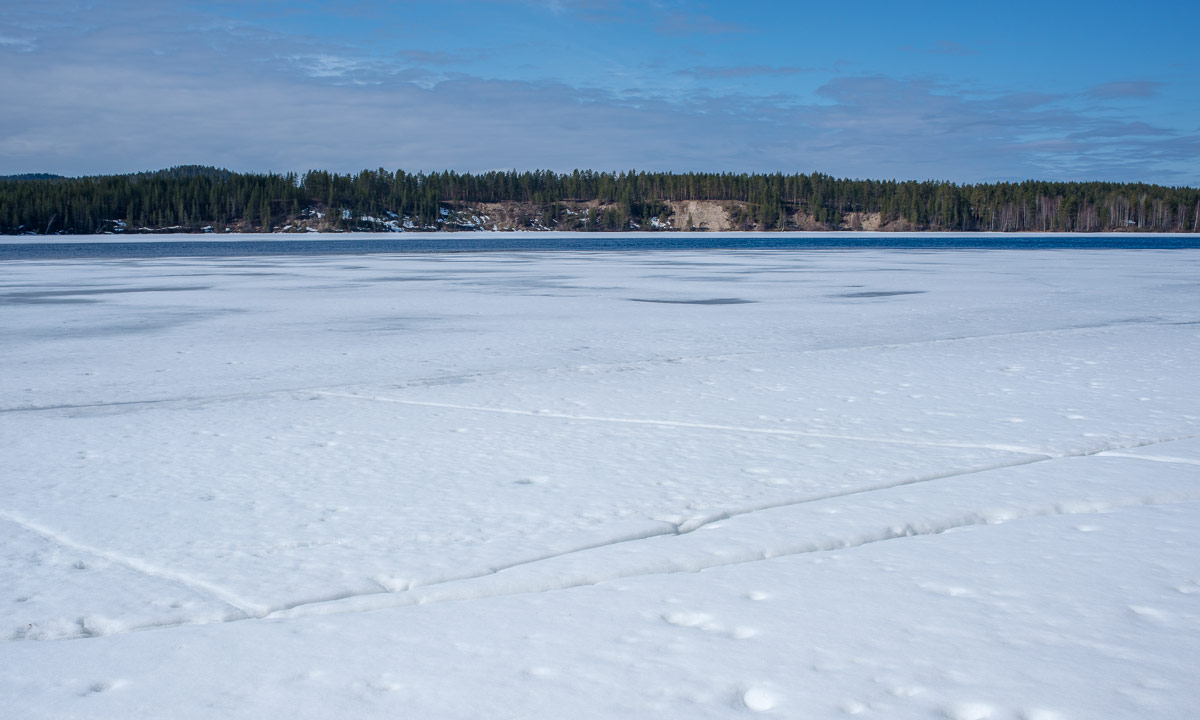
Kusfors is 70 km away from my home and it usually takes my exactly one hour car drive. Yesterday it took longer since I made some detours. There’s a nice minor road along the river Skellefteälven which still is partly ice covered – at the end of April!

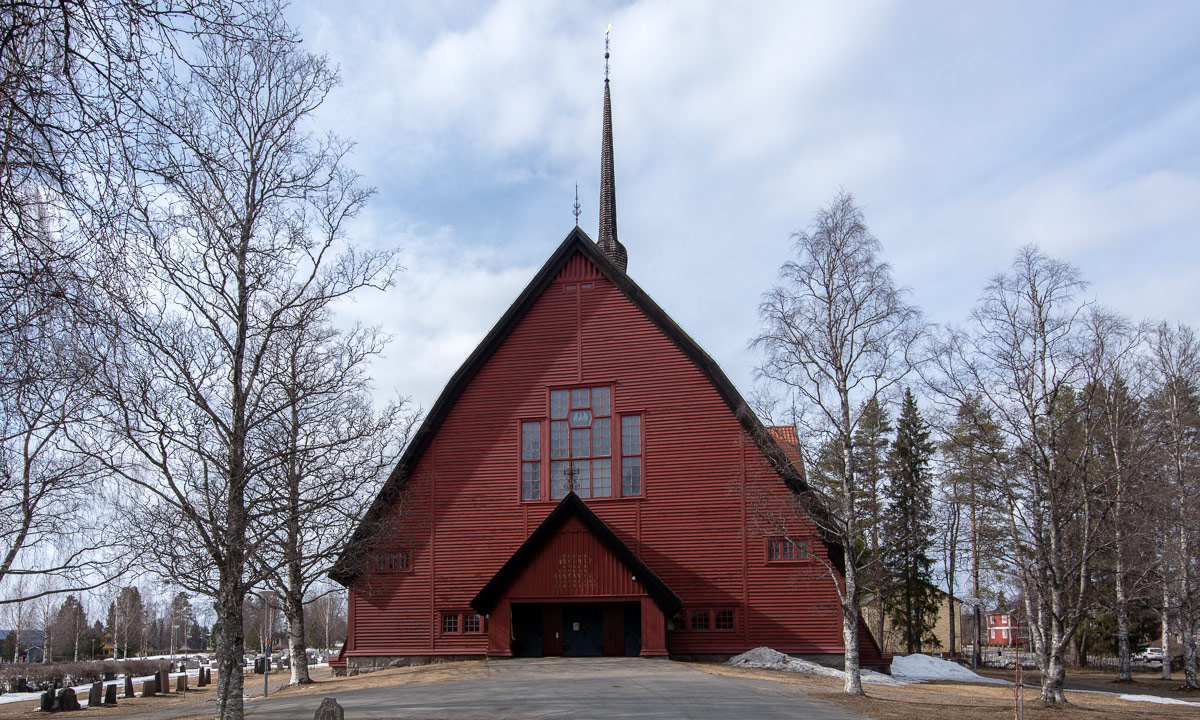
Martine, Lasse and I made a short trip to Norsjö and Lasse showed us around. For example the beautiful wooden church:

Or the ski slope nearby. (We where quite lucky that we didn’t get stuck in the rough clay road when we went up and down):

Or the farm shop in Svansele, that is specialised in carrots and is open 24-7.

But my favourite spot and motive was the old abandoned mill near Norsjö – Norrsjövallens kvarn:

I definitely have to visit this place again with more time and better light, probably in the evening, or even in the night time. (Perhaps with some polar light? …)

Addendum: A black and white version of the last motive:

Asia Zircon I

Skelleftehamn tonight: The “Asia Zircon I” landed in Skelleftehamn. That’s one of the bigger ships – 190 meters long. The ship came directly from Taicang, China with 4599 tons of wind turbine parts.

Taicang – China, that’s a long trip. My travel bug awakes. Perhaps I should join the crew and travel back to China. I’ve never been there. But the ship continues to Fredericia in Danmark, so I guess, I’ll stay home.

Valborgsmässoafton

Valborgsmässoafton, that’s the Swedish name of the Walpurgis Night, which is celebrated on April 30, which is today (or has been 15 minutes before). A friend invited me to celebrate valborgsmässoafton with her family in Aspliden and I accepted gladly.

Beside of nice people to celebrate with you need three ingredients for a typical valborgsmässoafton:

1. Good food.

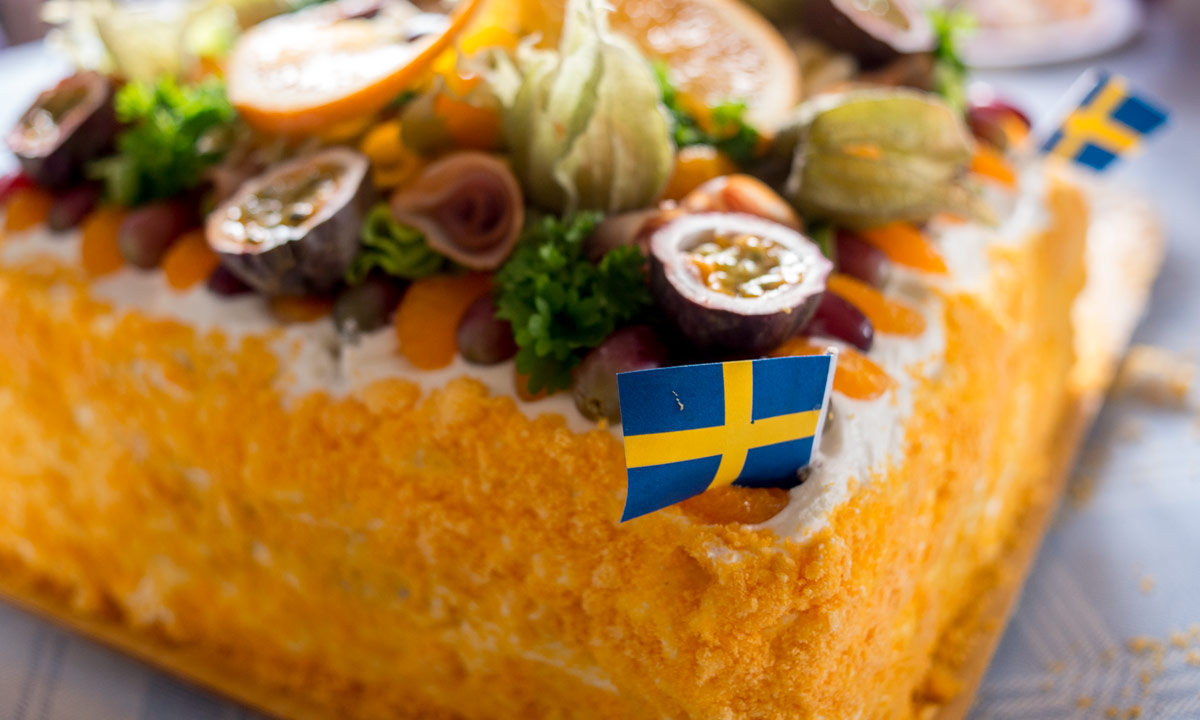
In this case a so called “Smörgåstorta” – a sandwich cake which is a very popular dish for special days as today.

2. A big bonfire.

The bigger the better. It can be quite hard to light a bonfire, because the cut down trees, twigs and branches are mostly very cold and soaking wet.

3. Cold weather, preferably with wind and snow showers.

While the first half of the day was sunny, clouds came in in the afternoon and round 8 o’clock we got our first snow shower. Last year it snowed as well.

Most Swedish people don’t think at all that chilly and snowy weather must be a part of the valborgsmässoafton, put it’s quite typical.

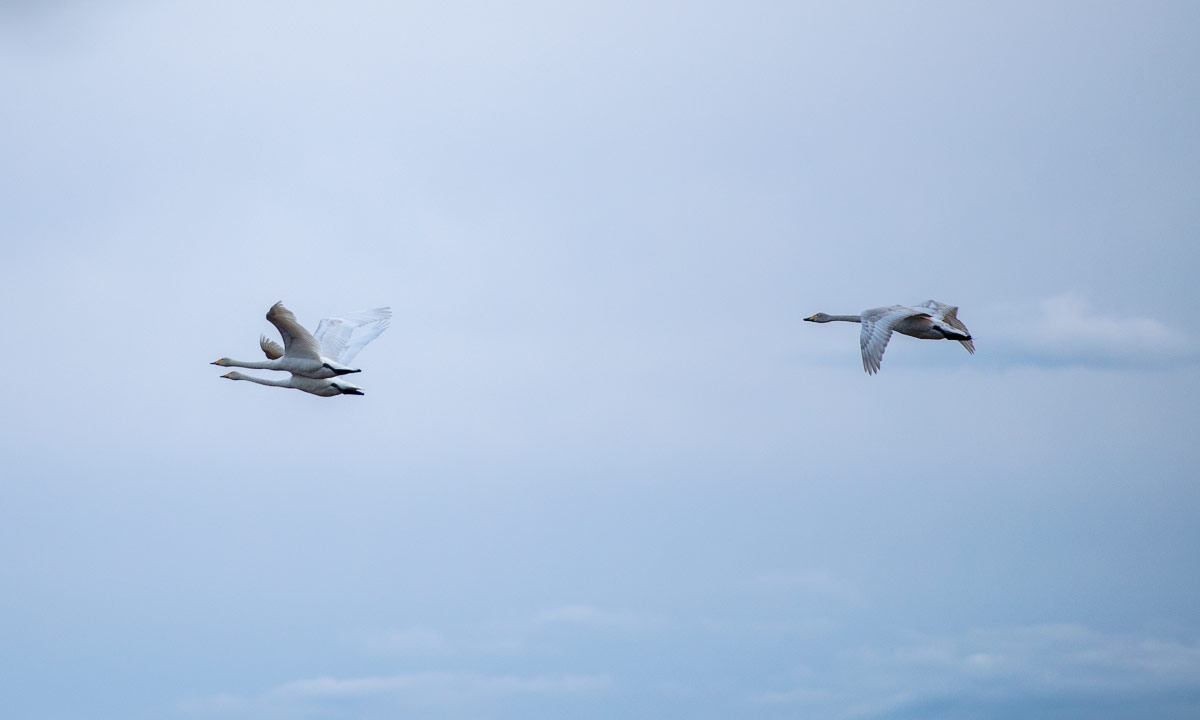
And just an off-topic photo from today. Three whooper swans that I saw today at the same place.

Paddling round Storgrundet

Two weeks ago the sea between the island Storgrundet and the mainland was still partly ice covered. Today I paddled round Storgrundet and couldn’t discover any ice left. The view of the blue sea almost looked like spring, but it didn’t felt like spring at all, it was very windy and chilly. When I left the protected bay I tried to make some photos but soon gave up since I was blown back ashore faster than I could take my camera out of its pocket. I only made a selfie on which it’s quite visible that – measured by temperature – spring hasn’t come far yet.

At the outside of the island I didn’t had a chance to release the paddle for a photo, too high were the waves. I regretted soon that I paddled without spray deck, because some of the bigger waves made it into my kayak. The next photo I made in a sheltered bay, where the water finally was calm enough and I could empty my kayak with a sponge (it wasn’t so much water, that came in).

Some hours later …

I had a look at “kanotudden” (literally: the canoe bay), a bay of the river Skellefteälven, where the ice is finally gone, too. Almost. There is some leftover ice, mostly crushed to small bits that were jingling and clanging with each arriving wave. But even the small bits were still solid enough to bear a wandering wagtail looking for food.

The canoe club, which is located at kanotudden still seems to be in hibernation, I’ll have to check later …


Nu grönskar det …

I have an “Ohrwurm” – an earworm: a piece of music that lingers in my mind. It’s a Swedish folksong based on a part of Johann Sebastian Bachs cantata “Mer hahn en neue Oberkeet”.

The text starts with “Nu grönskar det i dalens famn” which means “Now it flourishes in the valley’s arms”. And so it is: The birch trees in Skelleftehamn start to open their leaf buds and slowly, but surely nature becomes green again. And now – after much rain in the morning – even the sun came out. We had rain, now we need warmth and nature will explode. Sometimes spring in Northern Sweden is not a season but just a short switch from winter to summer.

Some images of a short kayak tour

Today I took a short tour from the small boat harbour Killingören, just 650 meters away from my house. After taking the Kejsar Ludvigs kanal – a small channel, that splits the peninsula Rönnskär – I headed to the small island Kalkgrundet, where I landed my kayak. In the shadow of the trees there’re still some patches of snow left – up to 30 centimetres. I guess it’s the leftovers of a huge snowdrift.

I walked round the island and saw a Canada goose swimming nearby. One more step and I saw another one fleeing from land to sea. It was really near but I didn’t see it before it fled. I took some photos and continued my walk. Then I saw the reason why the geese didn’t just swim away: They were nesting. Sorry, my geese, I didn’t know this. I took a very quick photo of the nest and continued walking round the small island. When I was round the corner I peeked back and could see the geese going on land again.

I continued my kayak tour to an old pier at the shore of Örviken. From the distance it looked quite stable, but when I came closer I could see that it was ruinous and many of the wooden logs wobbled in the tiny waves.

I crossed the Sörfjärden and entered the bay Kurjoviken.  I could see the bright coloured blossoms of the marsh-marigold (Caltha palustris). I love these flowers and when I was home again two hours later I visited the place from land to make some photos. Here they are:

Travelling back in time

Believe it or not, it is possible to travel back in time, at least some weeks.

Here in Skelleftehamn near the coast the ice on the Baltic Sea, the river Skellefteälven and all lakes is gone and all birch trees are bedecked with green leaves.

Yesterday I had a gig in the Skidstugan Stenabäck – a small ski hut between Norsjö and Lycksele. On the way there I could see the birch trees being less and less green until they were leafless again. As I said – like travelling back in time. But I was even more fascinated by the fact, that parts of the lake Stor kvammarn were still covered with ice.

Just at the driveway to the ski hut some reindeers were hanging around. I saw them again several times this weekend. The group was easy to recognise because of the white reindeer with the pale pink horns.

I stayed over night and so I got the opportunity to make a picture of the incredible evening sky. It looked like clouds burning in slow motion.

Today I took a short tour by car with R. who drove along some forest roads nearby. We saw a young moose standing in the forest and just beside the road a Western capercaillie probably looking for a hen.

Then I took my own car and drove home, not the fast and boring main roads but the smaller ones. I saw four more moose on three different  places. Five moose total – a new record, but there all were quite camera-shy, trotted away and hid in the dense forest – one even crossed a small river and even if I couldn’t see her anymore I could still hear her feet splashing through the water.

One photo through the windscreen – just for the records.

Translation:

EnglishGermanSwedish
western capercaillie, wood grouse, heather cockAuerhuhn/Auerhahntjäder

A short trip to Umeå

I have to admit, that it felt a bit strange to travel to Umeå. For one thing it’s a big town and for another thing it’s south from Skellefteå and that’s not my usual travel direction.

You may laugh at me calling Umeå a big town. Umeå has 80000 inhabitants and that may not sound very much, but the whole city with its many big buildings and streets feels much bigger, especially if you compare it to Skellefteå – the next town nearby – which is less than half as big and appears only a tenth as busy as Umeå.

I stayed over night in a hotel in the 12th floor with a nice view over the town and the river Umeälven. What a pity that it rained almost the whole time.

Today it still rained a lot and I didn’t have any interest in city sightseeing. So I fled the town and took a long walk in nature. That’s much more my cup of tea.

Submarine flower

I love the golden yellow blossoms of the marsh-marigold. They bloom and gleam all along the shallow shores of ponds, lakes and rivers. They love water.

Me too, I love water as well! But I like it less when it comes as rain. And this year’s May has been extremely wet, it rained many days. Beside of this the snow in the mountains is still melting and fills the rivers and streams with water. The result? High waters. And submarine marsh-marigold that I discovered at some places round the Innerviksfjärden.

Translation:

EnglishGerman
marsh-marigoldSumpfdotterblume

Dreaming in cardinal directions

I love the … east, west, north and the south of you

Cole Porter in “All of you”

I love the winter and therefore the North, that’s why I called my blog way-up-north. But there may be other nice directions as well, as for example south, east or west. Today I’ll invite you to accompany me on two journeys. Virtually and right now! We’ll travel round 57000 kilometres in total, but don’t be afraid, it won’t take long.

Let’s start with the longer journey:

Longitudinal journey – ca. 40000 km

Let’s start in Skelleftehamn, where I live. We enter our magic flying carpet and just head south. Already 44 km later we leave Sweden, cross the Baltic Sea and enter Finland. We traverse the Baltic Sea again, next countries are Latvia, Lithuania and the Kaliningrad Oblast, with is part of Russia. Remember? We fly south, not east! Next countries are Poland, Slovakia, Hungary, Romania, Serbia, Kosovo, Macedonia and Greece. Skelleftehamn is quite an eastern place, countries like Denmark, Germany or even the Czech Republic are more in the west.

Time to undress the jacket, we’re crossing the Mediterranean Sea. Soon Africa is within sight and we fly over Libya, Chad, the Central African Republic and the Democratic Republic of the Congo, where we cross the equator. Next countries are Angola, Namibia, Botswana and South Africa, where we leave the African continent at a nice sandy beach.

Time for the jacket again, we’re continuing the journey south. I hope, you love water, because it takes us almost 4000 km flight until we reach the next continent: Antarctica. I hope you brought your warmest jacket, the flying carpet has no heating. 2250 km later: The South Pole!

Antarctica is one of my dream destinations and I would love to travel to this place. But this is probably the most expensive of my travel dreams and I’m not sure if the dream will come true some day.

The flying carpet doesn’t stop, it just continues straight ahead. It flew south on the longitude 21°15′ E, now it heads north on 158°45′ W bringing us back on the other side of the Earth. We are still over Antarctica and fly another 1300 km until we are over the sea again. I really hope, you love water, you will see a lot of now. We reach the equator again without traversing a single island! Later we fly cross Hawaii between the Islands Kaua’i and O’ahu, but still only water under our flying carpet.

It takes us almost 15000 kilometers from Antarctica until we finally reached land again: Mitrofania Island, part of the Aleuten, part of Alaska, part of the USA. Our flying carpet doesn’t stop – we just traverse Alaska heading north until we reach the Beaufort Sea. Now we’re over open sea again, probably partly frozen and we reach the North Pole.

That was the only mainlands on the other side of the earth: Antarctica and Alaska, that’s all! Now the flying carpet has its original heading again: south on longitude 21°15′ E. To my big delight we’re traversing Svalbard.

Svalbard is another of my dream destinations but there are a lot of polar bears around. You should (a) know how to avoid them and (b) be able to use a weapon. I neither know (a) or can (b), so it’s probably a more future destination for me.

We leave Svalbard continuing our flight south. Soon mainland is in sight and we enter Norway, Finland and finally Sweden. After a while we see a minor town at the seaside and a green painted house surrounded by grass that is in the urgent need of being cut.

We’re home again in Skelleftehamn. Time to take a short break until we’ll start the other journey. You’re invited to follow, it’s shorter than the first:

Latitudinal journey – ca. 17000 km

I throw a coin, will we head east or west? The coin says: “East!”. OK, let’s enter our magic flying carpet again and start.

After 1500 meters we reach the Baltic Sea and after that Finland. I hope you can read cyrillic, the next country is Russia and it’s huge! It will take us round 7000 kilometers flight just traversing Russia. The last parts of Russia that we cross are the Sakha Republic (also known as Yakutia) and Chukotka Autonomous Okrug.

Yakutia is another dream destination. As a fan of cold weather I must travel to Oymyakon, probably the coldest inhabited place on earth, one day. But I’ll be disappointed if I won’t experience at least -55 °C, -60 °C.

The flying carpet continues and soon we’re over the North American Continent, first Alaska, USA, then Canada. In Canada we hardly see any people, just some Inuit, since we’re in the Canadian Arctic that has a much extremer climate than Sweden. The last part of Canada we traverse before the Arctic Ocean is Baffin Island.

I’ve never been in Canada and I definitely want to travel there, both in Autumn and in Winter. There are many places that are interesting to me, amongst others Nunavut and Labrador, but some towns as well.

The next mainland: Greenland.

Greenland, another dream destination, probably in wintertime.

The next mainland: Iceland.

Iceland, yet another dream destination, too, in all seasons! I need a sponsor!

The next land is better known to me: Norway. Always extremely beautiful and not too far from my home. But the flying carpet flies on,  crossing the Norwegian-Swedish border, flying over the fjäll, the forests of the inland, the town Skellefteå and finally lands gently on the grass of my backyard. Home again!

Thank you for following me on theses journeys. It was fun, wasn’t it? What were your dream destinations on these trips? I’m looking forward to your comments!
Almost like summer

For me it’s not the warmth, that makes a Swedish summer, it’s the colours! Blue sky, green birch trees and meadows with yellow flowers – dry ones with dandelions or very wet ones with marsh-marigold – both are just beautiful.

Translations:

EnglishGerman
DandelionLöwenzahn
Marsh-marigoldSumpfdotterblume

Midsommer colours

Finally it’s summery and warm in Västerbotten! Yesterday the car thermometer showed  20 °C for the first time this year, if only for two seconds. All people were out yesterday to celebrate midsommar. All mosquitos were out as well; there are a lot of them this year because of the wet May. Today I didn’t drive the direct way home but took some detours. It’s like loading the batteries with fresh colours and save them for the winter to come. The photos below are all taken in Kvarnbyn, a nice village near Burträsk.

Just beautiful!

Storberget

Storberget – “The big mountain!” A bit more than 90 meters high, which sounds completely ridiculous, if you live in Norway, near the alps or another place that has real, big mountains. But Storberget is a mountain, too, with a lot of rocks, a small ravine and a view on the near Baltic Sea and some islands. And it’s near, just fifteen minutes by car and a walk through the forest.

Umiak I

It started like many kayak trips: I put out to sea at the tiny beach Storgrundet without any plans at all. Unlike yesterdays weather forecast it was a nice and sunny day, although not very warm. Since the sea was calm I paddeled along the seaward sides of the islands Storgrundet and Brottören, crossed the Bredskärsviken to the islands Norrskär and Bredskär, continued at the east side of Flottgrundet and headed to Gåsören, probably my favourite island nearby. Some photos:

But much more fascinating than nature, birds and islands was the moment when I looked at the horizon and saw the faint but large silhouette of a big ship. The blurred outline looked more like a fata morgana than a real object. But I wasn’t the only one watching the ship. Two tugboats came from the port to bring the ship into port.

T., whom I met on the Island Gåsören knew the ship. It’s Umiak I, an ice breaker, that can break 1.5 meter ice and still going 6 knots (ca. 11 km/h). Impressing! I do like summer, but I really adore winter and started dreaming of travelling with the Umiak I in winter and cutting through solid ice.

Later today I made a better image of the ship in port.

It’s at least so famous, that it has its own Wikipedia page! I looked at Shorelink as well, to get some more information:

  • Cargo: 9257 tons copper concentrate
  • Coming from: Edwards Cove via Brunsbuttel

Of course I had to look up Edwards Cove, too. Never heard the name before. If the internet is right, Edwards Cove is a harbour west-northwest from Nain in Labrador, Arctic Canada. If the ship would go back the same way, I guess I would ask for a lift.

Links:

A curious squirrel

I love to take pictures from animals. Most animals doesn’t share this pleasure and flee – either from me or the camera with the big telephoto lens. Today I was lucky. A squirrel sitting in the tree stared curiously at me giving me time to change lens and make some pictures. It’s only after I went directly to the tree to come nearer, the squirrel scurried up the tree. But I got my portrait.

A hike and three tests

Do you remember Nokia? Cell phones and rubber boots? Today I tested a quite similar combination: Rubber boots and a Nikon lens. Plus a hiking trail.

A few weeks ago I discovered a big information board at a forest edge in Skelleftehamn. It describes the “kraftleden”The force trail or The energy trail. Perhaps the trail is named after Skellefteå Kraft, one of the sponsors I thought when I read the information.

Today I decided to try to hike the 18km long trail. I had two new things with me: My new rubber boots Tretorn Sarek which are made for hiking and my new lens Nikon 100mm f/2.8 (Series E), that I bought secondhand some days ago.

After a one kilometer walk I was at the starting point.

At the first junction I was lost, since I couldn’t see a sign. But after checking my photos of the information board I learned that the way marks where orange coloured blazes round the trees. That’s easy. The trail itself however wasn’t easy at all. It looked more like an area where you cut down trees and bushes. Like a stork I stalked through the cut down branches and twigs that lay criss-cross on this so-called trail hoping for a better path.

And the trail got better. But I still was slow. This time not because of the trail but of my new lens. It’s my first lens ever without an autofocus. This means that I have to focus manually at the lens itself. It took some time until I got used to it, but I still had to control every single shot on the display and I had to make some photos five times until I was satisfied.

I continued the trail – now a nice stony path until I came to the Örberget – altitude 40 meters, 30 meters higher than the starting point. It doesn’t take much to be called a mountain here. I made a photo of a “gravröse”, a tomb from the Bronze Age. Probably it was build at the shore some thousand years ago but the land has been rising round a centimeter a year since then.

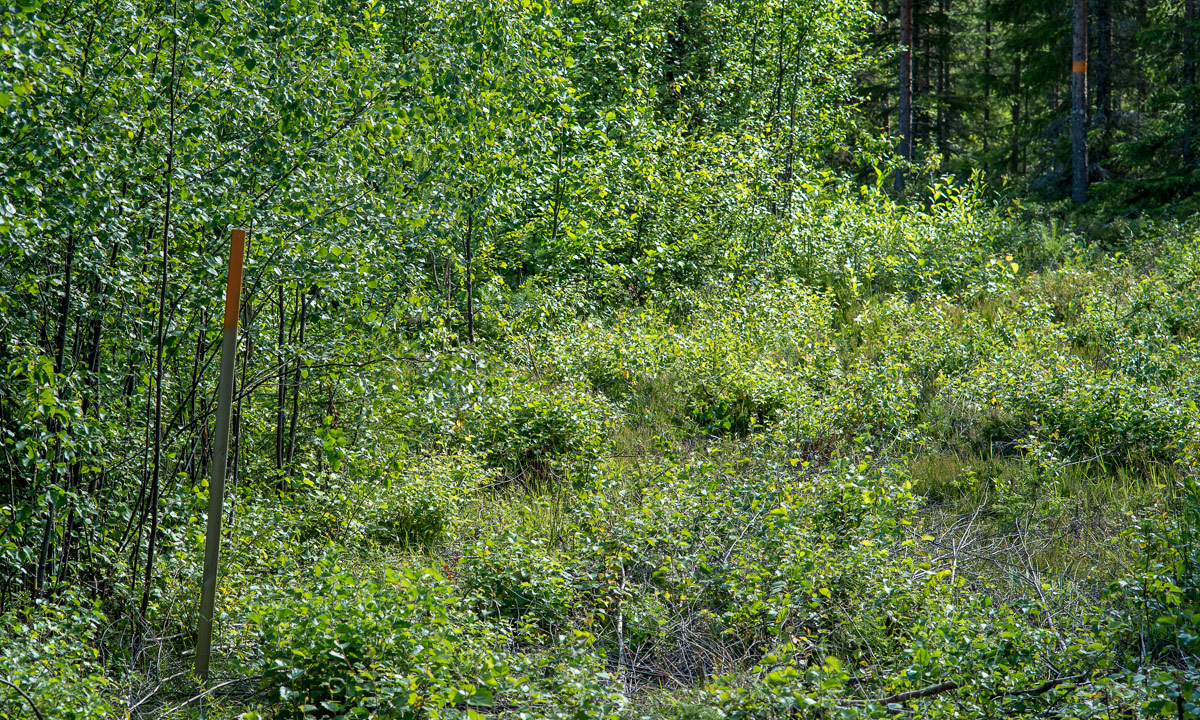
I continued the walk. The ground became wet and muddy and after a while I stood in front of a bog. In the middle of the bog I saw a wooden post with an orange blaze. OK, let’s go …

… now I knew, that the new rubber boots were not only comfortable but really waterproof. I didn’t get soaked, but it was quite close.

I always had to look down carefully to avoid the deep water and mud puddles, and I had to look forward to find my way. When I looked up I started to suspect why the trail was called kraftleden. Almost the whole trail followed the transmission lines and the Swedish word for transmission lines is kraftledning. That’s a really pragmatic approach to make a trail since some kind of path was made already to mount the power poles. But it’s not very inspiring just following the lines and not beautiful neither.

After round 11 kilometers I made a rest on a high seat normally used for hunting moose.

I continued the tour but I started to lose interest a bit. Parts of the way were hard to walk, harder than many mountain trails but without the reward of a beautiful landscape or great views. In addition of that I started the tour round half past two and I didn’t want to come to town too late. So I left the kraftleden and walked southwards through the forest. At the beginning I found some nice flowers and I changed the lens to a macro. First two additional test images of the new 100mm lens, then two flowers – a dactylorhiza maculata and a linnaea borealis:

OK, I have to admit: I tested four different things, not only three. Number four was a mosquito protection jacket, that came in quiet handy when I shot the macros of the flowers. Flocks of mosquitos darted for my blood, but they didn’t had a chance beside of biting into my unprotected hands.

After taking the flower images I had to walk some other kilometers until I came to the main road and another one to come to the bus station where I had to wait half an hour for the next bus. Happily I slipped of my rubber boots to try my socks, sat down and waited. Finally the bus came and half an hour later I was home. The GPS displayed:

19.0 kilometers · average when moving: 4.3 km/h · total average: 3.3 km/h

And here come todays test candidates:

Rubber boots Tretorn Sarek: Really nice and comfortable boots, perhaps a nuance too tight for me. They are made of natural rubber and it’s easy to turn the upper upside down. They could be a bit higher.

For me: 8 points out of 10.

Nikon 100mm f/2.8 (Series E): A small, lightweight lens with manual focus. I have to practise focussing. I prefer my huge Nikon 70-200mm VR II, but there’s a reason why I bought the former one: At the end of August I’ll start a two week hiking tour in the Scandinavian mountains and I want to save weight. The 70-200 weights more than 1500 gram, the new 100mm only 215 gram. Got the point? And it was cheap, too – only 53 Euros.

For me: 7 points out of 10.

The trail kraftleden: The only advantage of the trail is that you avoid navigation. Beside of that it’s an awkward combination of a trail a bit too hard to be nice and a bit too boring to be beautiful. I wouldn’t recommend it. If you want to give it a try, take high rubber boots and plenty of time with you. Take care and follow the way marks if you don’t want to end in almost knee deep mud as it happened to me today.

For me: 3 points out of 10.

The nameless mosquito jacket: Perhaps it’s not fun to walk within some kind of mosquito net but it was great, when I took the macro photos of the flowers. The hood is too big. Since it’s very light – only 214 gram – I will take it with me on all summer photo tours and perhaps even on the planned mountain hike. And with costing only 18 Euros it was a bargain, too.

For me: 6 points out of 10.

Translations:

EnglishGermanSwedish
Dactylorhiza maculata / heath spotted-orchid / moorland spotted orchidGeflecktes KnabenkrautFläcknycklar
linnaea borealisMoosglöckchenLinnea
upperSchaft (am Schuh)skaft