A ski tour in the Kvikkjokk mountains – day 4

This article is part of the series “2018-02: Ski tour near Kvikkjokk”.

Day 10 of my winter journey 2018

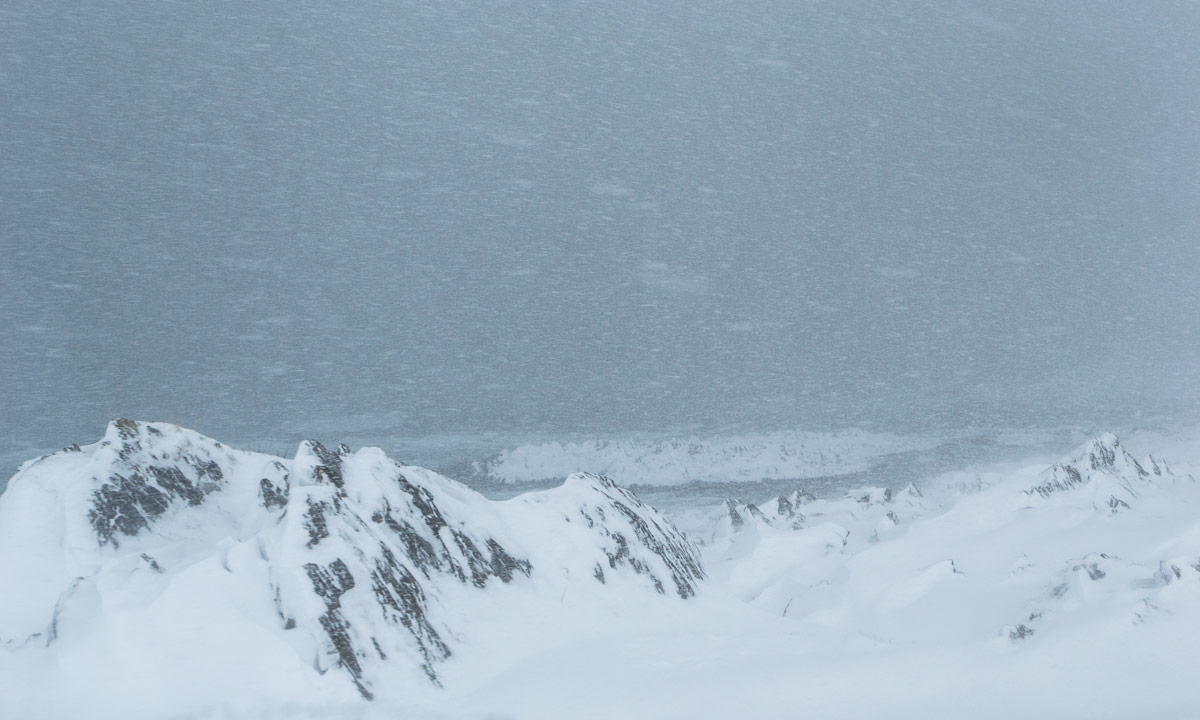
After two days in the Njunjesstugan Jonas and I continued our tour in the mountains west from Kvikkjokk, The weather continued to be grey and dull with temperatures round -11 °C and last night’s snowfall brought five to six centimetres of downy snow.

The winter trail led through forests and hills – one of them so steep, that we hardly managed to ascent it by foot. I guess, that some of the people marking the way prefer the snowmobile before the skis and adapt the trail to that …

Soon we reached the lake Darrávrre which we followed to the mountain hut Tarrekaisestugan. We made a rest, not to stay there but to simplify the continuation of our ski tour. The next tour would lead uphills and we wanted to reduce weight. Therefore we left food, paraffin oil and some spare clothes in the wood shed and took only food for two days with us. After two days in the higher mountains we would return to the hut.

We carried on. By crossing the lake Darrávrre to the west we left the hiking trail Padjelantaleden. On the other side of the lake the trail climbed up the hill. It was not as steep as feared and even if the ascent was quite exhausting for me we managed to get up to the tree line.

We reached an altitude of approx. 680 meter. Here we left the trail and erected the tent in the twilight between some birch trees. This time the snow was stable after tramping it down with the skis and we hadn’t to dig down as three nights before. It had become even warmer: -7 °C and it snowed. Both of us were longing for clear, crips and sunny winter days but it didn’t look like we would get better weather. At least it wasn’t as stormy as forecasted.


A ski tour in the Kvikkjokk mountains – day 2 and 3

This article is part of the series “2018-02: Ski tour near Kvikkjokk”.

Day 8 and 9 of my winter journey 2018

After the first night in the tent (it was a cold one!) we were eager to continue the tour. The tent was packed and so were the pulkas. We started by skiing through powder snow – a slow movement. I guess I hardly reached 2 km/h in average and I definitely was much slower when I had to go uphills. We looked for a good place to access the river again since it was much easier to follow the stable snow on the snowmobile tracks. After a while we found a good place to enter the river bed. Mostly the winter trail followed the river, only twice it continued on land where the river is narrow and had open water.

After some kilometres the river bent southwards and our trail left the river to continue more westwards. We continued the snowmobile tracks that led through forests and over smaller bogs.

We started to think about reaching the mountain hut Njunjes but weren’t at all sure if we would reach it before darkness. Anyhow, we didn’t had any pressure, since we had anything with us which we need for tenting:

  • a tent (of course)
  • down filled camping mats
  • very warm sleeping bags and vapour barrier lines
  • warm clothes from head to foot
  • a lot of food
  • a paraffin oil driven cooker
  • … and much more …

The way was easy but the pulkas were heavy loaded and after hours of walking I started to get tired and exhausted. That’s one of the reasons why I hardly made any photos. Another reason was that both my cameras refused to work in the morning with temperatures round -30 °C. It became warmer, but it was still round -25 °C, although it had become cloudy and overcast that day quite early.

Beside of a longer and a shorter rest we continued skiing, now with the defined goal to reach the hut. It started to get dark but we knew that we only had to go another hour or a bit more to make it.

After a while it went so dark that we skied with headlights. The buildings of Njunjes had come into view but they were on the other side of the river. When we were on a level with Njunjes we realised that the river became a quite deep ravine, probably with open water and quite impossible to cross …

… but we were really lucky: there was a metal chain bridge that led over that very ravine. It was quite a fight to climb up the slope after crossing the bridge, but with a lot of pulling (and without our skis) we managed it.

Soon Jonas found the open winter room with was made for people like us who like to travel off-season. A stove, wood, a bunk bed for two people, hooks for drying clothes, a table and two stools – anything to stay here for a night or two.

Day three was a day off. It was warmer than the day before and mostly dim and cloudy. I took pictures of the chain bridge, the mountain hut and the landscape (as far as it was visible)


After breakfast we attached new climbing skins to my skis and took a ski tour. First cross the river again and right to the sun. Then up some minor hills through sparse birch forests and eastwards to meet the branch to the hut that we had missed the day before. The skins worked well but it was almost a pity to have them attached to my skis since they slowed me down when skiing downhills through the loose powder snow. The sun was hardly visible through the clouds and the landscape almost looked sepia – like an old black and white photo.

First it only snowed a bit but when we finished our tour and arrived at “our” mountain hut snowfall increased. While Jonas was busy sawing and chopping wood I took a small nap.

In the evening we planned to continue to Tarrekaisestugan the next day – the next mountain hut in the west – and probably to continue and tent again in the wintry forests.

Photo #2 in this blog article is made by Jonas Balbasus.

A ski tour in the Kvikkjokk mountains – day 1

This article is part of the series “2018-02: Ski tour near Kvikkjokk”.

Day 7 of the winter journey 2018

I’m really glad, that my friend Jonas and I managed to realise a ski tour this year. It’s our 3rd ski tour together, but the last one was five years ago. A long time. Actually we had planned for eleven days, but due to severe snow falls between Gävle and Sundsvall two weeks ago the whole train traffic was cancelled and Jonas arrived more than two days later than planned.

On Wednesday, 7 February we left Solberget and took my car to Jokkmokk, where we bought food for nine days. Anything from muesli (with powdered milk), tea and chocolate to pasta with pesto, salami, potato mash and much more. Have a look:

After taking a lunch we continued to Kvikkjokk. The weather was sunny and the temperatures sank below -20 °C. In Kvikkjokk we packed our pulkas, transport sledges you carry behind, locked the car, put on the skies and started our tour. First along a road, then on a snow mobile track. We didn’t come long when we met a local with a snow shovel who asked for our plans. He looked at our heavy loaded pulkas and mentioned that we would have a hard time in pathless terrain. He said, that it was 100 cm of snow in Kvikkjokk and 150 in the mountains.

I reparked my car – another tip of the local – and we started our tour again. With his permission we used his private snowmobile track that led us to the river where it joined a larger snowmobile track. It already had been starting to get dark and our plan was to find a place for our tent quite soon. We weren’t alone on the river – two moose (mother and calf) stood on the river some hundred metres away. We waited until they left and continued. The river slopes were quite steep and after we had decided to leave the river we had to put off our skis and drag the heavy pulkas up through hip deep snow. Exhausting! At least we found a nice little clearing in the forest for our first night in the tent.

As usual we started to tramp down the snow with our skis to make it stable enough to bear the weight of tent and ourselves after some time. This snow however was so loose that it seemed impossible to us to erect the tent on top of it. Therefore we digged down half a meter (making round 6 cubic meters of snow to dig) and erected the tent in the hole. The temperature had continued to fall, now down to -25 °C. Finally the tent was “ready for occupation” and we were eager to eat something warm.

After Chinese noodles with some asian ready-made sauce we left the tent and watched the amazing clear starry night. The milky way gleamed over half the sky and Sirius had just started to rise on the eastern horizon. What a wonderful first night!

… and a cold one. When we started to sleep the temperature had fallen to -30 °C. Jonas and I have huge down sleeping bags and we had it warm and cozy anyway. I just had problems to sleep because I don’t like sleeping on my back and always have trouble to fall into sleep the first two, three nights when tenting.

Next morning: Clear blue sky, some feathery clouds that just started to colour purple. Jonas’ thermometer at the pulka showed -34 °C. It was completely calm and we decided to cook outside. Cooking in the morning mainly means boiling water for tea and for making milk for the muesli. I was glad about my warm mukluk boots, down pants and my puffy down parka. And finally the sun rose over horizon and trees.

Today we would continue westward to the mountain lodge Njunjes and probably sleep there.

Photo #1 and #6 in this blog article are made by Jonas Balbasus.

29 August: Kungsleden day 10 – Alesjaure—Abiskojaure (7+15 km)

This article is part of the series “2017-08: Kungsleden hike”.

From Alesjaure to Abiskojaure it’s round about 22 km to go. That’s the longest day’s march on that part of the Kungsleden. The first 7 km go along the lake Alisjávri which is good for a special reason: In summer there’s a boat shuttle service that allows hikers to skip this part. We all decided to take the boat, both to shorten the distance and to enjoy the boat trip itself.

Since the first regular boat starts at 10 o’clock we had a very relaxed breakfast with a lot of time. The quite large shop had fresh eggs so we had the pleasure of boiled eggs for breakfast. And very special egg cups …

The sun came out and illuminated the Alisvággi, the valley that leads to Tjäktja.

We went to the shipping pear already at 9:30, to go sure that we would find places on the boat. Andi ran up the yellow flag – the signal for the boatsman. The sun came out and I decided to take a bath. Not so easy, since the water was only knee-deep (and as icecold as expected).

Soon the boat arrived with stugvärd J. onboard. He was out fishing and succeeded: eight big arctic chars he caught.

At ten o’clock we departed. I could have stayed on the boat for hours, not only because I love to go by ship or boat, but even more because the sami boatsman had so much to tell.

He was living in Alesjávri for the summer “together with his dog and three common gulls” to run this transport business that he considers as a holiday. In September he would continue herding his reindeers. There are 17 families left in his sameby that do reindeer husbandry full time. (A sameby is kind of juridic and economical collective for reindeer husbandry.) He told us much more (all in Swedish) but after barely half an hour we arrived at the other shipping pear and went ashore.

When we started to walk it started to rain – bad timing. It was more a series of rain showers and I put on my hood and put it off again many times. Almost all mountains lay in the clouds, only the Ádnji seemed to have sun the whole time.

While we went on something chirped. Beep – Beep – (silence) – Beep … . We had heard that sound before on our hiking tour, but it was the first time that we could spot the matching bird. It was a golden plover as we figured out later. The bird was a bit nervous while I crawled nearer and nearer to get a photo, but it didn’t flee. Unfortunately my travel tele lens is not the best but I got a photo anyway.

We crossed the long reindeer fence that separates the sameby Laevas in the south and the sameby Gabna in the north. We just had to climb some stairs, where the Kungsleden crossed the border.

I knew that I had to say farewell to the treeless kalfjäll soon. In a short while we would enter the valley Gárddenvággi that would lead us deeper and deeper into more forested terrain. I was a bit sad, when i said farewell to that wonderful landscape.

The next kilometres were rainy, stony and muddy and we all just wanted to arrive in Abiskojaure, well knowing that it still would take some hours until we would arrive. I just trotted along and didn’t use my camera until we arrived in Abiskojaure. Here we finally made the photo of our four backpacks that we had talked about for days, but I was much too lazy to arrange it nicely.

The rain had stopped and the sun came out again so I took some last photos of the day, eager to eat something and to relax in the sauna.

Since Abiskojaure is the last hut before Abisko we found a lot of leftover food as dried vegetables, noodles or tuna sauce. That gave us a formidable afternoon meal. While we prepared for the sauna we heard, that there were moose on the other side of the lake. Indeed two female moose stood there in the wateraquatic plants. There were far away but we saw them dipping there heads into the water (they could hold their breeze really long) and eating aquatic plants. We saw them wading, swimming and shaking out the water. They had spotted us but knew that we were far away and no danger for them.

Katrin, Annika and Andi headed for the sauna, I watched a bit longer. When I went back to the hut I saw some others photoing something. It was a huge male moose, that stood amidst the huts and seemed to be not at all shy. I never saw a male moose so close! The moose went away, but stopped again, when he found rallarros flowers between the old toilet building and the wood shed. While watching us all the time he continued picking flowers with his huge mouth and eating them. At least twenty people stood there, watching, photographing and filming. Since all were quite sensible – no one was too hasty, too loud or came too near – we all could watch this big animal for some minutes. Then it took some step into the forest and almost instantly vanished in the shadows. What an experience!


28 August: Kungsleden day 9 – Vistas—Alesjaure (18 km)

This article is part of the series “2017-08: Kungsleden hike”.

Today Katrin, Annika, Andi and I would continue to Alesjaure, the longest distance to walk so far.

The morning was frosty with -2 °C and the petals of the flowers called rallarros (rosebay willowherb or fireweed) were covered with ice.

The sky was blue, the sun was shining, we had picture-book weather. As a photographer I would have preferred to hike two weeks later when leaf coloration would be in progress, but you can’t have everything. Anyway, the photo of the bridge over the Visttasjohka right at the Vistasstugan looks like a postcard motif:

This spot looked quite Canadian or Alaskan to me. I almost expected to spot some huge grizzly bears catching salmon in the river. But we’re still in Sweden where bears are brown bears and (luckily) very shy.

The first kilometres of the trail to Alesjaure lead through dense birch forest. Then gradually the forest got less and less dense and the snow covered mountains that frame the valley Visttasvággi were revealed.

The first kilometres were said to be muddy and they were, but not more than many other passages that we walked the days before. Unfortunately the trail continued to be both rocky and muddy and therefore wasn’t easy to walk.

After we left the birch forest the landscape became more rocky again. We found the resting place I remembered from two years ago. Someone had used a plank and some stones to build a bench in front of a huge block of stone. Still the sun was shining but gradually the sky become cloudy. Will we manage to arrive before the rain comes? We still hadn’t walked half of the distance.

We continued our tour until we reached the bridge over the stream Moarhmmájohka. Andi and I went down to refill out water bottles, then we took only a short rest since we were eager to arrive not too late.

After having crossed the bridge we had to go uphills quite steeply and we all slowed down more or less. Then we arrived at the plateau and looked back a last time into the beautiful valley Visttasvággi.

The clouds became denser, the wind increased but still it was dry. We passed the lakes Vuolip Čazajávri and Bajip Čazajávri. We went on and the sami village Alisjávri, located by the lake of the same name came into view. Now it was only 1.5 km left to the Alesjaurestugorna, our destination. As the day before we spotted the sauna first.

At 4 o’clock we arrived at Alesjaure and we stayed dry. Alesjaure is the largest mountain hut that we would stay at. It has as much as 86 regular beds (and more place if needed.)

I already found out, that stugvärd J. would be here, he whom Annika and I met in Nallo two years before and I again on my winter tour in Singi for some days. And really, he indeed was there and I was very glad to meet him again.

To meet J. means also to meet Simba, his kingsize dog. Simba dosed in the outside, stoically ignoring the mosquitoes in her eyes and on her nose. I said hello and started to pet her, which she apparently liked: she sighed and slumped onto her side. The photos I made before and afterwards:

Alesjaure has several houses, which appear more like a youth hostel than a mountain hut. That may look less cozy but we all enjoyed our big beds in our own four-bed-room. Katrin and Annika went to the sauna and after that we cooked one kilo (!) of pasta with goulash soup as a sauce. No, we didn’t manage to eat it all, the rest would follow us to Abiskojaure the next day.

Alesjaure would the last place in the kalfjäll above the treeline on this tour. Tomorrow we would continue to Abiskojaure, which is round 22 km away. This could be the longest day’s march, but we took a shortcut …


27 August: Kungsleden day 8 – Nallo—Vistas (9 km)

This article is part of the series “2017-08: Kungsleden hike”.

Going to bed early, getting up early – the second morning in Nallo we beat a record. We woke up at six and started our tour already at half past seven. The snow has melted away the day before but the night had been cold and some smaller puddles were covered with ice needles.

This year it was easy to cross the watercourse behind the hut Nallostugan. Later on we would have to cross a bigger stream where Annika had to put on her sandals to cross that stream two years ago while I barely managed to cross it in rubber boots.

The first part of the way was still quite arctic and alpine with many rocks and frozen ponds …

… but with each meter in height we descended to Vistas, our next destination, the variety of plants grew. Soon Salix lapponum (downy willow), Empetrum nigrum (crowberry) and Betula nana (dwarf birch) were found again and finally birch trees as well, the first ones for days.

Downy willows like wet places. If you see a long line of them you can be sure that they grow along an alpine brook and if they cover a whole area it certainly will be very wet. Apropos wet – we all managed to cross the river by stepping from stone to stone. Wading was unnecessary. Even if many parts of the trail have been quite muddy this year the water level had been generally low.

This tour was the shortest and easiest of the whole Kungsleden and we used the sunny weather to make a longer rest with lots of chocolate. We would buy new chocolate in Vistas.

The first building we could see was the new Sauna, which is sponsored of a gentlemen’s club called “Fjällrävarna”. Shortly after that the other buildings of Vistasstugan came into sight. We already arrived at 12 o’clock and would have been there even earlier, if we hadn’t been hold up by blueberries …

When we arrived we were alone. D., the German stugvärd left a note that he was hiking and would come back round 4 o’clock. Guests should just choose a bed. So did we. Then we took some items from the self-service shop, put ourselves on the outside stairs of the hut and enjoyed sun. After that we made pancakes with bluebe …

Oh well, the blueberries! I almost forgot them. We hadn’t found many eatable blueberries yet. Many of them were still small and green, probably due to the cold winter, and most blue ones we found turned out to be tasteless or sour. Until today, when we found another field of blueberries on our way to Vistas. This time they were ripe and aromatic. First we ate one or two, then some more. Then we dropped our backpacks and ate some more. Then we dropped ourselves on the ground to collect these tasty berries (and eat some more). It didn’t take long to fill a whole box and some hours later we got a delicious dinner:

Pancakes with fresh blueberries, sugar and cinnamon. They tasted extremely well and it was hardly imaginable, that the pancake dough had been just a powder in Annika’s backpack. Did I mention, that the blueberry garnished pancakes were delicious? I did? Well, you think a lot about food when hiking …

Our dinner was less special: Swedish meatballs in cream with mashed potatoes. It was tasty anyway but not very photogenic. I prefer to show the cans instead of the meal:

Stugvärd D. asked us if he should wake us for polar lights and we accepted gladly. He woke us round 22:30, when it was still dusky. Indeed there were polar lights on the sky, but they were quite weak and hardly spottable. I stayed up another two hours, glad to have a down vest with me, since the temperature already had reached freezing point. The aurora however continued to be weak most of the time. Anyway it was a pleasure to watch. And the stars, the many stars! It was months ago, that it was dark enough to experience such a starry night. At one o’clock I fell into my bed. Another great tour day and the sunniest one yet.

26 August: Kungsleden day 7 – a resting day in Nallo

This article is part of the series “2017-08: Kungsleden hike”.

The whole night the gusty wind howled in the chimney and heavy blows seemed to shake the whole hut again and again. Already in the evening before the temperature had dropped to 1 °C and when we woke up it looked like that:

To continue our hike under these conditions would be difficult and troublesome. What a lucky coincidence that we planned a day off in Nallo. But what should we do, if the wintry weather would continue or even intensify and we would get snowed in?

A notice pinned to the wall informed about helicopter prices. A flight to Nikkaluokta for up to four people costs 4600 SEK (approx. 480 Euros). That’s quite affordable and could be a possibility to reach civilisation if we were forced to abandon our Kungsleden tour because of the weather. Anyway, the day just had begone – just wait and see … .

G., the stugvärd asked Andi and me if we could fix the door of her stugvärd toilet. She had used the toilet in the night and a wind gust had snatched the door out of her fingers so violently, that one of the metal hinges had been torn off. Luckily the door jammed and was save for the moment. Andi and I could help her and fixed the door. (As a matter of fact it was mostly Andi who fixed it as the photo below reveals.)

Katrin and Annika were also not idle. Katrin sawed logs of wood into 30 cm long pieces, so that they would fit into the oven. Annika chopped them into pieces. All the more we valued the oven that held our rooms warm and cozy.

Annika surprised us with pancakes for lunch, she had pulverised pancake dough with her. She used half of her supply and we got 2½ pancakes each – delicious!

Meanwhile the weather changed for the better. It got a bit warmer and the snow in the valley Stuor Reaiddávággi started to melt. The wind fell off and breaks in the clouds appeared. Good news for us who wanted to continue our tour on the next day, even if we all enjoyed the relaxed atmosphere at Nallo and the beauty of the landscape around.

We took a midday nap, solved a puzzle, played Yahtzee and finally we prepared dinner, this time tortellini with dried feta cheese and chanterelle mushrooms. We were eating inside while the reindeers, who had been around the hut all the time were grazing outside.

Again it was worth to have a day off in Nallo.

Recommendation for nice people:

Nallo is worth a visit! The hut is cosy and the landscape is of a special beauty. You can enjoy the much more familiar atmosphere compared to the larger huts on the Kungsleden and the arctic scenery around.

Recommendation for not so nice people:

Nallo sucks! The hut is small and has neither sauna or shop. All ways from and to Nallo are difficult to go and as you can see, the weather is always awful. Stay away!

25 August: Kungsleden day 6 – Sälka—Nallo (10 km)

This article is part of the series “2017-08: Kungsleden hike”.

Today we would leave the Kungsleden. Instead of the route SälkaTjäktjaAlesjaure (25 km) we would go SälkaNalloVistasAlesjaure (37 km). Annika and I have been in Nallo two years before and fell in love with that place.

Again we woke up early, again it was cold with temperatures round +2 °C and again snow had covered the mountains over night, this time not only the highest peaks. After our breakfast—cleaning—packing routine we left the crowded Singistugorna hoping for less people in Nallo.

We went up a bit, but were on the wrong side of some alpine brooks. Katrin and Andi returned to use the small bridges, Annika crossed the brooks by balancing over some stones, I just waded through – one of the advantages of using rubber boots.

First the landscape didn’t seem to change but gradually the flowers and other plants lessened and the terrain became stony and harsh.

The mountains that framed the valley Stuor Reaiddávággi were rugged and rocky and powdered with snow. The lack of plants let them appear colourless.

More and more we had to cross boulder fields and some smaller streams. Water ran everywhere and we had to look for the path that was marked with piles of stone. Not easy to find in a landscapes made of rocks and boulders, even if some of the top stones were of white quartz.

It was cold, windy and then it started to snow.

We went along the lake Reaiddájávri. We would have to cross the river right behind the lake before it cuts down into a deep uncrossable ravine. Two years before Annika had to wade through in sandals, because the water was to deep for her boots. There are nicer things than wading through ice cold water while it’s snowing …

We were lucky. The water level was low and someone obviously had build a fort of stones that were quite easy to cross. We were cautious anyway, because no one wants to fall into icecold water with a backpack and fully clothed.

We succeeded and took a short rest to eat some chocolate (crucial food on hiking tours!) but we continued soon because of the chilly weather. We followed the Stuor Reaiddávággi and crossed some side valleys with old snow fields – reminders of last winter.

The precipitation got stronger, more rain than snow. While the others continued through the alpine and arctic landscape I went to the ravine to take pictures of the waterfall, but I soon gave up, since the rain fall grew too strong. The last photo after catching up with the others is blurred from the rain on my lens.

Finally we arrived at Nallo 12:30 and were delighted, that only few others had come there as well. We cooked an instant noodle soup and took a midday nap.

In the afternoon it had started to snow stronger and the wind speed increased while the temperature dropped to +1.5 °C.

The ground was still bare of snow – a good thing for the reindeers, that grazed in the valley.

Snowfall however continued the whole day and evening and slowly started to cover the ground. How good that we planned to take a day of in Nallo the next day.

24 August: Kungsleden day 5 – Singi—Sälka (12 km)

This article is part of the series “2017-08: Kungsleden hike”.

The morning in Singi was cold. The temperature was just above freezing point and again it had snowed onto the higher mountain tops.

Good to have a stove to fire and a gas burner to prepare hot tea!

Each day we got out of our beds earlier and earlier. This day we stood up way before seven and started our hiking day already at half past eight. Hejdå, Singi!

It’s only twelve kilometres to the Sälkastugorna, so we could take it easy. We planned to take a rest in the small emergency shelter Kuoperjåkka which is 6 km away from Singi but it was already occupied. So we rested outside. Despite to the cold weather there were many mosquitoes that tried to bite us. Some succeeded, some died …

We continued our trail to the north and crossed many small mountain rivers and alpine brooks. All of them were bridged. The smaller ones with wooden planks, the larger ones with metal chain bridges.

First the sky was grey and the air chilly but little by little it was clearing up and the mountain tops that first were hidden by clouds and haze started to reappear.

At 13:30 we arrived in Sälka where one of the three stugvärdar – the mountain-lodge keepers – gave us four beds in a 10-bed-room. A lot of people stayed overnight and some of the latecomers had to sleep on mattresses on the floor or in the sauna.

I took an afternoon stroll and peeked into the Stuor Reaiddávággi, the valley that we would hike through the following day.

The kitchen was both too small and designed in the most impractical way. So we moved into our room after dinner and avoided that kitchen. Quite early we climbed in our beds (it’s always bunk beds with two or in some huts even three beds on top of each other), but we didn’t get much sleep that night. Eleven people were sleeping in that room and it was noisy and the air was hot and fuggy. Anyway I managed to fall asleep after a while.

In the night some of us were woken up by a bright flashing light. It held on for minutes without stopping and I realised, that it came from the outside. The light was attached on an antenna on top of a roof and illuminated the whole area. I put on some clothes, went outside and woke up a stugvärd by knocking at the window. He told me, that the police would call. (Every hut on the Kungsleden has a satellite telephone, but only the police can phone the huts from the outside.) I went into bed again, realising once more the bad air  in the room, but I didn’t dare to open a window since it was cold outside. Finally I managed to fall asleep again.

Next day the stugvärd thanked me for waking up him. The police was asked to look for a hiker, that indeed had been in Sälka the day before but already had continued his trip.

There are summer trails and winter trails. Partly they are united and partly they run differently. Summer trails mostly are marked with piles of stones. The upper stone is often painted red to increase the visibility of the waymark. Winter trails are marked with red crosses sitting on the top of long poles. Nowadays many of those crosses are made of plastic. That’s a shame since they are ugly, probably less ecological and quite fragile, too.

Don’t follow a winter trail in summer if you don’t want to swim through lakes or find yourself sinking deeply into the mud of a bog.

23 August: Kungsleden day 4 – a resting day in Singi

This article is part of the series “2017-08: Kungsleden hike”.

After three hiking days we took a day off in Singi. It was cold and rainy and the higher mountain tops were powdered with a thin layer of fresh snow.

A good day to be lazy! Therefore there’s not much to tell. I’ve been in the sami village Goržževuolli and took some images, but the light was quite dull and soon I returned.

Annika had bought a food dehydrator some weeks ago and dried a lot of food for our Kungsleden hike, among others dried potatoes, dried onions and dried peppers. She had even powdered eggs with her. After rehydrating the potatoes and vegetables by watering them for some time they were ready to be roasted in a frying pan. Yummy!

Andi realised that someone took his hiking boots! Instead another pair of boots were left – the same model and size but much older and well-worn. We made a test hike to check if Andi would be able to hike with these shoes and luckily he was. Since it started to rain again we soon returned to the hut.

It’s said about hobbits that there prefer two warm meals a day when they can get them and so did we. We had rice with dried mushrooms for dinner.

As I said: A good day to be lazy!