Kayakvideo – my thing – winter kayaking in Skellefteå

Last summer I was asked by filmmaker Johan Granstrand if I would be interested in making a small film about my winter paddling. I felt honoured to be asked and gladly accepted.

Despite to this year we got a lot of snow already in the beginning of November last year. Since weather was nice (and cold) we decided to make the film on November 12, exactly one year ago.

I already blogged about this day in my post “Kayak – is it a boat or a sledge?”. Some weeks ago I got the permission to share the link to the video and that’s what I do today.

“Min Grej – Kayaking i Skellefteå på vintern” on Vimeo.

(I really like this film but I don’t like listening to me talking. My Swedish sounds awfully!)

30 August: Kungsleden day 11 – Abiskojaure—Abisko (15 km)

This article is part of the series “2017-08: Kungsleden hike”.

The night in Abiskojaure was anything but restful. Too many people in the room, some of them quite reckless and the air was too warm and stuffy. Very early we got up. I took a short stroll to the beach of the lake Ábeskojávri. Then we had breakfast and at already 8:10 we left Abiskojaure to begin our last hiking day. There was another good reason to start early: eating lunch in the restaurant of the Abisko Fjällstation, the Abisko Mountain Station!

This part of Kungsleden is easy to walk and planked footpaths led over the wet parts. With every kilometre of walking we came nearer to civilisation. More hikers with large backpacks, more day trippers, the first private stuga (cottage) and more and more other ways and paths. A signpost to a camp, fifty pupils resting – some of them preparing noodles with their Trangria camping stoves, the sound of a train running through Abisko. Civilisation (and lunch!) definitely came nearer and nearer.

When we had started that morning we had walked first by the lake Ábeskojávri and since then we followed the river Ábeskoeatnu. Near Abisko the river flows through an impressive canyon.

Another train transporting iron ore, this time we could see it. We walked barely another twenty minutes before we came to the northern end of the Kungsleden (most people use that as a starting point and hike southwards) in Abisko. A wooden portal invited us to a “we made it” selfie.

We crossed the railway line, then the road – European route E10 connecting Å i Lofoten i Norway and Luleå in Sweden – went another 200 metres and entered the large main building of the Abisko Mountain Station. We booked a four bed room and then we headed for lunch that we enjoyed very much, especially the fresh salad buffet.

The rest of the day we enjoyed the other luxuries of civilisation as electric light, WiFi or hot showers. It was so nice to have such things again. Anyhow we looked at the stamps we got on hour hiking trip – one from each hut:

Teusajaure – Kaitumjaure – Singi (two nights) – Sälka – Nallo (two nights) – Vistas – Alesjaure – Abiskojaure

What a fantastic tour we had made together! Thank you Katrin, Thank you Annika, thank you Andi! Perhaps we’ll manage to do such again.

Here you can read all articles of our wonderful tour on a single page. It will take some time for even if I didn’t mention all of the experiences we had on this trip, it was much to tell anyway:

Kungsleden hike 2017-08

29 August: Kungsleden day 10 – Alesjaure—Abiskojaure (7+15 km)

This article is part of the series “2017-08: Kungsleden hike”.

From Alesjaure to Abiskojaure it’s round about 22 km to go. That’s the longest day’s march on that part of the Kungsleden. The first 7 km go along the lake Alisjávri which is good for a special reason: In summer there’s a boat shuttle service that allows hikers to skip this part. We all decided to take the boat, both to shorten the distance and to enjoy the boat trip itself.

Since the first regular boat starts at 10 o’clock we had a very relaxed breakfast with a lot of time. The quite large shop had fresh eggs so we had the pleasure of boiled eggs for breakfast. And very special egg cups …

The sun came out and illuminated the Alisvággi, the valley that leads to Tjäktja.

We went to the shipping pear already at 9:30, to go sure that we would find places on the boat. Andi ran up the yellow flag – the signal for the boatsman. The sun came out and I decided to take a bath. Not so easy, since the water was only knee-deep (and as icecold as expected).

Soon the boat arrived with stugvärd J. onboard. He was out fishing and succeeded: eight big arctic chars he caught.

At ten o’clock we departed. I could have stayed on the boat for hours, not only because I love to go by ship or boat, but even more because the sami boatsman had so much to tell.

He was living in Alesjávri for the summer “together with his dog and three common gulls” to run this transport business that he considers as a holiday. In September he would continue herding his reindeers. There are 17 families left in his sameby that do reindeer husbandry full time. (A sameby is kind of juridic and economical collective for reindeer husbandry.) He told us much more (all in Swedish) but after barely half an hour we arrived at the other shipping pear and went ashore.

When we started to walk it started to rain – bad timing. It was more a series of rain showers and I put on my hood and put it off again many times. Almost all mountains lay in the clouds, only the Ádnji seemed to have sun the whole time.

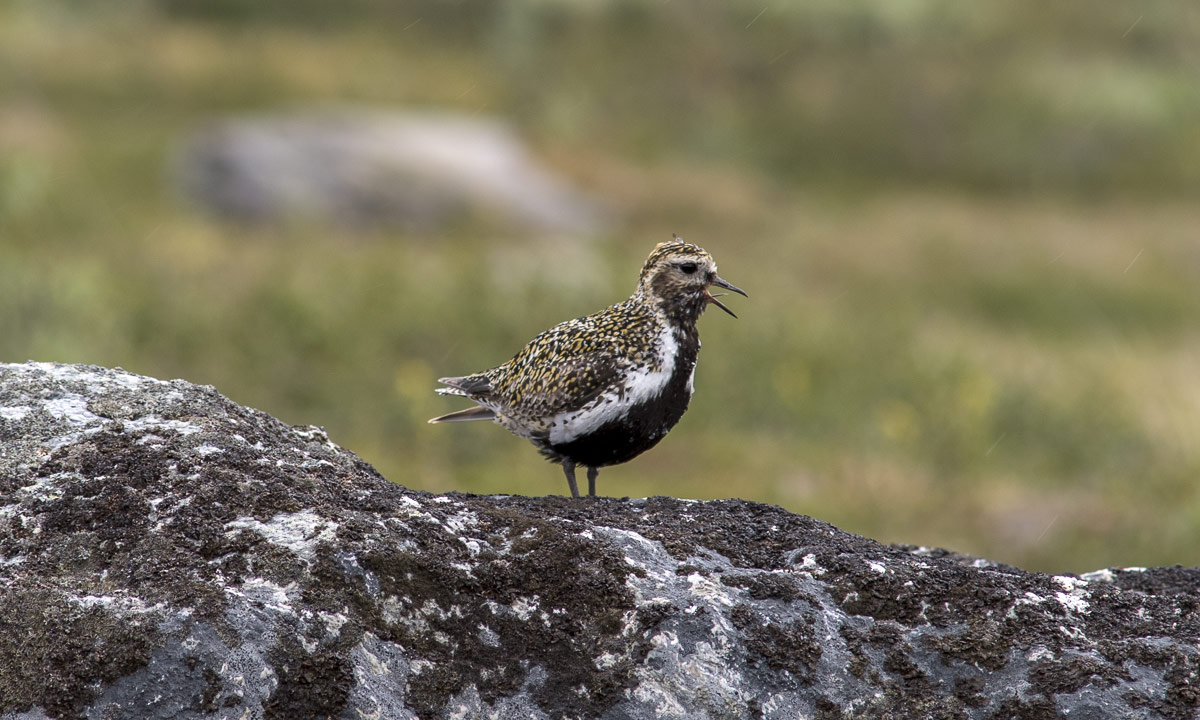
While we went on something chirped. Beep – Beep – (silence) – Beep … . We had heard that sound before on our hiking tour, but it was the first time that we could spot the matching bird. It was a golden plover as we figured out later. The bird was a bit nervous while I crawled nearer and nearer to get a photo, but it didn’t flee. Unfortunately my travel tele lens is not the best but I got a photo anyway.

We crossed the long reindeer fence that separates the sameby Laevas in the south and the sameby Gabna in the north. We just had to climb some stairs, where the Kungsleden crossed the border.

I knew that I had to say farewell to the treeless kalfjäll soon. In a short while we would enter the valley Gárddenvággi that would lead us deeper and deeper into more forested terrain. I was a bit sad, when i said farewell to that wonderful landscape.

The next kilometres were rainy, stony and muddy and we all just wanted to arrive in Abiskojaure, well knowing that it still would take some hours until we would arrive. I just trotted along and didn’t use my camera until we arrived in Abiskojaure. Here we finally made the photo of our four backpacks that we had talked about for days, but I was much too lazy to arrange it nicely.

The rain had stopped and the sun came out again so I took some last photos of the day, eager to eat something and to relax in the sauna.

Since Abiskojaure is the last hut before Abisko we found a lot of leftover food as dried vegetables, noodles or tuna sauce. That gave us a formidable afternoon meal. While we prepared for the sauna we heard, that there were moose on the other side of the lake. Indeed two female moose stood there in the wateraquatic plants. There were far away but we saw them dipping there heads into the water (they could hold their breeze really long) and eating aquatic plants. We saw them wading, swimming and shaking out the water. They had spotted us but knew that we were far away and no danger for them.

Katrin, Annika and Andi headed for the sauna, I watched a bit longer. When I went back to the hut I saw some others photoing something. It was a huge male moose, that stood amidst the huts and seemed to be not at all shy. I never saw a male moose so close! The moose went away, but stopped again, when he found rallarros flowers between the old toilet building and the wood shed. While watching us all the time he continued picking flowers with his huge mouth and eating them. At least twenty people stood there, watching, photographing and filming. Since all were quite sensible – no one was too hasty, too loud or came too near – we all could watch this big animal for some minutes. Then it took some step into the forest and almost instantly vanished in the shadows. What an experience!
 

28 August: Kungsleden day 9 – Vistas—Alesjaure (18 km)

This article is part of the series “2017-08: Kungsleden hike”.

Today Katrin, Annika, Andi and I would continue to Alesjaure, the longest distance to walk so far.

The morning was frosty with -2 °C and the petals of the flowers called rallarros (rosebay willowherb or fireweed) were covered with ice.

The sky was blue, the sun was shining, we had picture-book weather. As a photographer I would have preferred to hike two weeks later when leaf coloration would be in progress, but you can’t have everything. Anyway, the photo of the bridge over the Visttasjohka right at the Vistasstugan looks like a postcard motif:

This spot looked quite Canadian or Alaskan to me. I almost expected to spot some huge grizzly bears catching salmon in the river. But we’re still in Sweden where bears are brown bears and (luckily) very shy.

The first kilometres of the trail to Alesjaure lead through dense birch forest. Then gradually the forest got less and less dense and the snow covered mountains that frame the valley Visttasvággi were revealed.

The first kilometres were said to be muddy and they were, but not more than many other passages that we walked the days before. Unfortunately the trail continued to be both rocky and muddy and therefore wasn’t easy to walk.

After we left the birch forest the landscape became more rocky again. We found the resting place I remembered from two years ago. Someone had used a plank and some stones to build a bench in front of a huge block of stone. Still the sun was shining but gradually the sky become cloudy. Will we manage to arrive before the rain comes? We still hadn’t walked half of the distance.

We continued our tour until we reached the bridge over the stream Moarhmmájohka. Andi and I went down to refill out water bottles, then we took only a short rest since we were eager to arrive not too late.

After having crossed the bridge we had to go uphills quite steeply and we all slowed down more or less. Then we arrived at the plateau and looked back a last time into the beautiful valley Visttasvággi.

The clouds became denser, the wind increased but still it was dry. We passed the lakes Vuolip Čazajávri and Bajip Čazajávri. We went on and the sami village Alisjávri, located by the lake of the same name came into view. Now it was only 1.5 km left to the Alesjaurestugorna, our destination. As the day before we spotted the sauna first.

At 4 o’clock we arrived at Alesjaure and we stayed dry. Alesjaure is the largest mountain hut that we would stay at. It has as much as 86 regular beds (and more place if needed.)

I already found out, that stugvärd J. would be here, he whom Annika and I met in Nallo two years before and I again on my winter tour in Singi for some days. And really, he indeed was there and I was very glad to meet him again.

To meet J. means also to meet Simba, his kingsize dog. Simba dosed in the outside, stoically ignoring the mosquitoes in her eyes and on her nose. I said hello and started to pet her, which she apparently liked: she sighed and slumped onto her side. The photos I made before and afterwards:

Alesjaure has several houses, which appear more like a youth hostel than a mountain hut. That may look less cozy but we all enjoyed our big beds in our own four-bed-room. Katrin and Annika went to the sauna and after that we cooked one kilo (!) of pasta with goulash soup as a sauce. No, we didn’t manage to eat it all, the rest would follow us to Abiskojaure the next day.

Alesjaure would the last place in the kalfjäll above the treeline on this tour. Tomorrow we would continue to Abiskojaure, which is round 22 km away. This could be the longest day’s march, but we took a shortcut …


26 August: Kungsleden day 7 – a resting day in Nallo

This article is part of the series “2017-08: Kungsleden hike”.

The whole night the gusty wind howled in the chimney and heavy blows seemed to shake the whole hut again and again. Already in the evening before the temperature had dropped to 1 °C and when we woke up it looked like that:

To continue our hike under these conditions would be difficult and troublesome. What a lucky coincidence that we planned a day off in Nallo. But what should we do, if the wintry weather would continue or even intensify and we would get snowed in?

A notice pinned to the wall informed about helicopter prices. A flight to Nikkaluokta for up to four people costs 4600 SEK (approx. 480 Euros). That’s quite affordable and could be a possibility to reach civilisation if we were forced to abandon our Kungsleden tour because of the weather. Anyway, the day just had begone – just wait and see … .

G., the stugvärd asked Andi and me if we could fix the door of her stugvärd toilet. She had used the toilet in the night and a wind gust had snatched the door out of her fingers so violently, that one of the metal hinges had been torn off. Luckily the door jammed and was save for the moment. Andi and I could help her and fixed the door. (As a matter of fact it was mostly Andi who fixed it as the photo below reveals.)

Katrin and Annika were also not idle. Katrin sawed logs of wood into 30 cm long pieces, so that they would fit into the oven. Annika chopped them into pieces. All the more we valued the oven that held our rooms warm and cozy.

Annika surprised us with pancakes for lunch, she had pulverised pancake dough with her. She used half of her supply and we got 2½ pancakes each – delicious!

Meanwhile the weather changed for the better. It got a bit warmer and the snow in the valley Stuor Reaiddávággi started to melt. The wind fell off and breaks in the clouds appeared. Good news for us who wanted to continue our tour on the next day, even if we all enjoyed the relaxed atmosphere at Nallo and the beauty of the landscape around.

We took a midday nap, solved a puzzle, played Yahtzee and finally we prepared dinner, this time tortellini with dried feta cheese and chanterelle mushrooms. We were eating inside while the reindeers, who had been around the hut all the time were grazing outside.

Again it was worth to have a day off in Nallo.

Recommendation for nice people:

Nallo is worth a visit! The hut is cosy and the landscape is of a special beauty. You can enjoy the much more familiar atmosphere compared to the larger huts on the Kungsleden and the arctic scenery around.

Recommendation for not so nice people:

Nallo sucks! The hut is small and has neither sauna or shop. All ways from and to Nallo are difficult to go and as you can see, the weather is always awful. Stay away!

25 August: Kungsleden day 6 – Sälka—Nallo (10 km)

This article is part of the series “2017-08: Kungsleden hike”.

Today we would leave the Kungsleden. Instead of the route SälkaTjäktjaAlesjaure (25 km) we would go SälkaNalloVistasAlesjaure (37 km). Annika and I have been in Nallo two years before and fell in love with that place.

Again we woke up early, again it was cold with temperatures round +2 °C and again snow had covered the mountains over night, this time not only the highest peaks. After our breakfast—cleaning—packing routine we left the crowded Singistugorna hoping for less people in Nallo.

We went up a bit, but were on the wrong side of some alpine brooks. Katrin and Andi returned to use the small bridges, Annika crossed the brooks by balancing over some stones, I just waded through – one of the advantages of using rubber boots.

First the landscape didn’t seem to change but gradually the flowers and other plants lessened and the terrain became stony and harsh.

The mountains that framed the valley Stuor Reaiddávággi were rugged and rocky and powdered with snow. The lack of plants let them appear colourless.

More and more we had to cross boulder fields and some smaller streams. Water ran everywhere and we had to look for the path that was marked with piles of stone. Not easy to find in a landscapes made of rocks and boulders, even if some of the top stones were of white quartz.

It was cold, windy and then it started to snow.

We went along the lake Reaiddájávri. We would have to cross the river right behind the lake before it cuts down into a deep uncrossable ravine. Two years before Annika had to wade through in sandals, because the water was to deep for her boots. There are nicer things than wading through ice cold water while it’s snowing …

We were lucky. The water level was low and someone obviously had build a fort of stones that were quite easy to cross. We were cautious anyway, because no one wants to fall into icecold water with a backpack and fully clothed.

We succeeded and took a short rest to eat some chocolate (crucial food on hiking tours!) but we continued soon because of the chilly weather. We followed the Stuor Reaiddávággi and crossed some side valleys with old snow fields – reminders of last winter.

The precipitation got stronger, more rain than snow. While the others continued through the alpine and arctic landscape I went to the ravine to take pictures of the waterfall, but I soon gave up, since the rain fall grew too strong. The last photo after catching up with the others is blurred from the rain on my lens.

Finally we arrived at Nallo 12:30 and were delighted, that only few others had come there as well. We cooked an instant noodle soup and took a midday nap.

In the afternoon it had started to snow stronger and the wind speed increased while the temperature dropped to +1.5 °C.

The ground was still bare of snow – a good thing for the reindeers, that grazed in the valley.

Snowfall however continued the whole day and evening and slowly started to cover the ground. How good that we planned to take a day of in Nallo the next day.

24 August: Kungsleden day 5 – Singi—Sälka (12 km)

This article is part of the series “2017-08: Kungsleden hike”.

The morning in Singi was cold. The temperature was just above freezing point and again it had snowed onto the higher mountain tops.

Good to have a stove to fire and a gas burner to prepare hot tea!

Each day we got out of our beds earlier and earlier. This day we stood up way before seven and started our hiking day already at half past eight. Hejdå, Singi!

It’s only twelve kilometres to the Sälkastugorna, so we could take it easy. We planned to take a rest in the small emergency shelter Kuoperjåkka which is 6 km away from Singi but it was already occupied. So we rested outside. Despite to the cold weather there were many mosquitoes that tried to bite us. Some succeeded, some died …

We continued our trail to the north and crossed many small mountain rivers and alpine brooks. All of them were bridged. The smaller ones with wooden planks, the larger ones with metal chain bridges.

First the sky was grey and the air chilly but little by little it was clearing up and the mountain tops that first were hidden by clouds and haze started to reappear.

At 13:30 we arrived in Sälka where one of the three stugvärdar – the mountain-lodge keepers – gave us four beds in a 10-bed-room. A lot of people stayed overnight and some of the latecomers had to sleep on mattresses on the floor or in the sauna.

I took an afternoon stroll and peeked into the Stuor Reaiddávággi, the valley that we would hike through the following day.

The kitchen was both too small and designed in the most impractical way. So we moved into our room after dinner and avoided that kitchen. Quite early we climbed in our beds (it’s always bunk beds with two or in some huts even three beds on top of each other), but we didn’t get much sleep that night. Eleven people were sleeping in that room and it was noisy and the air was hot and fuggy. Anyway I managed to fall asleep after a while.

In the night some of us were woken up by a bright flashing light. It held on for minutes without stopping and I realised, that it came from the outside. The light was attached on an antenna on top of a roof and illuminated the whole area. I put on some clothes, went outside and woke up a stugvärd by knocking at the window. He told me, that the police would call. (Every hut on the Kungsleden has a satellite telephone, but only the police can phone the huts from the outside.) I went into bed again, realising once more the bad air  in the room, but I didn’t dare to open a window since it was cold outside. Finally I managed to fall asleep again.

Next day the stugvärd thanked me for waking up him. The police was asked to look for a hiker, that indeed had been in Sälka the day before but already had continued his trip.

There are summer trails and winter trails. Partly they are united and partly they run differently. Summer trails mostly are marked with piles of stones. The upper stone is often painted red to increase the visibility of the waymark. Winter trails are marked with red crosses sitting on the top of long poles. Nowadays many of those crosses are made of plastic. That’s a shame since they are ugly, probably less ecological and quite fragile, too.

Don’t follow a winter trail in summer if you don’t want to swim through lakes or find yourself sinking deeply into the mud of a bog.

20 August: Kungsleden day 1 – Vakkotavare—Teusajaure (16 km)

This article is part of the series “2017-08: Kungsleden hike”.

The idea to walk the Kungsleden with my sister Katrin and my brother-in-law Andi had been existing several years. This year we put our plan into action and went this famous Swedish long-distance trail from Vakkotavare to Abisko, which is round about 110 kilometres. Fortunately Annika had time to join us.

We started our tour on 20 August, exactly two weeks ago. As many hikes our tour started with public transport: The bus 93 from Gällivare to Ritsem. The last 130 km of that route are famous for being Sweden’s longest dead-end road.

We however left the bus at Vakkotavare where we immediately started the tour. We had no time to loose since our destination – the Teusajaure hut – is located on the other side of the lake Teusajaure and we hoped for a lift with the motor boat at 19:15 to avoid rowing cross the lake.

The first part of the trail is quite steep and leads along a mountain brook with some waterfalls. 500 metres in altitude can be exhausting, when it’s the first day and the backpacks are still packed with some extra food.

Finally we were on the plateau on the “kalfjäll”, the alpine region above the tree line. I really love that bleak but wide landscape where you can look so far.

Until then we were quite lucky with the weather. It wasn’t sunny but at least it didn’t rain. But the weather worsened. The clouds became darker and it started to rain, first lightly then gradually intensifying. We could see some patches of old snow far away but soon all mountain peaks vanished in the thick layer of clouds.

The last part of the trail descends again. This was probably the most dreadful stage of our whole hike: it rained more and more and the steep stony path downwards was muddy and slippery. Despite of the rain there was not a single wisp of wind. So every second we stopped we were immediately surrounded by clouds of mosquitoes that landed in our eyes and nostrils or tried to get into our ears to suck our blood. Anyway we hardly rested anyhow since we tried to reach the boat.

We managed to reach the landing stage at the lake Teusajaure in time, wound up the signal for the boat (a white plastic jerry can) and waited. At least we were glad that the hut Teusajaure was in sight.

I felt disappointed and frustrated. It was the first hiking tour in Sweden for Katrin and Andi. What would happen if the weather would stay like that? And the muddy trails? And the mosquito clouds? Would we continue or abandon the tour? What would they think about hiking in Lapland? Would they ever come again …?

Soon we could see the boat leaving the other side of the lake. Minutes later it arrived. We put the backpacks onboard, jumped in, put on live wests and soon brought across the lake.

On the other side we unpacked the wet trunks and the stugvärd – the mountain-lodge keeper – gave us four beds to sleep. While Annika and I had hiked in Sweden many times it was brand new to Katrin and Andi and felt like a culture shock:

No electricity, no water tap and no water toilet neither! Instead of that: candles, a wood fired oven, two gas cookers and some buckets with water – partly fresh, partly used. And the earth closet somewhere out in the dusk. Again I felt a bit guilty that I persuaded Katrin and Andi into that Kungsleden hike.

Anyway the first tour day that was long away from being ideal came to a nice end: We had pasta, fresh chanterelle mushrooms and sour cream with us for the first day and therefore could enjoy a dinner far above standard. Now we only hoped for the rain to stop. It didn’t take long until we went to bed and soon we all slept.

What do you do if you don’t want to get a motor boat lift? You row by yourself. That’s round 1 km one way.

There are three rowing boats total. If you have two boats on your side, you’re lucky: Just take the boat and row across the lake.

If you have only one boat on your side, you have to row three times: First you take the boat and cross the lake. Then you row back with the same boat and a second boat in tow. Then you leave that second boat and row again a third time. So it’s ensured that there’s always at least one boat on each side.

It’s summer

When you look out of your window and see long green grass in the urgent need of being cut, where 4 weeks ago a snow shower covered the whole garden with white

When you go along the river Skellefteälven and finally other flowers started to bloom than only tussilago

When nights are no dark nights any longer and it will take many weeks until you can see the first stars again …

When you paddle on the river Skellefteälven, barefoot, just with t-shirt and shorts, not with a drysuit as three weeks ago and you even enjoy becoming wet by some breaking waves, because it’s so refreshing …

… then it’s summer in Northern Sweden.

And summer is more than welcome after the long winter. By the way, summer solstice is just 10 days away.