Skiing and tenting in Jämtland – part 3

This article is part of the series “2020-02: Ski tour Jämtland I”.

Saturday, 22 February – skiing to Gåsen

Day 8 of our ski tour. After we have found shelter from the storm in the emergency hut Hulke we where eager to continue out tour. Next stop Gåsen fjällstugan and finally a resting day is awaiting us.

As usual I am awake before 7 o’clock. Time to visit the utedass – the outdoor toilet – and take a snapshot in the blue hour with my iPhone SE. Technically the image is crappy but I love the almost pointillistic appearance of the photo. Since it looks rough it reflects reality much better than the technically superior photo, that I took with my Nikon D750 45 minutes later.

The first 4 km lead us 150 meters up. Easy, but a bit boring since the weather is grey and dull. When it’s cloudy like that, the contrasts are so poor, that you cannot see any structures in the snow.

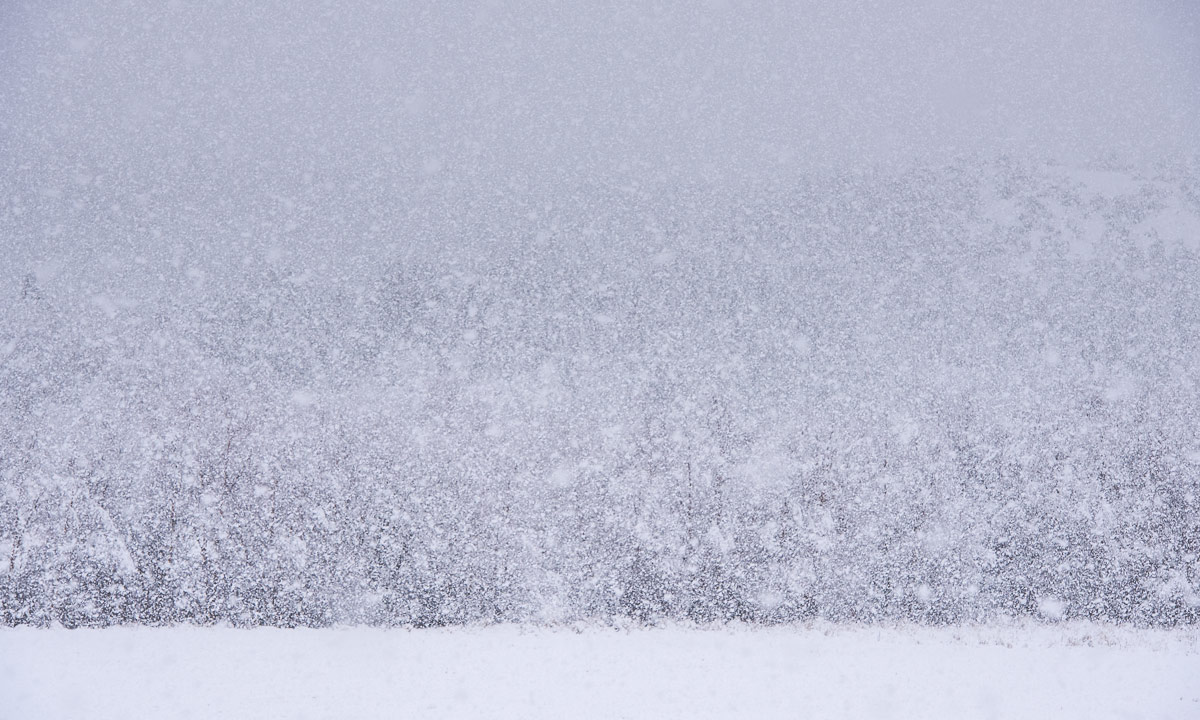
That’s not a big deal as long we climb the mountain. Soon we can see the buildings of the Gåsenstugan although they are still nearly 5 km away. But between them and us there is the valley Holkendurrie. We have to ski down 150 meters again. Perhaps this wouldn’t be a big deal for me although I’m a real lousy downhill skier but just in this valley it starts to snow and it gets quite windy. Now there’s even less contrast and the snow looks like a white, untouched paper.

It takes some time for me to ski down. I know, that there are icy patches and snow drifts but I cannot distinguish between them. It’s all plain white. I fall the first time, when my right ski gets stuck in a small snow drift, while the pulka – still on fast, crusted snow – just pushes me down. Ouch, my left wrist didn’t like that. I fall once more, but after a while I managed to reach the valley, where Arne and Jonas have waited for me. Now it’s time to ascent again, this time round 200 metres. At 13:30 we arrive at the cabins.

Anders, another skier that we met at Helags recommended the old cabin which he considered very cozy. This cabin however is almost completely snowed in and it’s quite clear that it is not habitable right now.

Anyhow it’s the stugvärd we have to ask where to sleep. For today is the first day, where the mountain cabins are officially open. That means, that one or two stugvärdar are around. These voluntary working people tell guests like us where to sleep, accept payments, show where to fetch water or firewood, explain the kitchen (if necessary) and sell food and some other items in a small shop.

So we walk to the cabin with the sign “Stugvärd”. We have to climb down some large stairs cut into a huge snowdrift, then we enter a small anteroom and finally the shop where we are welcomed by the stugvärd. We are the first guests today. We directly pay for two days because we all want to have a day off – both for resting and avoiding new storm squalls that are forecasted for tomorrow. We are in the left part of the (only) other habitable cabin, another Abrahamssonstugan. I use the shop to buy ecologically chips and cola – pure luxury!

Jonas fetches firewood, Arne water from the well (and by chance catches a river trout with the bucket). We hang up our jackets, sleeping bags and other clothes to dry. The rest of the day we throw firewood into the wood stove, since this part of the cabin hasn’t been used since last year’s September and everything is cold, especially the walls and mattresses. It takes hours for the room to get a little warm. No other guests come this day, we stay alone, enjoying the cabin that provides everything you need.

Sunday, 23 February – a stormy resting day

Again I am the first to wake up. Again the night was stormy and it still is. Round 9 o’clock, Ebbe, the stugvärd drops in. He invites us to fika – the Swedish coffee break – for 15:00. If we shovel free his door.

First I take some photos through the window, then I go out into the storm. According to the forecast we have storm squalls up to 27 m/s this morning. Snow is blowing everywhere and my wide angle lens will have problems with moisture for days.

Then I go the the cabin of the stugvärdarna. The entrance door is snowed in over the door handle. How did Ebbe get out of the house? I shovel away the snow and then enter the cabin. Ebbe tells me, that he had to climb out of the window since he couldn’t open the door. It was the second time since they arrived five days ago. I’m glad to help.

It storms all day. When we go to the utedass (hardly 50 m away) we look like polar explorers. In the night we will be glad about the reflecting waymarks to find the way.

At 15:00 we leave our cabin and visit the stugvärdarna Ebbe and his wife Svitlana. It’s not only coffee we get, Svitlana has baken delicious brownies. Tasty! I feel honoured being invited by them and we have a great time together talking about hiking tours, places like the Sarek and safety in the mountains. After an hour or so we use the shop to buy additional food for the evening, then we leave.

Two other skiers have arrived. It’s hardly visible from the stugvärdarnas kitchen because the snow in front of the window is piled up so high. They join us in our room. It’s warm inside and the candles provide a cozy light. Outside it’s still storming. As the evening before I wear balaclava, ski goggles and headlamp when I go to the utedass.

It was a good day for resting! Thank you Svitlana and Ebbe for your hospitality. Hopefully we’ll meet again!

Monday, 24 February – finally tenting again

Again a stormy night, nothing to mention anymore after so much wind and storm. I remove about 80 cm fresh snow in front of the entrance door of the stugvärd cabin and trudge back through knee deep snow drifts. My pulka is visible from the side, the others almost completely buried in the snow.

If the weather forecast is right, wind shall finally decrease for some days. Hopefully that’s true so that we can sleep in the tent again. We leave Gåsen at 10 o’clock. First we have to ski through deep snow but then the snow is more compact and effortlessly we ski down to the emergency hut Härjångsdalen. After a short break we continue equally fast.

If we continue like this we’ll soon reach the cabin Vålåstugan. Since the wind really calmed down we slow down, too and start looking for a good place to camp. After several days in the kalfjäll above the timberline we spot the first birch trees. We stroll around a bit because it is still early. At 14:00 we have found a nice camp ground amidst some birches. As usual Arne and Jonas erect the tent while I take photos.

Later even the sun comes out. The first time while tenting.

Now it’s time to melt snow, to cook and to eat. Today’s dinner is spaghetti with pesto and chocolate as a dessert. Already at 19:00 we lie in our warm sleeping bags. The outside temperature -14 °C. I close my eyes and minutes later I fall asleep.

Continue with part 4 >

Skiing and tenting in Jämtland – part 2

This article is part of the series “2020-02: Ski tour Jämtland I”.

Wednesday, 19 February – tenting in the kalfjäll

The night in the mountain cabin Vålåstugan was stormy, but in the morning the wind has calmed down. We leave Vålåstugan behind and head southeast.

Our way leads to Helags, the highest mountain in Jämtland. The Helags Mountain Station is about 23 km away, but we don’t have to go the whole way today since want to camp. The way leads up and there are less and less birch trees. Soon we are above the timberline in the kalfjäll – the bare mountains.

We take a break at Ljungan, one of Jämtlands emergency huts. For once it is not windy but it’s cozy to sit inside anyway.

Now we are already halfway to Helags. We decide to continue since the weather is supposed to get worse tomorrow. It would be nice to have just a short distance to the mountain station tomorrow. Ljungan lies in the valley of the river of the same name. Now we have to ski up again. We continue skiing the whole afternoon. On the one side I consider it quite exhausting, on the other side it’s so beautiful watching the light changing in the setting sun. White – yellow – orange – “peach” – purple and finally white again, but a cold one.

It’s already dark when we have found our campground for tonight. It is hardly protected again wind and storm but according to the weather forecast this night is supposed to be relatively calm.

If people ask me why I love winter tenting although it can be uncomfortable and sometimes even troublesome, have a look at the next photo. Can you imagine standing there? With an itching nose in the cold but the down parka keeps you warm? Looking at the milky way and zillions of stars? Hearing nothing than the crunch of snow underfoot and your own breath? Feeling how you calm down and find a deep satisfaction inside? That’s why I love winter tenting!

Thursday, 20 February – visiting Helags Fjällstation

Two o’clock. Suddenly we are all awake. It has got stormy again and tent was shaken by some stormy gusts. Is another storm approaching? No, soon it calms down again.

The next morning it is cloudy but calm. Through some gaps we can see the colours of the sunrise.

Some of the daily morning routines: melting snow – dissolving milk powder for the muesli – having breakfast – packing our things – dismantling the tent – putting on skis and the harnesses for the pulkas. It always takes a while, but we are not in a hurry, Helags is less than 7 km away. We leave at 9:40, ski to the winter trail that we left yesterday evening and follow the waymarks.

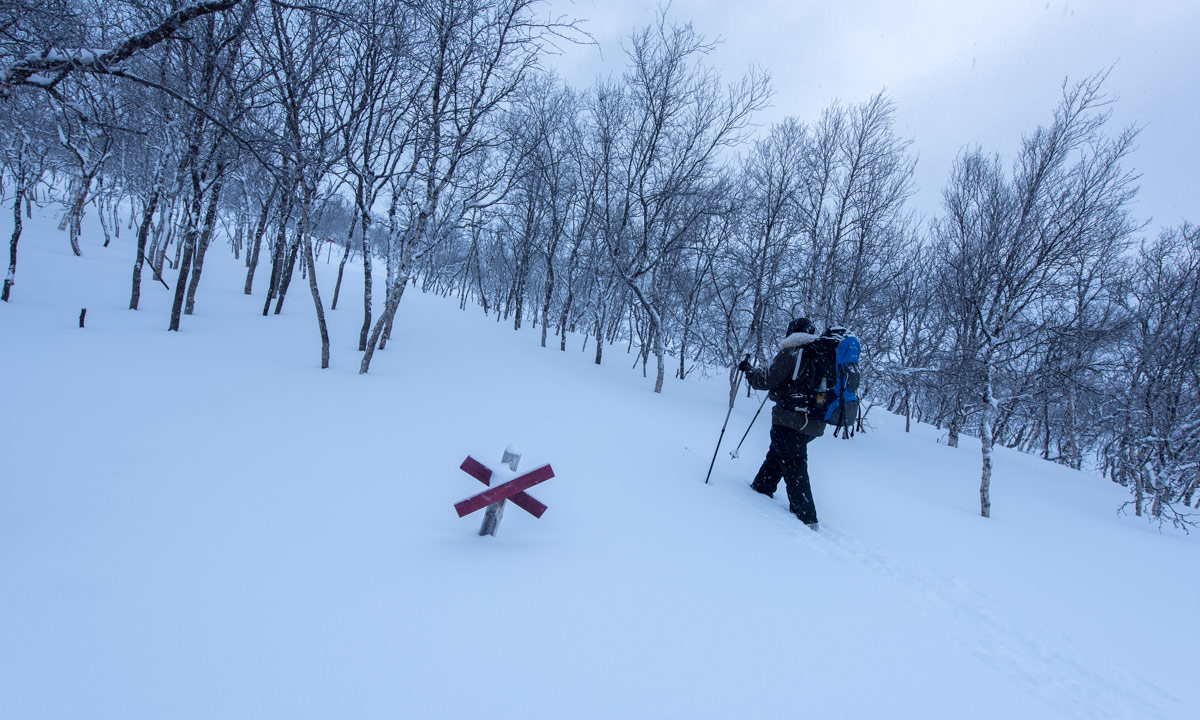
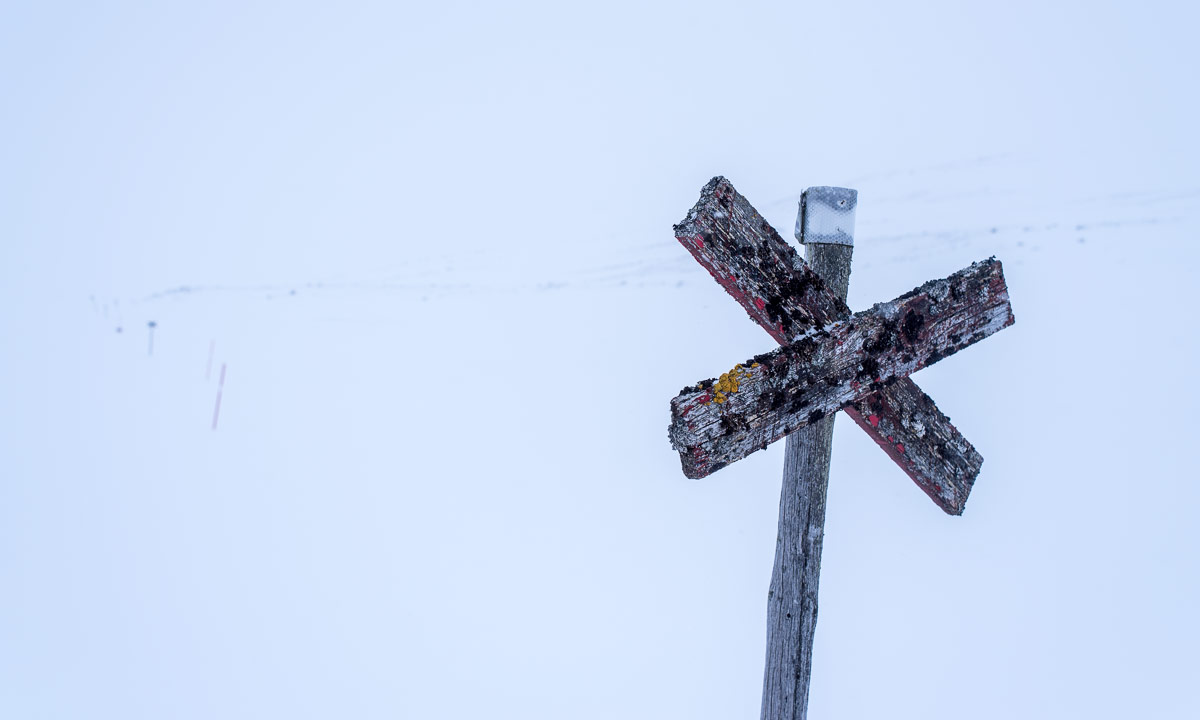
The wooden red crosses are our friends! Sometimes it seems quite boring following these waymarks, especially if you can see dozens of them standing in a straight line. But there’s a reason, that the distance between the red crosses is quite small. The weather can by very rough in the mountains and the visibility very poor. And the weather in the mountains can change very fast.

And so it happens to us. Within short the wind increases more and more. First it’s easy to continue but soon we are skiing in full storm. You hardly see more than the next red cross while the storm tries to knock you over. I manage to take some last snapshots with my smartphone.

Then I have to stop taking pictures because it would be too dangerous. We could loose each other or I could loose a mitten and get frostbite. There is hardly anything to see anyway because the visibility is extremely poor. I can spot a Arne, who is in the lead, my skis and sometimes the next red cross, that’s all. It’s very demanding to ski in storm, both physically and mentally and I’m really glad when we finally arrive at Helags. How long it took? I don’t know. I loose any sense of time in this kind of weather.

There are people at the Helags Fjällstation. Some craftsmen fixing things and two women working for the STF preparing Helags for the opening in eight days. After a bit of confusion we are shown the way to the emergency shelter, where we push the pulkas and ourselves inside. Arrived and protected from the storm.

We are safe and sound but disappointed. The cabin has eight beds and even electricity but no possibility to cook. I talk to one of the STF people who reacts with a mixture of confusion and ignorance. The only answer I get: it’s pre season and everything is closed. I tell them, that the mountain cabins as Lunndörren and Vålåstugan do provide everything even off-season but I get the same answer again. Quite disappointing.

Two other skiers have arrived. They manage to persuade one of the women to open another cabin with a kitchen until tomorrow. But the chaos continues. First Arne is locked in while using the indoor toilet in the main building and all STF people have left by snowmobile. Then they arrive again and want to lock the cabin with the kitchen already now, while we’re using it.

I never felt more unwelcome in Sweden since I moved here ten years ago. Actually we wanted to take a day off at Helags but it’s clear that this is not the place to be. We will leave tomorrow morning.

Friday, 21 February – finding shelter in Hulke

The next morning the storm has calmed down a bit and it promises to be a sunny day.

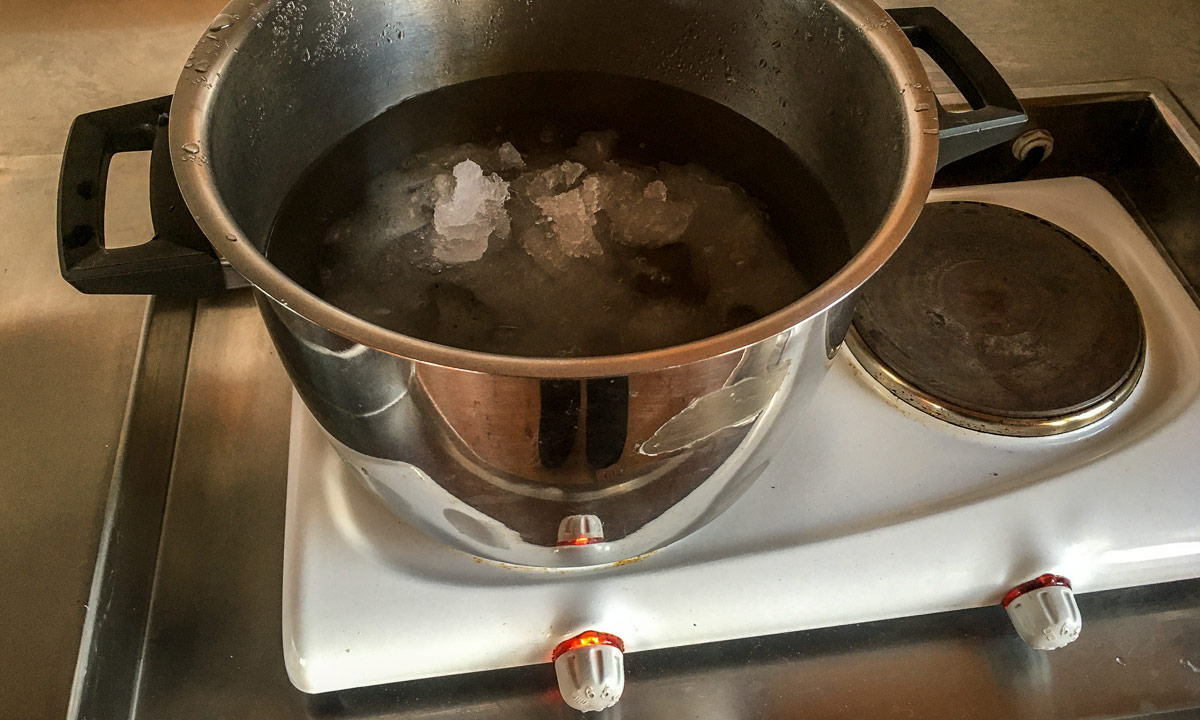
The kitchen is still open. Jonas fetches snow to melt on the electric(!) stove.

The utedass, the outdoor toilet is more than 100 m away from our cabin and lacks waymarks. I wouldn’t have dared to use it in full storm. But now I do. Things to bring: A warm jacket and a head lamp.

Although the storm subsided, it is still windy and the blown snow glistens in the sun.

Our departure is delayed a bit: A mitten I accidentally have dropped is blown away 20 metres. Jonas can fetch it before it is blown away even further. I pull on the glove and we can start.

The Helags massif is incredible beautiful and only reluctantly I break up. I would have loved a resting day but as I mentioned above not here.

Easily we continue. We have the wind behind us. First we slide down, then we have to cross the saddle between the mountains Miesehketjahke and Soenehketjärra.

From there we can spot the emergency hut Hulke. We only have to slide down the mountain saddle and we are there. Quickly we decide to stay here for the night because again hard winds are excepted for the night.

Most emergency huts have signs that restrict overnight stays to emergency situations. Not Hulke, so we feel safe to use it. Of course the firewood stays untouched. It is provided to save lives, not to increase comfort. We use our camping stove to cook and our warm clothes and sleeping bags to stay warm.

It doesn’t take long and it’s stormy again. I have to go to the utedass. After I have finished I open the door of the utedass from the inside. It is blown open so violently that the handle pulls me out of the building before I realise what happened. Jonas happens the same with the hut. From now on we open the doors only a bit and squeeze ourselves through the gap. And I wear ski goggles outside. My Nikon cameras dislike this weather and I only make some snapshots with my smartphone.

We sit on our inflated camping mats on top of the wooden benches. Mukluk boots warm our feet, warm jackets our body. After dinner we lie down. Jonas and I on a bench, Arne on the floor between us. Storm squalls howl in the stovepipe and make the hut vibrate. Will the stormy weather stop one day or will it continue forever?

Continue with part 3 >


On the road IV and V

Back to Sweden · Sneringsvika—Rötviken – 315 km

Have I told you, that the weather in Norway is constantly changing? So it was as well when I continued my road trip the day before yesterday.

It wasn’t cold, but most of the precitipation came as snow and even by the sea everything was white.

In Hofles I waited for the ferry to Lund which takes 25 minutes. I love standing onboard and watch the snow covered hills and mountains pass.

On the other side there was first less snow, …

… but as soon as the road climbed up a bit everything was white again. Here are two photos from a barbecue hut by the road 74 to Sweden. The first one from now, the other made in August 2016.

This time I have booked a cabin in advance. It is in Rötviken, 20 km behind the Norwegian-Swedish border. Although the campsite is by the road it is really quiet. Hardly any car uses this road.

I was tired from all the driving of the last days and fell fast asleep. The next day I would take it easy.

Arrival · Rötviken—Orrviken – 139 km

What a beautiful morning! The sun came out the first time since I left Solberget four days ago. Two dogs were barking. Did they bark at me? Now, it was the two moose that were about to cross the road but then turned too the the lake Hotagen.

This day I didn’t have to go far, just 140 km along broad roads through the Swedish forest. Easy to drive but a bit boring to look at.

I made a short stopover in Östersund, the largest town in the county Jämtland.

Then I continued to Orrviken.

Today I will spend my day here and repack my things for a ski tour that I will start with two friends tomorrow. Then I’ll be offline for about two weeks.

Vi hörs – see ya.

Starting my winter journey – Solberget

I have stopped counting how often I’ve been at the wilderness retreat Solberget in Swedish lapland. First of all it’s a nice place with great people, then it’s the week of the winter market in Jokkmokk, which is round 90 km away. Finally I just had to make a stopover here since my stove that I need for a ski tour was stored here.

Wednesday – a small ski tour

On the top of the hill Solberget I get to know Steffen who has spent some days in the mountain hut. It’s his last day and we ski down together. The way back is not long and so we extend our tour. Do we stand on a small bog or a frozen lake, when I make this photo? I don’t know.

Thursday – winter market in Jokkmokk

I’ve been here several times. This time I only stroll over the market and hardly make any photos. The only exception: The artist Yana Mangi, who gave a phantastic concert in the small old church in Jokkmokk.

Older photos from the winter market for example here, here and here.

Friday – ski tour on the Vihtukkajankka

It’s been long since I’ve been on the Vihtukkajankka. Together with Steffen I make a ski tour onto this mountain. First it’s cloudy but soon it clears up. Skiing through the snowy forest is sometime like visiting an art exhibition.

And here I have slept the last days:

Saturday – a foggy day

Acually I just wanted to be lazy but the fog was so beautiful that I skied down to the large bog Päivävuoma/Solmyran to make some “bog fog” photos.

This is my favourite photo from that day:

I close this article with a small riddle. The next photo is no photomontage but a single shot. Where am I?

Four variations of autumn

The first autumn colours on Gåsören

21, 22 September – Annika and I are invited by Solveig and Tommy to their summer cottage on Gåsören. Tommy picks us up by boat and after a short cruise we arrive at the small harbour, where Solveig already waits for us.

We have a wonderful evening with delicious food (hand-picked porcini mushrooms!) and inspiring conversations. And the weather is just great – first a blue and sunny sky, then after sunset a starry night. After a short nightly walk to the lighthouse – built in 1912 and still active – we go to bed.

The next morning I wake up early and take photographs of the splashing waves at the eastern shore. It’s a bit windy and the temperatures are near freezing. A lot of trees still have green leaves but some of the birches and rowan trees have become colourful, especially when illuminated by the low morning sun.

After breakfast we take a stroll round the small island together before we get a lift back to the mainland. Tack så mycket, Solveig and Tommy. We are looking forward to meet again!

Fog by the river

28, 29 September – I’m with Annika in Umeå. On Saturday we make a trip to Strömbäck-Kont, one of our favourite locations by the sea. Again the weather is sunny but due to the frost of last week’s nights a lot of more trees show coloured leaves. Especially the bright yellow birch leaves look wonderful.

On Sunday I wake up early as usual and take a promenade along the Umeåälven, one of Northern Swedens largest rivers. The morning air is damp and chilly and the landscape is fog-shrouded. The fog muffles all sounds and noises and gives me the impression of being completely alone. Half an hour later the fog goes away and the magic is gone.

Nightly squalls

Yesterday, 2 October – at 3:00 I’m awakened by storm squalls shaking the house. I almost expect that my house is lifted up and lands on the Wicked Witch of the East. But the gale is no tornado and my house resists the squalls.

The weather doesn’t come completely unexpected, both wind and enormous amounts of rain have been forecasted. But as usual the forecast was – ahem – imaginative but at least the wind speeds are quite accurate.

Hail, sleet and snow

Today, 3 October – again I’m awakened at 3 o’clock, this time by a hail squall drumming on the window. It’s round 3 °C and even colder at 7 o’clock on my way to work. Between my home and the town another rain squall buckets down. It is mixed with wet snow. Beside the road I can see white patches. Is it snow or last night’s hail? When I arrived at the office at Solbacken outside of the town of Skellefteå I see, that it’s snow grains – tiny frozen white balls.

At 8:33 I look through the window of my current office room and it’s snowing. The first snow on 3 October – exactly the same date as last year. Now I’m longing for winter even more ❄︎ !

Day 23 – travelling north again

This article is part of the series “2019-07: Southern Sweden”.

July 30 – Falun—Grövelsjön

Yesterday morning a guest room in Vetlanda in the forestal Småland – today evening a tenting place in Grövelsjön in Dalarna’s fells. We are travelling north again.

Yesterday we travelled from Vetlanda to Hosjö/Falun where we met Alex in real life the first time. It was just an overnight stay because we wanted to take a detour on our journey home that would take a bit of time.

Tuesday, seven o’clock. We say goodbye to Alex who has to leave for work. I take a bath in the lake Hösjön nearby. After breakfast Annika and I pack our things together and leave Alex’ cosy house behind.

As Alex recommended we follow tiny roads through Dalarna County – a county I’ve never visited before. As parts of Småland the scenery is extremely charming and looks a bit like “Sweden in a nutshell”.

In Leksand we reach the Siljan, Sweden’s seventh largest lake. We take the southern road to Mora via Sollerön, an island in the Siljan. Although the road is near to the lake it leads mostly through forest so that we can see the lake only from time to time. That’s quite typical for Swedish roads.

In Åsen we take a short stop to take pictures of the wooden chapel.

We follow the road 70 to Idre and turn right in the road to Grövelsjön. The trees become smaller and the mountains on the horizon higher. I’m glad to approach the fjäll, my favourite Swedish landscape. We make a last stopover at the church …

… then we arrive at our destination for today: Grövelsjön Fjällstation. This mountain station is operated by the STF – the Swedish Tourist Association. As we already have expected there are no rooms left, but we have a tent with us, that we set up in a sparse birch forest in the middle of other colourful tents. After dinner – pasta with pesto cooked in the common kitchen – Annika goes into the sauna while I take a short hike up the mountain. I do not reach the top of the Jakobshöjden, but at least the kalfjäll above the treeline.

There are no mountains home in Skelleftehamn, but after the sandy beaches of Österlen in Skåne and the mixed woodlands of Småland I feel home again when I see these landscapes. It’s still more than 630 km to Umeå and 750 to Skelleftehamn. But we do not plan to drive home yet – au contraire! Tomorrow we will travel to Norway.


An almost secret world of ice

This was my most daring tour on the sea ice yet. This article may not be for the faint-hearted. Spoiler alert: I kept safe and dry!

After an extremely lazy day yesterday I felt today like I had to go out and get some fresh air. Cross country skiing? No, the tracks are probably extremely icy. Jogging? No, the water puddles from the melting snow are deep and I wanted to keep my feet dry.

What about trying to walk to the island Bredskär? There’s a large patch of old ice that should be easy to cross. But behind the islands there could be weak ice.  Didn’t I want to keep dry?

Yes, I definitely wanted to keep dry. So I used a funny combination of equipment today. On the one hand snowshoes for winter walks, on the other hand a drysuit in case of breaking through the ice.

I took the car to the small boat harbour Tjuvkistan, changed into the rubber boots and started my tour from there. The ice was easy to cross even though there were some wet patches. That doesn’t automatically mean that the ice is weak. Mostly it’s freshwater from melted snow or seawater that found a way up through the cracks in the ice. Soon I arrived at the island Bredskär – it’s only 750 m to go. Unfortunately clouds had been approaching covering the sun.

I turned right and walked along the eastern shore. Wind, waves and winter’s coldness had built a ice wall along the shore.

When I reached the eastern tip I had a decision to make. Should I walk around the island and already go back? Or should I dare to cross the sea ice to the next islands Gråsidan and Nygrundet. I chose the latter. I opened the belt of the backpack, checked my ice claws and started carefully crossing the sea ice. Step by step. Step by step. The first half was no problem but then the ice started to look grey. That could be a sign for weak, thin or watery ice. I could see air bubbles moving under the ice with every step. I expected to break through the ice with every step. Perhaps the ice was not weak at all and only covered with water but I was not eager to find out and slowly continued. Step by step.

The ice seemed to get weaker and weaker, thinner and thinner, wetter and wetter. Perhaps it was real, maybe it was only my imagination that gave me this impression. After some more careful steps I finally reached the island Gråsidan. Hooray! Nevertheless only a temporary success because I knew that I would have to go back later on.

I arrived at the northern tip of Gråsidan, turned right and walked along the eastern shore heading south. It was there, where I found the almost secret world of ice. Of course it was not secret by purpose but I guess I was the only one that had managed to approach this special location.

East from the island there was a layer of sea ice and on that there was a huge variety of ice. Large ice floes, heaps of smaller ice discs, round-shaped ice objects and much more was there to see.

It was like an open air art exhibition. An art exhibition of one of my favourite artists: nature. And I had it all for myself. It was not easy to go. Sometimes I had to cross chaotic looking ice fields, sometimes my foot landed in a deep puddle of meltwater. Look at the next photo: This puddle had not only drowned half of my rubber boot but a snowshoe, too.

I was however wrong in one thing. Others visited this world of ice as well: moose. Countless moose tracks covered the sea ice heading seaward. What does a moose want there? There’s only ice and then – already visible in the distance – the open Baltic Sea. The next island in the southeast is more than 11 km away.

Either moose have a very poor sense of orientation or they like ice art just as me. I imagined several moose visiting the various objects and discuss shape, colour and the meaning of the artworks. These visitors however had left, only the tracks were left.

While strolling through the exhibition I already passed another island: Nygrundet, the outermost island of the archipelago. Nygrundet was near the open water. Very near. I approached a huge block of ice and there it was: My personal “Ultima Thule” for today.

After I was sure, that this ice block was connected to the island and no iceberg sailing to Finland I decided to climb the block and make myself comfortable. Although temperatures were slightly above zero it was quite cold due to the strong gale with wind gusts round 22 m/s. That’s round 80 km/h. Brrr! I was glad about my warm anorak that I took with me.

After eating and drinking a bit I decided to go back. I crossed a small patch of sea ice and then went along the island which is connected with Gråsidan by a stripe of land. Unnoticed by me the clouds had moved away and the sun came out. Ice gets a completely new look when sunlit. So I decided to go to the art exhibition once more and turned again.

And turned again to finally return home. On my way back I saw a manmade art object at the shore, but I could not understand its purpose. I preferred the tiny pine trees sticking out of the snow. Then I crossed the island Gråsidan from east to west (less than 200 meter).

The last photo clearly indicates that I hadn’t been in the Arctic. It’s still Skelleftehamn. On all of the mentioned islands there are summer cottages. The cottages on Nygrundet and Gråsidan were empty due to the difficulties to get there.

I started to look for a better place to cross the sea ice back to the island Bredskär. I had felt quite uneasy while crossing the ice to Gråsidan and I hoped for better ice. To make a long story short: I found a longer, but better and easier way.

I was relieved when I arrived Bredskär. Now the ice probably would be thicker and safer. I walked along the island somewhere between sea and land. There where a lot of very wet patches but on safe ice. Now I only had to cross the sea ice once more, then I would arrive on the mainland and at my car.

Here a lot of water, partly frozen, covered the ice. Snowmobiles and ATVs had left deep traces and wheel ruts. I started getting a bit impatient and instead of taking the same way home I turned left a bit earlier. First it went well then I had to plunge through surficially frozen water and slush. With the snowshoes that was quite exhausting but the shore came nearer and nearer.

I could spot my parked car and the snowy slope where I had to go up. 100 metres to go. 50 metres to go. 10 metr… – crash!

My right leg went through the ice to the upper leg. It was not weak ice, I just oversaw a large and broad crack. The rubber boot was soaking wet but not myself. The attached stockings of my drysuit had kept me dry. It’s funny anyway that this happened just seconds before finishing the tour.

Probably I will keep a bruise on my knee for some days as a nice memory of this very special inter-season snowshoe tour on the Baltic Sea. And a fabulous tour it was.

Equipment

Directly translated from my packing list with some comments.

  • smartphone + powerbank + charge cable + waterproof bag (the powerbank to be able to load the smartphone in emergency situations)
  • camera + memory card + cleaning tissue + reserve battery (all packed in a waterproof Ortlieb bag that I wore in front of my breast)
  • drysuit (to keep me dry in water. Only head and hands would get wet)
  • rubber boots (I chose my huuuge Russian rubber boots with thermal inner boots
  • snowshoes (flexible enough to work with the rubber boots)
  • 2× balaclava (for the head – one comfortable made of fleece, one tight and waterproof)
  • 2× gloves (one pair made of Powerstretch fleece, on pair of waterproof neoprene)
  • isdubbar – ice claws. (The most important thing! Two handles with spikes that you can use to pull yourself on safe ice after having broken through)
  • provisions (A cinnamon bun, chocolate and a coke(!) )
  • Cabela’s anorak (the insulated anorak with the fur trimmed hood you can see on my selfie)
  • waterproof bags (I stored everything in waterproof bags – from the other pair of gloves to the car keys)
  • sunglasses (today even used as wind protection)


Skiing from Viterskalet Fjällstuga to Syter Fjällstuga

This article is part of the series “2019-03: Ski tour Vindelfjällen”.

Monday, 4 March

I wake up early in our four-bed room. Annika and I are in the Viterskalet Mountain Cabin in the Vindelfjällen, part of the Swedish mountains. I get up, take tripod and camera and go out. The temperature in the kitchen has dropped to 7 °C, but that’s almost 30 °C warmer than outside, where it’s -22 °C according to the outdoor thermometers at the windows.

I love it when the rising sun colours the snowy mountains in purple, pink, orange and yellow until it stands so high, that the snow looks white.

At ten o’click we start our tour: 12 or 13 km to Syter Fjällstuga, the next mountain cabin. We follow the winter trail that slowly bends eastwards into the valley Syterskalet.

Here we walk in the shadow of the mountains. First it’s a nameless top (1603 m), then the Södra Sytertoppen (1685 m) that blocks the sun. Round a kilometre before the emergency cots– also named Syterskalet – we leave the shadow and walk into bright sunlight. We take a break at Syterskalet, both for eating and drinking and for attaching the climbing skins to our skis.

After the rest we have to climb a bit, round 100 metres in altitude. That’s why we mounted the climbing skins. With them the ascend is easier than expected.

When we reach the peak I remove the skins. Although I’m a lousy downhill skier I want to try anyway. The terrain is difficult for me, because parts of it are icy and others are hardly covered with snow. With large bends and a bit of luck I manage to ski downhill the slope. Annika skis downhill with climbing skins that slow down her skis. Because of that she can use the snowmobile tracks that are to steep for me. We meet at the chain bridge over the stream or Svärfarbäcken. The Syter Mountain Cabin is on the other side. We don’t have to use the bridge to cross the stream, it is completely frozen. There’s only a marked hole in the ice for fetching drinking water.

We arrive at the cabin and the stugvärd – the host – welcomes us with hot juice; a nice tradition on the mountain cabins. We realise that we met before in Nallo, a small cozy cabin in August 2017, when we took a day off.

We get a cozy room with a bunk bed and take it easy the rest of the day.

Of course I have to go to the toilet again in the night and the sky is as starry as the night before. I made some photos and due to the long exposure you even can see polar lights on the photos. These polar lights however were hardly visible to the naked eye.

Tuesday, 5 March

Today we are going to take a day off and stay at the Syter Fjällstuga. I’m an early bird and get up before sunrise. Again it’s -22 °C and the temperature will not rise above -15 °C for the whole day.

After a breakfast (we have crisp bread, butter and cheese plus hot cocoa) we start a small day trip on skis. We want to go up the slopes north from Syter. It is fun to go without pulka. Flocks of ptarmigans (snow grouses) are overall. First you hear them, then you can see them as white spots. If you come closer they fly away and you realise that you hardly spotted half of them.

Today we do not follow any marks, we make our own tracks. The tour is shorter than expected. Annika still has climbing skins under the skis and does not have any problem with the many icy patches on the slope, but I have. Instead of descending any further we turn right and make our way to the Kungsleden that continues to the northeast. Here we ski back to the cabin.

The rest of the day we stay in and round the cabin. It’s awesome to ski through the incredible beautiful winter landscapes but it’s just as great to meet interesting people.

  • Stugvärd G. with whom we talk a lot. She travelled a lot in the whole world.
  • Myra de Rooy, who is going to go the 440 km to Abisko, the first week with a friend. She writes books, mostly about her adventures in Tibet and Nepal.
  • the man who temporary helps with the cabin. He seems to know every path and every rock of the Vindelfjällen, where we are.

Annika realised that today is fettisdagen, the day in the year where the Swedes eat en semla, a barm filled with marzipan and cream. And right – the man mentioned above prepares semlor for him and his family. We are invited to take one and gladly accept. The rest of the day is a lot of talking, resting, eating and Annika making pancakes. But we even start to pack our things. Tomorrow we are going to Umasjö and that’s 22 km to go. We want to get up at 6 o’clock to start the tour as early as possible.

The last photo shows a typical situation in the Swedish mountains in wintertime: Sitting on the loo. It is dark, so you need a headlight to go there. It is cold (-23 °C), so you need a warm jacket, too. You think, that’s uncomfortable? Then you never tented in wintertime where you long for such a utedass (the Swedish word for this type of outdoor toilet).

Skiing from Hemavan to the Viterskalet Fjällstuga

This article is part of the series “2019-03: Ski tour Vindelfjällen”.

Sunday, 3 March

A perfect day for a ski tour awaits us when Annika and I wake up in Hemavan, where we arrived the evening before. The ski is blue, the air is calm and the outside thermometer at Hemavans Fjällcenter shows -23 °C.

Today Annika and I will start our first ski tour together. We are going to be in the Vindelfjällen mountains for four days and stay overnight in two mountain cabins of the Swedish tourist association: Viterskalet and Syter. Annika is going to use a backpack and I a pulka sledge. Hopefully Annika’s backpack will hold, she already had to fix a friable strap the day before. After a breakfast we take my car and drive up the slope to park it near the Kungsleden sign.

Here the Northern Kungsleden starts, Sweden’s most popular hiking trail which is 450 km in total. We will follow the Kungsleden for two days and then turn west to Umasjö or south to Solberg back to civilisation.

At half past nine we are ready to start the tour. An employee of the ski area takes some pictures of us, wishes us a good tour, sits down on his snowmobile and drives away.

Now we have to climb up the ski slope, luckily not directly. Anyway we have climbing skins under our skis that prevent slipping back when ascending slopes. It’s no fun at all to use a pulka without them. We ski on broad prepared ski trails. It doesn’t take long and the fixed strap of Annika’s backpack breaks again. At the small hut of a ski lift she replaces it provisionally by another strap. Luckily this makeshift solution will work for the rest of the tour.

Although the sport holidays started the day before the ski resort is anything but crowded. When we however leave the ski resort behind us we are really alone for a while. Only another pair of skiers faster than us overtakes us at the steepest slope of the day. We are above the tree line. Only some solitary birch trees interrupt the snowy kalfjäll.

After a while we meet the snowmobile track. This track is quite popular because the Viterskalet cabin serves waffles – a welcome destination for snowmobile enthusiasts. For us as skiers it is a bit boring to walk on a five to ten meter broad “snowmobile Autobahn” and the exhaust fumes of the less modern snöskoter stink terribly.

We pass the summer bridge over the Västra Syterbäcken. Here’s even a toilet in the middle of the snow covered mountains. Only four other kilometres to go.

The whole winter trail is marked with red wooden crosses and there are many of them. In nice weather this seems a bit overdone but all people who followed such a winter trail in snow storm know that it can be very hard to find the next mark even when it is near.

Another hour of skiing and we arrive at the Viterskalet cabin. The stugvärd who is responsible for the mountain cabin greets us. There are two larger buildings: The cabin of the stugvärd with shop and even a small café and the guest cottage. The shop is tiny but has everything you need. Therefore we can buy most food in the shops and do not need to bear everything for four days.

We allow ourselves the luxury of a cold coke and a waffle. Then we move into the guest cottage. It is huge and hasn’t been heated for a while. Our sleeping room is heated by gas and temperature is at least over 10 °C but the huge kitchen has only 1 °C and it will take hours to warm it up some centigrades. The other guests have left. We will be the only ones to stay overnight.

I stroll around and take photos while the sun is slowly going down.

Annika and I still have garlic bread bought in Hamavan and eat it with a goulash soup bought in the shop. It doesn’t take long and we cuddle ourselves in our sleeping bags. Soon we fall asleep. Mountain air makes you tired!

I however have to pee in the night. For that I have to go outside. That means putting on boots, mittens and a down parka, because it’s -20 °C. This seems to be very uncomfortable but it has its advantages. I can watch an incredible starry night in the Swedish mountains. It is so bright and clear that it only takes seconds to spot the milky way. I just have to go in to fetch my camera and tripod. The green lights over the horizon is a Northern light, but a very weak one.

A snowshoe tour over the snaufjell

This article is part of the series “2019-02: Northern Norway”.

After some very lazy days I decided to make a snowshoe tour today. I just had to move! I’m here without my own car and therefore with quite limited baggage, but I was lucky to be able to get snowshoes from the Snowhotel Kirkenes.

First I followed a marked snowshoe route. It was -8 °C and in contradiction to the forecast the sun was shining. After some time I left the trampled path and made my own tracks. That’s what snowshoes are made for.

I went around and up some of the higher hills. First I love the view and then I love the snaufjell, the part of the mountains above the treeline. In Swedish it is called kalfjäll, but both words mean the same: bare fell. And soon I got my views.

One thing is special: There are boulders everywhere. I guess it’s leftovers from the last ice age but I don’t know why you hardly find those round-shaped boulders at other places on the bare fell.

The sun had vanished behind a layer of clouds and it started to snow. Sometimes the snow underneath my feet was of such a perfect white that I could not see whether it was going up or down. At least the sight was good and the terrain is easily accessible.

I navigated only by sight, therefore I cannot give you the name of the mountain top that was marked with a pile of stones and a wooden stick.

After some time I started my way back and descended from the snaufjell until trees got more common again.

I walked down through the fresh white snow – sometimes knee deep even with snowshoes – until I came to the trampled path again. Here the snow was so firm that I unmounted the snowshoes and went the rest of the tour without. Three hours later I was back in my host’s house.

It doesn’t happen often that I have a clear photo favourite of a certain day. Today I have: