A short trip to Arvidsjaur – Main course

This article is part of the series “2015-12: Short trip to Arvidsjaur”.

Yesterday morning was cold: The thermometer at the stuga – the cottage – showed -19 °C. Our plan for the day: Try to find the snowy mountain that we saw yesterday and make a snowshoe tour if possible. After breakfast we packed snowshoes, cameras, GPS, map and warm clothing and entered the car.

Meanwhile we knew the following:

  • The mountain area is called Vittjåkk (“white stream”) – samian: Vyöhtjage.
  • Arvidsjaur wanted to sell the ski resort last year.
  • There where two ways to Vittjåkk, but we didn’t know if any of them was ploughed.

We tried the direct way, which is more like a maze of forest paths. Fortunately almost all of them where ploughed. Thanks to Annikas great navigation we found our way to Vittjåkkstugan, the valley station of the ski resort where we parked our car. Beside of another car and two pedestrians walking their dogs the whole area seemed to be deserted.

We mounted the snowshoes and ascended the first mountain. The sun hadn’t risen yet but the whole horizon showed warm pink and orange pastell colours. While we ascended the slope on a snowmobile track parallel to a ski lift the deep orange sun rose above the hilly forest landscape around and started to illuminate the snow.

We continued the tour until we were on the first peak, enjoyed both view and sun and wondered why it seemed so warm. Hadn’t it been -19 °C in the morning?

We turned right and descended the first peak just to head to the main summit. I was really stunned that you could find such a mountain landscape just “round the corner”. There were many tracks. Snowmobile tracks. We didn’t see any ski or snowshoe tracks; people start to get lazy.

After a while we stood on the top of the main summit – don’t ask me for a name, I couldn’t find any – and made a short rest, both of us drinking tea and taking pictures.

On the descent we wanted to catch as much sun as possible and took a detour. As you can see we succeeded …

… but we had to leave “safe terrain” and had to plunge through snow – sometimes knee deep even with the snowshoes. After 2 hours, 45 minutes we arrived at the car. A short but fantastic mountain hike.

When I started the car engine the car thermometer showed -8 °C, but it dropped down to -18 °C when we drove down toward the valley to Arvidsjaur. A good example for atmospheric inversion.

When we arrived at our cabin, we had -21 °C, later the temperature dropped to -22 °C. Probably the whole day had been quite cold in the lowlands. The inside of the cabin was quite cold, only + 11 °C, since the main heating wasn’t build for those wintry temperatures, but on the other side it was still 33 °C warmer than outside. A huge difference!

The rest of the day: Calm and lazy – just perfect after such a great tour.

Two sides of an autumnal morning

A cold side and a warm side. The difference? 19 Minutes and 500 meters.

It’s really fascinating that even larger water areas than mud puddles start to freeze over after just three mornings with temperatures below freezing; today round about -5 °C.

Leaving the comfort zone

Night 27

Last night I decided to tent and just before the village Mäntykero I hit a place. I started to pack my pulka with the most important stuff: Tent, stove, food, camping mat, warm sleeping bag, camera, head lamp and some more. My plan was to go into the snowy landscape some hundred metres to get some distance to the road.

But the way was hard! The snow hardly bore me and every time when I pulled the pulka I went down knee deep into the snow. With skis on! Then I had to climb up just to stand knee deep in powder again two meters later. I guess, it took me almost ten minutes to go 100 meters.

Earlier than planned I stopped and decided to erect the tent. I started to “bulldoze” an area 3 x 4 metres with my skis on to harden the snow and make place for the tent. Normally this snow should stabilise quite soon, but not this sort. It stayed loose for many, many hours. When I tried to put a tent peg (the huge ones for snow) into the ground I could easily push it down to the frozen swampy ground without meeting any resistance. Like pulling a tent peg into a basin of styrofoam pellets! I had to put on much more snow and tramp down again and again to harden the snow. I was so glad that it was only 80cm of snow at this place, not 150cm or even more. And I was glad that we didn’t had any wind at all.

Finally the tent stood – more or less erect. Two skies and poles in four corners and only some pegs – no wind to come. The next thing to do: Cooking, because it can take a long, long time in winter time.

The short version (some outdoor topics following later): It took much time to cook but finally I got my instant noodles with pesto. But I disliked them, they were overcooked and not far away from disgusting. Remember: When you eat warm food outside you will burn your tongue in the first half and eat cold or even half-frozen food in the second half. One of the lesser comfortable things of winter tenting.

Finally I wasn’t hungry and thirsty anymore. It was round half past six and beside of some lights from passing cars on the street it was pitch black.

Um …

Well …

Boring!

I had no book to read (could by a cold pleasure, too), I had no friend to talk with, it was quite dull and just boring. So I decided to sleep half past seven. It went just so-so. I woke up quite often and couldn’t sleep. The iPhone is useless in the cold so I used it diving deep down into my warm sleeping back but only for a minute or two.

I had to go out several times and that was the fun part of the tenting. I could see how it started snowing (only two cm), I could see the moon illuming the snowy flats, I could see the temperature drop down to -22 °C (almost record on this quite warm winter journey!) and finally after many one- or two-hour naps I could see the lilac clouds heralding the sun rise.

Again it took time to cook my “muesli” and some water for tea but because we hadn’t any wind at all I could cook outside – luxury! Eating was fast as usual before food starts to get cold or even freeze.

Then I packed my stuff, unpacked the tent, put it all into or onto the pulka and went back to the car. As I hoped, I could go in my old tracks without sinking to deep. Therefore I was back in the car quite soon. I tried to brush away all snow before loading my equipment into the car. Three hours later after standing up I started the motor and continued my journey to Pajala.

Conclusion:

I love winter tenting when I’m on a tour over several days, but I consider it time consuming and uncomfortable when I’m travelling by car and only use it as a cheap sleeping opportunity. But most of all do I prefer to do it with a friend, because that’s much more fun and even the time for erecting the tent, cooking and so one reduces dramatically.

Plan for winter 2015/2016: As many ski tours with old and new friends as possible!

Outdoor details:

Some stories, thoughts and tipps.

I asked myself, how should I tent, when there is much more snow, lets say two metres. Digging down? Fixing the tent to some trees. And what do you do, if you have deep and loose snow and storm. I don’t know.

I’m using a multifuel stove and use petrol as fuel. I have to admit, that I dislike my stove, it acts like a diva and it’s not so easy to find the right combination of pressure, opening and closing valves and preheating. And it always smells a bit petrol. Yesterday Lars from Vildmarksmekka gave me the tipp to use a common Trangria in combination with “Tenol”, a mixture of methyl alcohol and ethanol. He has used it without any problems with temperatures down to -37 °C. I have to check out this.

Lars tipped me off that I could use much longer skis to avoid sinking into the snow. Much longer means at least three meters! I think that’s great for open terrain, but I don’t want to get stuck in a birch thicket with them.

Note to myself: Buy better food! Food preparation takes a long time outdoors and it’s disappointing, if it doesn’t taste well. Avoid “Snabb makkaroni”.

I have a extremely warm sleeping bag and an Exped Down Mat as a camping mat. The sleeping bag was always too warm for -15 °C, but fine and cozy when temperatures dropped below -20 °C. First I thought, that the down mat was broken because It lost all air after some minutes. Fortunately it was only a valve, that I didn’t close properly.

Next time I would avoid making photos in the tent. Too much moisture so that the lens got fogged and the moisture froze on the lens.

I didn’t want to leave my laptop in the cold car and put it down in the sleeping back while sleeping. Not so comfortable, but it worked. Anyway should MacBook-Pro-computers cope coldness down to -25 °C without any problems, at least as long they’re off.

Clothes can get wet and all things that got wet will freeze. I had a hard time to use my gaiters the next morning. Putting on the ski trousers was like putting on cold planks and the gloves were frozen as well. I have to check for solutions …

I had the luxury that I used the tent only for one night. I could dry both tent and sleeping bag the day after. Otherwise I would use a vapour barrier liner, a plastic bag you wear inside of the sleeping bag to prevent moisture going into the down filling and freeze. Anyway you will have ice round the hood where you will breeze into in the night.

Plans: Learn to erect a tent in deep snow. Learn to erect a tent in storm. Check the Trangia stove with tenol. Check how I can prevent clothes from freezing or how I can minimise the effect.

The magic ice world

Today I was in another universe. At least it looked a bit like it.

After my adventure on the “ice shelf” last night I longed to see the place by daylight. Breakfast was late but so was sunrise and right after I’ve eaten I drove to Näsgrundet again. We had -17 °C (more or less the whole day by the way) and some snow crystal fluttered out of the grey stratus clouds. I put on my grödels – simple crampons – to be able to go on the ice slope. Soon I stood at the rim and looked down into the calmed down sea. The view was quite impressive …

… but …

it would be great to see the ice walls with its icicles from the seaside. It’s not, that I didn’t think about it before, that’s why I had both my waterproof camera and my waterproof survival suit with me. I undressed a bit (not the funniest thing when it’s -17 °C outside) and slipped into the red suit. Then I took the camera and glided into the water. And that’s where I entered another universe. But enough words, the photos! Here they are:

I really loved to paddle in the ice water and to look at the ice walls that where decorated so beautifully wich icicles. Since the attached rubber gloves are waterproof, but not warm at all, my right hand index finger didn’t like the adventure as much as I did and got a bit of frostbite (it still hurts a bit but nothing serious, fortunately). And that’s how I looked like today when I took all these photos:

Winter intensifies

Did I write about the “just normal” winter two days before? Well that changed a bit. Right after I wrote the last article the snowfall intensified and brought 10 cm new snow within 16 hours. It got both windier and colder and still snowed a lot.

Today¹ I took a walk round the small lake Rudtjärnen. Snow fell in thick, heavy flakes and made it impossible to look farther than 100 meters. The squalls whirled up the snow morphing the view into a grey-white nothing. And it was even windier on the slope by the lake. The trees on the 2nd photo were hardly 50 metres away!

That was a nice and not so long walk (which was intended since I don’t want to overstrain myself right after the infection), but it wasn’t enough. I wanted to go out again. And so I did. This time with food and drink, (of course) my camera, my new flashlight and my new down clothes for some testing. I already guessed that I couldn’t drive to the small boat harbour because the way wasn’t ploughed and snow was too deep for my car. So I decided to continue to the peninsula Näsgrundet. What a piece of luck!

I dressed up for cold weather, lit my new strong flashlight and went to the rocky beach. Normally the shore descends to the open sea but not tonight where – I couldn’t believe my eyes – the shore was an ice shelf rising up at least one meter before dropping into a black nothing. I could hear the sea behind but I couldn’t see it. Where am I? What happened? Then I heard a rolling wave and – SPLAT! – I could see water and foam rising high up behind the brink and clashing onto the ice shelf! It took a moment or two until I realised what happened: The brisk northern wind presses the waves ashore where they rocket up into the air several meters. I guess that the water and foam first landed on the rocks where it probably froze almost instantly – remember, it’s -15 °C  out there. The rocks became more and more ice covered until they vanished under a growing layer of ice. When I came to this place this evening some parts of the ice were already two meters above sea level! And still some of the waves managed to toss a lot of water onto the ice where it froze and enlarged the ice shelf. What a fantastic experience!

I was both happy to be out there and a bit disappointed that I couldn’t share this moment. If I at least could take a photo, but how to take pictures of waves when it’s so dark. Wait a moment – dark? – My new flashlight was described as extremely bright – Let’s test. I switched the flashlight to the brightest mode, laid it onto my backpack and adjusted the beam to the waves. Then I took tripod and camera and started to experiment. And that’s the result:

I’m impressed. The new Flashlight is really bright. So bright that I can take such pictures at night time. (For the photo freaks: 1/20 sec at f / 4.5, ISO 1600. 35mm)

OK. The flashlight succeeded the test. But what’s with the rest? I was curious how warm the new bought down parka and down pant would be. I just wore a single layer of woollen underwear and my thin but windproof Norrøna-jacket, mostly to test the fur under the down clothes, that was all. (Not mentioning boots and gloves, of course). I’ve been out more than an hour, first taking pictures, then measuring wind and temperature, than taking my frugal evening meal. And yes – the Marmot down combination is as warm, snugly and cozy as it looks like. Almost too warm when sitting although we had an average wind speed of 10 m/s resulting in a wind chill of  -27 C. That’s good to know.

Now I’m longing to sunrise. I want to visit the spot again and take some daylight pictures. That’s perhaps evan a reason to postpone my journey another day. I’m not in a hurry. But tomorrow, when I’ll visit the place again I’ll wear something less water-sensitive than down, because tonight I always expected a huge monster wave would flood half the shelf and soak me completely.

Finally just two selfies from today, one when I walked round the lake, the other when I sat outside after the evening meal.

Foot note:

¹ As a matter of fact: Yesterday. It will already be Monday when I publish this article.

Some vocabularies for my German readers:

squall – Windböe
down – (hier) Daune
foam – (hier) Gischt
flashlight – Taschenlampe
fur – Pelz

For equipment nerds:

Flashlight: Nitecore EA41 Pioneer
Down clothes: Marmot 8000M Parka, Marmot 8000M Pant. Older (or simpler) models.

Just for the archives:

Friday 2015-01-09 21:45 ca. 30 cm -4.6 °C
Saturday 2015-01-10 13:40 ca. 40 cm -7.1 °C
Sunday 2015-01-09 09:15 ca. 45 cm -8.6 °C
Sunday 2015-01-09 16:55 ca. 52 cm (47 cm backyard, 57 cm front yard) -15.0 °C

Roller coaster weather

This December the weather is like a roller coaster, going up and down, bringing frost, rain, hail, sleet and storm. It’s not at all the winter you imagine when you think on Northern Sweden.

Monday started with sunny weather and temperatures round 1 °C – cold enough to cover the windscreen with a thick layer of window frost. (I prefer the German name “Eisblumen” which means ice flowers.) Then it got colder.

Tuesday it was quite clear and cold with temperatures round -7 °C with a minimum of -9 °C at 22:00. In the next three hours temperatures rose by 10 °C and the next morning we had +3 °C and heavy winds. I left my car at the car service station to get it checked before my winter journey and took some photos on the way back home. I attached spikes to my boots because the wet icy roads where extremely slippery. When I went back some hours later to get the car I was surprised at the high water level. This day the water level climbed 70 cm, that’s a lot for the Baltic Sea and only happened because of the storm pressing the sea water ashore.

The next two days were cloudy, temperatures round + 2 °C with some drizzle that instantly froze on the cold ground. Saturday evening – which was yesterday – it started to get colder and rain started to mix with snow and some soft hail. In the evening it finally started to clear up a bit und got colder.

Today it was quite clear, temperatures round -8 °C and I took a tour to the peninsula Örviken. Örviken has an area of 1 km², 400 people are living here. Even if it is quite near I hardly has being there, which is a pity since it’s a nice place, especially if it’s clear and you’re waiting for the sun rise.

And that’s what I did today. A good activity if you caught a cold and want to take it easy.

On the photos you can see the impacts of the weather: The storm destroyed the ice cover leaving a lot of floating ice floes, but in the cold night the surface started to freeze over again. Do you see the stacked ice in front of the trees? Its laying on land and I guess it was left there after the high water some days before.

After that I drove to another place I already knew and took some photos of the last motif today:

Now it’s half past five and -7.4 °C outside. The weather tomorrow? +2 °C and rain! Probably the whole day! Onto the frozen ground! Sounds familiar?

Some vocabularies for my German readers:

roller coaster – Achterbahn
drizzle – Sprühregen
soft hail – Graupel
peninsula – Halbinsel
Ice floe – Eisscholle

What a Diff’rence a Day Makes

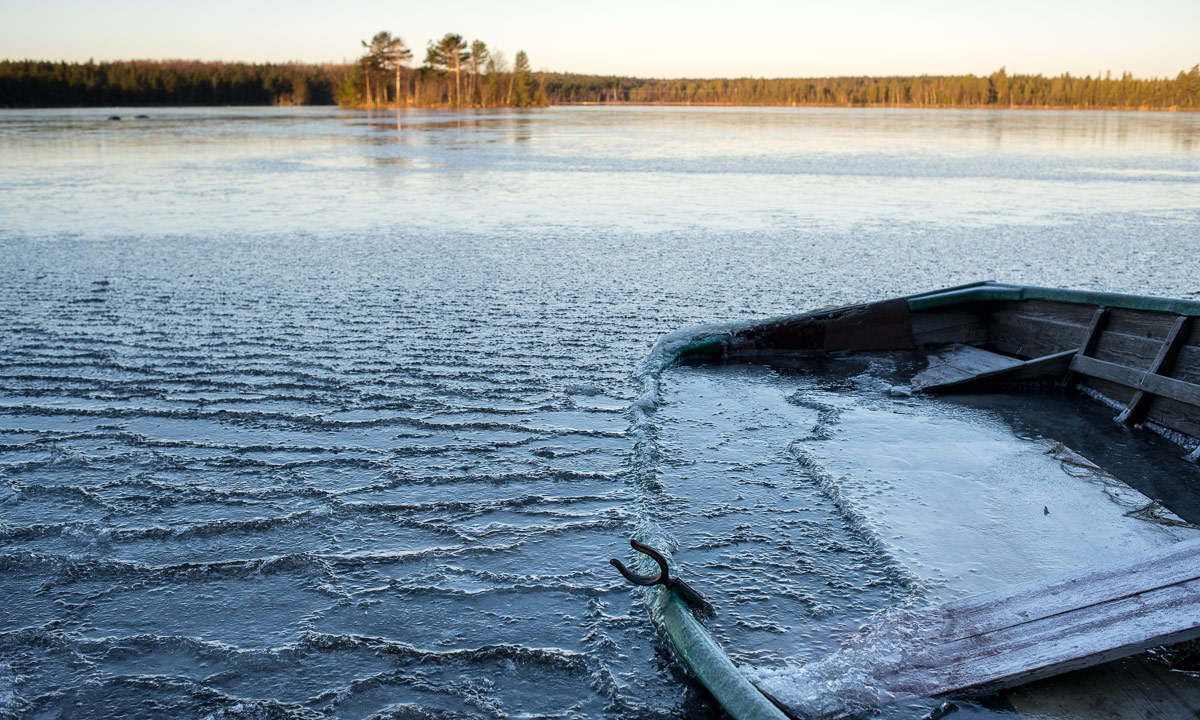
Today (6th of November) was probably the coldest day this season by now. When I left the house the thermometer showed -11 °C. I was a bit in a hurry to get the sunrise photo in time. After that I had a bit more time and drove to the lake Snesviken where I made the boat photos yesterday and last night. When I looked at the lake I was stunned! Yesterday only a minor bay was covered with thin ice, today – just 24 hours later – the whole lake.

And we’re not talking about a tiny duck pond, but about a lake one kilometre long and up to 500 meter broad. Amazing, how a single frost day can change the surface from small gurgling waves into a solid ice cover.

The evening before I was a bit angry with myself that I already dragged the kayak home again some days before, but when I came to the little beach Storgrundet I realized, that even this sheltered part of the Baltic Sea was completely covered with ice. Ice you almost could stand on and therefore much too thick to break it with the plastic blades of the paddle without ruining them.

It will get warmer the next days with even some rain, but I guess that kayak season is over, at least as long as I want to set in the kayak at the beach Storgrundet or at the boat harbour Killingören.

The first ice on the Baltic sea

After a clear and starry night temperatures dropped to -6 °C. I was quite curious if there would be ice on the Baltic Sea already and drove to the beach of Storgrundet. Of course the sea is still open in the midst of October, but in some protected bays the first thin sea ice starts covering the water. While I looked around the sun rose and instantly changed the colours of the scenery showing a nice contrast between the bluish ice in the shadowy and the warm colours in the sunlit parts.

Even if it’s cold, some bluebells are still blooming. I guess there’re quite tough. They really look nice with the tiny hoar frost crystals on their blue petals. (I guessed I looked quite funny while taking this picture from below with my head lower than my feet …)

The sun rose higher while it was still quite cold. A small outboard motorboat with two people in bright red thermal suits and fur caps went by. I took another photo of the first motif, just ten seconds before the tiny bow waves of the boat reached the thin ice and crushed it into pieces. That was the time when I realised that it’s friday, no weekend yet and I definitely should start working. So I drove home and took the bus at 9:30. Still -5 °C – the first day where a down jacket came quite handy.

Now its a quarter to eight, -5 °C again and I want to go paddling tomorrow morning. But I’m still unsure how to dress. I’m not too experienced in cold weather paddling.

Some vocabularies for my German readers:

starry – sternenklar
Baltic Sea – Ostsee
bluebell – Glockenblume
hoar frost – Raureif
petal – Blütenblatt
outboard – Außenborder
bow wave – Bugwelle