#escapism – kayaking to Gåsören

This article is part of the series #escapism. It’s about being outdoors and leaving civilisation behind in excursions that take less than 24 hours. Everyone should have time for such!

Yesterday I wanted to take advantage of the good weather and decided to make a kayak trip to the island Gåsören. I planned for an overnight stay and that means packing a lot of things:

Anything on the photo beside of the empty plastic box came with me. From left to right: Dry suit, life jacket, food and stove, camping map, spare clothes, tent, camera equipment, water bottle, book, sleeping bag, neoprene boots, 5 litre water canister. It’s almost miracle that everything fits into the kayak. Since it was quite warm I only wore pants and a t-shirt and of course the life jacket, that’s a matter of security and therefore principle.

I paddled between the islands Storgrundet and Brambärsgrundet, passed Vorrgrundet and then headed to Klubben and Flottgrundet. Here I left the islands behind and continued to Gåsören. The weather was nice and the sea was calm. Already 50 minutes later I arrived. I dragged the kayak ashore, took all baggage and went to my favourite campground (and one of the few placed not completely covered with pebbles and rocks) where I put up the tent.

After “cooking” and eating I visited two friends that own one of the two summer cottages on Gåsören. It’s really a beautiful place they have. We talked about paddling, hiking, skiing and much more. It was late when I want back to my tent and the sun started to set.

I didn’t go to sleep directly but watched the sun going down and the many fluffy but extremely clumsy seagull chicks walking around. They cannot fly yet and use to stumble over every other stone. What a contrast to the elegant flight of the grown ups.

It was much brighter than it looks like on these backlit photographs. It doesn’t get dark in the night  and I found it hard to sleep, not only due to the bright night but also to the increasing wind and the constantly screeching seagulls. I put on a woollen cap. It was not cold at all but it helped to block the direct light (though not the shrieks of the gulls).

At half past five I gave up and started to finish a book I’d been reading for a while. That took some hours. At half past eight I took a frugal breakfast: Toast with cheese.

Then I packed everything together. Clouds had started approaching and I wanted to have everything stowed in the kayak before the rain. The sky above was still blue but the sea started to get choppy.

I stopped by my friends again to say farewell. They have their cottage on the lee side of the island and we enjoyed the last hour of sun before the clouds started to cover it.

I dragged the kayak into the shallow water. It was hard to start against the wind, because the kayak was constantly turned parallel to the approaching waves. Wrong direction and quite unstable. But after some tries I managed to leave the island behind. It was exhausting but easy to paddle against the wind. Anyway I wouldn’t have dared to cross the open sea in these conditions without wearing a dry suit even if it’s only 600 metres. The water is still very cold and in case of the kayak capsizing I wanted to be completely sure to be able to reach the shore without hypothermia.

It took twice the time than the day before. The sky was grey and cloudy and it had started to rain. It may not sound like that, but it was real fun paddling through wind and waves. The hardest part was going round Vorrgrundet where I had to go parallel to the short waves. Here I had to be fully focussed to keep my balance. As soon as I reached Storgrundet I was in the lee of that island again and the water was much calmer. Soon I arrived at yesterday’s starting point.

The whole trip took less than 20 hours and is therefore a candidate for the series #escapism.

Finally, two selfies, one sunny from yesterday and one rainy from today (made in the lee of a small island).


Ships on the horizon

Two ships on the horizon. Blueish and blurred, far away from shore. The internet reveals: To the left it’s the Rolldock Sky, to the right it’s the Tian Jian. Both vessels are on the way to Piteå, the next town in the north with a larger port.

The ships make me dream a bit. Where will they continue next? To another Swedish town? To Finland or the Netherlands? To China? Where will they travel? It’s a tempting thought to travel onboard of such a ship with loads of books and loads of time.

Tian Jian has hardly move since yesterday. Perhaps it waits for the next job. The Rolldock Sky however has arrived in Piteå. I will follow the ships over the next weeks on MarineTraffic. I’m too curious what the next destinations may be and how long it will take the ships to go there.

Heat wave

Today it wasn’t warm, it was hot! While the daily maximum temperatures were between 23 °C and 28 °C the last seven days, the temperature was up to 30 °C today.

It has been hot in my house, too. Round 28 °C today. Since the daily minima have been as high as 18 to 22 °C and the sun rises already round half past two in the night it’s almost impossible to cool down the house.

There is however a place where you can cool down, at least for a while: the Baltic Sea. Today Annika and I took the car to Sillskatan where you can find a sandy beach and – much more important – refreshing cool water. A delight!

There is however something special with the photos above: They show clouds. Today the sky was quite cloudy for the first time in a long time. When we took the car back home it even started to rain but unfortunately only for half a minute.

I’m longing for rain, not only for myself but for Swedish nature and people. Forests have started burning due to the drought and the shortage of hay in Southern Sweden is so severe that farmers were forced to start slaughtering their cattle. The forecast for the next week however doesn’t look too promising. It continues to be hot and dry.

SSL

The techies among you may have noticed that this blog has been using SSL for some days to make the website more secure. This is indicated by the url prefix https:// instead of http://.

There has been a bug that prevented images of being displayed on pages with many images. I fixed this bug today but there may be others. If you find bugs, problems or mistakes just let me know.

Either write a comment (the comments are public, everyone can read them) or send me a private email. You can find the email address on the contact page.

And if there are still broken or missing images, just make a reload of the page.

The wrong lens

This evening a hedgehog sniffed around in my garden. It ignored the water bowl, probably looking for food. I put on my big telephoto lens to take a portrait but the hedgehog had other plans. It approached so fast, that it soon was too near for taking pictures. And it came nearer and nearer until it almost bumped into my leg. It sniffed a bit, considered me as completely uninteresting and continued its way through the grass of my backyard.

Thanks, Astrid for the Photo.

My house has got a new coat of paint

Last Tuesday at 4 o’clock in the morning a car approached Tallvägen, the street where I’m living. The car is a Saab 9-5. This car once belonged to me, now it belongs to friends who live 1100 km in the South. They had come to paint my house together with two more helpers that would arrive at the airport in the evening.

I still can hardly believe that four people could paint a house within two days, but they managed. It was exhausting work due to temperatures up to 30 °C and not a single cloud on the sky.

The first day we went out of bed at 3 o’clock (!) to use the less hot early morning hours. Especially Astrid hardly stopped painting until 21:30 and I considered making doping tests. The next day we started at 7 o’clock but it was soon so hot that we took a long, long siesta to avoid the heat. Beside of small details we finished the painting in the evening.

I write “we” but as a matter of fact I didn’t help at all with the painting due to problems with my elbow. I provided small help here and there and paid all the food but I have a very bad conscience anyway. On the other side, Astrid and Hein did not work for free either. It’s their payment for the Saab 9-5 mentioned above which I gave them last year.

While Astrid, Nicolas and Luka focussed on painting, Hein – a professional carpenter – also replaced rotten parts of the facade, lifted the winter garden so that the door opens and closes again and fixed many other details. I’m extremely grateful.

Here’s the team:

Here’s the result (choose your favourite photo):

Thanks a lot for your fantastic help!
@Nicolas und Luka It was really nice to meet you.
@Hein und Astrid: Have fun with the car, it’s yours!

Mårdseleforsen

Two days ago Annika and I made a trip to Mårdseleforsen (Mårdsele rapids). It’s a two hour trip by car from Skelleftehamn and it’s absolutely worth it.
At Mårdsele the river Vindelälven branches into several parts. Several chain bridges allow to cross them.

Behind the second chain bridge there is a planked footpath that leads to a third bridge, this time a wooden one. Here starts a short circular track through the Nature Reserve of Mårdseleforsen round many inviting looking freshwater pools. Many other families were there too,  taking a walk, bathing or sunbathing on the flat rocks. Unfortunately we had left our bathing things in the car.

After the short walkabout we returned to the parking place. Actually, we wanted to eat something but the restaurant Wild River was fully booked. Fortunately we could buy some burgers that we consumed sitting outside in the sun.

After the lunch we were so eager for a bath, that we got the bathing things out of the car and returned to the freshwater pools. Chain bridge one – across the island again – chain bridge two – to the left – along the planked footpath – to the right – over the long wooden bridge and again we reached the river islands. There were some people left when we arrived but after a while we were completely alone. The weather was perfect: Some sun, some clouds, warm but not too hot.

Soon we found a nice place to stay and took the first swimming tour. Right into a rocky pool, swimming into the current of a small stream that transported us under the bridge where the current broadened and the current weakened. Almost like using a water slide! It was not easy to come ashore again because the algae made the flat rocks very slippery. But with mutual help we finally managed it.

You realise that strange mask I was wearing? It’s a snorkel-google combination, perhaps more a toy than professional diving equipment but it works extremely well and is much more comfortable to wear than the usual snorkel. In addition to that it works quite well with my underwater camera. I snorkelled several times and observed the underwater life: Water insects, freshwater snails, small fishes and river mussels lived in them.

The “making of” (Photos: Annika Kramer):

Even after more than eight years living here I’m still amazed that there are so many incredibly beautiful and interesting places to discover and explore that I’ve never been to before. Mårdseleforsen is one of them.


From the #archives: winter season

The weather of the last weeks has been hot, mostly too hot for me. Even today’s thunderstorm and heavy rain showers didn’t manage to cool down the temperatures below 20 °C. I’m really longing for cooler weather. Since I cannot change the weather itself I can only provide some winter photos from the archives. Voilà:

A two-day journey to Stora Fjäderägg

There are so many wonderful and special locations to stay overnight in Northern Scandinavia. Many of them are quite far away as e.g. Låktatjåkko (590 km) or Kjølnes Fyr (970 km). Others are quite near.
Two days ago Annika and I started a two-day journey to such a place, unknown to both of us. Already the journey was interesting, since you cannot reach the destination by land. We started in Umeå and drove to Norrfjärden, where we parked the car and waited for the 8 o’clock ferry to the island Holmön. This ferry is operated by the Trafikverket (Swedish Transport Administration) and free of charge.

We had four hours to explore this island, part of the island group Holmöarna, that have 75 year-round inhabitants. The small village Byviken, where we arrived has a boat museum and a small shop, that is open all year. We went for a walk and discovered a nice place: Bergudden. There’s a lighthouse and you can rent rooms, on request even in wintertime.

We arrived back in time to wait for the departure of our next vehicle: Holmöslupen.

Holmöslupen is a chalupa, an old cutter-like sail boat which is a reconstruction of an old boat type as commonly used 100 years ago. It takes up to 12 passengers and you are allowed (and asked) to help with e.g. hoisting the sails. Life vests available, sailing experience not needed. This boat would bring us to our final destination.

The wind was so weak, that we sailed only a part and mostly used the motor. Otherwise the trip (planned to take 40 to 60 minutes) would have taken several hours. We passed the islands Trappskär and Lill-Fjäderägg before we arrived at our travel destination Stora Fjäderägg, an island of 1.8 km × 1.3 km.  Here’s a hostel driven by the STF (Swedish Tourist Association). The story of this hostel is worth to tell:

After people of the boat museum were done with the building the Holmöslupen they asked themselves what to do with such a fine and seaworthy ship. It was them who had the idea to install a hostel on the uninhabited island Stora Fjäderägg just to give the chalupa a purpose. That’s why there is a hostel on a desert island in the Northern Baltic Sea and a wooden boat that transport the guests.

Some images of the island:

There is electricity on the island, there is mobile internet and there is drinking water. The latter comes from a well and especially this year you have to be economical with it due to the long period of dryness. Luckily it rained some days ago and the rain barrels were filled to the brim. The rain water is used for washing oneself and for the dishes. The hostel has a fully equipped kitchen, but you have to bring all food with you.

Annika and I had decided for one of the all-time travel dinners: spaghetti with pesto and parmesan cheese. It was very warm but not too hot to sit outside. We enjoyed our meal and watched the barn swallow feeding its six children that begged for food with open beaks. They seemed to be almost grown-up and hardly fitted into the small nest any more.

We were told, that there are many seals round Stora Fjäderägg and where to find them. Together with Annika I doubtfully followed the tiny path through the heath – I’ve never seen a single seal in the Swedish Baltic Sea since I moved here eight years ago. The ground became rocky and we had a view of the sea. First I saw a black spot on top of a grey spot. A seal on a rock? Then we saw round black spots floating back and forth – definitely seals, I never heard of swimming rocks … . I used a small tree for cover and creeped nearer. The back spot was a seal too and other seals were lying along a headland a bit farther away.

I took the camera, ducked and tried to creep nearer to a large boulder to hide behind. The seal however saw me and *splash* jumped into the water and dived away. I waited behind the rock and I was lucky. After some minutes a seal approached the same rock and crawled onto it. I was so near that I could hear the flippers splashing.

After having taken these photos I returned to Annika and the seal – seeing me – dived again. This rock kept empty for the next time but along the headland more and more seals appeared and seemed to cover the rocks completely. Next time I’ll definitely will take my huge tele photo lens with me.

We both sat there for a while – on a big rock, both listening and watching. The sun had already set, zillions of small insects hummed and buzzed around and we watched the many grey seals, at least 40 of them. Finally we decided to walk back as long it was light. Some of the small paths are not easy to walk on. On our way back I stopped because I saw something moving. It was a young hare. No, it was two of them. No, even more.

Three young hares were hopping around, eating a bit of grass and completely ignoring us. I was able to get close to three meters and still they didn’t seem to be frightened at all. I increased the ISO of my camera to 3200 and took some photos of these cute furry animals. (Don’t ask me what they do in photo 3 and 4, I’m not a hare expert.)

When we arrived at the hostel nightfall had intensified. Frog hopped around everywhere and the blue hour invited for taking more pictures. I however was tired and only took a photo of the old lighthouse before going to bed.

The next day: After a nice outside breakfast Annika and I took another walk over the island. Stora Fjäderägg has a lot of historical places, anything between the not-so-old lighthouse and ancient heaps of stones only readable for archeologists. Here are some of them:

Again it was warm or even hot at midday. Passing the lighthouse we returned to the hostel longing for water to drink.

Apropos lighthouse: We were ten people on the island that had stayed overnight: The host family (3), Annika and I (2), a family from Örnsköldsvik (4) and a man that had bought that old lighthouse. He showed Annika and me around and told us about his plans to renovate the lighthouse and to build a flat into it. A great project that probably will take some years, because it’s just a summer project.

We already had packed our backpacks and cleaned our rooms, now we were ready to go back to the small harbour waiting for the Holmöslupen. This time we were lucky, we could use both mainsail and foresail to sail back to Holmön.

Step by step we came back to civilisation: Holmön – the grocery shop (ice cream!) – the ferry to the mainland – the parked car – driving the E4 to Umeå – a Thai restaurant – home at Annika.

Conclusion: Absolutely worth it! I’m sure it wasn’t the last time, that Annika and I travelled to this very special place.

More info:


Eternal winter in Skellefteå

The July in Sweden was the hottest since 1756, when temperature measurements began. In Skellefteå it was extremely warm as well in July: 29 days had a maximum temperature above 20 °C, 19 days of them above 25 °C.

There is however a place of eternal winter in Skellefteå, just 3 km away from the centre.

Is it a glacier? Is the ice age coming back? No, of course not, this area is just Skellefteå’s snow dump. The last winter was long and snowy and more than 13000 trucks transported snow to this place until the end of April. This resulted in a snow pile of 25 meters in height – another record.

No wonder, that there is still a lot of snow left despite the warm summer. At the edge Tussilago was flowering as if it were spring. The snow was surprisingly clean, only grit and a bit of rubbish showed that I was near civilisation.

Call me stupid, but I had to touch the ground to feel the icy snow – yes, it was cold. It may be tempting to visit this place on a hot summer day, but that’s maybe not the best idea. For one the place is anything but beautiful and for another not without risk, because there could be invisible holes under the icy snow. I was extremely cautious while taking these pictures.

If you would ask me about the strangest place in Skellefteå in summer, the Skellefteå snow dump was definitely a candidate.

Links

Another bath in Storgrundet

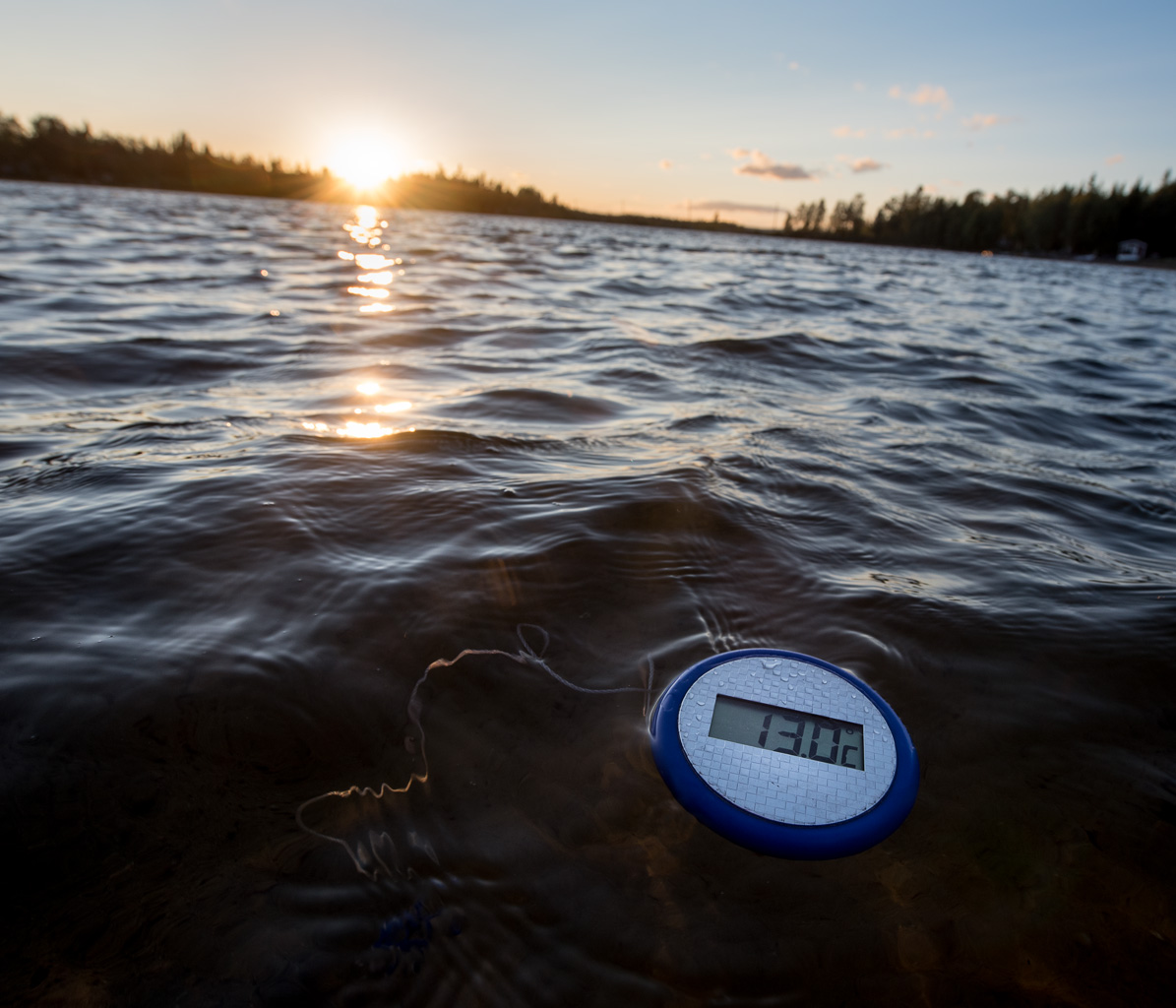
Bathing in the Baltic Sea is still fun but it starts getting chilly. Today water temperature was round 13 °C, that’s 5 °C less than two days ago. Maybe the strong gusty wind has been mixing the warmer surface water with colder water from the depth.

If the water temperature drops below 10 °C you can call it winter bath. I guess, that will not be long.


Travelling to a new country

This article is part of the series “2018-08: Iceland”.

Finally I’m travelling again. A trip to a country I never visited before. Annika and I are sitting at Arlanda airport and waiting for the connection flight to …

… well, which destination are we travelling to? Your guesses?

Addendum:

My blog had a small bug that I discovered right before entering this plane. This is my first flight ever with WiFi, so I was able to fix it up in the air while flying over Sweden’s inland.


Flying to Iceland

This article is part of the series “2018-08: Iceland”.

Saturday, 25 August

After an early flight from Skellefteå to Stockholm Arlanda Annika and I switched plane and airline. For the first time in my life I travelled to Iceland, where we would spend the next two weeks.


The Atlantic ocean was mostly cloud covered. We could only spot some offshore platforms off the Norwegian coast before the cloud layer became too dense to see anything.

A good opportunity to play around with the entertainment system of the plane. Icelandair, I’m really impressed! Miles Davis · Bitches Brew, John Coltrane · A Love Supreme, Ligeti · Piano works, Steve Reich, Karlheinz Stockhausen … . And that’s only an excerpt of  fJazz and Classical Music aboard. Great music and a good reason to favour Icelandair before other airlines in the future.

Shortly before approaching Iceland however I could see something different, as white as the clouds but of another shape. A glacier, the first sign of Iceland. Shortly after this the cloud layer broke up and we had a fine view of Iceland from above.

The plane descended and started approaching Keflavík Airport. Welcome to Iceland!

Landmannalaugar

This article is part of the series “2018-08: Iceland”.

Sunday, 26 August – Monday, 27 August

There are only a few roads leading across the Highlands of Iceland. Most of them are only open for cars with four-wheel drive because it is necessary to ford rivers. Even though the road to the Landmannalaugar, our destination for Sunday, is not the toughest, we decided not to hire such a car. They are expensive, we don’t have any experience in fording and there are busses making such trips as well.

Sunday morning we entered the bus to the Landmannalaugar. The whole trip takes round about four hours and goes mostly on normal asphalt roads: through Reykjavík, along the Ring Road that runs around the island, then along a minor road. Finally we reached the junction where the gravel road starts and the bus ride became a bit jumpy. We met some other cars, some of them huge jeeps, some of them small SUVs. After a while we approached the first ford, where a small Dacia Duster crossed the water, followed by our bus.

The other two fords are within sight of the Landmannalaugar mountain hut. There were deeper and many of the drivers with smaller cars decided to use the parking place nearby instead of fording. The bus however splashed through the water and brought us to the mountain hut, where we had booked two places to sleep.

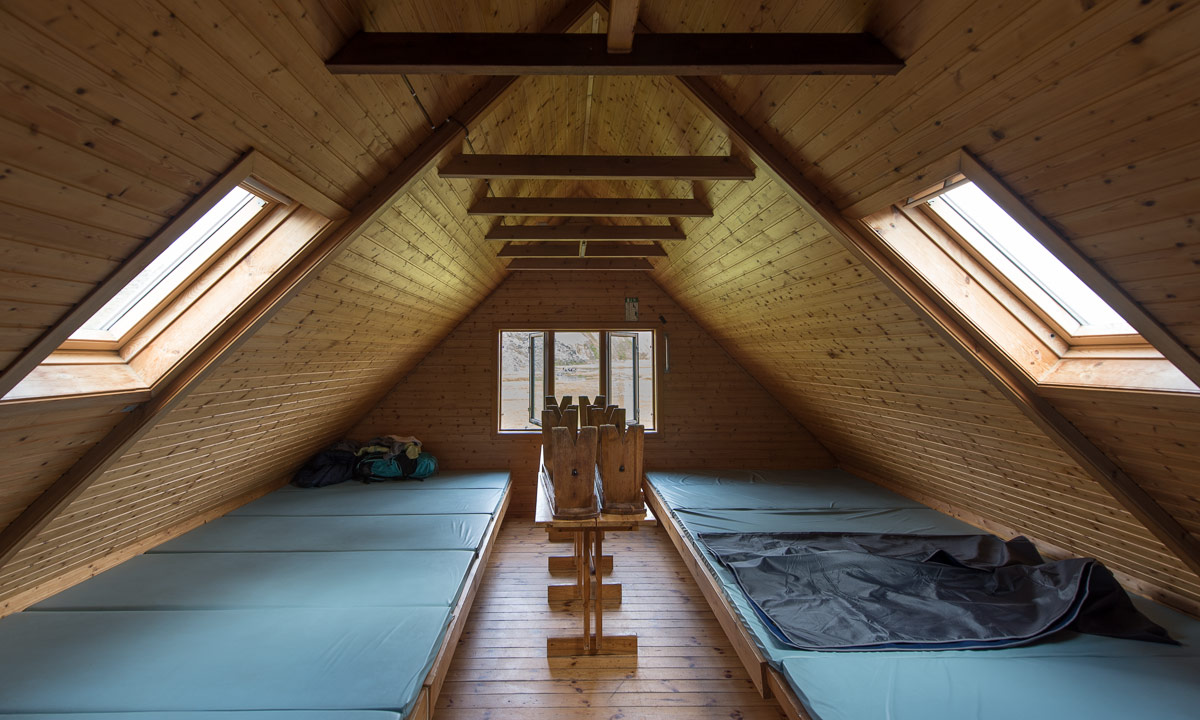
After we unpacked our sleeping bags and put them on two of the narrow mattresses we put on our jackets and boots and started a hike through the amazing landscape. Annika has been in Iceland before several times and told me about the almost unbelievable colours and shades of the mountains and she was true. Some of the mountains were orange, some brown or yellow, some green and one of them red. The lava rocks were black, partly covered with white-green moss and the higher mountains had white snow fields on their colourful slopes. Take a look by yourself:

Iceland has a lot of tourists, last year more than 2 millions. To protect the sensitive environment and avoid destroying the flora you mustn’t leave the trail. There’s another reason for sticking to the trails: Iceland has many geothermal areas where you could break through the thin crust into bubbling mud or boiling sulphuric acid. Some of these spots are visible, they smoke and you smell the sulphur compounds.

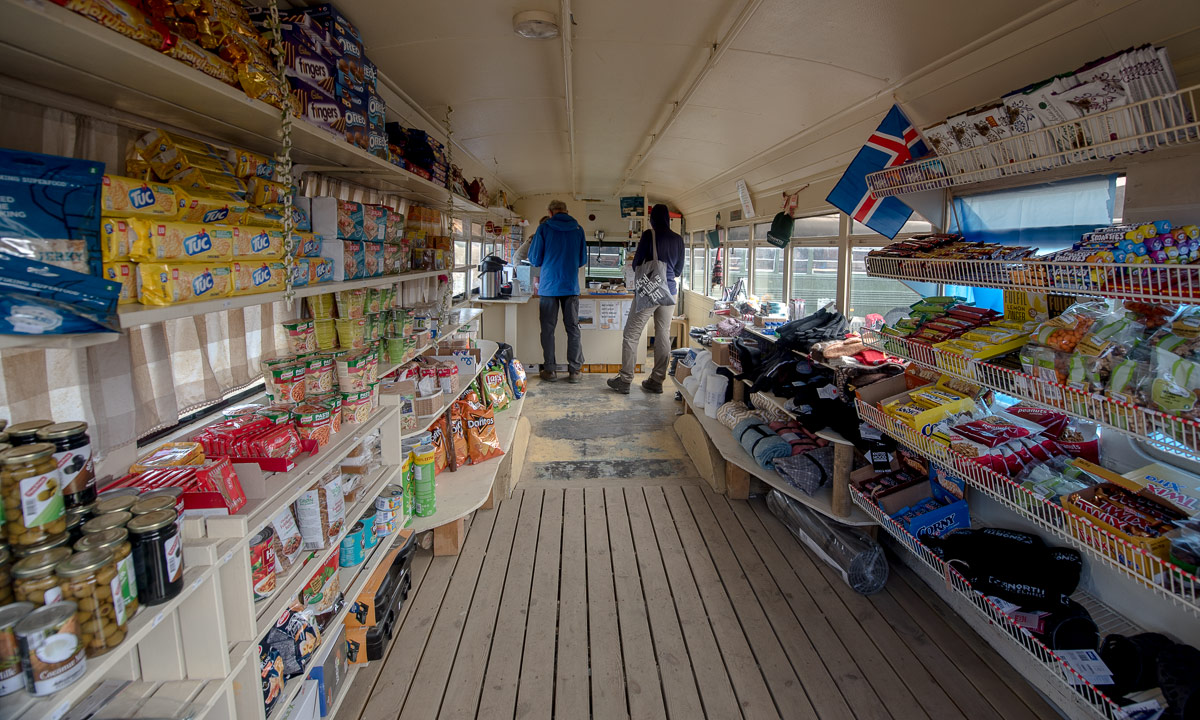
After some hours hiking (including an ascent of a mountain) we returned to Landmannalaugar. There’s not only the mountain hut providing 75 beds and a camp ground with place for at least hundred tents, there’s also the Mountain Mall, an old bus where you can buy food.

We enjoyed a rest with two cokes before we headed to the next attraction: A warm bath in the river. Because of the geothermal activity the ground is partly hot and heats up the water to temperatures between round 30 °C and 42 °C. We were not the only ones bathing, but there was enough place for all. You could even decide how warm you wanted your bath by just moving another metre. Great!

After a saturating dinner with spaghetti and pasta I took another walk and some more photos. Then I went to our room and got to bed.

Amazing! Although more than 15 people had slept in the room and the mattresses were so narrow that we could hardly turn around Annika and I slept very well. It was very quiet, hardly any snoring, no talking, no rustling with plastic bags. I experienced much worse when I had spent nights  in alpine mountain huts in Germany or Austria.

After breakfast we took another bath and then another hiking tour. I hardly made any photos due to the drizzle and the strong winds. At least I could take some pictures of the sheep grassing on the plain.

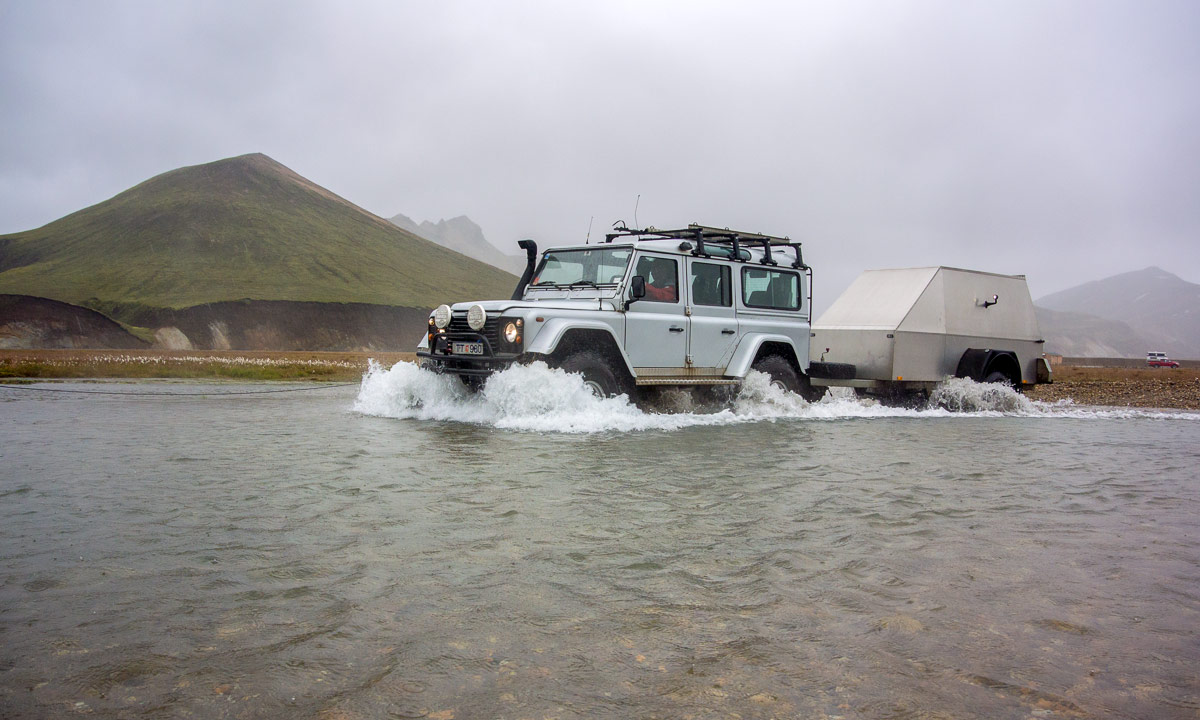
Drizzle became stronger and turned into rain. We went to the ford and looked at the cars crossing. This time I had my waterproof camera with me. Look at the snorkel of the white jeep, I guess this car could almost dive!

The rain got stronger and stronger and when we entered the bus our rain clothes were soaking wet. I looked through the rain-wept window for a while, tried to make same photos, but the autofocus couldn’t handle the situation. After a while I fell asleep.

Conclusion: A great experience! Yes, Landmannalaugar is touristic and crowed, but for good reasons. It’s absolutely worth a visit. Here you can even start a four-day hiking trip but you have to reserve the mountain huts years before. I’m quite eager to do this trail, perhaps in 2020 …?

Hveravellir

This article is part of the series “2018-08: Iceland”.

Wednesday, 29 August – Thursday, 30 August

After our long bus tour we arrived in Hveravellir in the Highlands of Iceland. Hveravellir lies 650 metres above sea-level and here you can find geothermal areas, where fumaroles emit hot gas, mostly water, carbon dioxide and hydrogen sulphide. The latter one is responsible for the smell of rotten eggs.

We went along the wooden path (don’t leave it, the crust is thin and boiling hot!) and looked at the fumaroles. Then we continued a path westwards.

The landscape scenery changed. The path led mostly through lava rock, only sparsely covered with soil, moss, grass and some flowers.

Some sheep were grassing here and there. They preferred the grassy parts of the desertlike surrounding.

The willows however had to cope with the soil that they had got and even more with the weather. There were flat and crouching on the ground to avoid exposure to the wind.

The way we chose is no circular track so after a time we had to return to Hveravellir, where we had booked an overnight stay. We used to wooden bridge to cross a small stream. You have to be careful, the water is hot!

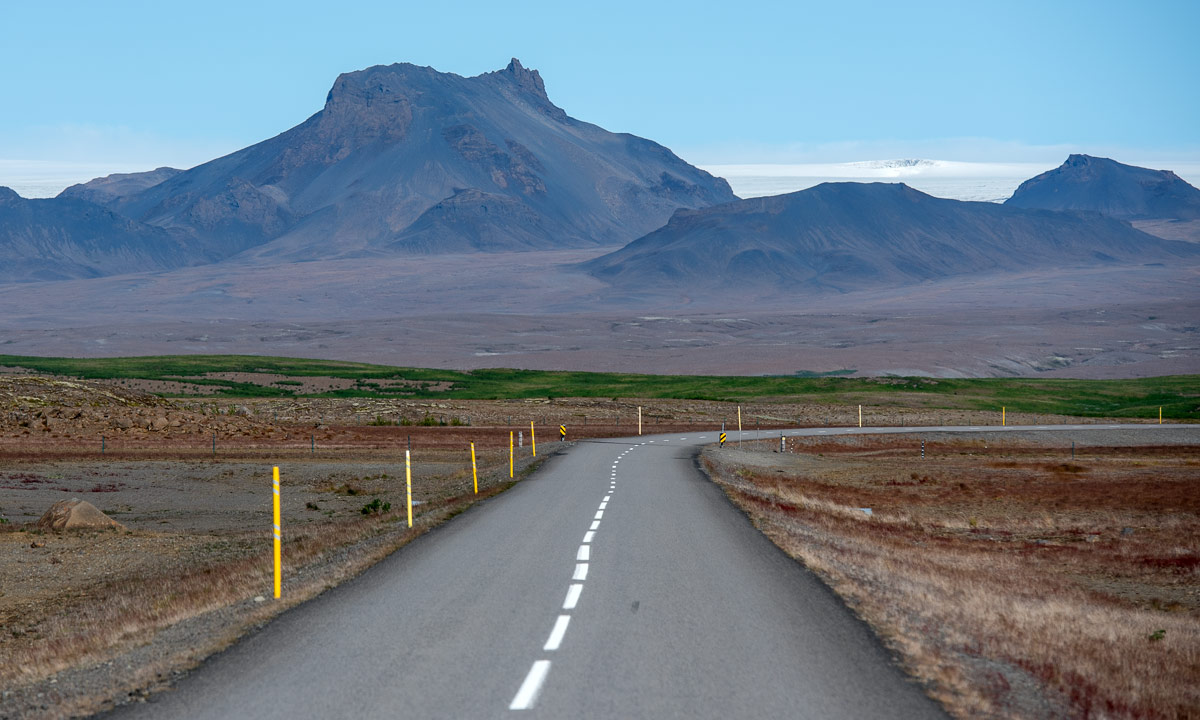
“Home” again we cooked tortellini for dinner and bathed in the hot tub that was located right beside of our mountain hut. While Annika stayed in the hut after that I took another walk and enjoyed the evening light. The sky was clear and the sun was shining. (And I thought, it would only rain on Iceland!) The motives? Smoking fumaroles against the light · glaciers and snow covered mountains far away · sheep nearby.

I slept very well but woke up quite early. Time for another walk, this time enjoying the sunrise.

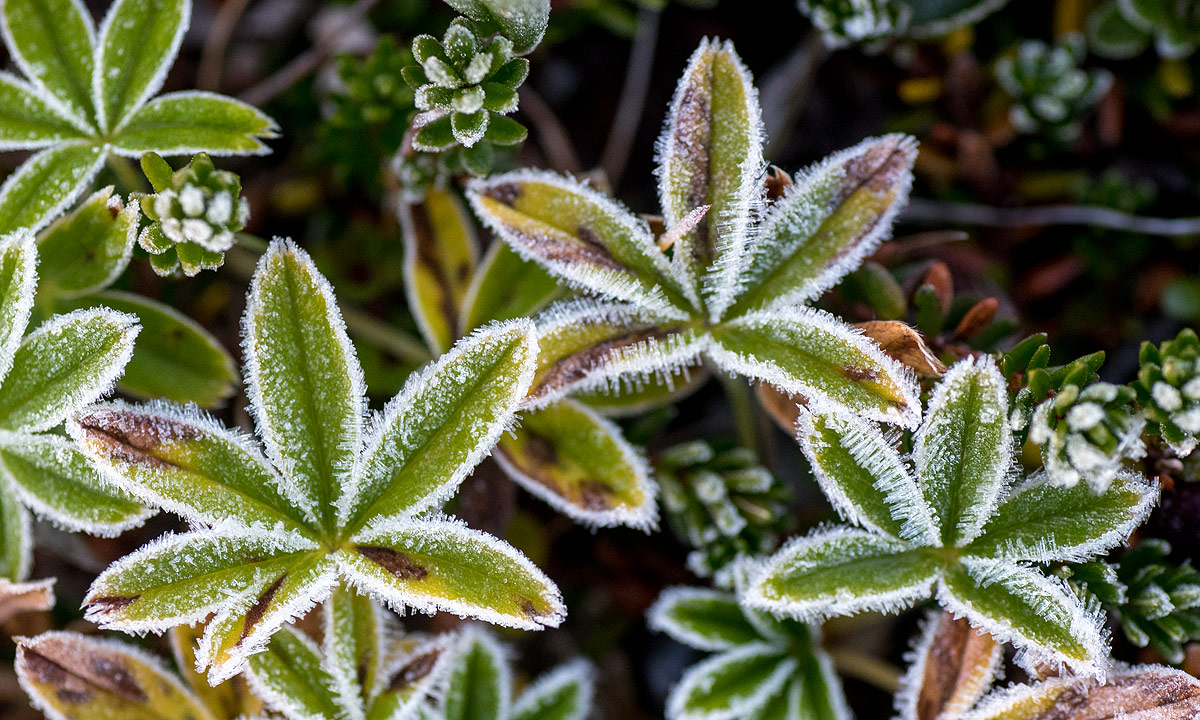
The night has been cold and ice crystals covered flowers and leaves. The wet parts of the ground were covered with hoarfrost that looked hairlike.

The fumaroles enveloped the geothermal areas in steam. I can do without the sulphuric smell, but the look is very impressing, especially with the warm sunrise colours.

After my early morning walk Annika and I had breakfast and then packed our stuff. The bus back to Reykjavík wouldn’t leave before 12, so we had time for a two-hour walk together, this time heading south. One of the things that make Iceland unique for me is the colours, not only the colourful mountains in Landmannalaugar, but even the moss and the grass looks special. And the volcanic lava rock is so sharp that the photos look oversharpened.

Round 11 o’clock we had returned to the parking place waiting for the bus. But we spontaneously changed plans when we met Matti whom we got to know in Reykjavík some days ago. He was here by car and invited us to join him and his friend. They wanted to drive to another place, hike around then return to Reykjavík. We happily agreed and had a great time, but that’s another story …


Icelandic letters

This article is part of the series “2018-08: Iceland”.

While the latin alphabet has 26 letters, the Icelandic alphabet has 32. C, W, Q and Z are not included. So the Icelandic alphabet has ten extra letters that are not part of the latin alphabet.

The first 6 letters are vowels with an accent that changes the pronunciation. It’s ÁÉÍÓÚ, and Ý. Two others are vowels, too: Æ/æ and Ö/ö. The letter Æ is also used in Danish and Norwegian, while Ö is used in e.g. the Swedish and German language.

There are two letters however, that are a bit special: Ð/ð and Þ/þ. The letter Рis called eth and its pronunciation resembles the th in that. The letter Þ comes from the runic alphabet Elder Fuþark and is called thorn. It is pronounced like the th in thing.

When Annika and I took the bus to Landmannalaugar some days ago I spotted a sign on front of a house. It contains 5 of the special letters: The Ö, the Æ, the Ð, the Þ and the Ó.

What does the word Lögfræðiþjónusta mean? Lögfræð means law and þjónusta means service, so the whole world means “legal services”.

A special place in the Highlands of Iceland

This article is part of the series “2018-08: Iceland”.

Thursday, 30 August

When Annika and I were in Hveravellir waiting for the bus back to Reykjavík, we met Matti whom we got to know some days ago. We gladly accepted his invitation not to take the bus but to follow him and his friend by car.

First Matti followed the very same way that the bus would have taken, but soon he turned in another gravel road that led us up a slope. The path got worse and worse and I was glad that Matti has an old Nissan Patrol and knows how to handle it when crossing a ford or driving through deep clay mud. The gravel track ended in a parking place with a tiny toilet. From this point we had to walk.

I stood at the rim of the parking place and was stunned by the iconic view.

I could see coloured mountains everywhere as in the Landmannalaugar, many of them covered with old snow fields or small glaciers. The scenery was partly covered with steam that emerged from fumaroles as in Hveravellir, but here were hundreds of them.

We followed the path and descended the clayey slope on some ridiculously steep looking steps. This geothermic area is very active and constantly changing. Sometimes a fumarole is less than a footstep away. We crossed a bridge, partly hidden in the steam emitted by boiling water pools, were Matti cooked some eggs.

We continued our hike and ascended another clay hill. From here we could see many other hills and stairs leading up and down.

We came nearer and nearer to an old snow field. Here the normal path came to it’s end.

One path led up the slope over the snow. We continued another path that led to the top of a slope. From here we could see huge snow blocks that had slid down the clayey slope. Matti, his friend and I went down that slope. The ground was extremely slippery and when I arrived down in the valley my rain pants were completely covered with wet clay. The weather worsened: First it drizzled, then it even snowed a bit and in addition of that the steam of the fumaroles was everywhere. The following photos of the snowy ice blocks were the last ones before I gave up making pictures, because camera and lenses became too wet and muddy.

It took I while until I managed to crawl up the slippery clay slope again. We started heading back. The wind had increased and on the last crest-like hilltops it was really stormy. Luckily the storm was not strong enough to blow us over. Anyway I was glad to be in the shelter of the car again.

This place is really special. Not too easy to hike when it’s wet, but both interesting, varying and extremely beautiful. Of course other people know this place as well but at least there are no commercially guided tours yet. To keep it that way, I promised not to reveal the location of that place although Iceland experts probably have recognised it already.

Thank you, Matti for this experience, the long drive back to Reykjavík and the lift to our guesthouse!