Ekkerøy and Nesseby

This article is part of the series “2018-03: Varanger peninsula”.

Day 34 and 35 of my winter journey 2018

After some days in Ytre Kiberg Annika and I travelled to the next place: Ekkerøy. This village, 50 km southwest from Kiberg lies on the peninsula Ekkerøya that is connected to land by a natural dam with sandy beaches on each side. We already had taken a short walk at one of the beaches last week, where we had met H., one of the locals.

We arrived in Ekkerøy three days ago. The day before yesterday I took a morning promenade with my camera. I made some photos, but the light was a bit dull.

After breakfast Annika and I started a tour round the island, partly with snowshoes, partly on foot. There’s a cliff at the southern shore that looks quite impressive. At the eastern tip there’s an old wooden sea mark. The northern shore is quite flat and was more snowy. Outgoing tide already had started so we walked the last meters on the beach until we came to our wonderful house, that we’ve rented for four days.

As you might have noticed almost all photos shown in this blog have a landscape format. I have a project however that might involve having portrait format photos as well. Therefore I walked to the beach yesterday morning to find a motif fitting portrait format, not too easy in a landscape that’s extensive and mainly quite flat. It was almost high tide and it was quite cold – -12 °C and very windy. The water at the beach was almost of a slushy consistency and each wave flushed new liquid slush to the beach where it froze to a wavy line of ice. That motif went quite well in portrait format, I just have to practise my view.

(I have to think over the design of my blog, these portrait format images are way too large.)

It cleared up more and more and the sun shone from a blue sky. We took the car to Nesseby, 50 km away, where I planned to make some photos of the Nesseby Church. The more we came to the more sheltered parts of the fjord, the colder it got and the open water of the Barents Sea smoked. This phenomenon is called sea smoke and happens, when cold air lies over the open sea.

From the harbour Nesseby Church could be seen through the foggy sea smoke. It is located quite exposed at the thinnest part of a peninsula and can be spotted from long, when weather is good. After looking from the harbour we continued to the church and had a closer look.

We took a short detour to Varangerbotn. There it was even colder with -19 °C but fair weather and hardly any wind.

It’s fascinating to have a look at the fjord of the same name. At the end it’s completely frozen with many icy humps, but on the way back (and north again) it opened and sea smoke appeared again.

In Vadsø I took a promenade on the island Vadsøya to have a look at the airship mast. Since I’ve been a child I’m a huge fan of balloons and airships and it was interesting to see this mast, built in 1926 and only used twice: by Umberto Nobile and Roald Amundsen for their expedition over the North Pole with the airship Norge in the same year and on Nobile’s flight with the airship Italia two years later.

Home again we remembered that H. who we’d met the week before had asked us in for coffee some day. At 4 o’clock we knocked at the door of her house and met her husband T. who directly invited us to come in. H. was visiting a friend and would join us later. We talked and talked, about languages, life in Northern Norway in general and Ekkerøy in special and we had a good time (and got coffee, cakes, cheese, grapes and red wine). When we left H. and T. – two of the round twenty permanent residents in Ekkerøy – it was already 9 pm and sky was dark … beside of a beautiful aurora dancing above the northern shore.

It took some minutes to walk home, put on warmer clothes, get camera and tripod and the aurora already had weakened a lot when I took the photo below. So it is with northern lights: intensity can change very fast, often within seconds.

Today we have another day in Ekkerøy. Our plans so far: not any. That’s nice, too!


That arctic feeling

Have a look at the following photo:

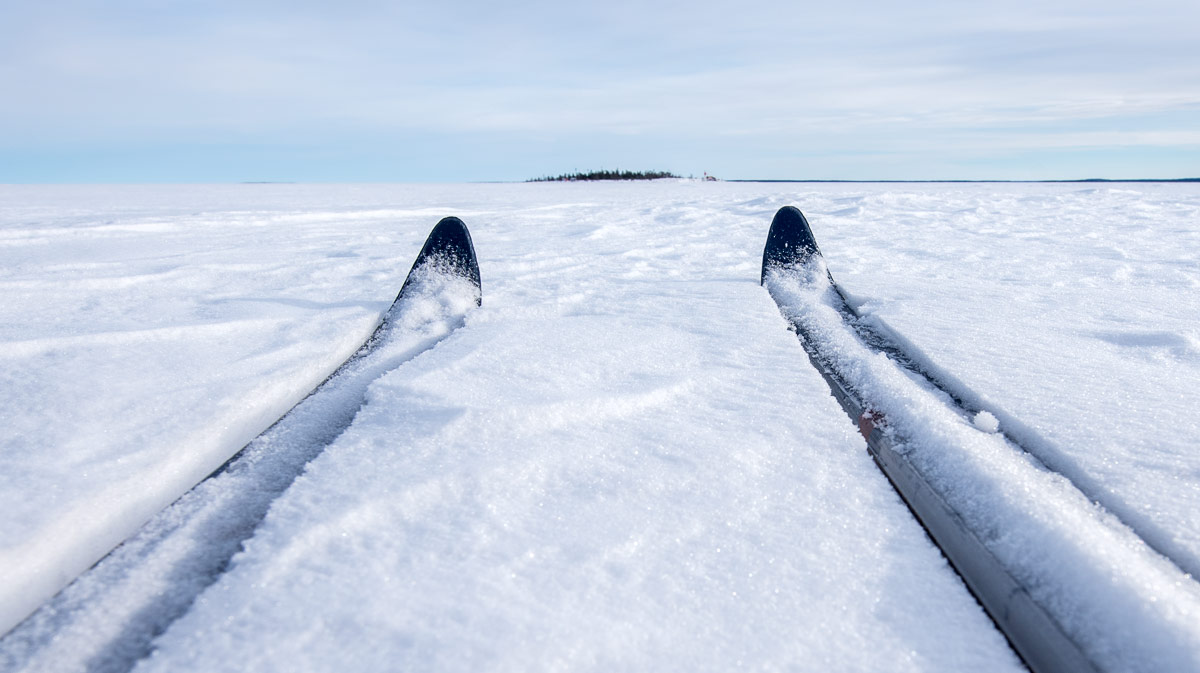
It could have been taken at some spot at the Arctic Sea, couldn’t it? But it wasn’t. I made that photo just today, only 2 km away from home!

Today I wanted to test whether the camera backpack worked well together with the waist harness of my pulka. Therefore I made a small ski tour. First I crossed the ice between mainland and the island Storgrundet. The water between mainland and island is well protected and always calm. Therefore the ice is about 40 cm thick and more than safe to cross. I crossed the forested island, which is partly less than 200 meters wide and soon stood on one of the snow drifts at the outer shore. Beside of some smaller other islands and an old boat shed all I could see was clouds, snow, and ice.

There were many thick ice floes along the shore, but the ice between them was hardly a centimetre thick. No surprise, since large parts of the sea had been free of ice last week. I pierced the new ice with a stick and measured 60 cm water beneath. Not life-threatening, but I definitely didn’t want to get soaked and therefore sticked to the shoreline of Storgrundet. That’s where I took the photo above.

The other photo? Yes, that’s me with my Norrøna jacket (light and windproof), my Lowepro camera backpack and my Fjellpulken pulka. The test succeeded: pulka and backpack do work well together! Good to know for the ski tour in the Swedish mountains that I’ll start next week …

Question: Do you see the mistake I’m making on the 2nd photo? Please comment.

3× winter coast

Yesterday, 13:30

After having lunch, Annika and I drove to Näsgrundet, where the Baltic Sea had been mostly clear of ice three days before. Still most of the sea was ice-free, only at the coast some meters of new thin ice had formed.

It had started clearing up and the temperatures dropped to -15 °C already in daytime. The cold air over the open water created sea smoke, that gleamed in the colours of the low sun.

Yesterday, 23:00

It continued getting colder and soon the temperature dropped below -20 °C. Before sleeping I was out again, this time to check for an optical effect, that can appear when it’s as cold as then: light pillars. Even though it was round -23 °C I wasn’t lucky, but I took some photos of the Rönnskär industry anyhow.

Today, 8:00 – 9:00

This morning was the coldest yet this winter with temperatures round -24 °C. That’s when I start wearing two pairs of gloves for taking pictures. The inner fleece glove for handling the camera and a thick woollen mitten for staying warm when I just wait or look for motives.

The first motive may look quite boring but I love motives like these: just different cloud layers and ice up to the horizon plus the first gentle sunrise colours.

Remember, this part of the Baltic Sea had been clear of ice the day before. Due to the cold weather it has frozen within a range of several kilometres within less than twenty hours. It still amazes me how fast this process can be.

After I had made the former photo I detected that purple-red spot beside of the island Gåsören. The sun started to rise. I changed the lens and made a telephoto shot. (It’s quite blurred due to the atmospheric conditions)

Then I waited for the sun to rise. And really – after some minutes the sun succeeded to rise above the lower cloud layer. But only seconds later the upper cloud layer, that approached from the southwest covered the red orb again and the sun disappeared for the rest of the day.

Though it was still below -20 °C it started to snow.

Varning! Isvak!

The river Skellefteälven between Skellefteå and the coast of the Baltic Sea. That particular place is called Stackgrönnan. On warm summer weekends the café is quite crowded. In winter it’s closed.

This sunday however the small snow covered way is crowded, even though it’s mid-January. Many cars are parking, many people are standing around, warmly dressed for winter. Some of them have bags or rucksacks with them.

The Skellefteälven is completely frozen and covered with snow. Snowmobile tracks lead to the opposite riverside. On the river ice there are signs round a cordon.

They say “Varning! Isvak!” – “Warning! ice hole!”. And there is an ice hole indeed, four square meters big. Some people stand around with spearlike tools and remove the last thick ice blocks from the hole.

So that ice hole seems to have a purpose and it has: It’s an ice hole maintained by the association Mörkrets och Kylans Glada Vänner, or in english Happy Friends of Cold and Darkness.

I’ve been member of this association almost from the beginning and had the pleasure, honour (, and work) of being part of the organisation team for the very first Swedish Winter Swim Championship in Skellefteå in 2012. It was the coldest day of the winter with temperatures below -30 °C, but that’s another story …

Back to the plot: All people have come to take a winter bath or at least to cheer to those who do. Annika and I have winter-bathed before but not yet this winter. We aren’t the only one’s who want to take a bath, there are at least 30 others and the changing rooms are stuffed with people, some wearing winter parkas and warm boots, others just their swimwear and a cap. The same outside: Woollen mittens and down jackets on the one side, wet semi-nude bathers with towels on the other side.

And what is in the ice hole? One winter bather after the other. First looking tensed or even shocked, since the water temperature is round 0 °C (and yes, that’s cold!), then relaxed and happy because the body releases endorphins. But have a look by yourself:

After the last bather – most people and cars already have gone – wintry silence starts to set in again. The snow covered tables and benches are still untouched and the fairy lights round the big flag pole are on. Temperature is -11 °C. If you ask me, a perfect winter day.

Appendix one

On 17 February 2018, the Open Scandinavian Championship which is a part of the World Cup will be held in Skellefteå for the seventh time. And you can apply!

Appendix two

Evidence photos of me in the ice hole? Thanks to Annika, who took photos with her mobile they exist. Var så god:


Checking the winter …

This winter has been quite lagom yet. It hadn’t been too warm for a longer period, nor it was it really cold. We got snow several times, but we didn’t get any lake effect snow neither as e.g. five years ago where it snowed more than 80 cm within 24 hours.

Yesterday and today it snowed round 20 cm. Since we already had round half a meter of snow, the fence of my garden is about to disappear in the snow.

I took the photo above through the window of my living room. It shows my (and the neighbours) backyard. The fence is round 80 cm high.

Today I took the car to the Näsgrundet, one of my favourite places in Skelleftehamn. When I had been at the same place 12 days ago, the Baltic Sea was covered with ice as far as the eye could see. When I arrived today I was really surprised to see the Baltic Sea clear of ice again.


The photo above shows a small bay beside of Näsgrundet. The ice had been broken by wind and the floodwater two days ago. The wind was pushing the ice floes slowly offwards and some of them already had started to drift seawards.

That was the view to the northeast. The view to the southwest is completely different: there is the peninsula Rönnskär with the copper smelter of the same name. It snowed but the low sun managed to peek through the airy cloud layer. Temperature was -9 °C and the chimneys smoked.

In front of the industrial plant is the “cape” of Näsgrundet, which is a peninsula as well. I took a short discovery tour and found another motive. When I was standing up, Rönnskär and some trees were visible but when I knelt down I was able to hide the background and to make a completely different photo:

I intensified both contrast and colours to give this photo a more irreal appeal. The motive itself however is unchanged.

What type of winter comes next? I could take a look at the weather forecast of SMHI, but I have difficulties to take it seriously. Beside of the overall temperature and wind direction trends the web forecasts for Skelleftehamn are quite bad. The 20 cm of snow for example weren’t forecasted at all.

But in the back of my mind I know that lake effect snow could be possible again as long as the Baltic Sea is open and wind comes from eastern directions …


Sunnanvik at dawn

Last night when I returned home from town I saw the small ice breaker Baus at the pier of the cement factory. When I went out this morning – it was -17 °C outside – Baus already had left. Instead the Cement Carrier Sunnanvik had come and was anchored at the pier, its strong spotlight illuminating parts of the ice covered bay.

In the background you see the copper smelter Boliden Rönnskär. So Skelleftehamn is not only nature as my blog sometimes seem to indicate, but industry, too. Sometimes you can get afraid when you see big cargo boats coming in filled with many thousand tons of sulfuric acid. On the other side this industry creates jobs for a lot of people and last not leasts heats my house with district heating. Two sides of a coin …

Blue hour – golden hour

Some winter days are grey and colourless. The photos taken on such dull days appear almost look black and white as long you don’t have a colourful motive.

Some other winter days are clear and colourful. There are two colours, that are especially prominent: orange and blue.

Orange is not only the colour of candlelight and cozy fires, but of the golden hour, too. The golden hour is defined by the time, when the sun’s altitude is between -4° (thus below the horizon) and 6°.

Blue is the complementary colour of orange. If you look at snow in the shadow you may realise, that it’s not of perfect white but looks a bit blueish. And the whole landscape gets a blue tinge when the sun’s altitude is between -6° and -4°. This period has a name, too, it’s called the blue hour.

Both images are made today. The first one at 09:32 (sun ±0°), the second one at 08:30 (sun -4.5°). If you have a closer look to the 2nd photo you can see the first sunrise colours on the left part of the sky. I should have make it a bit earlier.

It’s a good thing for such to live way up north. In Skelleftehamn the sun won’t rise more than 6 °C for two months, that’s golden hour even at lunchtime! And since the path of the sun is quite flat, these time periods are quite long. Today I didn’t need to rise up very early since the days are still short, but this will change soon:

Sunrise was 09:35 on 1 January and will be 08:20 on 1 February and 06:44 on 1 March. Then it’s time to get out of bed really early! Or to travel even more north, but that’s another story …

Links

The Baltic Sea freezes over

I guess, another kayak season has come to an end when I have a look at the photo I made two days ago.

The night before last was cold in Skelleftehamn with a minimum of -17.4 °C, since then it got warmer and it snowed 5 – 10 cm. Tomorrow I’ll have another look at the same place and take some other photos.

Even though temperatures have been mostly subzero for a while it will take some more weeks until it’s save to enter the ice and walk or ski to the island Gåsören, which you can see in the background.