Three ships in Kirkenes
This article is part of the series “2019-02: Northern Norway”.


To the left: the fishing vessels Салацгрива (Salatsgriva) and Александр Машаков (Aleksandr Mashakov)
To the right: the Hurtigruten cruise ship Nordlys.
This article is part of the series “2019-02: Northern Norway”.
To the left: the fishing vessels Салацгрива (Salatsgriva) and Александр Машаков (Aleksandr Mashakov)
To the right: the Hurtigruten cruise ship Nordlys.
This article is part of the series “2019-02: Northern Norway”.
Today it was cloudy and much warmer in Bjørnevatn than yesterday day and evening. Chris and I took breakfast at the Thon Hotel Kirkenes. This breakfast is just superb! There is a wide variety of food and the quality is excellent. While we had breakfast it started snowing. I looked out of the window and watched a small icebreaker. Two years ago the Elvenesfjorden was completely free of ice. This year however it had been so cold the last weeks that the whole fjord is frozen. Or would be, if the icebreaker wasn’t going back and forth and crushed the ice.


Kirkenes is the endpoint of the Hurtigruten line, that connects many Norwegian coastal towns as e.g. Bergen, Trondheim, Bodø, Tromsø, Hammerfest and Kirkenes. As long as the weather allows the ship arrives at 9:00 and departs at 12:30 every day. Many tourist go ashore to discover the city or to go dog sledding in the Snow Hotel.
Today it was the MS Spitsbergen that was in the harbour. It is possible to visit the ships and so Chris and I took a small tour to explore the ship.


The MS Spitsbergen both operates the Hurtigruten line Bergen—Kirkenes but also makes cruises to places like Iceland (from 4373 EUR), Svalbard (from 7058 EUR) or even Franz Josef Land in Russia (from 7696 EUR). Great destinations but much too expensive for me.
P.S.: Don’t ask me why there is dried fish on the top deck of the MS Spitsbergen.
Today I had a meeting in Norrbotten, Sweden’s northernmost län (county). It was the annual general meeting of Barents Press International, a joint network of journalists in the Barents Region. I joined this organisation a few weeks ago and took the meeting as an opportunity to meet members of Barents Press in real live.
The projects presented at the meeting were really impressing. In addition to that the people were both very friendly and extremely interesting.
The meeting was in Avan near Luleå, 150 km from here or as the Swedes say: 15 miles. The name Avan rang a bell, but it took a look on the map to remember that it’s the place where Annika and I had used the ferry to cross the river Luleälven in May 2015. And later that day we had been forced to wait before a bridge, where people tried to get out a ship with a crane. (It didn’t work.) After a long time of waiting we had been able to continue the tour.
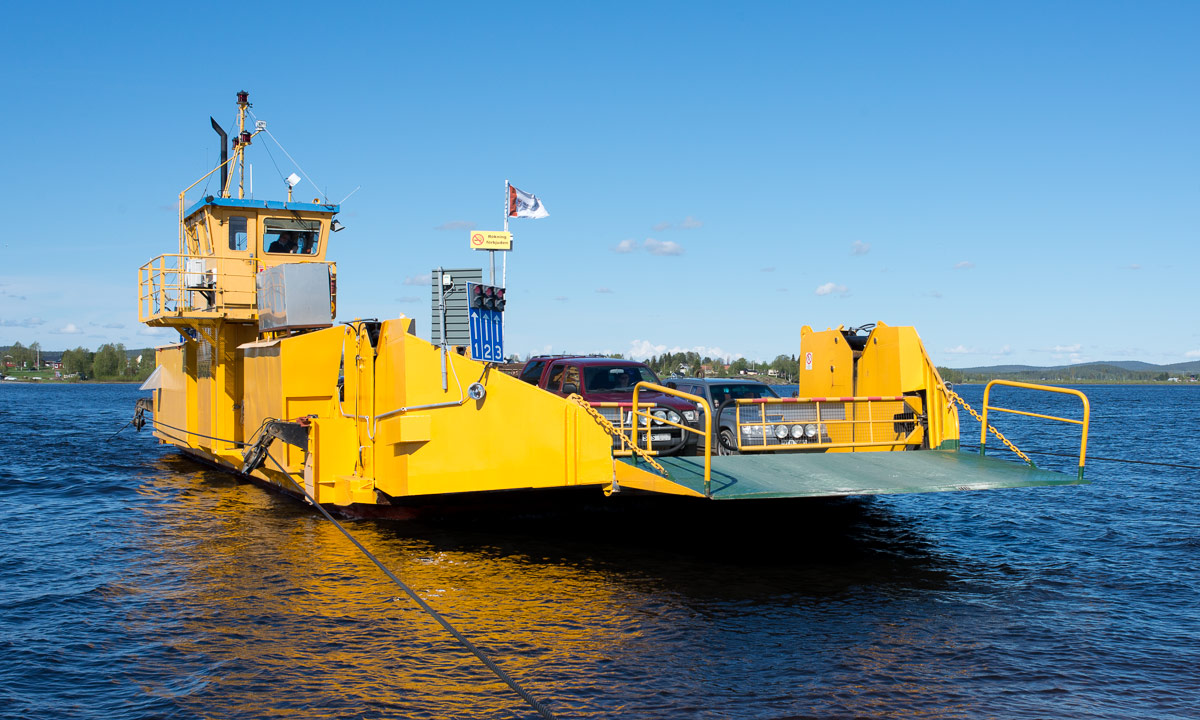

But back to today. It’s 2 February, -18 °C and the Luleälven had been frozen for many weeks.
I had left the E4 and drove the road to Avan. It was picture-perfect weather. Everything was covered with soft snow. It was snowing gently and since it was quite early, the snow looked still a bit blueish.


Some hours later – we had finished the meeting and went upstairs to have fika. This Swedish coffee break took at least twice the time of the official meeting, but fika is anything between 15-30 minutes (most common) and open end …
While we were holding fika and it was still snowing the sun came out. The sunlight made the scenery look even more beautiful. What a gorgeous view the house owners have!


Half past twelve I thanked the hosts and left Avan. I had got an idea: I remembered that there was an ice road crossing the river in wintertime. I was not sure if it was open but it was not far away. I drove there and right, the ice road over the Luleälven was open.

It had stopped snowing and the sun was shining. I parked the car and took some pictures (and was annoyed with myself that I only took the small camera with me).


I saw other cars using the ice road, otherwise I wouldn’t have dared to cross the river, which still is a river with water under the ice. Flowing water. Ok, let’s go …

And so I have got my ice road premiere today. Check ✔︎. I took some photos on the other side and decided to drive back again because I prefer the southern road which I came from.


It was still sunny but clouds had started gathering in the south. While I drove back south it got more and more cloudy. When I made a stopover at my favourite Thai restaurant in Skellefteå it was quite windy and my mobile phone displayed a message:

Warning class 1 snowfall Västerbottens … Snowfall which from Sunday morning to night to Monday can give 20-30 cm. In coastal areas in combination with fresh northeast wind. Snowfall contin…
Later there were the first snow showers. Let’s see, what will happen tomorrow.
When I walked home from an early meeting today it snowed at -12 °C. I trudged through the fresh snow like a small child.
Actually, I wanted to work with my online shop for my photo website. Outside it continued snowing. It took less than a minute to change plans. I took my skis, the backpack with the camera equipment, ski pants and my old Norrøna-jacket and went outside. I went down the snowy stairs, put on my skis and started a local ski tour. I skied 300 meter and was in the …
First I followed a snowy snowmobile track (with a detour to a small wetland) and then paw prints of a hare.


Following the paw prints led me to a …
In winter however these swampy areas are frozen – no problem with skis.


The snow was round 30 cm deep and quite fluffy so that I sank down even with the skis. Perhaps my 240 cm long wooden Tegsnäs skis would have been the better choice. I crossed a small pond and a small ridge – probably formed in the last ice age – and then I came to a larger …
The lake Snesviken had been frozen already in November. Now it was just a snowy plain with a small island in the middle.


I took a selfie …

…crossed the lake and came to a …
I knew that this forest was dense with a lot of underwood and many rocks, but I forgot how hard it is to find a way through it on skis. Now I was quite glad that I didn’t take the Tegsnäs skis.

I fought my way through birch thickets and rocky passages. It took a long time until I left the forest and reached a snowy road, part of a …
I followed the road to its end. Skiing was easy and effortless after the dense forest.


As in the whole of Sweden there are many summer cottages in Skelleftehamn, too. This cottage – as most of them – was by the …
I crossed the small thicket at the rocky shore …

… then I stood on the frozen Baltic Sea. I started skiing leaving the mainland behind. It was much windier and I was glad about my fur-trimmed hood. The field of view however is limited. Looking down I saw the fur, the skis and a white featureless surface. Almost whiteout conditions. Parts of the landscape were featureless as well.

It may look like I was in the middle of the Arctic, but no, right behind me there was an …
The Island Storgrundet is the nearest island from the mainland. Here I had looked at the sea ice 10 days ago, here I watched the lunar eclipse last week.


I followed the coastal line, crossed a frozen bay and arrived at the old boat shed that probably had been there for ages.


Then I crossed the island through the forest.

The island is not very wide. After 200 meter I could see the mainland’s …

This part of the coast is one of my favourite places in Skelleftehamn. In summer it has a nice sandy beach, in winter it’s the first part of the sea that freezes. In summer I use to paddle kayak, but most locals prefer small motorboats. Now all boats lie upside down on the shore.


Where there are boats are also houses. Where there are houses there’s also a …


And this road is special, because it leads …

Here I arrived three hours later. I put off the skis, shock of the snow and went in.
Oh, I love winter!

This article is part of the series “2018-12: Holmön”.
It is Monday. It has rained the whole night and it still rains. Most of the snow is history and everything is wet. After breakfast we decide to give the road to the southern tip of Ängesön another try. Indeed, it is almost free of snow and soon we are at the southern tip of the island where we walk along the coast. The clouds are grey and so is the sea. Some water areas are still covered with wet, brownish ice but the sea itself is open.


There are some marked hiking paths on Ängesön that we want to give a try. The guide book recommended “tåliga skor” – that means tough, durable shoes – due to the wet ground. The first path to the east has many deep water puddles and flooded parts. Partly the path is supported by wooden planks, but mostly not. The path leads through a quite old forest as we can see by the many lichens that cover the pine, spruce and birch trees. Snowless and wet as it is, it looks more like mid-October than December.


We try the other trail that leads to a shelter at the western coast of Ängesön. This trail is less wet and easier to follow than the other one. It is however not too easy to reach the rocky coast because of the marshland between forest and coast. It still drizzles and rains and everything is damp.

The hiking paths are nice but I would strongly recommend high rubber boots if you want to keep your feet dry.
After our “three course hiking” we return to our accommodation at Berguddens fyr. We’re still the only people, the place – as beautiful it is – seems less popular in winter time as the guest book tells us. While Annika prepares a warm lunch it starts to get dark outside. Grey clouds still cover the sky and it continues drizzling. The lighthouse starts sending its light beams over the Västra Kvarken, part of the Baltic Sea between Holmön and mainland.
Today day we leave Berguddens fyr. We were lucky to be change the booking for the ferry from 19 o’clock to 9 o’clock to avoid another rainy day – partly in darkness. At 8:20 we sit in the small waiting room, because it’s very windy outside. Waves break at the quay wall and after some the small ferry arrives and wobbles into the small harbour.


I have to admit that I get a bit nervous when I learned I have to back the car onto the ferry. The man however that pilots me onto the ship is fantastic and guides me much better than every rear camera. I am relieved, but get nervous again when I watch the man securing the car with belts. Is it so stormy? Will the belts hold?

First the boat trip is quiet but soon the ferry starts to roll and pitch more and more. I stay in the inside of the boat where I feel safer. While Annika and I are hoping the best for the car, the other two passengers do not pay any attention to the rough weather. Probably they live on the island Holmön and they are used to something like that.

45 Minutes later we arrive in Norrfjärden. My car has survived this unsteady trip without any problems.The ferry needs several attempts to dock, but finally I can leave the ferry with the car. Annika, who already went ashore gets into the car and we drive to her home in Umeå. This drive takes only 30 minutes – less than the ferry passage.
It’s fantastic to have such an interesting and special place nearby. We’ll come again, hopefully with better weather.
This article is part of the series “2018-12: Holmön”.
Saturday, 8 December – 0 °C – it’s snowing and two centimetres of new, wet snow cover the ground. Annika and I made a hiking trip to Vedaögern in the south.


Now it’s pitch black outside and still snowing. Nevertheless we will leave our comfortable accommodation soon for good reasons: we attend the julbord – the traditional Swedish Christmas dinner – today.
This article is part of the series “2018-12: Holmön”.
When Annika and I made a two-day trip to the small island Stora Fjäderägg in August this year, we spent some hours on the island Holmön. We walked to a place called Berguddens fyr – Berguddens lighthouse – were you can rent a room.
4 months and 5 days later we stand at the shipping pier and wait for the small ferry Helena Elisabeth that shall bring us to Holmön. We booked a room in Berguddens fyr for four nights. With us is my car. Annika booked a place for it on the ferry that only provides space for a single car. At 7:30 the ferry approaches.


We have to wait, because first all groceries and goods have to be brought onto the small ship. Holmön has 75 inhabitants and a grocery store. Finally I drive the car onto the ferry where it is saved with wedges.

We are not the only people travelling to Holmön. Everyone is sitting in the inside beside of me that tries to make some photos. The foredeck however is covered with wet, salty ice and so slippery that I do not dare to stand there without any hold.


After about 40 minutes the ferry goes ashore in the port of Holmön. I have to back from the ferry with the car and I am quite glad about the rear camera. Then we take the main road, turn right into a snowy gravel road, turn right again into another small road through the forest and then we arrive at Berguddens fyr.


No one is there, but the house is open and warm and soon we find our large but cosy room:

Probably we will be completely alone in the house. Who travels there in early December? Already at 3 o’clock it is quite dark and the lighthouse has started to be active.

Days are short in December but we have a lot of books with us and even two musical instruments: A violin for Annika who plays viola, and an accordion for me who plays piano. (Did I mention, that we are alone in the house ;-) ?) And a book with many, many Christmas songs.
Yesterday and today morning it snowed in Skelleftehamn. 10 cm of snow cover my backyard. The snow is wet and heavy but it brightens up the scenery in the dark hours of the day. And there are many dark hours: Sunrise 9:11 , sunset 13:40. Today I worked from home and took a break to take some pictures:
The Baltic Sea is still open. There was an ice cover between the island Storgrundet and mainland some days before, but now there is partly open water, too.

The lake Snesviken however is completely frozen and covered with a fresh, white layer of snow. The trees on the island are mostly free of snow, probably because of the quite warm temperatures.

When I drove to the peninsula Näsgrundet and went to the shore I could spot a dark, blurred object through the falling snow.It was the MTM Gibraltar, a tanker, that was towed into the port – a tow boat ahead, the ice breaker Baus behind. It looked enormous through the falling snow flakes, although it is only 140 m long.

I was stuck. I couldn’t go straight ahead, I couldn’t go backwards, I couldn’t turn. And I definitely couldn’t go sidewards because I sat in a kayak on the Baltic Sea and was surrounded by ice.


Back to the beginning of the day: I took a day off today because of the nice weather and decided to make a kayak tour. My goal was to sea the sunrise from the open sea. When I came to the tiny beach were my kayak has been lying since June it was still dim. The sea between the island Storgrundet and the mainland was covered with a fresh layer of clear ice. Two days ago these parts had been free of ice.


I already changed into paddling clothes at home: Woollen underwear, a drysuit that would keep me dry when falling into the ice cold water, a waterproof face mask and neoprene boots. It just took some minutes to take of the warm anorak – it was about -7 °C – and put some stuff into the cargo hatches of the kayak. I put on my woollen mittens and the long, waterproof overmittens, then I was ready to start the tour.
The question was: How thick is the ice? Would the kayak slide onto it or break through?
I sat in the kayak and pushed myself backwards, first with the paddle, then with the hands. The ice didn’t break. Anyway I was still quite near the shore. I continued pushing myself backwards until I came to the area of new ice. The ice didn’t break.


It is both exhausting and very ineffective to sit in a kayak and push yourself over bare ice with waterproof mittens. You just don’t get a grip. I realised that I wouldn’t come long. I returned ashore, got out of the kayak, went to the car and drove home.
At home I got my isdubbar – my ice claws. They look like a jumping rope with nail attached to the handles and are used for self-rescue, if your break into the ice. I changed also into winter boot, because my feet were freezing. The neoprene boots are not the warmest. Ah, that feels better! I got into the car and drove back to my kayak. Second try!
It was still exhausting to move the kayak over the ice, but with an ice claw in each hand I could pull my kayak forward with a speed up to 5 – 6 km/h. The sun had not risen yet and the air was calm and chilly. The horizon started to turn pink.

I found a bit of open water at the narrow passage between island and mainland. Then I came to another sheltered bay that was frozen, too. First the ice was quite thick, then it started to become thinner.

Here my problems started. The kayak went through the ice and floated. The ice was too weak for using the ice claws, but too thick to use the paddle. After some metres I was stuck! Every time when I used the paddle to move forward another meter I was surrounded by ice and couldn’t use it anymore. During the seconds that it took for changing from paddle to ice claws the kayak drifted back and I was surrounded by open water again, making the ice claws completely useless. Finally I started some kind of dog paddling with hands and arms, still the ice claws at hand until I could reach ice again, pull me forward another meter and break through the ice again. The sun had already risen minutes ago. (Goal missed!)
These are the situations where I learn a lot about my lack of patience …

Anyhow the island Storgrundet was near and with some efforts I reached a spot where I could go ashore. I just wanted to check the water and ice conditions on the outer side of the island.


Beside of some pancake ice near the shore the Baltic Sea was completely clear of ice, exactly as excepted. I returned to my kayak and went along the stony shore pulling it nearer to the open water. The sea was still covered with ice but it was thinner and I could hack my paddle through it. Small patches of open water were enclosed in the icy surface and tiny waves vibrated in the rhythm of my paddling. Very funny to look at! And then, some curses later, I finally reached open water – almost two hours later than my first arrival at the beach this morning.


What a relief to put the paddle blades into normal water. Ice cold water, but just normal, liquid water. Delighting. Where should I go? To Finland …?

Soon I spotted a possible destination: Nordlundsstenarna a.k.a. Själagrundet, more a gravel bank than an island, 1.6 km from shore. When I arrived there I looked at the next island Medgrundet, which would be much more attractive for taking a break than this pile of stones. I continued paddling. The wind increased slightly and it got a bit chilly, but it’s only 1.1 km from Själagrundet to Medgrundet so I arrived there quite soon.
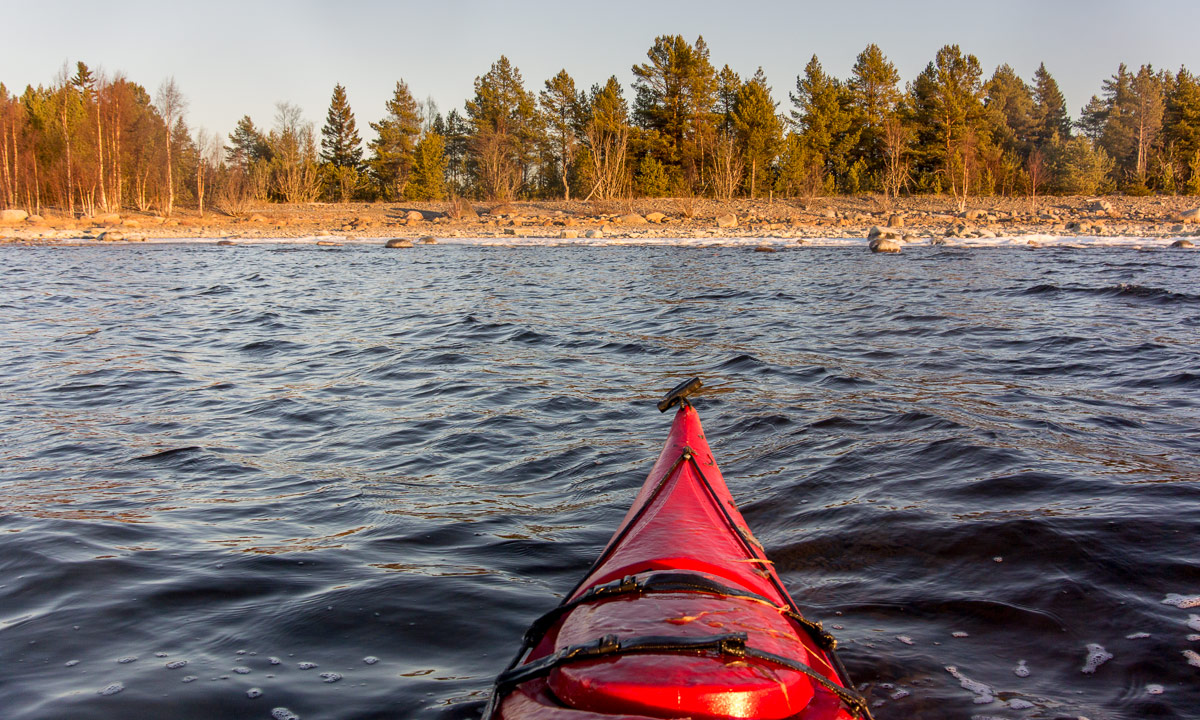

The first think I did when I was at land was to put on my winter anorak. Then I explored the island. Some photos:
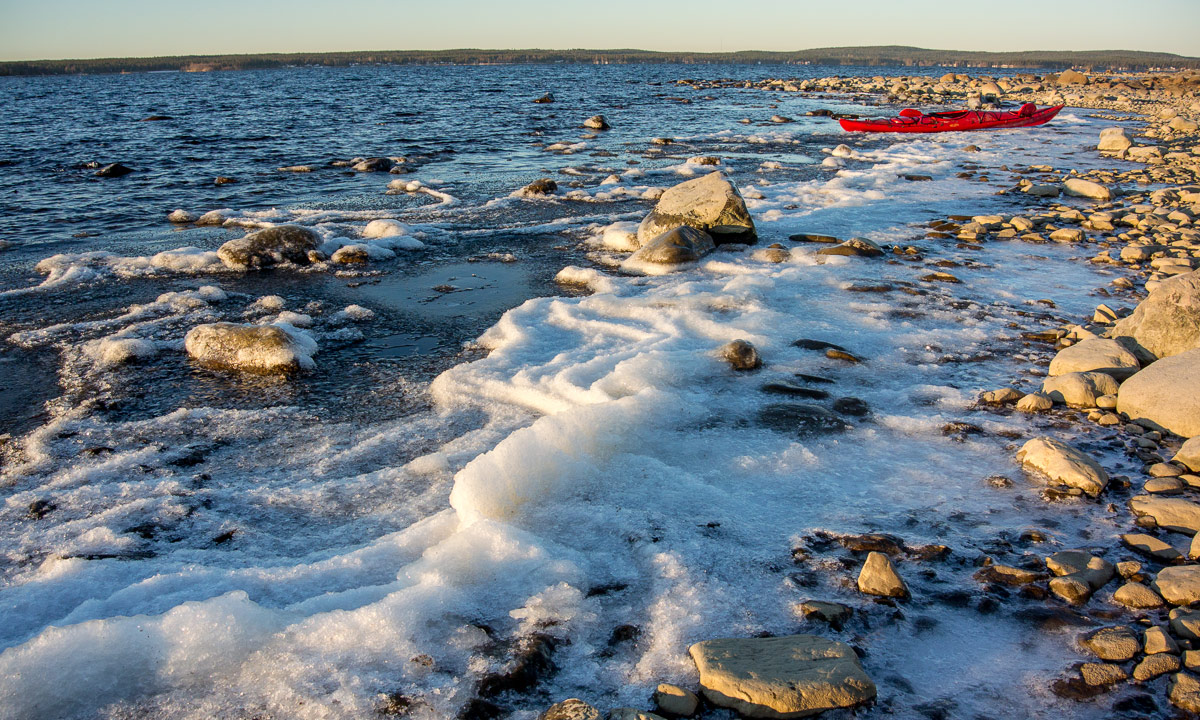


Actually I could have spend the whole day on this island, but I made a huge mistake: I didn’t bring any food with me. (Don’t try that at home, kids!) So after a stroll over the island I returned to my kayak that was as ice covered as the rock nearby.


What I did bring with me were my sunglasses. I was really glad having them because the trip back was straight against the sun. Ok, time for some selfies …


The way back was nice and beautiful and not very spectacular. I enjoyed the sun and the colours of the sea – it could be covered with ice and snow quite soon.

Since I hardly could recognise anything on land I went a bit wrong but the detour was small. After a while I reached Storgrundet and then the ice covered parts again. This time it was much easier because I could follow the ice-free channel that I had cut into the ice on the way there. But when I had to use the ice claws on the more solid ice again to pull myself forward I realised something: There are many things I lack, one of them is strong chest muscles. They will ache for certain tomorrow.