Skitour to Bergskäret

Today I took advantage of the marvellous weather and joined a ski tour over the frozen bay Kågefjärden to the island Bergskäret. Bergskäret is the island in the Kågefjärden that is nearest to the open sea. We were four: Hans and Stefan, with whom I have already made some trips, Kenneth and myself.

We took the car to Kågehamn where we started the tour. Round 5 kilometres over the snow covered frozen Baltic Sea and we arrived at the island. We were not the only ones. We looked for a good spot on the sunny south bank of the island where Hans made a fire with fire steel and we grilled the sausages that Kenneth had bought. I had a light down jacket with me but instead of putting that on I put off my soft shell because I felt so warm. Although it was hardly more than +2 °C the sun warmed us and the island protected us from the wind. After barbecuing, eating and resting a bit we went round the island and skied back to Kågehamn. Round 11 kilometres in the finest weather. A good way to spend the Sunday!

Tack för turen Hans, Stefan, and Kenneth.

Postscript 1

On the way back we saw the first whooper swan of the season. Another spring sign.

Postscript 2

While the snow and ice on the Baltic Sea are still beautiful the minor streets are in a very poor condition. The ice on the street is so deeply rutted that I’m quite glad about the high ground clearance of my Subaru. Anyway I learned that even a car with permanent all-wheel drive can spin out although driving slow.

Båtsfjord – Ørnes by Hurtigruten

This article is part of the series “2018-03: Varanger peninsula”.

Days 41 to 44 of my winter journey 2018

13 March at 19:45 the Hurtigruten ship MS Nordnorge docked in Båtsfjord. Annika went on board with all our luggage that we would need the next days, while I drove the car into the elevator. The next 59 hours we would travel many miles but stay in the same cabin. Cabin number 305. Kind of luxury. We would even get breakfast because of a campaign. On 16 March round 7:00 we would leave the ship in Ørnes and drive home.

I will not write much about this part of the winter journey but showing photos from the Hurtigruten trip with some comments.

13 March 20:30 – finally on the Hurtigruten. Shop, reception, restaurant and people cruising.

13 March 22:00 Berlevåg – the westernmost of the four Hurtigruten stops Vadsø, Vardø, Båtsfjord and Berlevåg. Some days ago we stood on the breakwater to see the ships coming in, now I stand outside on the bow of the ship to see the very same breakwater passing as we approached the peer.

14 March 05:25 – very early and quite cold in the wind. I’m the only one outside beside of people working.

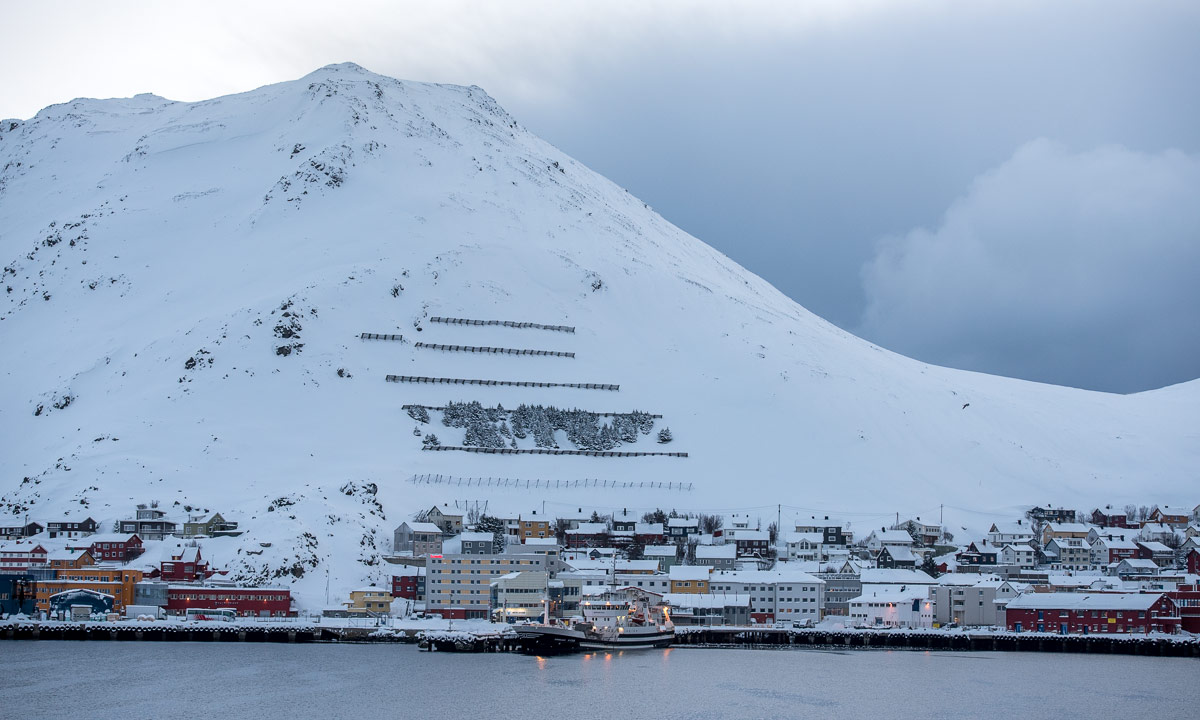
14 March 05:40 – approaching Honningsvåg on the island Magerøya. Main attraction of that island: the North Cape.

14 March 06:35 – I stay outside and look at the constantly changing weather.

14 March 08:25 – two ships pass. First a smaller boat, twenty minutes later the Hurtigruten ship Kong Harald. It’s snowing.

14 March 11:15 – we approach Hammerfest. Normally the ship will lie there for two hours, but today the ship is late.

14 March 15:45 – I’m outside for some hours and enjoy the view at the landscape. Everything is constantly changing: The mountains, the perspective, the light.

14 March 20:15 – strong polar lights cover the sky. Many people are outside and so are we. I already showed some photos in the article Aurora on the Hurtigruten.

14 March 23:45 – we approach Tromsø. Annika and I are already in our cabin and ready for sleep, but I can see the Tromsø Cathedral through our porthole. (We booked a cabin with limited view to save money and our porthole is more like a tube.)

15 March 07:30 – it’s not cold but very windy on the bow of the ship. My advise for such a winter journey: take the warmest jacket you have.

15 March 07:35 – we approach Harstad.

15 March 10:20 – we reach Risøyrenna – the Risøy Channel, build between 1911 and 1922 to enable bigger ships pass between the islands Andøya and Hinnøya. Only seven meters deep.

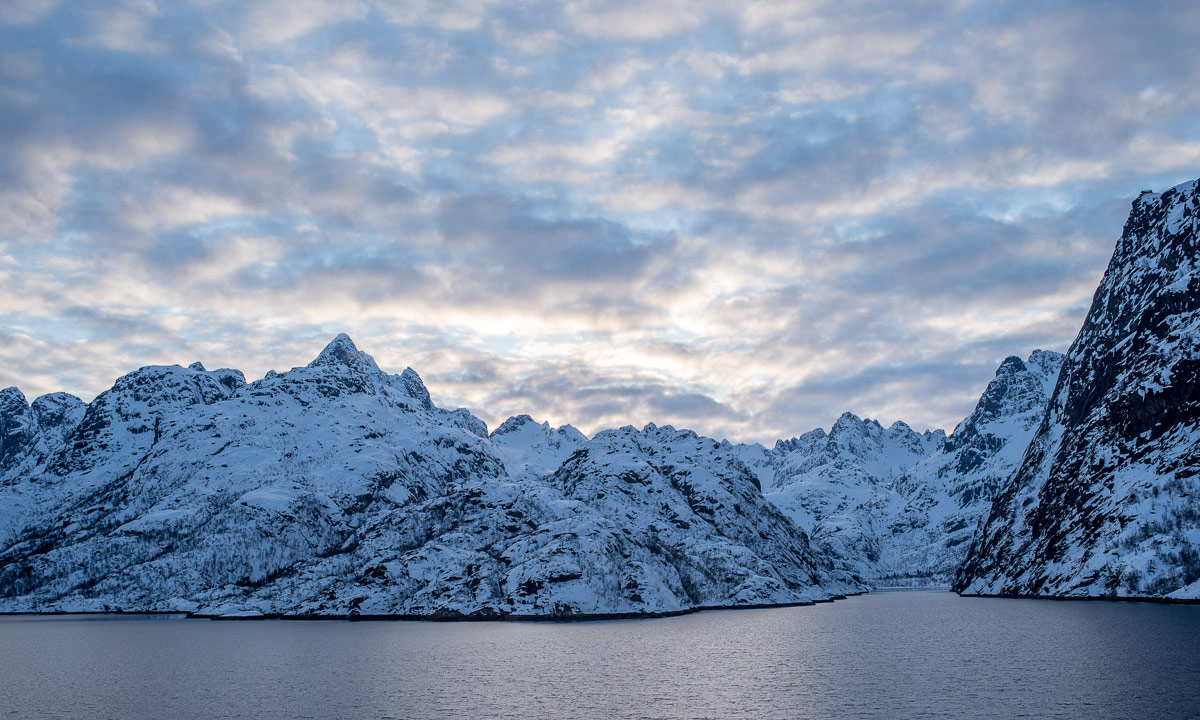
15 March 17:00 – we approach the quite famous Trollfjord. In winter however the Hurtigruten ships do not enter it.

15 March 18:30 – we arrive in Svolvær, largest town on the Lofoten. It’s a longer stop and Annika and I leave the boat for looking around.

16 March 06:00 – the alarm clock rings. At 7 o’clock we will arrive in Ørnes, leave the ferry and drive to Skelleftehamn. 583 km by car then I’ll be home again after more than six weeks of travelling.

A day in Båtsfjord

This article is part of the series “2018-03: Varanger peninsula”.

Day 41 of my winter journey 2018

After a difficult car ride over through gale and snow Annika and I arrived in Båtsfjord, where we stayed overnight.

As usual I woke up early. I got out of bed and took a first look at this town. Although a lot of snow had come the day before all roads and streets were already cleared. Some houses and fences however were still snowed in. Perhaps the houses were not in use or the owner was travelling, too.

And here a look at one of the harbours.

After breakfast Annika and I got a guided tour through Båtsfjord by our landlord. He comes from Finland and came to this town in 1999. He showed us round and told us a lot about this town whose main economical sector still is fishing. The fishing port is one of the biggest in the Finnmark with around 10000 boat arrivals per year.

He drove us to a place at the harbour where you can watch two species: (1) the king eider, a large sea duck and (2) the bird-watcher, a subspecies of the human being. Four of these bird-watchers lay in a huge box in the water and were spotting the king eiders. Mostly you couldn’t see the bird-watchers themselves but only their huge tele lenses.

Thank you, landlord from Finland whose name I forgot for this interesting guided tour!

Some other images of Båtsfjord I made over the day:

Later that day we sat in the waiting room and waited for the Hurtigruten to come. Our two-week stay on the Varanger Peninsula would end today and we slowly would travel home again. But instead of directly heading home by car (943 km) we would take the Hurtigruten ship to Ørnes and drive home there. Well, that spares us only 360 km and takes almost 60 hours, but it’s nice to travel by Hurtigruten, especially after visiting so many different places by car.

At 19:45 the Hurtigruten ship MS Nordnorge arrived and the next stage of the journey began.


Stopover in Kongsfjord

This article is part of the series “2018-03: Varanger peninsula”.

Day 38 of my winter journey 2018

After our lonely drive over the kalfjell we approached the coast again. First we spotted small forests, then quite a lot of cabins and finally the Kongsfjorden. The landscape looked much wilder and rougher with steeper mountains and quite inaccessible coast lines than the eastern coast of the Varanger Peninsula, that we just left two days ago.

After some kilometres we approached the village Kongsfjord.

Although this village has hardly more than 30 inhabitants it has however a grocery, that acts as a museum and a café as well. After it had been closed for some time, the new owners had opened it last August and keep it open all the year.

We went round the small town a bit too but continued then to Kjølnes Fyr, 5 km before Berlevåg where we planned to stay for one or two nights. Some impressions of Kongsfjord’s harbour area in wintertime:

By the way: Now it’s two days later and Annika and I are actually sitting in the very same café in Kongsfjord while writing this blog article. We’re waiting, but that’s another story …


Ekkerøy and Nesseby

This article is part of the series “2018-03: Varanger peninsula”.

Day 34 and 35 of my winter journey 2018

After some days in Ytre Kiberg Annika and I travelled to the next place: Ekkerøy. This village, 50 km southwest from Kiberg lies on the peninsula Ekkerøya that is connected to land by a natural dam with sandy beaches on each side. We already had taken a short walk at one of the beaches last week, where we had met H., one of the locals.

We arrived in Ekkerøy three days ago. The day before yesterday I took a morning promenade with my camera. I made some photos, but the light was a bit dull.

After breakfast Annika and I started a tour round the island, partly with snowshoes, partly on foot. There’s a cliff at the southern shore that looks quite impressive. At the eastern tip there’s an old wooden sea mark. The northern shore is quite flat and was more snowy. Outgoing tide already had started so we walked the last meters on the beach until we came to our wonderful house, that we’ve rented for four days.

As you might have noticed almost all photos shown in this blog have a landscape format. I have a project however that might involve having portrait format photos as well. Therefore I walked to the beach yesterday morning to find a motif fitting portrait format, not too easy in a landscape that’s extensive and mainly quite flat. It was almost high tide and it was quite cold – -12 °C and very windy. The water at the beach was almost of a slushy consistency and each wave flushed new liquid slush to the beach where it froze to a wavy line of ice. That motif went quite well in portrait format, I just have to practise my view.

(I have to think over the design of my blog, these portrait format images are way too large.)

It cleared up more and more and the sun shone from a blue sky. We took the car to Nesseby, 50 km away, where I planned to make some photos of the Nesseby Church. The more we came to the more sheltered parts of the fjord, the colder it got and the open water of the Barents Sea smoked. This phenomenon is called sea smoke and happens, when cold air lies over the open sea.

From the harbour Nesseby Church could be seen through the foggy sea smoke. It is located quite exposed at the thinnest part of a peninsula and can be spotted from long, when weather is good. After looking from the harbour we continued to the church and had a closer look.

We took a short detour to Varangerbotn. There it was even colder with -19 °C but fair weather and hardly any wind.

It’s fascinating to have a look at the fjord of the same name. At the end it’s completely frozen with many icy humps, but on the way back (and north again) it opened and sea smoke appeared again.

In Vadsø I took a promenade on the island Vadsøya to have a look at the airship mast. Since I’ve been a child I’m a huge fan of balloons and airships and it was interesting to see this mast, built in 1926 and only used twice: by Umberto Nobile and Roald Amundsen for their expedition over the North Pole with the airship Norge in the same year and on Nobile’s flight with the airship Italia two years later.

Home again we remembered that H. who we’d met the week before had asked us in for coffee some day. At 4 o’clock we knocked at the door of her house and met her husband T. who directly invited us to come in. H. was visiting a friend and would join us later. We talked and talked, about languages, life in Northern Norway in general and Ekkerøy in special and we had a good time (and got coffee, cakes, cheese, grapes and red wine). When we left H. and T. – two of the round twenty permanent residents in Ekkerøy – it was already 9 pm and sky was dark … beside of a beautiful aurora dancing above the northern shore.

It took some minutes to walk home, put on warmer clothes, get camera and tripod and the aurora already had weakened a lot when I took the photo below. So it is with northern lights: intensity can change very fast, often within seconds.

Today we have another day in Ekkerøy. Our plans so far: not any. That’s nice, too!


Eight times Ytre Kiberg and around

This article is part of the series “2018-03: Varanger peninsula”.

Day 31 and 32 of my winter journey 2018

1. Yesterday, Ytre Kiberg – the morning

Two days ago two other guests arrived at Cape East Arctic Adventure, our cozy stay in Ytre Kiberg. They came from Utrecht in the Netherlands and were on a three week car trip from Utrecht to the North Cape and back – 8500 kilometres in total!

Trond, our fantastic host made a special breakfast for them: King crabs, locally caught in the Barents Sea. Annika and I got our share, too. King crabs are probably my favourite seafood but it was the first time I got such for breakfast.

After breakfast Trond had some work to do: clearing the snow with his rotary snow plough. Last days had been very windy with some short but intense snow showers. The snowploughs had to work a lot to keep the roads clear of snow and Trond had to clear the snow on his property several times a day. This morning the snow drifts were especially high and Trond had to work hard to get through with his snowblower.

2. Yesterday, Vardø – a private guide tour by Trond

After the driveway was cleared, Trond invited the Dutch guests and us to a short private guided tour in Vardø. We entered his all-wheel drive car and he drove us the short way to Vardø – a town with 2100 inhabitants located on an island – where he showed us some of his favourite places. There is a lot of street art in Vardø and next time I have to take a closer look to all the graffiti and more conceptual artworks. But you cannot do all in a single journey.

There’s a mountain pass between Vardø and Ytre Kiberg called Domen. It’s quite exposed to the elements and when we crossed it waves of driving slow covered the road.

3. Yesterday, Skallelv – a short visit

Soon after we arrived in Kiberg, the Dutch guests left and Annika and I made a car ride to Skallelv, 30 km south of Ytre Kiberg. The weather was really nice: sunny and hardly any wind. We went round a bit and I made some photos. I had however problems with some lenses, they got moisture inside that tends to freeze when being outside. Hopefully they will dry within the next days.

4. Yesterday, Vardø – the Vardøhus Fortress

After a rest we took a tour to Vardø again, this time we wanted to focus on two local attractions: The fortress and the witch memorial.

The Vardøhus Fortress (Vardøhus festning) was built round 1300 and is the northernmost fortress of the world. Beside of being a museum it is used today as a school for the Norwegian marine. Shortly after we arrived there, the Trollfjord, a Hurtigruten ship landed in Vardø and shortly after many tourist rushed through the fortress. In contrary to us they only had litte time.

5. Yesterday, Vardø – Steilneset Memorial

After visiting the fortress we went on to visit the witch memorial. It’s not easy to reach. First of all you have to know that it is called Steilneset Memorial (or find it visually), then you have to plunge through deep snow, because there are no cleared ways to the memorial.

In 1621 91 people, mostly women and Sami people had been executed for witchcraft. This memorial, created in 2011, shows the history of all 91 people and lists the confessions made. It is a shocking and touching place about the cruelty of mankind and worth to visit, if you are in Vardø and have the time.

After this long and eventful day we were quite exhausted and decided to take it a bit more easy the next day.

6. Today, Ytre Kiberg – a promenade in Ytre Kiberg

Today morning it was quite warm (-4 °C) and almost windless. 10 cm of new snow had been fallen over night. After breakfast we took a medium short promenade along the beach and into the village and back. The weather was changeable as it uses to be here. It could change from sun to snow within less than a minute.

Snow fall intensified and it became a bit windier, too.

7. Today, Ytre Kiberg – a private tour though the partisan museum

At 15:30 we had an appointment: we were invited to visit the Partisanmuseet – the partisan museum in Ytre Kiberg. We would get a personal guided tour from Steinar Borch Jensen – expert for the history of Kiberg and around – who would open the museum for us.

Trond took a huge spade, we entered the car, drove the short way to the museum, plunged through the snow to the entrance, where Steinar already had started to clear the outer stairs. Trond joined him shovelling.

The museum is not the biggest and the showpieces maybe not the most special, it’s the stories behind the showpieces that matter. Steinar had a lot to tell about the partisans in Northern Norway that fought on the Soviets side against the National Socialists in World War II. Beside of Steinar’s huge knowledge about that time there was another facet, that made our visit in the museum very special. Both Trond and Steinar have personal relations to the partisans. They know their relatives and they know the places where they lived. For many Norwegians the history of WWII is not just an academic interest but personal history. Soon the last witnesses of the past will be gone.

I felt very touched by the visit and was glad that we got the opportunity to get involved into the local history, but it made me thoughtful, too and reinforced my personal pacifistic worldview.

8 .Today, Ytre Kiberg – the first Varanger polar lights

Actually I planned only seven stories in this long blog article, but well …

I was out after a great two course dinner: reindeer (provided by Trond), pancakes (provided by Annika) and me doing the dishes. I wanted to make a photo of Cape East Arctic Adventure, Trond’s house, where Annika and I had such a good time. Then I spotted faint polar lights. I wore only a t-shirt and got in to fetch my Canada Goose parka. I was outside quite a while since the polar lights gradually became stronger. They constantly changed place making it hard to take any good pictures. It was -10 °C, quite windy and more and more I closed the zipper of the parka to prevent freezing. After a while the aurora weakened and I went in to look at the photos. I’m not content with the image above, but it’s a nice remembrance of our fantastic stay at Cape East Arctic Adventure in Ytre Kiberg.

Tomorrow we will leave and stay in Ekkerøy for some days.

Tusen takk, Trond, for your kindness and your great hospitality!

A trip to Murmansk – day two

This article is part of the series “2018-02: A trip to Murmansk”.

Day 23 of my winter journey 2018

When we came home from our dinner last night it started to get quite foggy und it became colder. The fog intensified and the city started to smell smoggy.

This morning however was clear and some millimetres of snow dust had fallen over night making everything looking white and fresh. It was much colder than the day before (Murmansk airport reported -29 °C) but the hotel doesn’t have a thermometer so I don’t know how cold it was in town.

After breakfast we went through the Park Zhertv Interventsii (Парк Жертв Интервенции), a small park directly at the hotel.

Then we continued through the streets and across the railway to the port.

We wanted to visit the atomic icebreaker Lenin (Ленин) and check if we already could buy tickets. Lenin was the world’s first nuclear-powered surface ship and launched in 1957. She was decommissioned 1989 and subsequently converted into a museum.

Two big ships lay at the pier: Lenin and Vladivostok (Владивосток). Parts of the water surface were covered with ice but most of the water was open and steaming in the cold. The other side of the Kola Bay was hardly visible in the fog although only one kilometre away. The small ice particles in the air made the air feel quite cold.

A man left the icebreaker to meet a french couple at the pier, that had booked a tour. Unfortunately we couldn’t follow with them since this tour was privately booked. The man could speak a bit of German and we learned that the outside temperature was round -22 °C and that we had to wait for the first public tour at 12 o’clock.

So we went back to town, this time crossing the railway by a pedestrian bridge. Large chains of good wagons, some empty, some filled with charcoal were seen on almost all tracks.

While Chris and Ørjan went their own ways Annika and I went to the center to find a book shop. We knew that we had to follow the Lenin Alley (Проспект Ленина) and we found several book stores where I among others bought a pictured children dictionary English—Russian.

We continued the alley and finally came to Murmansk Mall (Мурманск Молл), a large shopping mall. Here both local stores and many international shops as e.g. H&M were found. The mall was extremely tidy and a huge contrast to the many rundown concrete buildings.

We’ve been in another mall the day before where you mostly could find Russian fashion for women. And that means mostly fur coats, partly in very fancy colours, high heeled boots and a lot of accessories in pink, silver and glitter. Some of them looked like plastic toys made for four-year-old girls, but in adult sizes. A fashion quite different from the informal one in Germany or Sweden.

I was really irritated when I entered some shops. People in Murmansk don’t smile or even laugh in public unless they know each other quite well. When you enter a shop the salesperson will stand up and observe you and even follow you through the shop. They won’t take contact with you, they won’t smile but will instead look stonily at you. I felt treated completely unwelcome and more like a thief than a customer. Strange and irritating!

Annika and I went back to the hotel and passed a Lenin figure and a house painted in bright turquoise, a colour that seems to be quite popular in Murmansk, as some other houses were painted the same.

We met Chris and Ørjan at the hotel and continued to the port together. Although it had become warmer it was still quite cold and some of the water that was open in the morning had frozen over in the last hours.

We arrived at the port at half past eleven and were the first one’s for the guided tour through the icebreaker Lenin. Shortly before twelve Annika and I could go aboard but most other tourist pushed to the front so that Chris and Ørjan were left behind. Later we realised that they attended another tour just some minutes later.

The following hour was one of the most boring experiences for long and made me remember some of the dullest school lessons. We were guided in a crowd of people by a Russian guide that loved to speak in a monotonic language without a split second of resting. Since he was so eager to talk another group behind us fenced us in so that we could hardly move and we were really glad to be able to sneak from the icebreaker before the guided tour was over. I guess, that most tourists are Russians too and so are able to understand the guide but even then I consider this kind of guiding as extremely boring and almost narcotic. My personal advise: Look at the boat from the pier but avoid the tour.

Some pictures from the inside anyway.

After this experience we needed fresh air and a café. We went to the Café Yunost (Кафе Юность), took some sweet cakes and after that we returned to the hotel to rest for a while.

In the evening we went to Terrasa (Терраса), another restaurant, though not to the White Rabbit (Белый кролик), our preferred choice. First it was Friday and then it was a holiday: Defence of the Fatherland Day. Therefore many restaurants had been fully booked. We enjoyed the food, went home to the hotel to take a short drink. Then we went to bed early. Next morning the alarm clock would ring at 6:15 local time, that’s 4:15 Swedish time.

When being in the hotel I took pictures from above. Here you could spot almost all places and attractions we visited the last two days, among others Alyosha, the Church of the Savior on Waters and the icebreaker Lenin. A good summary of the last two days.

A trip to Murmansk – day one

This article is part of the series “2018-02: A trip to Murmansk”.

Day 22 of my winter journey 2018

tl;dr Alyosha monument · old concrete buildings · Church of the Savior on Waters · view over Murmansk · restaurant Tundra · nocturnal Murmansk

Alyosha (Алёша)When we arrived in Murmansk the day before it was already dark and we were tired. Today after breakfast we were eager to explore. We ordered a taxi to our first tourist attraction: The Alyosha Monument.

“Defenders of the Soviet Arctic during the Great Patriotic War” (Защитникам Советского Заполярья в годы Великой Отечественной войны), commonly called Alyosha (Алёша) is a monument to Soviet soldiers, sailors, and airmen of WW2.

It was build in 1974 and it’s the second-tallest statue in Russia. The 70th aesthetics and the communistic concrete appeal didn’t help to make me like this statue, but I always have difficulties with war memorials. I’m a pacifist.

I enjoyed however the view over Murmansk. It was visible, that it’s a large town (it has 300,000 inhabitants) with a large port and many concrete high-rise buildings.

After we visited Alyosha we started to walk back into the center of Murmansk, where our hotel Azimut was located. We turned right into the street Ulitsa Aleksandrova. To the left there were old concrete buildings. They were extremely rundown and I was shocked to see these building and imagine people living here. Maybe the inside would look nicer, but the outside was horrifying.

In many directions you could see these high-rise estates with rectangular concrete buildings. But we could see something else: a Ferris wheel. We went on and came to a permanent amusement park, located beside the lake Semyonovskoye (Семеновское озеро). Of course the lake is covered with ice and snow in wintertime and some locals used the ski tracks going round the lake.

From that place the next destination was quite near: the Church of the Savior on Waters (Спас на Водах), a small Russian orthodox church, built 2002.

When we came to the church I could see some people leaving, going backwards and making the sign of the cross again and again. It is allowed to enter the small church but not to take pictures. I’ve never been in an orthodox church before and I was stunned. The walls were covered with icons of saints and incense was burned. Some elderly women were lighting candles and immersed into deep prayers and almost seeking physical contact to the icons and other objects. I felt deeply touched by this lived religiosity although I’m not religious by myself. On a table some food was placed. Bread and fruit, among others a bag with three lemons. Sacrifices or donations to the priests?

I have to admit that I felt like an intruder and completely at the wrong place. I have to read more about this religion and a bit about how to behave.

We continued our promenade back and passed the Memorial Complex to the Soldiers and Seamen Who Died in Peaceful Time.

We left the memorial behind and entered the streets of the center. We walked back to our hotel and took a short rest. We passed an old theatre, painted in bright indigo but more a ruin than a building. A pity, I think it must have been beautiful in former times.

Then the hotel. I had twisted my ankle one week ago and was glad to rest the foot a bit. Time for shooting some photos from the 16th floor.

Some hours later. We decided to eat dinner and Annika and I found the restaurant Tundra (Тундра) that got excellent reviews in the internet. And excellent it was. The restaurant was fully booked but we were allowed to sit in the bar. In Russia the food is quite cheap compared to Scandinavia even in really good restaurants. The dishes are not as huge as in many places in Europe. I like that because it gave me the opportunity to taste different things: borscht and caviar with seaweed. Both very tasty!

After a nice evening at this great location with fantastic food we went back to the hotel. Murmansk is definitely not the most beautiful town in daylight but it wins a lot when it gets dark because many places, streets, parks and buildings are illuminated with lights of all colours.

We have seen a lot that day, both the beautiful and less beautiful facets of this arctic Russian town and I was as exhausted as I use to be when strolling through a big town for a whole day.

We were glad however to have another day to explore a bit more.

Some other random pictures of the day:

3× winter coast

Yesterday, 13:30

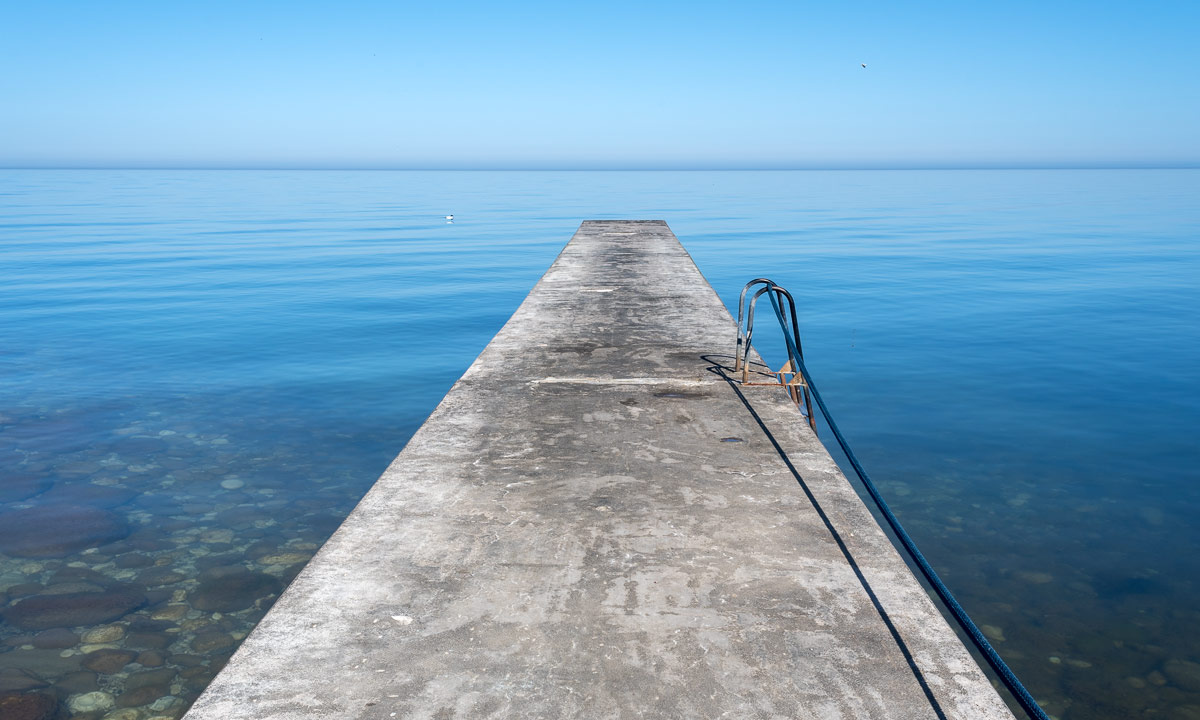
After having lunch, Annika and I drove to Näsgrundet, where the Baltic Sea had been mostly clear of ice three days before. Still most of the sea was ice-free, only at the coast some meters of new thin ice had formed.

It had started clearing up and the temperatures dropped to -15 °C already in daytime. The cold air over the open water created sea smoke, that gleamed in the colours of the low sun.

Yesterday, 23:00

It continued getting colder and soon the temperature dropped below -20 °C. Before sleeping I was out again, this time to check for an optical effect, that can appear when it’s as cold as then: light pillars. Even though it was round -23 °C I wasn’t lucky, but I took some photos of the Rönnskär industry anyhow.

Today, 8:00 – 9:00

This morning was the coldest yet this winter with temperatures round -24 °C. That’s when I start wearing two pairs of gloves for taking pictures. The inner fleece glove for handling the camera and a thick woollen mitten for staying warm when I just wait or look for motives.

The first motive may look quite boring but I love motives like these: just different cloud layers and ice up to the horizon plus the first gentle sunrise colours.

Remember, this part of the Baltic Sea had been clear of ice the day before. Due to the cold weather it has frozen within a range of several kilometres within less than twenty hours. It still amazes me how fast this process can be.

After I had made the former photo I detected that purple-red spot beside of the island Gåsören. The sun started to rise. I changed the lens and made a telephoto shot. (It’s quite blurred due to the atmospheric conditions)

Then I waited for the sun to rise. And really – after some minutes the sun succeeded to rise above the lower cloud layer. But only seconds later the upper cloud layer, that approached from the southwest covered the red orb again and the sun disappeared for the rest of the day.

Though it was still below -20 °C it started to snow.

Checking the winter …

This winter has been quite lagom yet. It hadn’t been too warm for a longer period, nor it was it really cold. We got snow several times, but we didn’t get any lake effect snow neither as e.g. five years ago where it snowed more than 80 cm within 24 hours.

Yesterday and today it snowed round 20 cm. Since we already had round half a meter of snow, the fence of my garden is about to disappear in the snow.

I took the photo above through the window of my living room. It shows my (and the neighbours) backyard. The fence is round 80 cm high.

Today I took the car to the Näsgrundet, one of my favourite places in Skelleftehamn. When I had been at the same place 12 days ago, the Baltic Sea was covered with ice as far as the eye could see. When I arrived today I was really surprised to see the Baltic Sea clear of ice again.


The photo above shows a small bay beside of Näsgrundet. The ice had been broken by wind and the floodwater two days ago. The wind was pushing the ice floes slowly offwards and some of them already had started to drift seawards.

That was the view to the northeast. The view to the southwest is completely different: there is the peninsula Rönnskär with the copper smelter of the same name. It snowed but the low sun managed to peek through the airy cloud layer. Temperature was -9 °C and the chimneys smoked.

In front of the industrial plant is the “cape” of Näsgrundet, which is a peninsula as well. I took a short discovery tour and found another motive. When I was standing up, Rönnskär and some trees were visible but when I knelt down I was able to hide the background and to make a completely different photo:

I intensified both contrast and colours to give this photo a more irreal appeal. The motive itself however is unchanged.

What type of winter comes next? I could take a look at the weather forecast of SMHI, but I have difficulties to take it seriously. Beside of the overall temperature and wind direction trends the web forecasts for Skelleftehamn are quite bad. The 20 cm of snow for example weren’t forecasted at all.

But in the back of my mind I know that lake effect snow could be possible again as long as the Baltic Sea is open and wind comes from eastern directions …