A trip above the treeline

Today the weather was really nice in Venneshamn in Norway. I took the car to drive to a mountain area not far away. At least, if you can fly … . If you take the car in Norway, there’s always at least one fjord you have to drive round, in this case the Verrasundet. So it took a bit longer than excepted taking the ways 191, 193 and 720 round the fjord. Finally I approached the street to the lake Ormsetvatnet. Street, well … it’s more like a steep gravel path, that you can drive up some kilometres to a parking place. The last kilometre to the lake is closed for cars and I had to walk it.

At Ormsetvatnet I crossed a dam wall, walked up a tree covered slope and soon was above the treeline. To be honest, I’m not too fond of forests, when it comes to taking pictures and I’m always glad, when I leave the trees behind when doing a mountain trip.

Now I was on a hilly plateau, the Vakkerheia. Some of the flat mountain tops were marked with piles of stones.

In the plain valley between the hilly tops the ground is soft and wet. Sometimes I had to go round shallow ponds and bogs, but mostly the ground was easy to go. In and round the swampy ponds the cotton grass was blooming. To my big delight there were many cloudberries plants growing in the lesser wet parts and the berries were ripe and ready to eat!
Picking cloudberries can be tedious, because of the many bloodthirsty horseflies that seem to guard them. I think, I slew most of them, but some bit me anyway.

After some hours of a really relaxed mountain hike I took another way back until I came to the gravel road again, where my parked car waited for me.

Half a day later

A thunderstorm approaches from the west. The center seems to be above the very same area that I wandered some hours earlier. The thunder and lightnings were as impressive as the intense colours, that I could see from the other side of the fjord. I was glad, that I haven’t been on that plateau – there would be hardly any place to seek shelter from the massive rain fall or to protect from the dangerous lightnings.

Addendum

And since we’re living in the age of selfies …

Summer in Skelleftehamn

Blue sky and temperatures above 20 °C, but not too hot – cool water, but not too cold, that’s summer in Northern Sweden, how I like it. As most Swedes, I have semester – holidays – until the beginning of August. Hopefully the nice summer weather will continue for a while.

Norrbyskär – Sweden in a nutshell

Prologue

It’s a bit funny. Although the internet weather forecast rarely correspondents with reality, I check it anyway. Then I at least try to ignore it.

Last sunday, when Annika and I considered what to do, the forecast promised sun for two or three hours, but rain showers for the rest of the day. We decided to take the car to Norrbyn 40 km south from Umeå and the 11:30-ferry to the island Norrbyskär. If it really rained, I could at least try out my brand new rain jacket.

Sweden in a nutshell

11:20 we were on board of the ferry Norrbyskär and soon the little ship put out to sea. The trip didn’t take long, it’s only 2 km to the island. I just love boat trips, it always feels like holidays when you stand on the ship’s bow, feel the airflow and look at the blue sea.

Norrbyskär consists of several islands connected with dams and as we experienced later even another possibility to cross the water. We went ashore with the other guests and headed left on the island Stuguskär. The way is framed by quite large brick houses. Most houses in Northern Sweden are made of wood and for us the brick houses looked more like a small coastal town in Germany, not a North Swedish island. The broad way ended soon, but a path continued through the forest and led us to a tiny bay. The single summer house standing on stilts brought us back to Sweden: it was wooden and painted red.

We continued to a place called Calmarn, another part of the island. The soil along the bay was brown and very bouncy. I had to look twice until I realised that the soil was neither sand nor mud. As many other places Norrbyskär had a huge sawmill in former times and this bay was completely covered with a thick layer of sawdust that gave you the feeling of crossing a huge trampoline when you walked on it.

We continued the path and entered the forest again. Soon we stood on the rocky north point of Calmarn, where we took the first rest. We sat down on a big rock, looked at the sea and enjoyed the blue sky and the warm sun. No rain in sight yet.

Now we went back the whole way until we almost were at the shipping pier again but continued the main road that connects the islands Stuguskär and Långgrundet. The street ends at a place surrounded by two white wooden houses and a bell tower. The entrance of the main building was labelled sommarkyrka – “summer church”. The ferries that connect the island with the mainland are going only between late april and early october – hardly more than 5 months, so probably this church is only active these months.

We went around the church where we found the Tannskärsstigen, a forest road on the peninsulas Tannskär and Truthållan. Sometimes the path was near the shore and you could see water lingering through the trees. Sometimes the path looked like leading through a huge and dense forest, even if Tannskär is hardly 500 meters in diameter.

It got warmer and warmer and we longed for a bath. The first beach was not actually crowded, but the nice places were occupied and so we continued our walk. The second bathing place wasn’t completely deserted neither, but big enough for us to find a place. A pair sitting on a wooden bench, some boats, some people on the pier, some kids in huge orange life jackets. We drank some water, ate some sweets and decided to take a bath.

Brr – the water was still really cold but so refreshing. So delightful! After the bath we laid down on the wooden pier and the sun dried us in a short time.

We continued the circular track and soon approached the summer church again. We went a bit back and crossed another dam to reach the island Stengrundet. Here’s a huge campground of the YMCA (in Swedish: KFUM). We had a look at the climbing crag where people with climbing harnesses and helmets climbed ladders and balanced on ropes, but soon we went to another shore were we had a look at the blue sea with its small and tiny islands.

We went back to the campsite, found another path through the forest and followed it, this time in direction north. The north peak of this island is extended by a quite long breakwater made of big rocks. Again a nice place to rest. In the east we could see the tiny island Burgrundet. It looked spooky. Some leafless dead trees and black birds. Crows? Dead man’s island? No, it weren’t crows, but cormorants sitting on the bare branches of the dead trees.

In the south we could see some wooden wrecks in the shallow water between Stengrundet and Långgrundet. On the satellite photos it looked like shipwrecks – almost like a ship graveyard. We went back – first along the shore then through the forest. It took a while but finally we found the path to the shore where we could see the wrecks of some twenty meter long wooden shipwrecks – an amazing view!

I already started to check the time because we wanted to reach the 18:15-ferry. The museum, which is not far away from ferry dock, was already in view and hardly hundred meters away, but on the other island. To reach the museum by foot we would have to go two kilometers to use the dam between the islands. But there happened to be an alternative:

When we looked at the shipwrecks we found a big wooden raft, tied to some cords that were fixed to the shore of both islands. Apparently it was possible to enter the raft and just pull oneself cross the water. After some considerations whether it would be (a) possible and (b) permitted we entered the raft, took the soaking wet cords and pulled ourselves over the water. It didn’t take long and we were able to hop on shore. We went into the museum, bought lemonade, strolled back to the ferry dock, sat in the warm sun (still no rain cloud in view) and waited for the ferry. A short boat trip to the mainland ended a wonderful day on the island(s) Norrbyskär.

Conclusion

This felt like an ideal day trip and – even though Annika and I both live in Sweden – a bit like Sweden in a nutshell: ferry trips and tiny islands, sailing boats and motor boats, a museum, a restaurant and a kiosk, stony and sandy beaches, huge rocks and forest paths, not to mention many flowers, ice cream and the first blueberries (still very sour!).

Conclusion: fully recommendable!

Official Site: visitnorrbyskar.se

Autumn colours

The tiny aspens standing under the overhead power cable seem to be ahead of the time. While the whole of Sweden is preparing for summer, these little trees definitely show already autumn colours, approximately three months too early.


View from Odenskrapan

I’ve always loved standing on viewpoints, mountain tops or roofs of high buildings. Just to be able to look far. My apartment in Munich – an expensive town, when it comes to accommodation – had just one room, but a big roof terrace, where I even could see a tiny bit of the alps. You have to prioritise …

Yesterday we had a party with the Skellefteå Kammarkör – the local chamber choir. We were invited by K., who has an apartment in the new built Odenskrapan, a twelve-storey house in the center of Skellefteå. As the weather was fine, we celebrated on the huge roof terrace, where you have an awesome view over the whole city.

I never looked at Skellefteå like this – from high above – and of course I took some pictures (the first one is a panorama made of three photos).

Since I may come to this fine place again – I already have some ideas in mind – these probably won’t be the last pictures of Skellefteå from high above.

Second kayak tour 2016

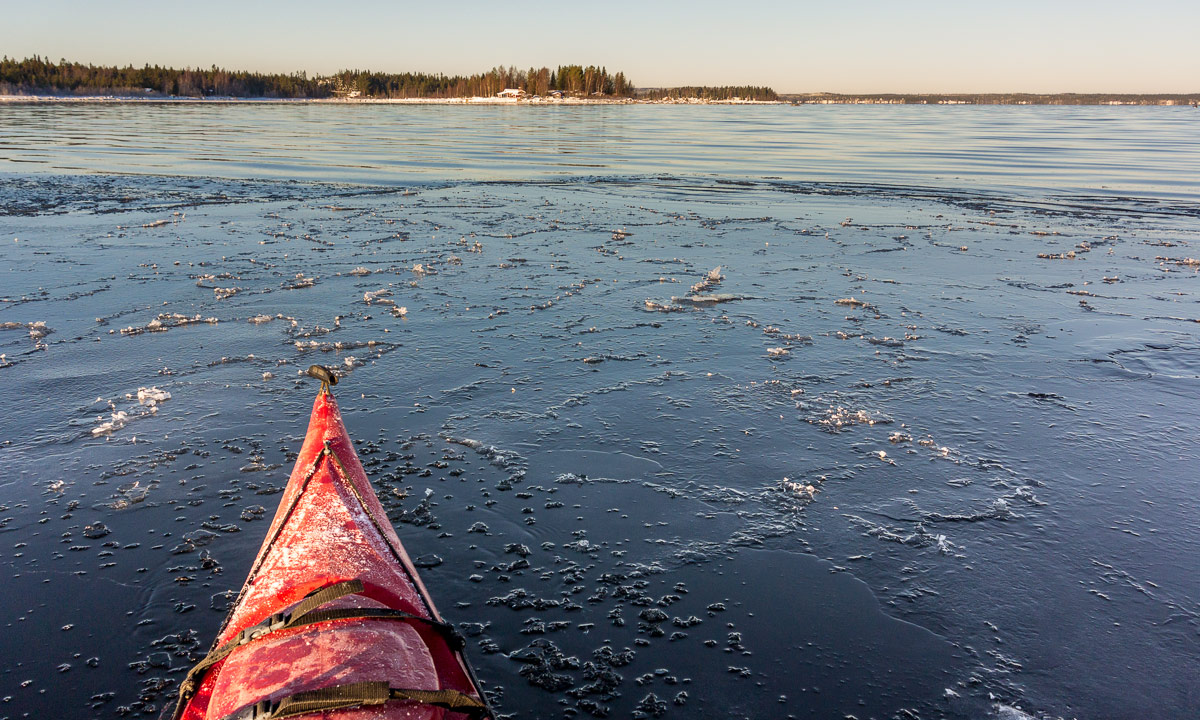
What a contrast to the first kayak tour six weeks ago: Last time dry suit, today t-shirt. Last time between ice floes, today birches with fresh leaves. Last time Baltic Sea, today the river Skellefteälven.

I put my kayak onto the new two-wheeled dolly (the old one broke down) and dragged it to the small bay Killingörviken, where I started my today’s tour. First I paddled along the harbour, then I turned right into the channel Kejsar Ludvigs Kanal. It always reminds me a bit of the “Ruhrgebiet” in Western Germany, where I lived for eleven years. After the last tunnel waited the Sörfjärden.

There I left harbour and industry behind and considered, where to go. The tour into the Nördfjärden wan, since it was windier than expected and I didn’t want to cross the Sörfjärden. So I paddeled upstream.

After a while the peninsula Örviken to my left ended. That’s where the Nördfjärden starts. I knew the first part and paddled to one of the rotten wooden piers. Luckily I realised that there were also under water parts – there were almost everywhere. I slowed down to avoid a collision with one of the big rusty underwater-nails. Finally I came to one of the four old platforms that probably formed an old pier, too – many, many years ago.

Now it was not far to the small island Gustavsgrönnan, where I made a short break. The whole shore is wet and covered with reeds, that lay flat on the ground.

I continued my tour by surrounding the island and paddled to the islands Stensgrönnan and Björnsholmen. To these islands you can drive by car and I was curious, if there would be a bridge or a tunnel to allow me continuing my trip.

First try Stensgrönnan: No chance! A solid dam connects the island to the main land.

Second try Björnsholmen: A small chance … . This island is connected to Stensgrönnan by bridge, but it looked really low. I didn’t believe I could manage to squeeze me underneath it until the end, but it worked. I had to bend my upper body onto the kayak and drag myself forward slowly by hand.

(Reminder to myself: This tour works only when water level is ±0. 20 cm more water and I wouldn’t fit under the bridge. 20 cm less and paddling could be hard due to the shallow water round the islands.)

Now I paddled downstream, which was not as much help as expected since the wind increased and came right from the front. But soon the bridge of the Sundgrundsleden was in view, the tiny cabins ashore and the dry dock with the read ship that I already saw on the way there.

I was a bit exhausted when I turned left to enter the bay Kurjoviken on the other side of Kallholmen. Now I was almost home, I just have to take the tiny tunnel “Lappstrupen” and I’m …

… well, that didn’t work. Due to roadworks this tunnel was completely blocked. Can I traverse the tunnel anyway? No. Do I want to walk and get the jetty? Neither. So I returned to the open water again and had another two kilometres against the wind until I entered the Kejsar Ludvigs Kanal again.

Now I headed back to my starting point. Another kilometer to go and I was onshore again. Phew – the last part was exhausting!

Today’s tour: Round 19 km total. (3.2 km extra because of the blocked tunnel Lappstrupen.)

Art, sound, and spring flowers

In contrast to the weather forecast yesterdays morning was sunny and sky was blue. I’ve been in Umeå the weekend and after the breakfast Annika and I decided to make just a small trip before weather would get worse.

We drove to Baggböle, 8 km west from Umeå. Here’s the “Arboretum Norr”, a tree collection (or arboretum) along the river Umeälven. We enjoyed the springlike temperatures and the many small flowers that started to blossom everywhere.

It was a bit too early for an extensive visit, since many trees just started to get their leaves, but we had another destination anyway.

In an abandoned turbine sump you can find an orange figure sitting cross-legged just as a statue of a meditating monk. The figure is reflected in the shallow water. This artwork is part of the Konstvägen sju älvar, a 350 km long tourist and sculpture route in Västerbotten. Sju älvar (seven rivers) sounds almost like sju elva (seven eleven), that’s how this artwork got its name: 8 11. Outside it was warm and sunny, inside it was dark and chilly. The ground was still frozen.

Probably the weather missed the forecast, because outside it continued being warm and sunny. So we continued our car trip, first toVännäs to visit another artwork: Eldsoffa (fire sofa) – a brick sofa that you can heat by fire (no picture).

After that we took a detour via Pengsjö and headed to another artwork between Vännäs and Bjurholm: Hägring (mirage).

A model of a church built of pieces of mirror glass seems to hover above a bog. It reflects it’s surroundings and if you go there over the wet boggy ground it reflects you yourself.

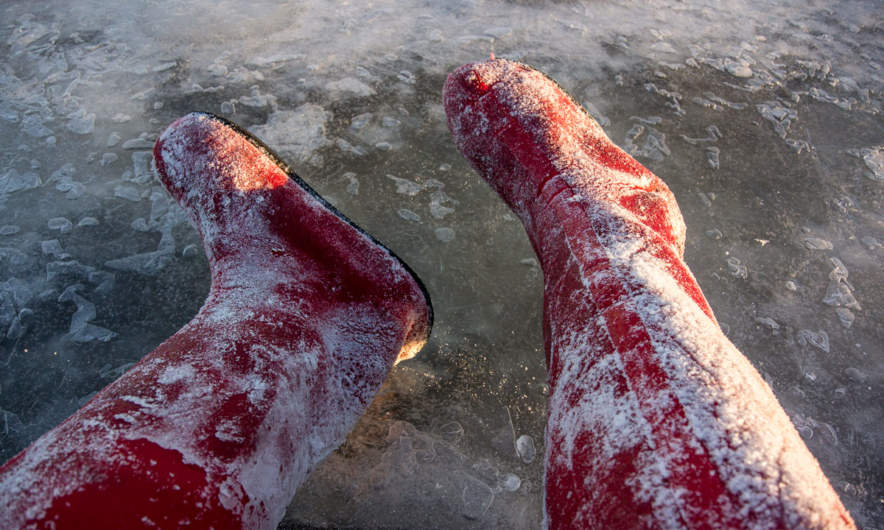
If you want to go to that artwork: Take rubber boots with you or you’ll get wet feet, at least in May.

After going round that artwork we continued our tour, had a brief look to Bjurholm and after that we started to return to Umeå again. We took the 353 southwards and would have been in Umeå one hour later if not my curiosity made me turn right into the road to Ågnasbacken, a local ski area. I love standing on hill and mountain tops and enjoy the views, but we discovered something better: The klangvägen (the sound path), a 1.5 km long path on two of the ski slopes with sound objects. Especially Sofie Weibull’s Klockspel – a wind driven installation of metal pieces sounding like bells – fascinated us very much. I did not make any photos because in my opinion it was sound that mattered, not the optical appearance of the installations themselves.

Anyway, I made a photo from one of the ski slopes and the view. And some leftover snow …

We came back to Annika’s flat eight our nine hours after start. Sometimes a short trip can get out of hand a bit …