Two days on the Hurtigruten

This article is part of the series “2017-02: Northern Norway”.

On Wednesday we left Kirkenes and started our journey to the next destination: Stokmarknes on the Vesterålen where we planned to visit good friends of mine.

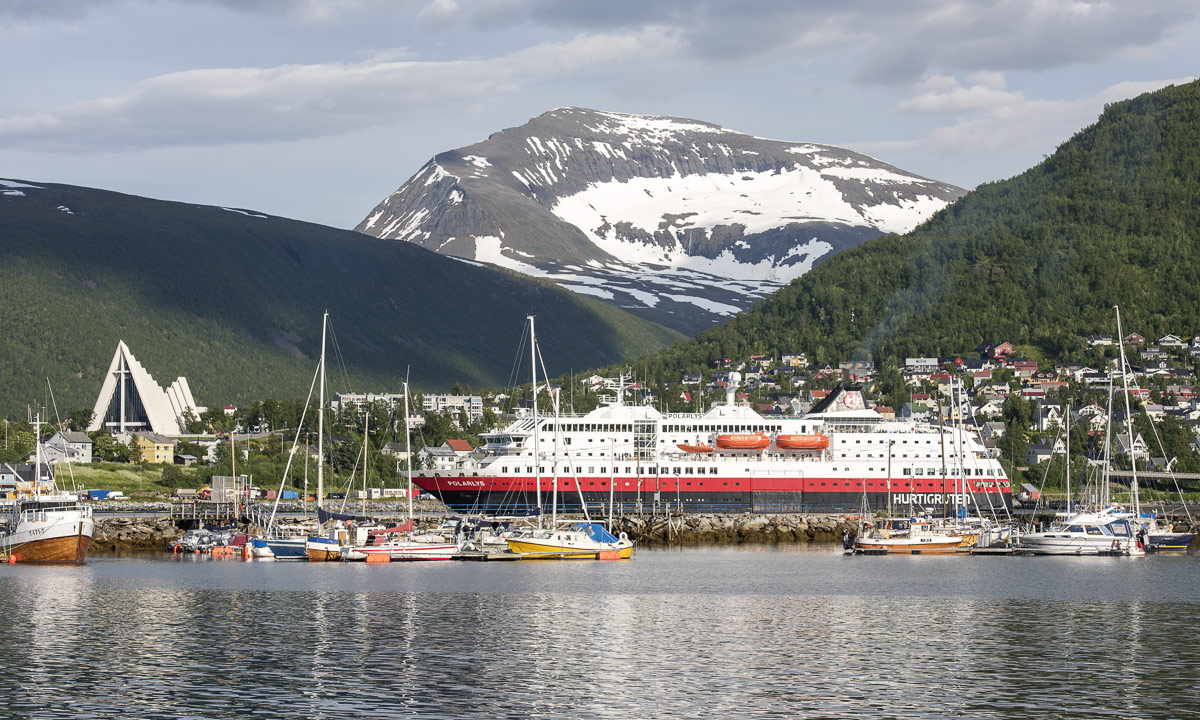
KirkenesStokmarknes would be 1000 km by car and take at least 14 hours, if you take the faster way through Finland and Sweden. Anyway there’s an alternative: The Hurtigruten express route, which connects many coastal towns, among others Kirkenes and Stokmarknes. That’s why we took the Hurtigruten ship instead of driving for at least two days. In Vardø we entered the vessel Trollfjord and 16:45 we started our two day long tour.

The first night we went to bed quite early and I only took some pictures in Berlevåg. Since the ship already was moving again I decided to make a longer exposure with the camera on a tripod. That’s Berlevåg by night seen from the Hurtigruten:

We missed Mehamn, Kjøllefjord, Honningsvåg. The first place with a landing stage I saw was Havøysund, were we anchored from 7:45 to 8:00. Shortly after we met the Lofoten, the oldest and smallest ship of the Hurtigruten fleet today. It was tiny compared to the much bigger Trollfjord (which is tiny compared to modern cruise ships).

I tried to be as much outside as possible. It was cold and quite windy, not only because of the airflow, but the gusty wind, too. First I thought, that I would be extremely overdressed in my Canada Goose expedition parka, but soon I found it quite comfortable to wear it in the chilly weather.

In Hammerfest we left the Hurtigruten, looked round in town and bought food. In Øksfjord it started to get dark and the black-white mountain ranges became blue.

… and blurred if you wanted to …

… and it got darker …

Then it started to snow. Sometimes the snowfall was quite heavy especially with the wind and I was even more glad about my warm parka.

In Tromsø we arrived at 23:35 and I made some night shots of this favourite town of me.

We could have left the ship for a visit of Tromsø but we preferred sleeping. We’ll probably visit Tromsø this summer.

The next morning came and the last day aboard began. Good for me, because even if I was glad to slip the car ride it’s not my world to be on a large ship looking at the landscape rolling by. Last night snow fall has brought much snow on the top deck. I never waded through snow drifts on a ship before.

At the same time the Trollfjord anchored in Harstad, a town on the island Hinnøya.

On our way to the next destination Risøyhamn it got extremely windy, the stabilised ship started to roll and to pitch and heavy snow showers appeared, reducing the view to some hundred metres.

Suddenly the wind calmed down, the snow showers were left behind and for the first time of the whole cruise patches of blue sky and finally the sun came out. We approached Sortland, the last stop before our destination Stokmarknes where I gazed at the beautiful mountains of the Lofoten archipelago in the south.

I generally dislike the last 30 minutes of transportation, if it’s by train or by plane. I just want to arrive, and so it was on the Hurtigruten. Impatiently I waited in the inside of the Trollfjorden for its arrival in Stokmarknes, then another fifteen minutes for the allowance to enter the car deck and another ten until I was allowed to drive the car onto the very same car elevator which I used to enter the ship almost 46 hours ago.

I could write a lot more about the Hurtigruten and its passengers, but that’s another story. Short résumé: I love those ships for transportation, but cruising is not my cup of tea. (Anyway, the outside jacuzzi on the top deck is really great!)

The Varanger Peninsula

This article is part of the series “2017-02: Northern Norway”.

Never have I been so far northeast before, travelling from Kirkenes to Vardø, where Annika and I would enter the Hurtigruten vessel Trollfjord. After the visit of the Sjøsamisk Museum we were glad to be in the warm car again as it was quite stormy outside with temperatures round -12 °C.

We left the E6 in Varangerbotn and continued eastwards on the E75. While there were many trees along the E6, the landscape became more and more arctic now. Between Varangerbotn and Vadsø there were still small and scattered birch trees and thickets, but there’s hardly any visible vegetation left between Vadsø and Vardø in wintertime. On the left side of the street lay snow covered mountains, hills and tundra plains, on the right side the rough Barents Sea. Hardly believable that people live here, but they do, mostly on places quite exposed to the sea and of course near to the E75, the only street.

We had to catch the Trollfjord the same day, a pity, since there was so much to look, to explore, to photograph. Next time I would plan an additional overnight stay to have more time.

Far away at the horizon of the Barents Sea we could see something rectangular. A container ship or our Trollfjord? Coming further and the ship coming nearer we could see that it indeed was the Trollfjord that left Kirkenes some hours after us.

We didn’t have much time to visit Vardø, just a very brief run through the witchcraft trials memorial, then we had to enter the big ship by car. I was the only car boarding; most passengers are cruisers, either taking the whole tour Bergen—KirkenesBergen, or the much shorter Tromsø—Kirkenes—Tromsø.

We got our room (small, but sufficient), I bought internet for two days (quite poor, since it blocks a lot of urls and ports, among others my mail traffic) and then we left Vardø by Hurtigruten.

Since then Annika and I have been on the Trollfjord. In three hours we’ll be in Tromsø, tomorrow afternoon we’ll leave the ship in Stokmarknes and will stay on the Vesterålen for some days.

Sjøsamisk Museum

This article is part of the series “2017-02: Northern Norway”.

Today Annika and I left Kirkenes and headed north to the Varanger Peninsula and the towns Vadsø and Vardø. Well, heading north it would be without the fjords. We took the E6 and followed it in almost all directions to drive round Neidenfjorden, Munkefjorden, Bugøyfjorden and the large Varangerfjorden.

Ørjan had advised us to visit the Sjøsamisk Museum – the museum of the sea sami. It is located in Byluft 30 km before Varangerbotn when you come from Kirkenes. We rang at the door bell of the private looking house and Helmer Losoa, the creator and owner opened the museum for us. We entered the large wooden building and looked stunned. We didn’t expect such a huge collection related to the history of the sea sami and the region. Almost uncountable items hung on the walls, the ceiling, stood on large tables or in cupboards. From old sami costumes to wooden fishing boats, buoys made of glass and ancient radios – I guess there’s hardly a thing you cannot find in this collection. And Helmer, who has both built the museum and has been collecting all these items for 27 years, know them all and can tell stories about them.

So that’s my tipp for today: If you ever should be near Kirkenes or Vadsø – visit this collection. If you come in wintertime, keep in mind that the rooms are not heated. Inside temperature = outside temperature minus the stormy wind.


Crossing and not crossing borders

This article is part of the series “2017-02: Northern Norway”.

Hardly believable that Annika and I started our holiday trip just three days ago when we looked at the arctic landscape today.

On Tuesday we started in Skelleftehamn, Sweden and crossed the first border to Köngäs, Finland. 481 km.

On Friday we continued in Köngäs, Finland and crossed the second border to Kirkenes, Norge, where we’re visiting Christine and Ørjan. Another 387 km.

Yesterday on Saturday we took it easy and relaxed after the two day road trip.

Last night I got sick. (That’s another story but the reason, why we cancelled our ski tour today.) Instead of that we took a short road trip to the Russian border, a border that we cannot cross without a valid visa.

The only border checkpoint between Norway and Russia is at the E105, the road to Murmansk. This checkpoint is only 10 km away from Kirkenes. I’ve been there two years ago.

In Elvenes there’s another small road to Skafferhullet. This place lies at the Russian border, too. There’s no checkpoint, the small road just ends and a fence with some signs marks the border to Russia and warns of crossing it. Here I really had the impression, that the world – as known to me – had come to its end and another kind of secret part of our planet begins right after that wire mesh fence.

Only wild animals can cross borders without any harm. They don’t share my memories of the inner German border, they don’t know anything about the cold war, they don’t have to care borders at all. Lucky them!

Perhaps I’ll witness the day, when the border to Russia is as open as many inner European borders today. Who knows …?

Just before the border checkpoint on the E105 there’s the road 886 to Grense Jakobselv – another place located at the Russian border. Most of the road is closed in winter time, but the first part is open. And this way is quite beautiful. We followed it until the barrier, where only snowmobiles are able to continue. There we took the minor road to Lanabukt located at the Jarfjorden.

Some photos:

What a great day with fantastic winter weather and temperatures round -17 °C. On the way back we stopped at the petrol station to buy me salted sticks and a Coke because unlike in Sweden super markets are closed in Norway on Sundays.

The Sunmountain

I have stopped counting the times I was in Solberget, the beautiful wilderness retreat in Swedish Lapland. This time I was asked if I want to join a three day first aid course in Solberget. Since my last one was long ago I accepted gladly.

The course, arranged by the German Outdoorschule Süd, was both intense and fantastic and I’m glad that I was able to participate. I stayed another day after the course to make a ski tour. It has snowed quite a lot in Lapland in November and round about 60 cm of snow covered the forest soil. I started the tour at 8:30 – an hour before sun rise. The air was crisp and cold with temperatures round -15 °C. I borrowed a pair of wooden Tegsnäs skis. They are long and broad and fit to every boot which makes them ideal for the powdery snow in the Northern forests. I crossed the street and entered the narrow forest path that leads to the hill which bears the same name as the wilderness retreat: Solberget – the Sunmountain. I crossed the Solbergsvägen, which was covered with a half metre of snow and soon went slightly uphill through the old forest with its mighty spruce and pine trees.

Even though I didn’t take the smoothest way up it didn’t take long until I arrived at the top of the Solberget, which is 459 meters above sea level. I ignored the cozy mountain hut and went straight to the old fire lookout tower which provides a unique 360 degree view over the landscape.

As fastly as I arrived at the tower as slowly I climbed it, since the handrails and the steps of the three ladders were covered with a thick layer of hard and crusty snow. Finally I was on the top of the tower, just in time to see the sun rising above the hilly horizon.

I stayed on the tower for more than an hour, happy to see the snow covered trees in the warm and ever-changing light of the low hanging winter sun. First the sun got free of the clouds and started to illuminate more and more of the scenery. The colours changed from a pale pink to shades of orange and many other colours I don’t have any name for. After a while a cloud layer approached from the north changing the mood of the landscape again. At the end almost the whole landscape was shadowy beside of the fog that still hung above the swampy areas in the southwest.

Finally the sun vanished behind the cloud layer. I climbed down the three ladders of the tower and continued my ski tour. First I headed southeast, then I turned more and more to the right while I descended the hill. After a while (and a bit of squeezing through the pathless thickets) I reached the Solbergsvägen again, however more in the south. This part of the path was completely untouched beside of a track of a hare that you still could guess under the fresh snow of the last day.

After a while I came to the turn-off to the swamp Solmyran which I followed a bit. The sun was low again and illuminated the snow in bright orange colours, while the snow in the shadows looked more blueish. There are many colours in winter, you just have to go out to spot them.

The photographer and his studio:

Links

I can highly recommend both a stay at Solberget and the first aid courses of the Outdoorschule Süd. In February you can combine the two, if you can speak and understand German.

#snowember16 – part VI

This article is part of the series “2016-11: #snowember16”.

1. A tiny ski tour

As yesterday I took the car to the hill Bureberget, this time with skis and snowshoes. I had thought that the biggest challenge would be to park the car – not easy if there are only snow walls on the left and the right off the road, but I was lucky, a side road was cleared and I could park the car there in front of an old, wooden house buried in the snow.

I decided for the skis, changed shoes, put on gaiters, strapped the backpack on and put on my skis. After following the main road to Burvik a bit I bent left into the road to the top of Bureberget. The snow has settled a bit and was less high than yesterday. Soon I found a nice way downhills – my first “ski-run” this season, perhaps 20 seconds long. Of course I had to climb up again. That was partly not so easy between trees, rocks and quite soft snow where I sank down to my knees quite often even with the skis on. I found a steep but nice passage up that led me to some kind of bridge or ladder crossing a small ravine. This part I took without my skis …

After I had succeeded the “winter climbing challenge” I stood on a huge rock, almost up on the level of the top again. I took a detour to the forest and was soon back again.

This ski tour was quite short. One of the reasons was, that I didn’t find nice motive for photos today. It was very windy and all treetops were bare of snow. Many pine needles and pieces of bark lay on the snow which made the snow looking old and dirty, even if it was just one day old.

But anyway, it’s always great to be out and so it was today! And even better, when the sun comes out.

2. The coast of Storgrundet

When I was back in Skelleftehamn I didn’t drive home directly but to the coast of Storgrundet. I was curious how much ice would cover the part of the Baltic Sea between island and mainland. There’re still patches of open water, but most of the water is covered with ice. I guess that I have to look for other starting points, when I want to paddle kayak in the weekend.

It was only some degrees below zero but the strong winds made me shiver and I was very glad to had a warm down jacket with me and put the hood on tight. Brrr, autumn is definitely over.


#snowember16 – part V

This article is part of the series “2016-11: #snowember16”.

Last night it snowed another 15 cm, increasing the snow depth in my backyard to 76 cm and finally the fence in my backgard was gone, hidden by the snow.

You see, that the picture looks a bit hazy? That’s because it snowed still a lot, when I made this picture this morning at 6 o’clock. You see that blending light to the right of the house? It’s a tractor that already had started to plough away the snow.

Some hours later Annika and I took the car to Bureå – another “snow pocket” nearby. As a matter of fact I was curious, if there was even more snow as here in Skelleftehamn.

Finally I could take a picture of the beautiful pavilion Åbacka paviljong which lies near Bureå on the other side of the E4. A huge pile of snow left by a tractor came in handy to get a higher perspective.

And we saw buried cars. And half buried tractors, and really buried cars, and a quite snowed in bicycle.

I heard from some people living in Bureå, that at least one meter of snow has fallen, but I couldn’t find such places in town.  I seemed to be as much snow as home, perhaps a bit more.

When we took a detour, left Bureå and headed to Burvik over the hill Bureberget (altitude: 99 meters!) the snow walls at the sides of the road increased. I stopped the car on the side of the street and just took some steps into the forest. Here the snow was really much deeper, I should say round 110 cm! Here seems to be Bureå’s “snow center”.

I left Annika at the bus station and took the E4 to Skellefteå where I had a meeting at one o’clock. Well, I tried to take the E4, but from the next exit on it was closed due to an accident. I left the E4 and took a secondary route. There were many trucks and other cars taking the same detour and since the road was quite snowy and it still snowed the drive was at quite a low pace. Following a truck is no fun since you hardly see anything beside of the white snow whirling through the air. That is called snörök – “snow smoke”. Sometimes it was not easy to follow the street because all meadows and fields are just as white as the road and the red sticks marking the road hardly help in the snörök.

I took it easy, stopped the car in one of the rare snow-free parking bays and made a photo from the collapsed barn buried in the deep snow.

When I came home the snow fall had stopped and the streets where ploughed. On each corner you could see piles of snow up to four meters high. And finally even my elder bush seemed to realise that summer is over and has started to cast of its leaves.

Tomorrow I’ll take a day off and enjoy the early winter. Skis or snowshoes? I haven’t decided yet.

Some other snow depth:

  • The neighbour at the other side of the street: 86 cm.
  • Some people in Bureå: 100 cm, already four days ago.
  • Someone in Lycksele in the inland: 2 cm!

#snowember16 – part I

This article is part of the series “2016-11: #snowember16”.

Hooray! Winter is here! I want 4 meters of snow and -45 °C already in November. (Well, a bit less is ok, too.)

I saw the first snow of the season two days before on my way back home from Umeå. The forecast predicted more snow to come today – even a class 1 snowfall warning had been issued – but not in Skelleftehamn where rain was forecasted.

Skelleftehamn showed only some patches of slush-like snow this morning as a result of last nights precipitations. Skellefteå got two centimeters of snow and experienced some wet snow showers today. On the way back to Skelleftehamn more snow lay on the ground. Between town and home it’s mostly a bit colder with neither city nor the Baltic Sea directly nearby. In Skelleftehamn itself however the snow has been almost rained away and the thermometer showed +2 °C.

Today I had a rehearsal with a new jazz trio in Kroksjön, which means hook lake and is just eight kilometres south from Skellefteå. It was just slightly colder there and the snow less wet. Round ten centimetres had fallen down – still wet but white and beautiful to look at. I took some photos after the rehearsal (I always have a tripod in the car).

When I made these photos it didn’t snow anymore, temperatures where below zero and I could see some stars. When I was on the 364 to Skellefteå it started snowing again, but not much, so I took the E4, the fastest way to Skelleftehamn. Well, normally. Today it took much more time. The snow fall intensified more and more and the visibility was really poor. Instead of 110 km/h I hardly dared to drive 70.

Another car tailgated me, eager to overtake. Finally the E4 became two-lane and the car driver overtook me. I really had to smile, because now – without my backlights in front – the other driver was forced to slow down as well, driving exactly the same tempo I had been using all the time.

It wasn’t easy but I found the exit to Skelleftehamn. The snow fall intensified even more and I slowed down further. Using the full beams the approaching snow looked like a tunnel of stars when a space ship goes into some kind of faster-than-light hyperdrive. That’s what it looks like (imagine that in fast motion):

Funnily enough the heavy snow fall decreased when I approached Skelleftehamn and stopped when I arrived home.

Now at 23:30 we have ca. 5 cm of snow and it started snowing a bit again. If the forecast is right we will get permanent frost on Friday and 30 cm of snow from Friday until Monday morning.

Jämtland hike part III: back to Sweden and finishing the tour

This article is part of the series “2016-09: Jämtland and Norway”.

After two days in Norway we headed back to the Swedish mountains.

Thursday, 15. September

We started our day with a breakfast.

The Norwegian lodge Nedalshytta is really beautiful, but doesn’t have a kitchen and sells only some snacks, when it comes to food. Luckily we had both own things to eat and a mug with us, so would could enjoy our own breakfast: oat flakes with frothy milk! How to get frothy milk on a mountain tour? Mix milk powder and water in an empty coke bottle, shake it vigorously and voilà: schiuma di latte à la Annika.

After packing our backpacks we started our hike to the Sylarna Fjällstation. It was the first cloudy day since we started our tour three days before and anything was moist and wet. Sometimes we had to take a break to pluck some blueberries, that still tasted fresh and sweet.

We went along the Templet, which is Swedens highest peak of the Sylarna mountain range (1728 m). (Storsylen with its 1762 meter altitude is higher, but on the Norwegian side, just 100 meters from the Swedish border.) Due to the weather we first couldn’t see that much but after a while it started to clear up and the clouds released the view on the huge and barren slopes of the Templet massif. We were so lucky, that we hadn’t to go this part of the trail in fog and clouds.

Soon we arrived at a place called Ekorrdörren – the squirrel door.

We started our tour at 780 m above sea level. Now we were on 1100 meter and would have to go up another 260 meters to reach the Ekorrpasset – the squirrel pass – which is 1360 m above sea level and so the highest point of our tour so long. We started climbing up the slope but had to look back over and over again. The undulating valley of the river Åeruvedurrienjohke with it’s many hills and ponds looked like from another planet.

Our trail got more and more rocky. After a while there was hardly any way left, we just went over angular rocks with gorgeous views of the Templet, including a small glacier and the Slottet, another peak of the Sylarna.

I really love the changes of the landscape you can have within just some hours: From autumnal birch forest with blueberries over to grass covered plateaus and finally up to an asteroid-like landscape that looks like a pile of stones.

Especially the squirrel pass looks both harsh and impressive. Anyway, when you go up a pass you’ll probably go it down as well and even 200 meters altitude make a difference. The Sylarna Fjällstation lies near the river Sylälven that flows through a wide grass covered U-shaped valley and when we came nearer we could see three reindeers standing in front of the cabins. Back to civilisation.

We had hiked four days in a row and were quite eager to take a day off. Sylarna fjällstation would be an ideal place, since it lies beautifully and you can leave that place in six different directions. Alas, there weren’t only reindeers, but people, too. Many people. The place was crowded! There were many hikers and mountain joggers. In the big dining room sat a large group of bankers that got their three-course dinner including candlelight and fresh salad, brought by helicopter. We were unsure, if this should be a good place to rest for a day.

The information we got in the evening shocked us a bit: There were already 100 – 125 booked sleeping-places for that night (in addition to all people that would come without booking). That means, that this place would be even more crowded. Even Helags, which is more in the South had just some single sleeping-places left.

That was the moment, where we decided to escape.

We would stay overnight of course, but the next day we would abandon the tour and hike back to Storulvån, were I parked my car.

Friday, 16. September

I was awake quite early, took my camera and tripod and walked out to wait for the sunrise. The valley Endalen was covered with fog. I looked at the glacier Storsylglaciären,that covers the eastern slope of the Storsylen and a lavvu – a traditional sami dwelling. The sun however showed up quite late, there were too many clouds.

I looked at the less beautiful parts of that place too: An excavator on a flat building site, a welcome sign surrounded by building material and waste.

We started the tour being content to leave Sylarna behind but a bit melancholy, too, because we didn’t plan to leave the mountains already after five days. Annika started to count the approaching hikers, there were quite many …

After half the way we approached something quite funny:

It’s neither a sculpture nor a church, it’s a WiFi-station including a recharging unit for smartphones! It is even marked in the hiking map: “WiFi och laddstn.”. There were many hikers and even some mountain bikers resting, but no one started the WiFi. The cellular network is quite good in that part of the mountains and I guess there’s hardly a young Swede without a mobile internet flat rate.

We continued our tour and slowly hiked down the valley Endalen. After a while we were below the tree line and the landscape got even more colourful.

And just shortly before we reached our starting point, were we had left four and a half days before I spotted a lonely birch tree – almost leafless. A symbol, that winter will come even this year. Fifteen minutes later we reached Storulvåns fjällstation, then the parking place, then my car. Annika has counted almost 150 people hiking, jogging and cycling to Sylarna, just from one direction! That confirmed our decision to leave Sylarna behind.

It has been a fantastic and varying tour with many different experiences in a short time. Tack för turen – Annika!

The End.

“Wait, wait …”
– “… wait, what?”

“How can it be the end? You had two weeks holidays, not only five days!”
– “well, ok, we did continue our journey.”

After changing cloth, using the bath room and drinking a coke we got in the car and I drove the way back to Enafors, that lies at the E14 which connects Trondheim in Norway with Sundsvall in Sweden. We considered some options but didn’t decide yet what to do next. Shortly before we approached the E14 I asked Annika: “Back to Umeå or Norway?” The answer was: “Norway”. So we travelled to Norway …

Stay tuned for the next article telling more about our trip in Norway …