3×2 weekend images
Still summer weather – blue sky, temperatures not too hot and the last rain seems to be away like ages. Flowers are blooming, the Baltic Sea is blue and the cows are left on the green pastures for the first time of the year.


Still summer weather – blue sky, temperatures not too hot and the last rain seems to be away like ages. Flowers are blooming, the Baltic Sea is blue and the cows are left on the green pastures for the first time of the year.
Today I had two visitors in my backyard. They apparently enjoyed the high growing grass on my lawn (most neighbours already cut it). It was two hedgehogs.
The smaller one seemed to be cautious. He stayed mostly on one place and ducked into the grass. The bigger one however walked zig-zag through the grass, visited all three willow bushes and sniffed curiously around. I sat in my backyard and followed him with the tele lens of my camera.

Thanks for the visit, hedgehogs and welcome back.
This article is part of the series “2018-05: Gotland”.
It’s Thursday, our 4th full day on Gotland. Today we want to hire a car, meet Ingrid again and explore Fårö, an island northeast from Gotland.
We return our e-bikes, that we used the last two days and walk to Mickes biluthyrning, where we rent a VW Passat from 1995. Annika drives. We fill up the car and drive to Lärbro, where we meet Ingrid. She has been living on Gotland for a year and will guide us around.
In Fårösund we drive on the free ferry; the ferry crossing takes only 8 minutes. Then we are on Fårö.


First stop: Fårö kyrka. Beside this church used to be a tourist information, but it doesn’t exist anymore. It’s not a big problem, since Ingrid knows all these places she wants to show us.

The next stop however is a request of Annika and me: a real bakery! With a few exceptions, there are no bakeries in Northern Sweden and we enjoy visiting this one. We buy bread and cake and take a break to eat the latter.

We drive through the landscapes of Fårö, which are as varied as Gotland’s landscapes. Sometimes you think, you are in Spain or Greece, sometimes you believe being in Northern Germany and (only) sometimes in Sweden. Now I understand the Swedish people better, who say that Gotland is not Sweden.
Next stop Fårö Fyr, the lighthouse of Fårö, located at the easternmost point of Fårö. There’s a beautiful rock coast, but we do not stay very long, there’s a lot to see.


Next stop Skärsändan, a beautiful sandy beach that is several kilometres long. Annika and I take a bath (the water is quite shallow) and then Ingrid, Annika and I walk barefooted along the beach.


After a longer promenade we continue our Fårö exploration trip. On the way to Langhammars Raukar we make a stopover. Here we find many things typical for Gotland and Fårö: grey sheep, windmills, thatched houses, braided fences and dry stone walls.


Next stop is Langhammars Raukar, one of the famous spots with rauks – steep limestone formations formed by the waves of the sea. On of them reminds me on the stone statues of the Easter Island.


We continue to another fascinating spot, three kilometres away: Helgumannen, an old abandoned fishing village. This group of tiny wooden houses located on a rocky beach that seems to be endless looks really remote and I ask myself what kind of live the inhabitants had.


The last stop on Fårö for today: Gamle Hamn, another spot well-known for raukar. The last photo shows the “coffee pot”. Personally it reminds me more of Buckbeak, the hippogriff in Harry Potter.


I has become late, we are hungry and a bit tired. Ingrid drives the way back to the ferry and soon we are on Gotland again. Here we take the first restaurant and get something to eat, before we drive back to Lärbro and say goodbye to Ingrid.
Tusen takk, Ingrid for a wonderful day!
When Annika and I arrive in Visby it’s so late that the sun sets and the ice cream shop is already closed.
This article is part of the series “2018-03: Varanger peninsula”.
Some unpublished photos from my winter journey. I want to show them as long it is still wintry here.
While the grown-up huskies are doing their job the puppies have to wait in the trailer. I guess it is very boring for them. There are curious and seek contact.

While Chris, Annika, Ørjan and I are enjoying the gorgeous breakfast in the hotel Thon an asian tourist is waiting outside. She seems to be well protected against the elements but why has the fur to be pink …?

On the way to Kiberg Annika and I make a stopover in Ekkerøy where we enjoy a beach walk. Here we meet H. who invites us to visit her. We will make that true some days later. I take a photo of Annika’s and H.’s footwear. Tradition, meet modern world.

Cape East Arctic Adventure, our stay lies directly at the beach. I could spend weeks with only watching the tides and the changing weather.


There’s hardly any commercial fishing left in the small former fisher villages and the large drying racks for drying cod remain empty. Some people however still dry cod for personal usage.

A view through the window of Cape East Arctic Adventure. Today we will continue our journey.

We hardly have the time to explore Berlevåg, we only buy food. Two images of Berlevåg anyway. Just for the records …


This snowstorm shaken rocky shore appears more arctic than many other places of this journey.

A woman has found a wind protected place and watches the Norwegian winter landscape.

On our long car trip back from Ørnes to Skelleftehamn we pass Saltstraumen, a small strait with one of the strongest tidal currents in the world. We are too early to see the strongest maelstroms and I’m too eager to continue home. It’s still 500 km to drive.

Now I finally can erase my “later” folder on the computer.
I woke up from a bad dream tonight and stood up to get something to drink. I peeked though the kitchen window, it was snowing. On the snow wall in front of the neighbours front yard I could see a large snowball. It was moving. What?! I looked again and saw a mountain hare sitting on top of the snow wall. I spotted even two other pairs of white ears behind the snow wall.
Luckily I still had the big telephoto lens on my camera, so I adjusted the ISO value to 256000 (!) and tried to make some photos of the hare. The best one:

It’s not raining on the photo, it’s snowing, but even with this extreme ISO value I had to expose ⅛ second.
Then I got my tripod to get better images but the mountain hare seemed to spot me through the window and all hares run away in a flash. But only to hide on the street behind the snow wall in my front yard. (We still have at least 85 cm of snow in Skelleftehamn.) Some minutes later I spotted two of the hares in the street again but only for seconds before they ran away once more, this time for good.
This hare is a mountain hare. In Sweden this species is called Skogshare (“forest hare”) while in Germany its name is Schneehase (“snow hare”).
Now I’ll continue to sleep …
This article is part of the series “2018-02: Ski tour near Kvikkjokk”.
Day 7 of the winter journey 2018
I’m really glad, that my friend Jonas and I managed to realise a ski tour this year. It’s our 3rd ski tour together, but the last one was five years ago. A long time. Actually we had planned for eleven days, but due to severe snow falls between Gävle and Sundsvall two weeks ago the whole train traffic was cancelled and Jonas arrived more than two days later than planned.
On Wednesday, 7 February we left Solberget and took my car to Jokkmokk, where we bought food for nine days. Anything from muesli (with powdered milk), tea and chocolate to pasta with pesto, salami, potato mash and much more. Have a look:

After taking a lunch we continued to Kvikkjokk. The weather was sunny and the temperatures sank below -20 °C. In Kvikkjokk we packed our pulkas, transport sledges you carry behind, locked the car, put on the skies and started our tour. First along a road, then on a snow mobile track. We didn’t come long when we met a local with a snow shovel who asked for our plans. He looked at our heavy loaded pulkas and mentioned that we would have a hard time in pathless terrain. He said, that it was 100 cm of snow in Kvikkjokk and 150 in the mountains.
I reparked my car – another tip of the local – and we started our tour again. With his permission we used his private snowmobile track that led us to the river where it joined a larger snowmobile track. It already had been starting to get dark and our plan was to find a place for our tent quite soon. We weren’t alone on the river – two moose (mother and calf) stood on the river some hundred metres away. We waited until they left and continued. The river slopes were quite steep and after we had decided to leave the river we had to put off our skis and drag the heavy pulkas up through hip deep snow. Exhausting! At least we found a nice little clearing in the forest for our first night in the tent.
As usual we started to tramp down the snow with our skis to make it stable enough to bear the weight of tent and ourselves after some time. This snow however was so loose that it seemed impossible to us to erect the tent on top of it. Therefore we digged down half a meter (making round 6 cubic meters of snow to dig) and erected the tent in the hole. The temperature had continued to fall, now down to -25 °C. Finally the tent was “ready for occupation” and we were eager to eat something warm.


After Chinese noodles with some asian ready-made sauce we left the tent and watched the amazing clear starry night. The milky way gleamed over half the sky and Sirius had just started to rise on the eastern horizon. What a wonderful first night!

… and a cold one. When we started to sleep the temperature had fallen to -30 °C. Jonas and I have huge down sleeping bags and we had it warm and cozy anyway. I just had problems to sleep because I don’t like sleeping on my back and always have trouble to fall into sleep the first two, three nights when tenting.
Next morning: Clear blue sky, some feathery clouds that just started to colour purple. Jonas’ thermometer at the pulka showed -34 °C. It was completely calm and we decided to cook outside. Cooking in the morning mainly means boiling water for tea and for making milk for the muesli. I was glad about my warm mukluk boots, down pants and my puffy down parka. And finally the sun rose over horizon and trees.


Today we would continue westward to the mountain lodge Njunjes and probably sleep there.
Photo #1 and #6 in this blog article are made by Jonas Balbasus.
Day 4 of the winter journey 2018
This morning was cold, clear and crisp with temperatures round -25 °C. The snow glittered and the sun slowly started to illuminate the snow covered trees. Today Annika would travel back to Umeå and our main plan for that day was to not have any plans at all.
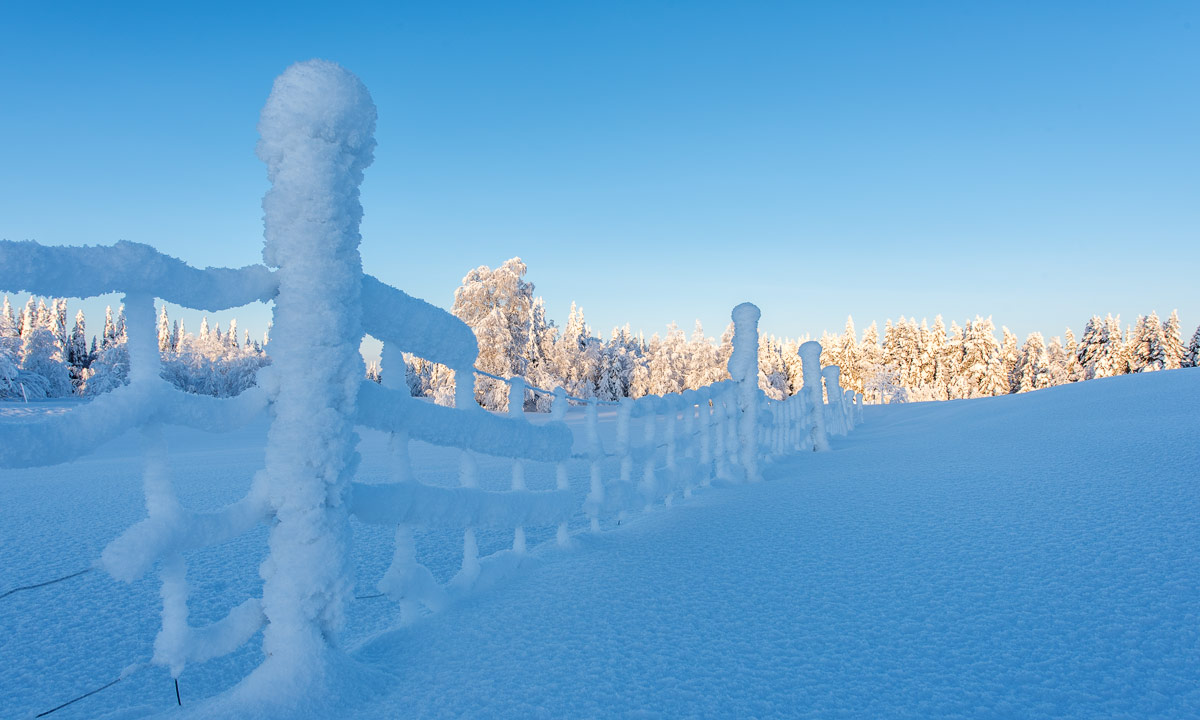
Dirk, the owner of Solberget asked me however if I could have a short photo session to make pictures of his reindeer sledges in action – one of the attraction of the wilderness retreat. And I gladly accepted. Here’s a first selection of the photos i made.


When I later took Annika to the nearest train station Nattavaara the temperature dropped to temperatures round -30 °C. Good to know, that the small station in Nattavaara has a small heated waiting room where you can wait for the train.
Her train was several hours late (I’ll come back to that topic later …) but thanks to internet and mobile app we already were informed about that delay and hadn’t wait too long until the train arrived in Nattavaara.
Annika will be away for two weeks until we’ll meet again and start our main winter journey. Meanwhile I’ll do a ski tour with Jonas, a good friend from Germany who should already have arrived the day before. Which he didn’t. Well, the train delays – I promised you to come back to that topic.
Due to a snowstorm in Gävleborgs län all trains to Northern Sweden had been cancelled. Jonas had been stuck in Stockholm. He couldn’t take the train the next day neither since it was fully booked. Therefore he was forced to wait another day and then take the night train with a scheduled arrival on Monday, 7:38. This train however was stuck in Vännäs for many hours due to technical problems. Instead of arriving on Saturday, 12:40 as originally planned he arrived on Monday, 17:00. That’s more than 52 hours delay!
But finally he arrived and tomorrow we can plan our ski tour which we’ll probably start on the day after tomorrow, 7 February.
This article is part of the series “2017-08: Kungsleden hike”.
From Alesjaure to Abiskojaure it’s round about 22 km to go. That’s the longest day’s march on that part of the Kungsleden. The first 7 km go along the lake Alisjávri which is good for a special reason: In summer there’s a boat shuttle service that allows hikers to skip this part. We all decided to take the boat, both to shorten the distance and to enjoy the boat trip itself.
Since the first regular boat starts at 10 o’clock we had a very relaxed breakfast with a lot of time. The quite large shop had fresh eggs so we had the pleasure of boiled eggs for breakfast. And very special egg cups …

The sun came out and illuminated the Alisvággi, the valley that leads to Tjäktja.

We went to the shipping pear already at 9:30, to go sure that we would find places on the boat. Andi ran up the yellow flag – the signal for the boatsman. The sun came out and I decided to take a bath. Not so easy, since the water was only knee-deep (and as icecold as expected).


Soon the boat arrived with stugvärd J. onboard. He was out fishing and succeeded: eight big arctic chars he caught.
At ten o’clock we departed. I could have stayed on the boat for hours, not only because I love to go by ship or boat, but even more because the sami boatsman had so much to tell.
He was living in Alesjávri for the summer “together with his dog and three common gulls” to run this transport business that he considers as a holiday. In September he would continue herding his reindeers. There are 17 families left in his sameby that do reindeer husbandry full time. (A sameby is kind of juridic and economical collective for reindeer husbandry.) He told us much more (all in Swedish) but after barely half an hour we arrived at the other shipping pear and went ashore.


When we started to walk it started to rain – bad timing. It was more a series of rain showers and I put on my hood and put it off again many times. Almost all mountains lay in the clouds, only the Ádnji seemed to have sun the whole time.

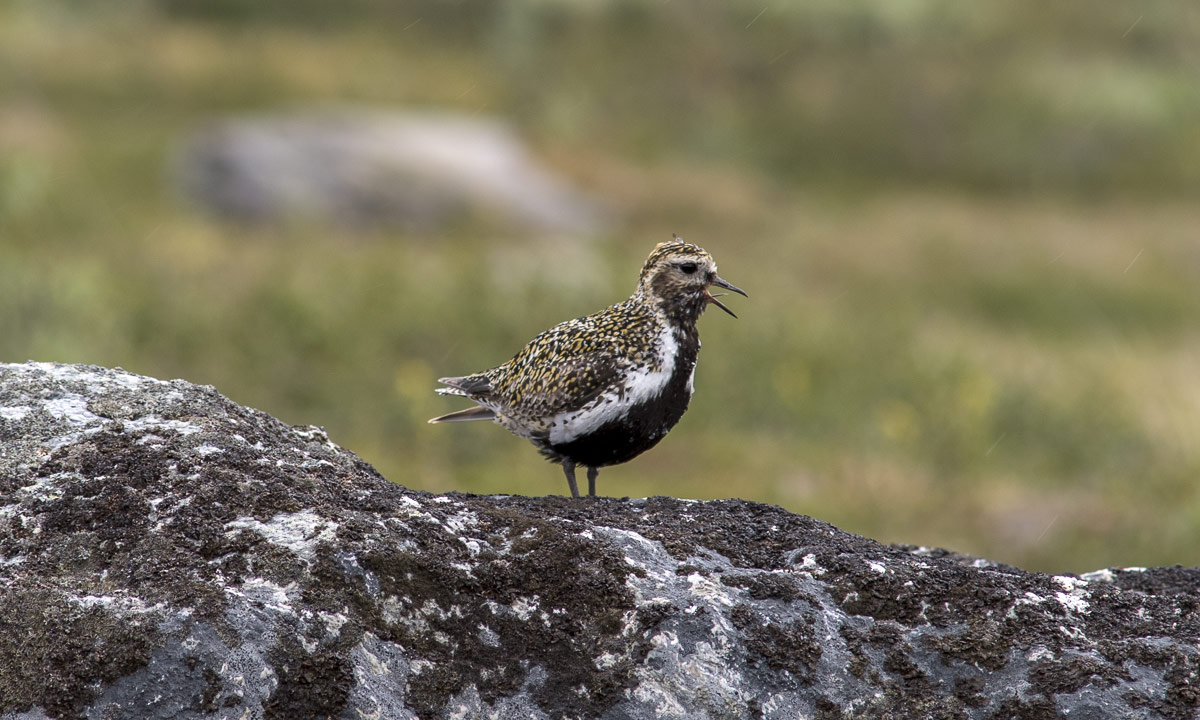
While we went on something chirped. Beep – Beep – (silence) – Beep … . We had heard that sound before on our hiking tour, but it was the first time that we could spot the matching bird. It was a golden plover as we figured out later. The bird was a bit nervous while I crawled nearer and nearer to get a photo, but it didn’t flee. Unfortunately my travel tele lens is not the best but I got a photo anyway.
We crossed the long reindeer fence that separates the sameby Laevas in the south and the sameby Gabna in the north. We just had to climb some stairs, where the Kungsleden crossed the border.
I knew that I had to say farewell to the treeless kalfjäll soon. In a short while we would enter the valley Gárddenvággi that would lead us deeper and deeper into more forested terrain. I was a bit sad, when i said farewell to that wonderful landscape.


The next kilometres were rainy, stony and muddy and we all just wanted to arrive in Abiskojaure, well knowing that it still would take some hours until we would arrive. I just trotted along and didn’t use my camera until we arrived in Abiskojaure. Here we finally made the photo of our four backpacks that we had talked about for days, but I was much too lazy to arrange it nicely.

The rain had stopped and the sun came out again so I took some last photos of the day, eager to eat something and to relax in the sauna.


Since Abiskojaure is the last hut before Abisko we found a lot of leftover food as dried vegetables, noodles or tuna sauce. That gave us a formidable afternoon meal. While we prepared for the sauna we heard, that there were moose on the other side of the lake. Indeed two female moose stood there in the wateraquatic plants. There were far away but we saw them dipping there heads into the water (they could hold their breeze really long) and eating aquatic plants. We saw them wading, swimming and shaking out the water. They had spotted us but knew that we were far away and no danger for them.


Katrin, Annika and Andi headed for the sauna, I watched a bit longer. When I went back to the hut I saw some others photoing something. It was a huge male moose, that stood amidst the huts and seemed to be not at all shy. I never saw a male moose so close! The moose went away, but stopped again, when he found rallarros flowers between the old toilet building and the wood shed. While watching us all the time he continued picking flowers with his huge mouth and eating them. At least twenty people stood there, watching, photographing and filming. Since all were quite sensible – no one was too hasty, too loud or came too near – we all could watch this big animal for some minutes. Then it took some step into the forest and almost instantly vanished in the shadows. What an experience!


This article is part of the series “2017-08: Kungsleden hike”.
Today Katrin, Annika, Andi and I would continue to Alesjaure, the longest distance to walk so far.
The morning was frosty with -2 °C and the petals of the flowers called rallarros (rosebay willowherb or fireweed) were covered with ice.


The sky was blue, the sun was shining, we had picture-book weather. As a photographer I would have preferred to hike two weeks later when leaf coloration would be in progress, but you can’t have everything. Anyway, the photo of the bridge over the Visttasjohka right at the Vistasstugan looks like a postcard motif:

This spot looked quite Canadian or Alaskan to me. I almost expected to spot some huge grizzly bears catching salmon in the river. But we’re still in Sweden where bears are brown bears and (luckily) very shy.
The first kilometres of the trail to Alesjaure lead through dense birch forest. Then gradually the forest got less and less dense and the snow covered mountains that frame the valley Visttasvággi were revealed.


The first kilometres were said to be muddy and they were, but not more than many other passages that we walked the days before. Unfortunately the trail continued to be both rocky and muddy and therefore wasn’t easy to walk.
After we left the birch forest the landscape became more rocky again. We found the resting place I remembered from two years ago. Someone had used a plank and some stones to build a bench in front of a huge block of stone. Still the sun was shining but gradually the sky become cloudy. Will we manage to arrive before the rain comes? We still hadn’t walked half of the distance.


We continued our tour until we reached the bridge over the stream Moarhmmájohka. Andi and I went down to refill out water bottles, then we took only a short rest since we were eager to arrive not too late.

After having crossed the bridge we had to go uphills quite steeply and we all slowed down more or less. Then we arrived at the plateau and looked back a last time into the beautiful valley Visttasvággi.


The clouds became denser, the wind increased but still it was dry. We passed the lakes Vuolip Čazajávri and Bajip Čazajávri. We went on and the sami village Alisjávri, located by the lake of the same name came into view. Now it was only 1.5 km left to the Alesjaurestugorna, our destination. As the day before we spotted the sauna first.


At 4 o’clock we arrived at Alesjaure and we stayed dry. Alesjaure is the largest mountain hut that we would stay at. It has as much as 86 regular beds (and more place if needed.)
I already found out, that stugvärd J. would be here, he whom Annika and I met in Nallo two years before and I again on my winter tour in Singi for some days. And really, he indeed was there and I was very glad to meet him again.
To meet J. means also to meet Simba, his kingsize dog. Simba dosed in the outside, stoically ignoring the mosquitoes in her eyes and on her nose. I said hello and started to pet her, which she apparently liked: she sighed and slumped onto her side. The photos I made before and afterwards:


Alesjaure has several houses, which appear more like a youth hostel than a mountain hut. That may look less cozy but we all enjoyed our big beds in our own four-bed-room. Katrin and Annika went to the sauna and after that we cooked one kilo (!) of pasta with goulash soup as a sauce. No, we didn’t manage to eat it all, the rest would follow us to Abiskojaure the next day.
Alesjaure would the last place in the kalfjäll above the treeline on this tour. Tomorrow we would continue to Abiskojaure, which is round 22 km away. This could be the longest day’s march, but we took a shortcut …
