MS Spitsbergen

This article is part of the series “2019-02: Northern Norway”.

Today it was cloudy and much warmer in Bjørnevatn than yesterday day and evening. Chris and I took breakfast at the Thon Hotel Kirkenes. This breakfast is just superb! There is a wide variety of food and the quality is excellent. While we had breakfast it started snowing. I looked out of the window and watched a small icebreaker. Two years ago the Elvenesfjorden was completely free of ice. This year however it had been so cold the last weeks that the whole fjord is frozen. Or would be, if the icebreaker wasn’t going back and forth and crushed the ice.

Kirkenes is the endpoint of the Hurtigruten line, that connects many Norwegian coastal towns as e.g. Bergen, Trondheim, Bodø, Tromsø, Hammerfest and Kirkenes. As long as the weather allows the ship arrives at 9:00 and departs at 12:30 every day. Many tourist go ashore to discover the city or to go dog sledding in the Snow Hotel.

Today it was the MS Spitsbergen that was in the harbour. It is possible to visit the ships and so Chris and I took a small tour to explore the ship.

The MS Spitsbergen both operates the Hurtigruten line Bergen—Kirkenes but also makes cruises to places like Iceland (from 4373 EUR), Svalbard (from 7058 EUR) or even Franz Josef Land in Russia (from 7696 EUR). Great destinations but much too expensive for me.

P.S.: Don’t ask me why there is dried fish on the top deck of the MS Spitsbergen.

Travelling to Bjørnevatn

This article is part of the series “2019-02: Northern Norway”.

After visiting me home in Skelleftehamn Chris and I continued to Jokkmokk on Thursday. We visited the winter market and then drove to Solberget, where we stayed overnight.

The next day we started a long drive with her car. Chris lives in Bjørnevatn near Kirkenes and we planned to arrive there the very same day. At 7:10 we started our journey that would lead us through Sweden, Finland and Norway.

First the sky was cloudy but the visibility was good. Then it started to get a bit foggy.

Normally that’s no problem. This icy fog however started to cover the windscreen more and more and we had to stop often to scrape of the ice.

In Gällivare we stopped at the gas station and had some breakfast. We also bought a bottle with de-icer for the windscreen and continued our trip.

The de-icer didn’t help, we had to stop many times to scrape away the ice from the freezing fog. We were not the only ones. The headlights and the number plate were covered with several millimetres of ice, too. I never had experiences something like this before.

Only the bottom 15 cm of the windscreen were free of ice. While Chris crouched into the seat to be able to see I gave up taking pictures from the road and photographed sideways.

We approached the Swedish town Karesuando. This small town is located directly on the Muonio älv, which also forms a natural border with Finland. On the other side the town is named Karesuvanto where we took another break.

Strangely the ice problems stopped right after the Finnish border. We continued to Palojoensuu without any problems. There we turned left onto the road 93. An hour later we were at the Norwegian border.

After being stopped by the customs and assuring them that we have neither alcohol nor cigarettes with us, we continued driving through the snowy plains. Next stop: Kautokeino, where most inhabitants are Sámi. Here we ate a hamburger with chips, a typical meal if you travel through Northern Norway.

Until now, Chris had driven a car. Now it was my turn to drive to give her at least a short rest. The first time I drove a diesel.

Round two hours later we arrived in Karasjok. What I already had suspected, confirmed here: It was cold outside: -30 °C.  Time for another break.

Back in the car, Chris was driving again. It was dark, it was cold, we were tired and still more than four hours to go.

I started to get bored and played around with my camera.

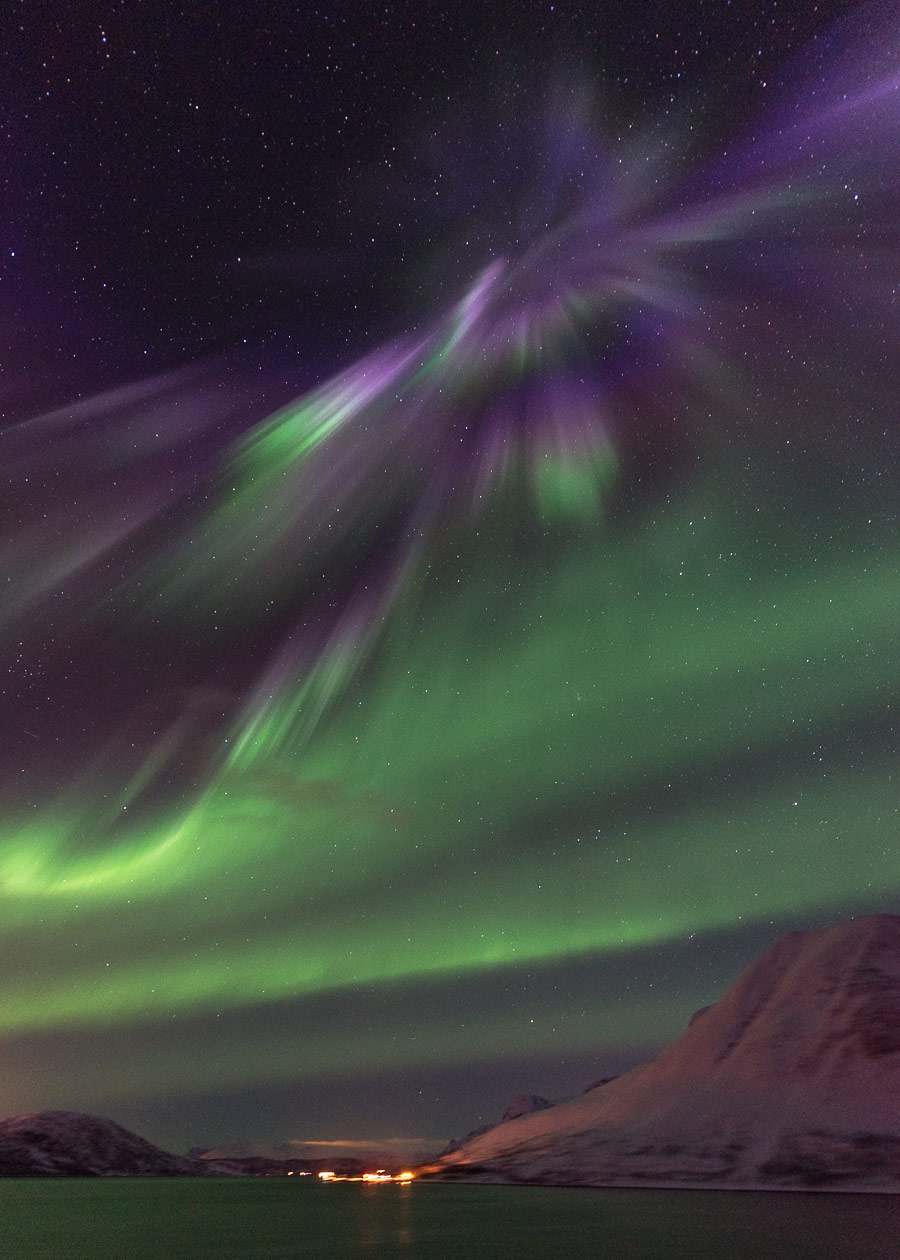
A pale green stripe appeared above the street. A northern light. The next hour we got quite nice northern lights, mostly directly in front of us. Though being tired we got at least entertainment. The photos are awful, northern lights are not made for being photographed free-handed from a car on a bumpy road.

Finally we came to Tana, where we crossed the river of the same name. A quarter hour later we arrived in the small town Varangerbotn, were we took the last stop of our long trip.

Now we drove along the fjord Varangerfjorden. Anyway, beside of some street lights and the weakened aurora it was pitch black and I couldn’t see the fjord. Beside of that I just longed for a bed.

But finally we arrived at Chris’ home in Berg near Bjørnevatn. Arrival time 23:40, 16½ hours after we started in Solberget.

Here I’ll spend the next days.

Link to the route on Google Maps


Light pillars and northern lights in Bjørnevatn

This article is part of the series “2019-02: Northern Norway”.

I have seen light pillars in my life and I have seen the aurora many times. Today I got the perfect combination of these two light effects. And never ever saw I light pillars as clear as today.

To see light pillars you need cold weather. When I was out, it was between -22 °C and -24 °C, probably colder on the frozen fjord. Light pillars are caused by hexagonal ice plates that tend to hover horizontally and therefore reflecting the light vertically. The light source can by natural, as e.g. sun and moon or artificial.

I was very lucky that it was cold and clear today so that I could observe them and make some pictures.


Travel remainders

This article is part of the series “2018-03: Varanger peninsula”.

Some unpublished photos from my winter journey. I want to show them as long it is still wintry here.

2 February – Jokkmokk

While the grown-up huskies are doing their job the puppies have to wait in the trailer. I guess it is very boring for them. There are curious and seek contact.

21 February – Kirkenes

While Chris, Annika, Ørjan and I are enjoying the gorgeous breakfast in the hotel Thon an asian tourist is waiting outside. She seems to be well protected against the elements but why has the fur to be pink …?

1 Mars – Ekkerøy

On the way to Kiberg Annika and I make a stopover in Ekkerøy where we enjoy a beach walk. Here we meet H. who invites us to visit her. We will make that true some days later. I take a photo of Annika’s and H.’s footwear. Tradition, meet modern world.

1 Mars – Ytre Kiberg

Cape East Arctic Adventure, our stay lies directly at the beach. I could spend weeks with only watching the tides and the changing weather.

4 Mars – Ytre Kiberg

There’s hardly any commercial fishing left in the small former fisher villages and the large drying racks for drying cod remain empty. Some people however still dry cod for personal usage.

5 Mars – Ytre Kiberg

A view through the window of Cape East Arctic Adventure. Today we will continue our journey.

10 Mars – Berlevåg

We hardly have the time to explore Berlevåg, we only buy food. Two images of Berlevåg anyway. Just for the records …

11 Mars – Kjølnes Fyr

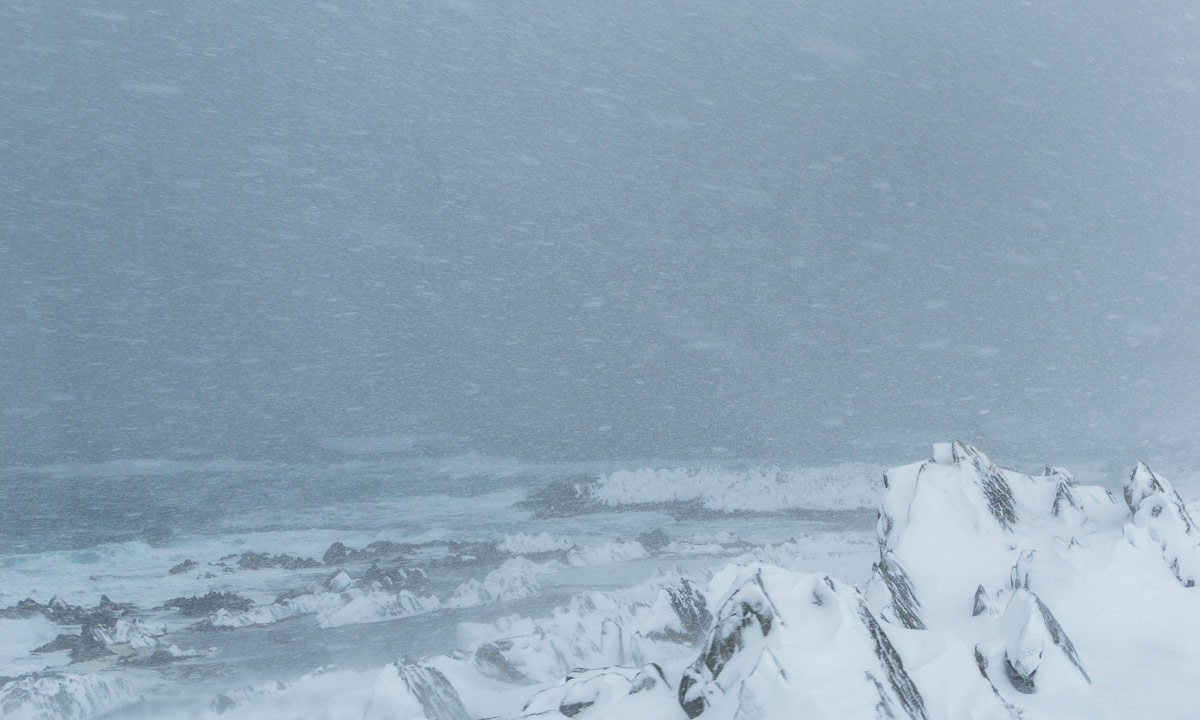
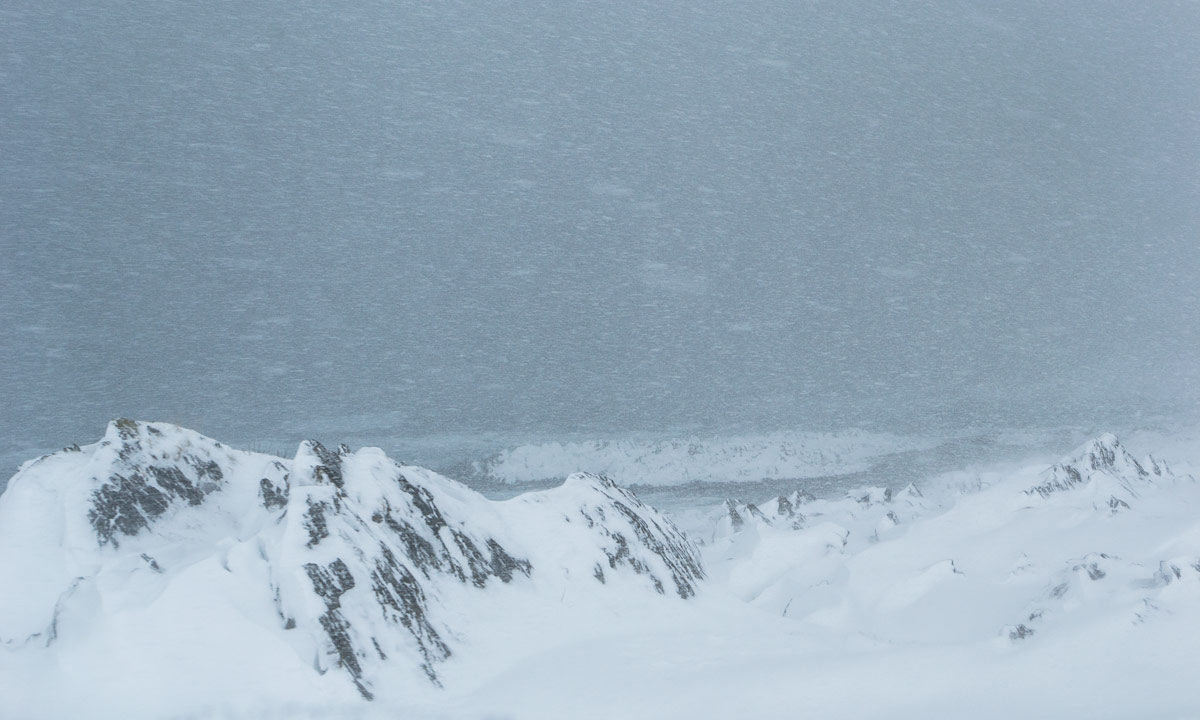
This snowstorm shaken rocky shore appears more arctic than many other places of this journey.

14 Mars – Hurtigruten, near Øksfjord

A woman has found a wind protected place and watches the Norwegian winter landscape.

16 Mars – Saltstraumen

On our long car trip back from Ørnes to Skelleftehamn we pass Saltstraumen, a small strait with one of the strongest tidal currents in the world. We are too early to see the strongest maelstroms and I’m too eager to continue home. It’s still 500 km to drive.

Now I finally can erase my “later” folder on the computer.


Båtsfjord – Ørnes by Hurtigruten

This article is part of the series “2018-03: Varanger peninsula”.

Days 41 to 44 of my winter journey 2018

13 March at 19:45 the Hurtigruten ship MS Nordnorge docked in Båtsfjord. Annika went on board with all our luggage that we would need the next days, while I drove the car into the elevator. The next 59 hours we would travel many miles but stay in the same cabin. Cabin number 305. Kind of luxury. We would even get breakfast because of a campaign. On 16 March round 7:00 we would leave the ship in Ørnes and drive home.

I will not write much about this part of the winter journey but showing photos from the Hurtigruten trip with some comments.

13 March 20:30 – finally on the Hurtigruten. Shop, reception, restaurant and people cruising.

13 March 22:00 Berlevåg – the westernmost of the four Hurtigruten stops Vadsø, Vardø, Båtsfjord and Berlevåg. Some days ago we stood on the breakwater to see the ships coming in, now I stand outside on the bow of the ship to see the very same breakwater passing as we approached the peer.

14 March 05:25 – very early and quite cold in the wind. I’m the only one outside beside of people working.

14 March 05:40 – approaching Honningsvåg on the island Magerøya. Main attraction of that island: the North Cape.

14 March 06:35 – I stay outside and look at the constantly changing weather.

14 March 08:25 – two ships pass. First a smaller boat, twenty minutes later the Hurtigruten ship Kong Harald. It’s snowing.

14 March 11:15 – we approach Hammerfest. Normally the ship will lie there for two hours, but today the ship is late.

14 March 15:45 – I’m outside for some hours and enjoy the view at the landscape. Everything is constantly changing: The mountains, the perspective, the light.

14 March 20:15 – strong polar lights cover the sky. Many people are outside and so are we. I already showed some photos in the article Aurora on the Hurtigruten.

14 March 23:45 – we approach Tromsø. Annika and I are already in our cabin and ready for sleep, but I can see the Tromsø Cathedral through our porthole. (We booked a cabin with limited view to save money and our porthole is more like a tube.)

15 March 07:30 – it’s not cold but very windy on the bow of the ship. My advise for such a winter journey: take the warmest jacket you have.

15 March 07:35 – we approach Harstad.

15 March 10:20 – we reach Risøyrenna – the Risøy Channel, build between 1911 and 1922 to enable bigger ships pass between the islands Andøya and Hinnøya. Only seven meters deep.

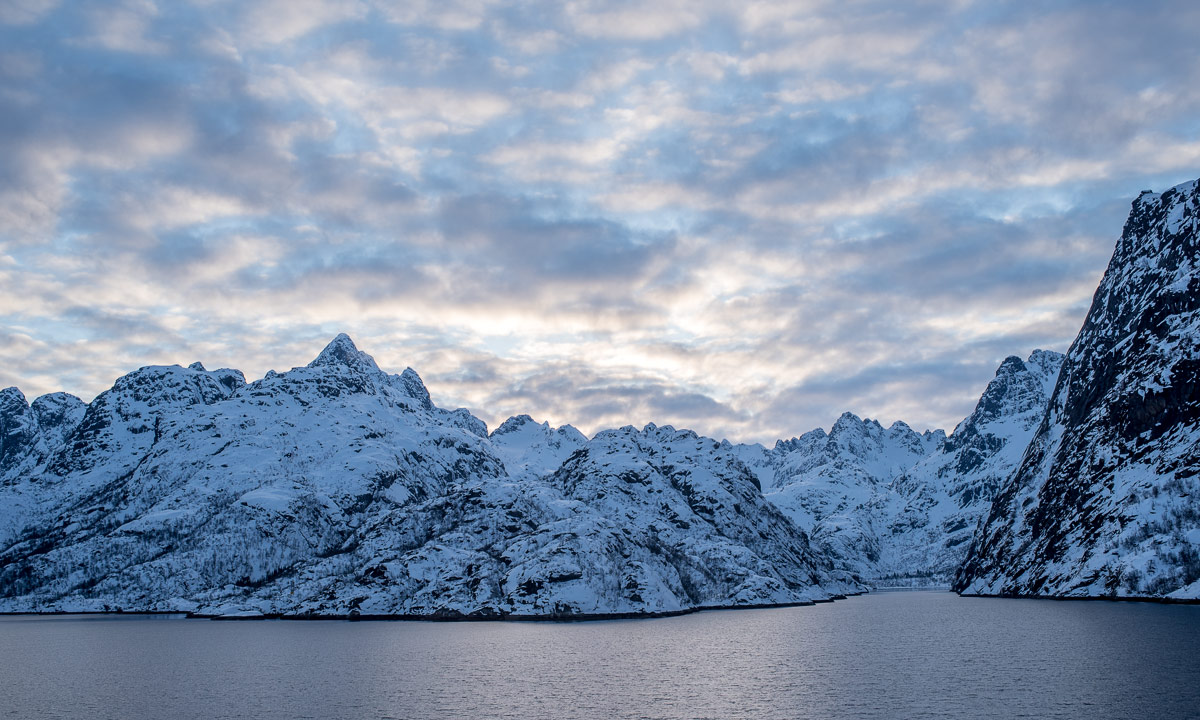
15 March 17:00 – we approach the quite famous Trollfjord. In winter however the Hurtigruten ships do not enter it.

15 March 18:30 – we arrive in Svolvær, largest town on the Lofoten. It’s a longer stop and Annika and I leave the boat for looking around.

16 March 06:00 – the alarm clock rings. At 7 o’clock we will arrive in Ørnes, leave the ferry and drive to Skelleftehamn. 583 km by car then I’ll be home again after more than six weeks of travelling.

A day in Båtsfjord

This article is part of the series “2018-03: Varanger peninsula”.

Day 41 of my winter journey 2018

After a difficult car ride over through gale and snow Annika and I arrived in Båtsfjord, where we stayed overnight.

As usual I woke up early. I got out of bed and took a first look at this town. Although a lot of snow had come the day before all roads and streets were already cleared. Some houses and fences however were still snowed in. Perhaps the houses were not in use or the owner was travelling, too.

And here a look at one of the harbours.

After breakfast Annika and I got a guided tour through Båtsfjord by our landlord. He comes from Finland and came to this town in 1999. He showed us round and told us a lot about this town whose main economical sector still is fishing. The fishing port is one of the biggest in the Finnmark with around 10000 boat arrivals per year.

He drove us to a place at the harbour where you can watch two species: (1) the king eider, a large sea duck and (2) the bird-watcher, a subspecies of the human being. Four of these bird-watchers lay in a huge box in the water and were spotting the king eiders. Mostly you couldn’t see the bird-watchers themselves but only their huge tele lenses.

Thank you, landlord from Finland whose name I forgot for this interesting guided tour!

Some other images of Båtsfjord I made over the day:

Later that day we sat in the waiting room and waited for the Hurtigruten to come. Our two-week stay on the Varanger Peninsula would end today and we slowly would travel home again. But instead of directly heading home by car (943 km) we would take the Hurtigruten ship to Ørnes and drive home there. Well, that spares us only 360 km and takes almost 60 hours, but it’s nice to travel by Hurtigruten, especially after visiting so many different places by car.

At 19:45 the Hurtigruten ship MS Nordnorge arrived and the next stage of the journey began.


Why travelling in Northern Norway can take time

This article is part of the series “2018-03: Varanger peninsula”.

Day 40 of my winter journey 2018

At 11 o’clock we left Kjølnes Fyr and started our car trip to Båtsfjord. First we had to take the road 890 to Kongsfjord and over the Kongsfjordfjellet, then we had to continue on road 891 over the Båtsfjordfjellet to Båtsfjord.

I wasn’t sure if we would manage it due to the severe stormy and snowy weather. Another guest staying at Kjølnes Fyr had a hard time driving the 5 km from Berlevåg with very bad visibility. The roads however were still open though marked with a warning “difficult driving conditions because of snowstorm”.

And yes, it was stormy and it snowed a lot. The sight on the road however was still quite good. While I focussed on the road Annika took some photos of the coast beside of the road:

Some parts however were very hard to drive, since the visibility was extremely bad. It was hard to see whether there were snowdrifts on the road and how deep they were and several times I had to stop completely to find out, where the road continued.

I started to doubt if it was possible to cross the mountain passages but we would make it at least to Kongsfjord where we could stay overnight if continuing became impossible. Annika tried to check the traffic information of Vegvesen – the Norwegian Public Roads Administration – but there was no mobile internet available.

I continued driving along the E 890 and the only other vehicle we met was a snow plough. The street behind it however seemed as snowy as before.

Shortly before Kongsfjord Annika’s smartphone was online again and she informed me about the updated traffic information: The mountain sections of both the 890 and the 891 where restricted to kolonnekjøring which means that you cannot drive alone but have to follow a convoy guided by a snowplough. The kolonnekjøring was scheduled to 14:30. The good thing: Driving in a convoy would be much easier than driving alone.

When we arrived in Kongsfjord it was 12:10, so the 28 km drive from Kjølnes Fyr had taken more than an hour. We were lucky that there is a landhandel – a grocery – in Kungsfjord that is open all year. We entered the landhandel, told about the kolonnekjøring and were invited to coffee and cookies straightaway. A big thank you to the owner for the warm welcome!

While we sipped our coffee and waited we constantly checked the traffic informations. After a short while we learned that the start of the kolonnekjøring was postponed to 17:00. That meant more waiting, but we were not the only ones. Other men in work clothes – mostly fishermen – waited as well. They told stories, laughed out loudly while drinking coffee or eating fast food. Anyway we all were still lucky. While we only had to wait some more hours many other roads were completely closed due to the weather, among others the way to Mehamn, the passage between Kiberg and Vardø and the only way to the North Cape.

Hours later: We said goodbye, cleared the car of snow and drove the short way to the boom gate. Here some other vehicles, mostly trucks waited for the convoy to start. One of the truck drivers attached snow chains to his truck.

Dusk had already been falling when our convoy started some minutes after 5 o’clock. My job for the next time was following the rear lights of the car in front.

Some passages were quite easy to drive, some passages were hard to follow due to the blowing and driving snow. (Sorry, no photos.) After 35 minutes we arrived at the T-junction, where the 890 from Kongsfjord, the 890 from Tana Bru in the south and the 891 from Båtsfjord meet. A long queue of cars coming from Tana Bru already waited. Some minutes later the convoy from Båtsfjord arrived as well. The snowplough leading the convoy to Kongsfjord passed and seconds later our queue of cars started to approach the intersection were we turned left to follow the convoy to Båtsfjord.

This part of the trip was extremely exhausting. It was dark, the convoy was slow and mostly the visibility was really bad. I just tried to follow the red lights in front and it felt like hours and hours until the snowplough turned right and we suddenly arrived in Båtsfjord. Here it seemed to snow as much as in the mountains and I was very relieved when I finally parked the car at our overnight stay. Phew – that was no easy ride and I’m really grateful that convoys led us over the mountains under the snowstorm conditions.

The rest of the day? Buying foodstuff at REMA 1000, eating fast food, falling asleep quite fast while the snow squalls over Båtsfjord continued. According to our host 30 cm of snow already had fallen that day and more was expected.

At least we arrived in Båtsfjord, probably our last overnight stay on land. The next evening we would take the Hurtigruten to Ørnes, were we would drive home to Skelleftehamn and Umeå.

(The first five photos were shot by Annika. I did the editing.)

+++ breaking news +++ aurora on the Hurtigruten +++

Day 42 of my winter journey 2018

Just one hour ago: Aurora on the Hurtigruten ship MS Nordnorge just behind Skervøy, and what a nice one!

I was glad to find a place for me and my tripod because there were a lot of other travellers – mostly tourists – out and watched the northern lights. They made photos with any camera they had; from smart phone to DSLR camera with tripod.

I used ISO 1600, ƒ 1/2.8 and an exposure time of 4 seconds. To my surprise some of the photos were quite sharp although the ship was moving.

Kjølnes Fyr

This article is part of the series “2018-03: Varanger peninsula”.

Days 38 to 40 of my winter journey 2018

Saturday

After our stopover in Kongsfjord we continued the road 890 in direction Berlevåg. The road follows the coastal line of first the fjord Kongsfjorden and then the open Barents Sea. Our destination for today is Kjølnes Fyr where we planned to stay over for one or two nights.

Kjølnes Fyr is located on a small headland called Kjølneset 5 km east from Berlevåg. We had booked a two-bed room at this place because it looked more interesting than the “large” city Berlevåg with its round thousand inhabitants. At half past one we arrived.

I directly fell in love with this place. The lighthouse – some other houses around – a rugged rocky coast, partly covered with snow, partly with seaweed – to the west bare mountains and to all other sides the open Barents Sea.

If you started a boat trip from Kjølnes Fyr heading north, the next land you would approach would be Kongsøya, part of Svalbard.

Viggo who operates the lodging gave us the key to the lighthouse and we took a closer look. The original lighthouse from 1916 was destroyed in World War II, the new lighthouse was built in 1949 and has a very functional and sober appearance. We went up and looked over the Barents Sea watching the high waves breaking at the rocky shore.

Viggo and his wife moved to Kjølnes Fyr in last autumn. He has rented the houses, that are protected as a historic monument. He told us from a winter storm that he experienced in January. Wind speed was up to 70 m/s (~250 km/h) and the upper floor of their house was shaken so violently, that the vibrations moved around the furnitures inside. Compared to that experience we had it quite calm.

The only thing we made over daytime was driving to Berlevåg to buy food. In Norway almost all shops are closed on Sundays and there were things we needed (spaghetti …) and things we wanted (chocolate …).

Later that evening we drove to Berlevåg again to see the Hurtigruten ships coming in.

Sunday

Under the night the wind got a bit stronger and the waves approaching from the north had become higher. Annika and I took a really lazy day. I was outside several times, but only for taking photos of waves. They never broke at the same place twice and gave me a hard time making pictures.

Weather became worse the whole day: The wind increased more and more and it started to snow, which means that snow was thrown into my face vertically when I dared to look into the wind. When it started to get dark, the ice and snow covered rocks in the cold light of the blue hour made the landscape look as what is actually is: arctic.

Already in the afternoon the Norwegian Meteorologisk institute had issued a class one wind warning for the whole area. I started to get a bit nervous. The next day we wanted to continue to Båtsfjord, our last stay on our Varanger trip but I was not sure whether the weather would allow it. Anyway, all roads were still open.

Monday

It had snowed a lot in the night and still was snowing heavily. Due to the stormy wind parts of the ground were completely bare of snow while other parts were covered with knee deep snow. At the same time it was quite warm, hardly below zero. The weather warning was extended to the afternoon but wind should decrease a bit over the day, so we planned to start round 12 o’clock. I was out and took some more photos, but it was really rough weather, especially for the camera.

Right after breakfast Viggo got a call of another guest approaching from Berlevåg by car. She couldn’t find the departure to Kjølnes Fyr due to severe weather conditions and asked for help. He took the car and drove to the main road just to mark the departure visually. When she came in she looked quite exhausted from the short car trip. She advised us not to continue the trip that day and told us, that visibility was partly only 10 meters which would make it impossible to see the next way mark.

We waited some time but despite of the stormy wind the visibility looked really good. Therefore we decided to give it a try and drive at least to Kongsfjord, that we passed two days ago. Here we could either continue our trip or take a room and stay in Kongsfjord overnight.

So we packed the car, said goodbye, removed the snow from the car and started our car trip to Båtsfjord at 11 o’clock.